The Advanced Reactor Materials Problem: TRISO, Graphite, and the Supply Chains That Don’t Exist Yet
Pick a graphite grade. Build a reactor core out of it. You can’t — not legally, not yet. Of all the advanced reactor materials the industry is counting on, not one nuclear graphite grade is code-qualified under ASME’s rules for high-temperature reactors. Zero. A designer can’t open a catalog, choose a grade, and start cutting core blocks, because the data a regulator would need to accept that grade hasn’t been produced.
That fact surprises people, and it should. We talk about advanced reactors as if the hard part is the reactor — the physics, the licensing, the first-of-a-kind engineering. The designs are, by and large, worked out. What’s missing sits one layer down, in the materials the designs are made from, and it’s a much slower problem than most of the headlines let on.
I’ve written before about the nuclear supply chain bottleneck for big light-water reactors — the argument that the scarce thing isn’t forging-press tonnage but qualified capacity: the machining, welding, inspection and records work that turns a raw forging into a component a regulator will accept.
That story is about waking up a supplier base that went dormant during thirty years of almost no construction. Advanced reactors are a harder version of the same problem, and it’s worth being precise about why.
For most of the materials these designs depend on, there’s no dormant supplier to wake up. The supply chain was never built in the first place. And for some of them, the rulebook that would tell you how to qualify the material is still being written.
You’re not reopening a shop. You’re generating the data, writing the code case, and standing up the supply chain, all at once.
Why the light-water playbook doesn’t transfer
I work on a pressurized water reactor (PWR), not a pebble bed or a molten salt machine. But the qualification machinery is the same whatever the design, and that’s exactly why the gap stands out to me.
A PWR runs its coolant at roughly 320°C, uses ordinary low enriched uranium in zirconium-alloy cladding, and is built mostly from steels that the ASME Boiler and Pressure Vessel Code has governed for decades.
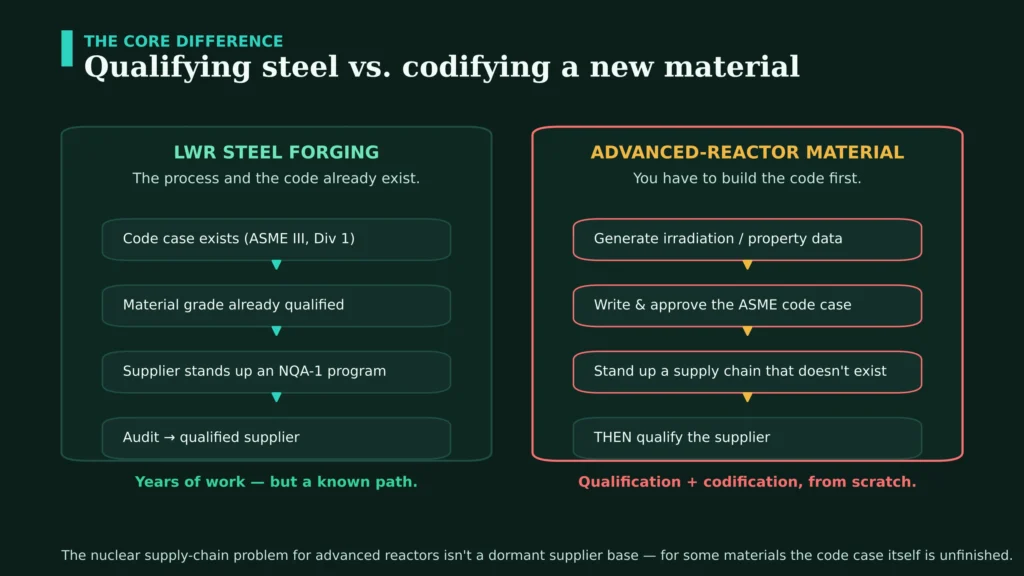
When a new supplier wants in, the target is fixed. The grades are qualified. The code cases exist. The non destructive examination methods are written down. The supplier’s job, hard as it is, comes down to building a quality program and proving it can hit a known specification. If you want the detail on that, it’s in how to become NQA-1 qualified.
Advanced reactors change the target itself. A high-temperature gas reactor is designed to run at 750°C and above. A sodium fast reactor runs hot metal coolant instead of water. A molten salt reactor circulates a fluoride or chloride salt that eats ordinary alloys.
None of these conditions is covered by the materials and codes a PWR relies on, and in several cases the material that survives them has never been through commercial nuclear qualification at all. The two most instructive examples are the fuel and the moderator: TRISO and graphite.
TRISO: the fuel that needed a twenty-year head start
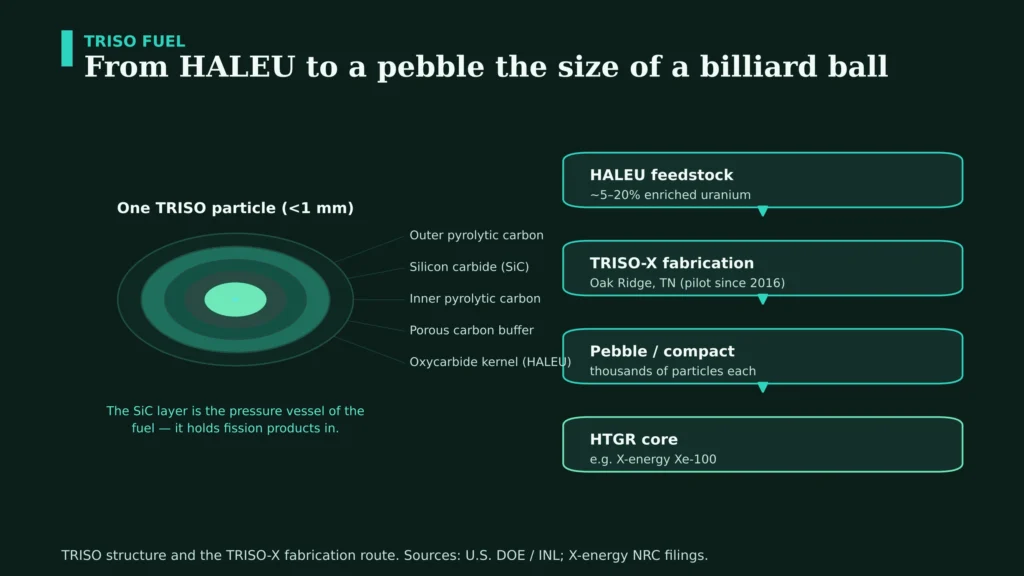
TRISO is genuinely clever engineering. Each fuel particle is a kernel of uranium — in X-energy’s TRISO-X version, uranium oxycarbide made from HALEU — smaller than a poppy seed, wrapped in four layers. A porous carbon buffer gives fission gases somewhere to go. Then two dense pyrolytic carbon layers and, between them, a shell of silicon carbide.
That silicon carbide layer is the whole trick. It’s a pressure vessel around each individual kernel, maybe a third of a millimetre across, and it holds the fission products inside even when the particle gets very hot.
The U.S. Department of Energy has called TRISO about the most robust fuel form there is, and the claim is earned: you’d have to fail hundreds of thousands of these tiny vessels at once to get a meaningful release. Pack tens of thousands of particles into a graphite pebble or compact, and the fuel carries its own containment wherever it goes.
Here’s the part that gets skipped. Being clever on paper isn’t the same as being qualified, and qualifying TRISO took the better part of twenty years of taxpayer-funded work. The Advanced Gas Reactor Fuel Development and Qualification Program, run by the DOE with Idaho National Laboratory, Oak Ridge, BWXT and General Atomics, exists for exactly this reason.
It has been loading TRISO fuel into the Advanced Test Reactor at INL and irradiating it, one experiment after another, since 2006.
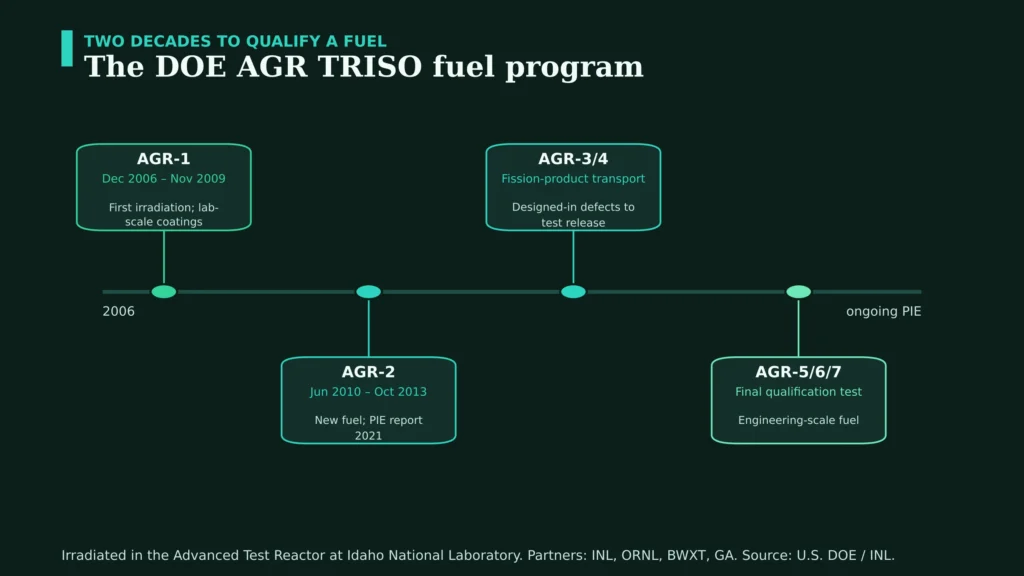
Look at the dates. AGR-1 went in at the end of 2006 and came out in late 2009. AGR-2 ran from 2010 to 2013, and its post-irradiation examination report didn’t land until 2021. The final qualification test, AGR-5/6/7, uses fuel made at engineering scale, and its examination work is still finishing now.
That’s the timeline for a fuel form everyone agrees is mature. The reason it’s slow is physical, not bureaucratic: the only way to know how fuel behaves under years of neutron bombardment is to bombard it for years and then take it apart.
On the commercial side, X-energy has been fabricating its TRISO-X fuel at a pilot plant in Oak Ridge since 2016 and is standing up a larger commercial facility, TX-1, under NRC licensing.
Smartly, its qualification approach leans on the AGR data rather than starting the clock over — the NRC-reviewed TRISO-X methodology references the AGR results as its basis. Even so, the lesson holds. The “established” advanced fuel is established because the government spent two decades and a test reactor building the data set. Nobody is doing that from a standing start on a venture-capital timeline.
Graphite: a code with almost nothing to certify
Graphite is the quieter problem, and in some ways the more revealing one, because here the rulebook exists and the qualified material doesn’t.
High-temperature gas reactors are graphite-moderated. The graphite isn’t a minor part — it’s the core structure, thousands of precisely machined blocks or the matrix the pebbles are made from, sitting in the neutron flux for the life of the plant.
ASME wrote rules for it: Section III, Division 5, Subsection HH lays out which properties a graphite grade has to demonstrate, and how those properties must be shown to change under irradiation and oxidation, before the grade counts as “code qualified.” Get through that, and a designer can specify the grade and build. The problem is that nobody has gotten all the way through it.
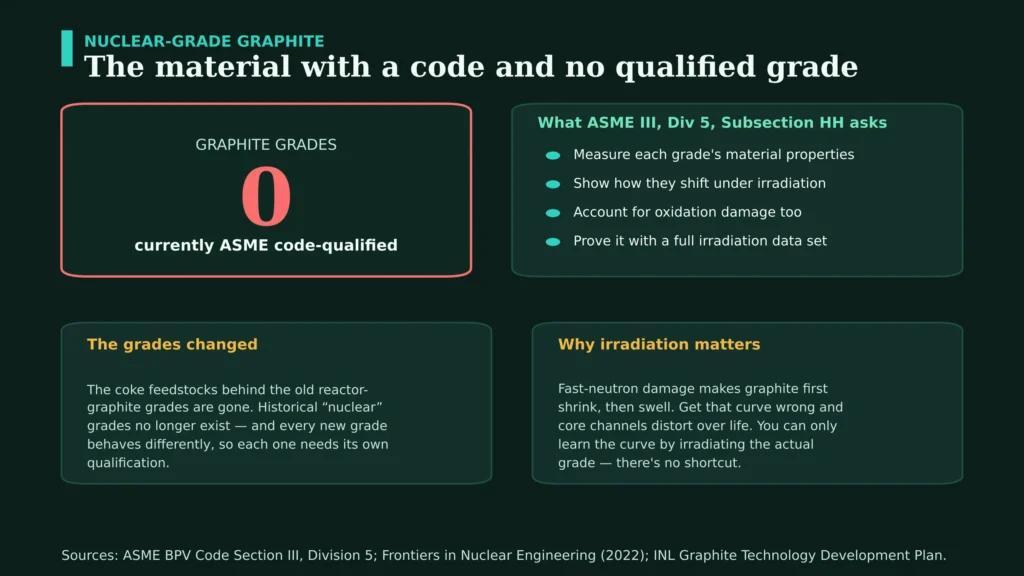
Two things make graphite nastier than it looks. First, the grades changed out from under the industry. The specific petroleum cokes that the old reactor-graphite grades were made from aren’t produced anymore, so those historical grades effectively no longer exist.
Every modern grade is a slightly different material, and because graphite’s behavior depends intimately on its raw feedstock and manufacturing route, you can’t assume one grade’s data applies to another. Each one has to be qualified on its own.
Second, irradiation does strange things to graphite. Under fast-neutron damage a graphite grade first shrinks, densifying, and then past a turnaround point it starts to swell. Get that dimensional change curve wrong and the core geometry distorts over decades — coolant channels close up, blocks stress against each other.
The only way to pin down the curve for a given grade is to irradiate that exact grade and measure it, which drops you right back into the multi year test reactor queue that TRISO sits in.
Then there’s where the graphite comes from. For years the United States had no domestic producer of nuclear-grade graphite and leaned on foreign suppliers. That’s changing, but unevenly.
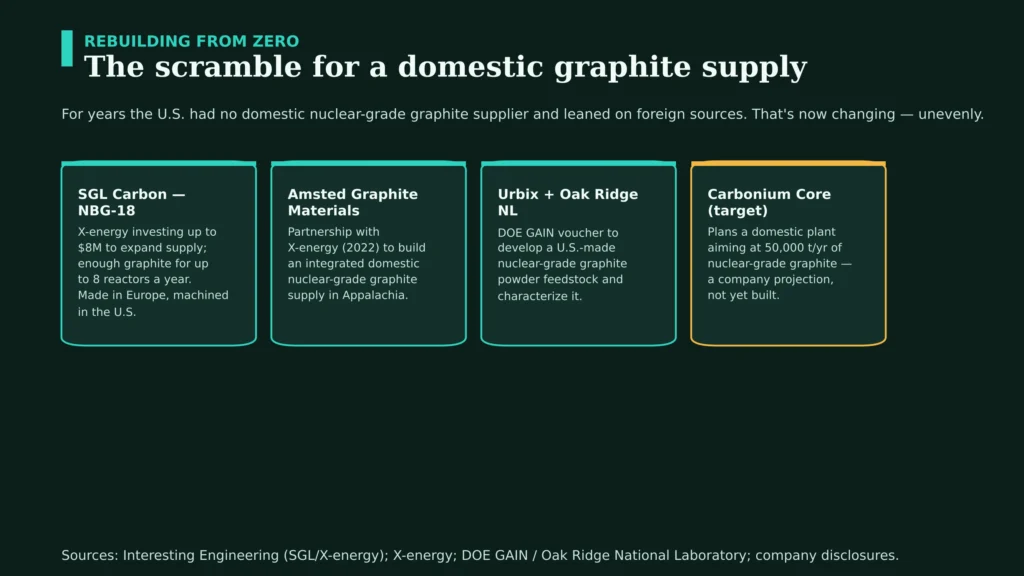
X-energy uses a grade called NBG-18, made by SGL Carbon, in its Xe-100 pebble-bed core, and has put up to $8 million into expanding that supply — enough, the company says, for as many as eight reactors a year, with the graphite produced in Europe and machined in the U.S.
It also partnered with Amsted Graphite Materials back in 2022 to try to build an integrated domestic line in Appalachia. On the feedstock side, Urbix and Oak Ridge National Laboratory worked a DOE voucher to develop U.S. made graphite powder. And newer entrants have announced large domestic plants — Carbonium Core has talked about 50,000 tonnes a year — though those are projections, not operating facilities.
The honest read: the money and the intent are finally there. The qualified material at fleet scale is not, and no amount of investment shortcuts the irradiation data.
It’s not only fuel and graphite
If TRISO and graphite were the only gaps, this would be a manageable to-do list. They aren’t. The Electric Power Research Institute, which tracks this for the industry, flags a cluster of advanced-reactor materials as specific supply-chain risks, and the pattern repeats in each one.
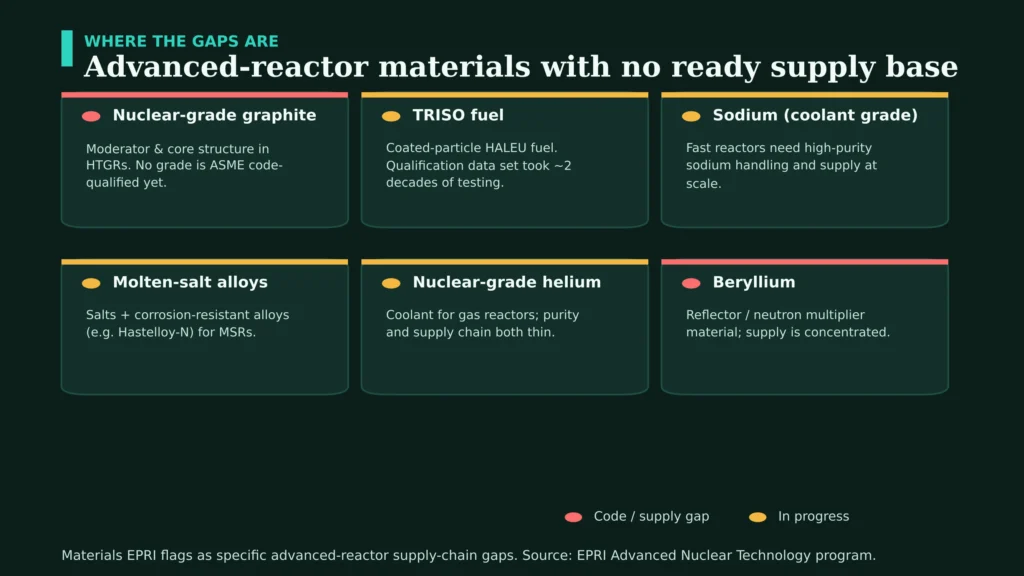
Sodium fast reactors need high-purity sodium handled and supplied at a scale the current industry doesn’t run. Molten-salt reactors need both the salts themselves and alloys that survive hot fluoride or chloride chemistry — materials like Hastelloy-N, whose long-term behavior in those conditions is still being codified.
Gas reactors need nuclear-grade helium, where both purity and supply are thinner than the demand forecasts assume. Beryllium, used as a reflector and neutron multiplier in several designs, comes from a concentrated and strategically awkward supply base. Every one of these is the graphite story in a different costume: the commodity isn’t the hard part, the qualified-and-certified version of it is.
Why this is harder than the steel problem
With a light water reactor, a capable forge or machine shop is qualifying itself against a target that already exists. It has to build an NQA-1 quality program, prove its procedures and people, and — for commercial parts going into a safety role — run commercial grade dedication. That’s years of work, but it’s a known mountain with a marked trail.
For a lot of advanced reactor materials, the trail hasn’t been cut. You can’t qualify a supplier against a code case that hasn’t been written, and you can’t write the code case until you have the data, and you can’t get the data without running multi year irradiations. That’s two hard problems stacked on top of each other: qualify the supplier, and first codify the material.
The qualification bottleneck for steel is about reawakening a supplier base. For the newest advanced-reactor materials, the supply chain and the rulebook both have to be built before a single supplier can be qualified.
And the slow step resists money in a way people find hard to accept. You can parallelize machining by buying a second machine tool. You cannot parallelize irradiation damage. The material has to sit in a reactor and soak up neutrons at the rate physics allows, then come out and be examined. That’s why the AGR program reads in decades, and why a well funded startup can’t simply buy its way to a qualified graphite grade next year.
What actually moves this
The fixes that matter aren’t glamorous, and they’re mostly not things a single company can do alone.
The most useful lever is shared, government backed qualification data. The AGR program is the model: a baseline fuel data set that multiple developers can reference, so every pebble bed vendor doesn’t re-run the same irradiations.
The same approach — national labs generating a public graphite data set keyed to the properties Subsection HH demands — is the fastest realistic route to a code-qualified grade. One campaign, many beneficiaries.
Second, durable demand. Standing up a nuclear-grade graphite line or a TRISO plant is a large bet, and no company makes it on the strength of a maybe. Firm offtake, loan support, and order books that outlast a political cycle are what turn an announced partnership into an operating facility.
Third, standardization. Every bespoke design forces its own round of material qualification. A smaller number of repeated designs lets a supplier qualify a grade or a fuel once and produce it at volume — which is the only way qualified throughput actually climbs.
None of that is a quick fix. It’s years of sustained, coordinated work, and it runs on exactly the quality-and-qualification machinery that the rest of the nuclear supply chain already struggles with.
So when you read that an advanced reactor is “ready,” hold that against the material underneath it. The design may well be ready. The fuel took twenty years of test-reactor time to qualify. The graphite still doesn’t have a code-qualified grade. And a handful of other materials are somewhere on the same long road. That’s the real constraint on how fast this fleet gets built — not the reactor, the stuff it’s made of.
Frequently Asked Questions
What materials do advanced reactors need that today’s reactors don’t?
Most advanced designs move away from water cooling and ordinary uranium rods, which brings in materials current plants don’t use at scale: TRISO coated-particle fuel, nuclear-grade graphite for high-temperature gas reactors, high-purity sodium for fast reactors, corrosion-resistant alloys and salts for molten-salt reactors, nuclear-grade helium, and beryllium. For most of these, a qualified commercial supply chain doesn’t yet exist in fleet quantities.
What is TRISO fuel and why is it considered so safe?
TRISO means tristructural isotropic. Each particle is a sub-millimetre uranium kernel wrapped in carbon and silicon carbide layers. The silicon carbide shell works like a tiny pressure vessel around each kernel, holding fission products in even at very high temperatures — so the fuel resists melting or releasing radioactivity under accident conditions.
Why isn’t nuclear grade graphite code-qualified?
ASME Section III, Division 5, Subsection HH requires a grade’s properties and their change under irradiation and oxidation to be fully characterised before it can go into a core without extra testing. That data takes years of test-reactor irradiation. The historical reactor-graphite grades are no longer made, and today’s grades haven’t finished that data set, so none is currently code-qualified.
Is there a domestic US supply of nuclear-grade graphite?
Not at commercial scale yet. The U.S. long relied on foreign sources. Efforts to change that include X-energy’s work with SGL Carbon and Amsted Graphite Materials, a DOE voucher project between Urbix and Oak Ridge National Laboratory, and newer entrants targeting domestic production.
Who makes TRISO fuel?
U.S. TRISO fabrication grew out of the DOE’s Advanced Gas Reactor program, with INL, Oak Ridge, BWXT and General Atomics as partners. Commercially, X-energy fabricates TRISO-X fuel at a pilot plant in Oak Ridge, Tennessee and is building a larger facility; BWXT also runs TRISO production.
How long does it take to qualify a new nuclear material?
For anything needing irradiation data, years — often more than a decade. The AGR TRISO program began irradiating fuel in 2006 and its examination work is still finishing. You can’t speed it up with money, because the material has to accumulate neutron damage in a test reactor in real time.
Sources and Further Reading
- Idaho National Laboratory / U.S. DOE — Advanced Gas Reactor (AGR) Fuel Development and Qualification Program
- Frontiers in Nuclear Engineering (2022) — Perspective on “code qualifying” new graphite grades for advanced reactors
- ASME Boiler & Pressure Vessel Code, Section III, Division 5 — High Temperature Reactors
- EPRI Advanced Nuclear Technology — Supply chain actions and material gaps
- X-energy — TRISO-X fuel
- Interesting Engineering — X-energy and SGL Carbon expand nuclear-graphite capacity
- X-energy — Partnership with Amsted Graphite Materials
- DOE GAIN / Oak Ridge National Laboratory — Urbix nuclear-grade graphite feedstock voucher
Need content like this for your company?
I write white papers, technical explainers, and thought-leadership for nuclear vendors, reactor developers, and the agencies that serve them — accurate enough for engineers, clear enough for buyers.