HALEU: The Fuel That Could Make or Break the Nuclear Revolution
High-assay low-enriched uranium (HALEU) is uranium enriched to between 5% and just under 20% U-235 — the fuel that roughly two-thirds of advanced reactor and SMR designs need, and the one almost no one in the West can yet make at scale. This is what HALEU is, why these reactors can’t run without it, and why a single fuel is quietly deciding the pace of the nuclear revolution.
Picture a brand-new nuclear reactor. Not a render, not a slide — a real one, gleaming and finished, every weld inspected, every system tested, the control room humming. It is ready to make clean power for the next sixty years. There is just one problem. It cannot start, because the fuel it was designed to run on does not exist in any quantity you can actually buy.
That isn’t a hypothetical. It is the quiet bottleneck sitting underneath nearly every advanced reactor you have read about — the new designs from TerraPower, X-energy, Oklo, Kairos, and the wave of microreactor startups racing to reach criticality. They have venture funding, government backing, and serious engineering. What most of them do not have is a guaranteed supply of their fuel.
The fuel has an unglamorous name: high-assay low-enriched uranium, or HALEU. And here is the thing almost no one outside the industry understands — the advanced-reactor revolution is not really being held up by reactor physics, or even by money. It is being held up by a fuel that, today, almost no one in the free world can make.
I work on reactor fuel for a living — it is the part of this field I know from the inside — and HALEU is one of those topics where the public story and the engineering reality have drifted a long way apart. So let me close that gap.
By the end of this, you will understand what HALEU actually is, why these reactors can’t just run on ordinary uranium, why the number twenty matters so much, and why a fuel can quietly hold an entire industry hostage.
What is HALEU, Exactly?
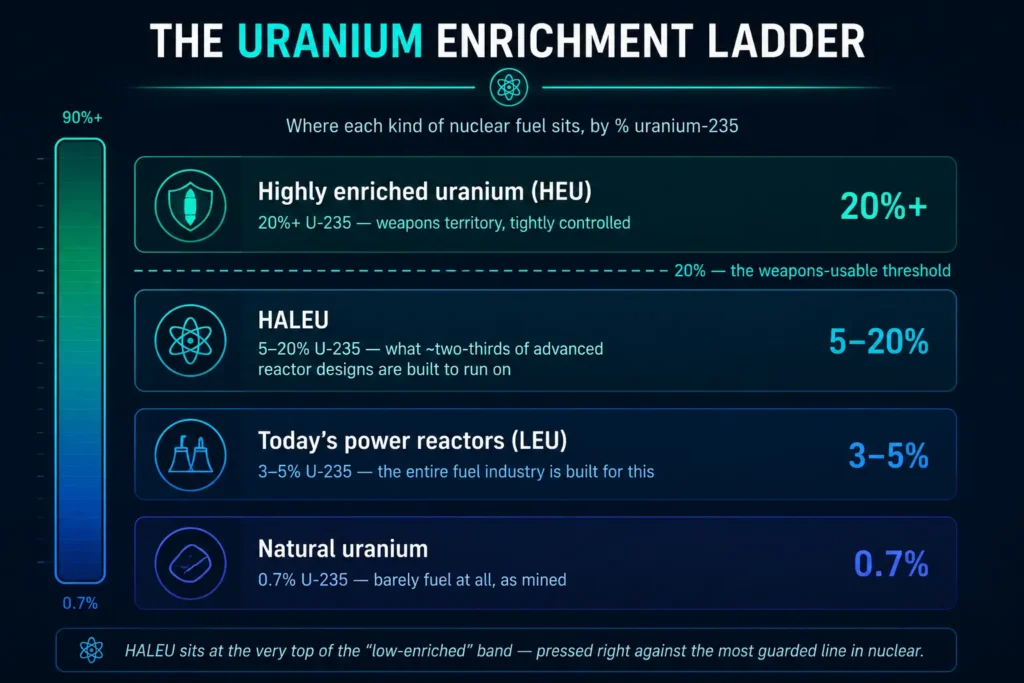
Start with a fact most people never learn: natural uranium is barely nuclear fuel at all. Dig it out of the ground and only about 0.7% of it is uranium-235 — the isotope that actually splits and releases energy. The other 99.3% is uranium-238, which mostly just sits there. To make usable fuel, you have to concentrate the U-235, and that concentration step is called enrichment.
The reactors powering cities today — the big light-water plants (PWRs, BWRs etc)— run on uranium enriched to somewhere between 3% and 5% U-235. That is “low-enriched uranium,” or LEU and the entire global fuel industry is built around it: the enrichment plants, the transport casks, the fabrication lines, the regulations. Everything is tuned for five percent and under.
HALEU lives one rung up the ladder. It is uranium enriched to between 5% and 20% U-235 (technically, up to 19.75%) — still “low-enriched” by the official definition, but far more potent than anything in a conventional plant. (See how HALEU compares to conventional LEU). That extra concentration is not a luxury. For a large share of the new reactor designs, it is the whole point. By one industry count, roughly two-thirds of the SMR designs in development are built to run on it.
Why Can’t Advanced Reactors Just Use Normal Uranium?
This is the question that unlocks everything, so let’s actually answer it rather than wave at it. The short version: the new reactors are smaller, hotter, and cleverer than the old ones, and all three of those things ask more of the fuel.
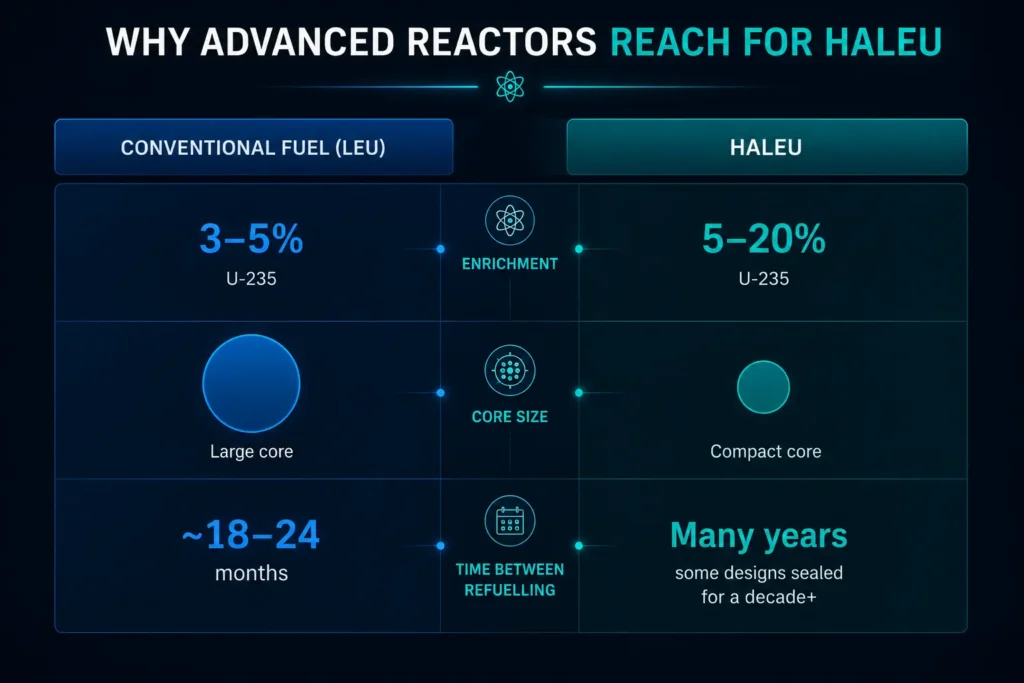
Think about what “small” really means physically. When you shrink a reactor core, you have less room to pack in fissile material. To keep a self-sustaining chain reaction going inside that smaller space, the fuel you do fit has to be richer — more U-235 per unit of volume.
It is a bit like trying to keep a campfire roaring in a tiny grate: you can’t pile on more wood, so the wood you use has to burn hotter. Higher enrichment is how a compact core stays critical.
Then there’s burnup — how much energy you can wring out of a load of fuel before it’s spent. Higher enrichment lets a reactor run much longer between refuelings. A microreactor designer dreams of a core that runs for five, ten, even twenty years sealed shut, never opened.
You simply cannot do that on 5% enriched fuel; there isn’t enough U-235 in the tank. And the sodium-cooled fast reactors and high-temperature gas designs — the TRISO-fuelled concepts — need the higher fissile density to make their physics work at all.
So HALEU isn’t reactor designers being greedy. It is the unlock for the three things that make advanced reactors attractive in the first place: smaller cores, longer life, and less waste per unit of energy. Take HALEU away and most of these designs don’t get worse — they simply don’t function.
The 20% Line: Why HALEU Stops Exactly Where It Does
Here is where it gets genuinely fascinating — and where you’ll learn the single fact that makes the whole HALEU story click into place.
Notice that HALEU has a hard ceiling: 20% U-235. Not 25, not 30. Twenty. That number is not an accident of chemistry or a rounding choice. It is a line drawn by treaty and physics together, and it marks the boundary of one of the most carefully guarded thresholds on Earth.
At 20% U-235 and above, uranium is classified as highly enriched uranium — HEU — and HEU is the stuff of weapons. HALEU is deliberately defined to stop just short of that door, at 19.75%.
But why 20%, specifically? The answer lies in something counterintuitive about enrichment, and once you see it, you never un-see it.
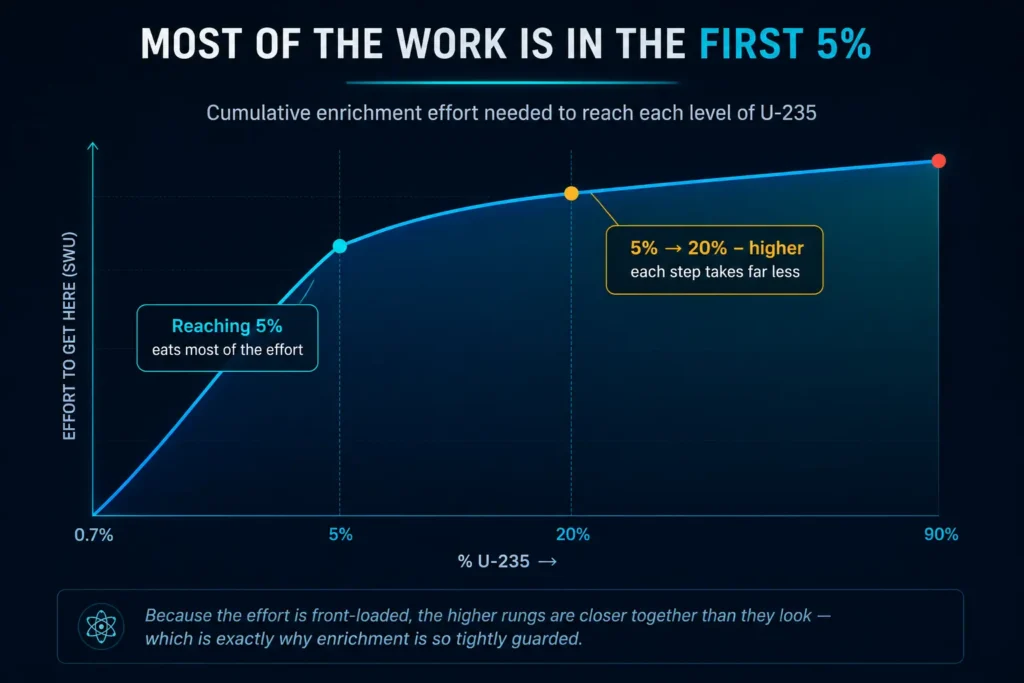
Enrichment effort is not spread evenly up the ladder. The overwhelming majority of the work — the energy, the spinning centrifuges, the time — goes into the very first part of the climb, getting from that natural 0.7% up to around 5%. By the time you’ve reached 5%, you have, in a real sense, already done most of the hard separating.
That means the step from 5% up to 20%, and even the further step from 20% toward weapons-grade, takes comparatively little additional effort. That means the step from 5% up to 20% and even the further step toward weapons-grade takes comparatively little additional effort. This is the uncomfortable truth that sits underneath all enrichment policy: the closer you get to the top, the smaller each remaining step becomes. I’ve put exact numbers on this elsewhere: [why HALEU costs almost six times the separative work of ordinary fuel], and where the real cost cliff actually sits. (put your own numbers through the SWU & cost calculator)
It is exactly why enrichment technology is one of the most tightly safeguarded capabilities in the world, and why international bodies treat the 20% line as the place to hold the wall. Below it, the practical barrier to misuse stays high. Above it, the barrier falls away fast.
So when a reactor engineer tells you HALEU is “low-enriched,” that’s technically true — but it sits at the very top of the low-enriched band, pressed right up against the most sensitive boundary in the nuclear world. That tension is the reason HALEU is treated with a level of security, accounting and scrutiny that ordinary reactor fuel never attracts. It also, as we’ll see, is a big part of why it’s so hard to make and move.
So Why is HALEU So Hard to Get?
If HALEU is just uranium enriched a bit further, you’d think the existing enrichment industry could simply dial it up. The reason it can’t — or won’t — is one of the great chicken-and-egg traps in modern energy.
First, the geography of the problem. For years, essentially the only place producing HALEU at commercial scale was Russia, through its state nuclear company. China is building the capability too. Which means the most advanced reactor programs in the United States and Europe were quietly depending on a fuel supplied, in practice, by a strategic rival.
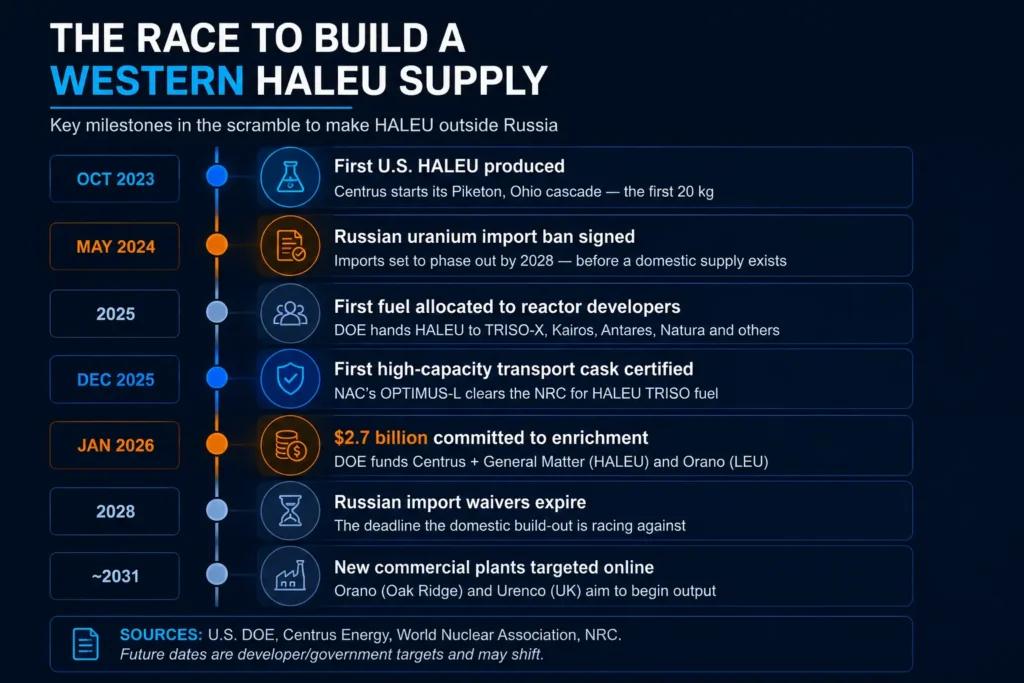
After 2022 that arrangement went from awkward to untenable — and the Prohibiting Russian Uranium Imports Act of 2024 began closing the door, with imports set to phase out by 2028, well before a domestic replacement is ready.
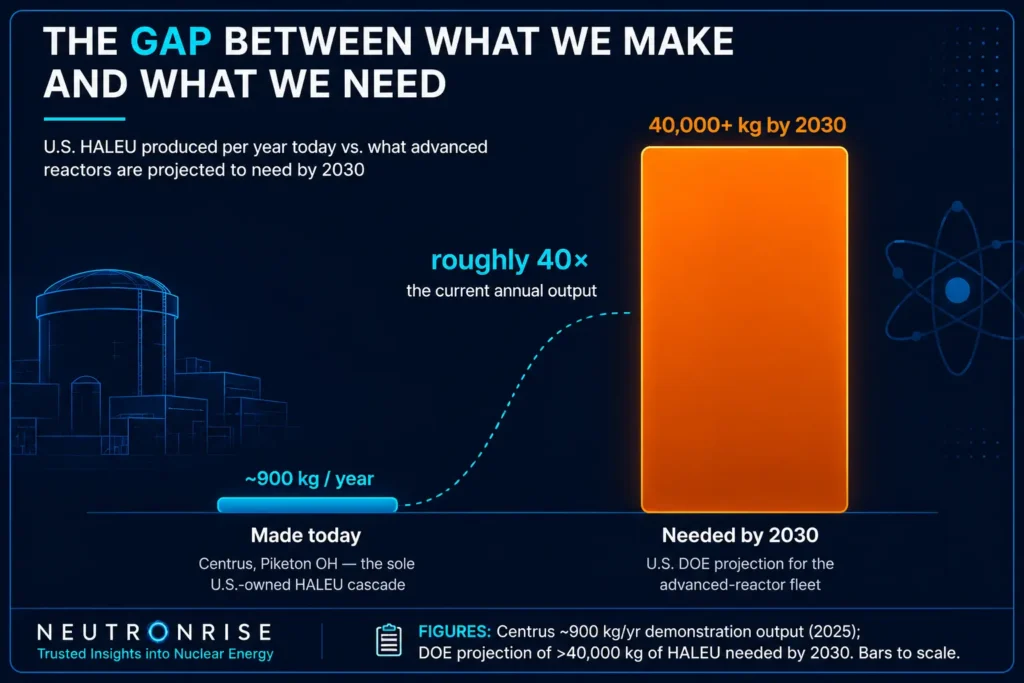
The response has been a scramble. America’s only domestically owned enricher began producing HALEU at a demonstration cascade in Piketon, Ohio, in 2023; by mid-2025 it had delivered more than 1,900 kilograms to the government and shifted that cascade from a federal demonstration into commercial operation.
That sounds like progress — and it is — but roughly 900 kilograms a year sits against a very different number. The U.S. Department of Energy (DOE) projects the advanced-reactor fleet will need more than 40,000 kilograms — around 40 tonnes — of HALEU by 2030. Current output, in other words, is on the order of a fortieth of the coming need. That is the gap the whole industry is staring at.
Money is now moving to close it. In January 2026 the U.S. Department of Energy committed $2.7 billion over ten years to expand domestic enrichment — awarded as three $900 million contracts: two for HALEU (Centrus and General Matter) and one for conventional LEU (Orano). The money is real. The timeline is the problem.
For a full walk through the five production steps and where the bottlenecks really sit, see [how HALEU is actually made].
Because underneath it all sits the trap: enrichers won’t pour billions into HALEU plants without firm, long-term orders — and reactor developers can’t commit to firm orders until they know the fuel will actually be there to buy.
Each side waits for the other to move first. Supply waits for demand; demand waits for supply. Government money exists precisely to break that standoff, by being the buyer of first resort. Whether it breaks in time is one of the most consequential open questions in nuclear energy today.
The Problems Nobody Talks About: Moving HALEU and Keeping It Subcritical
Even if you solve the enrichment problem, two quieter obstacles remain — and these are the ones I find most people have never even heard of, because they live in the unglamorous engineering weeds where I spend my days. They’re worth understanding, because they explain why “just make more HALEU” is harder than it sounds.
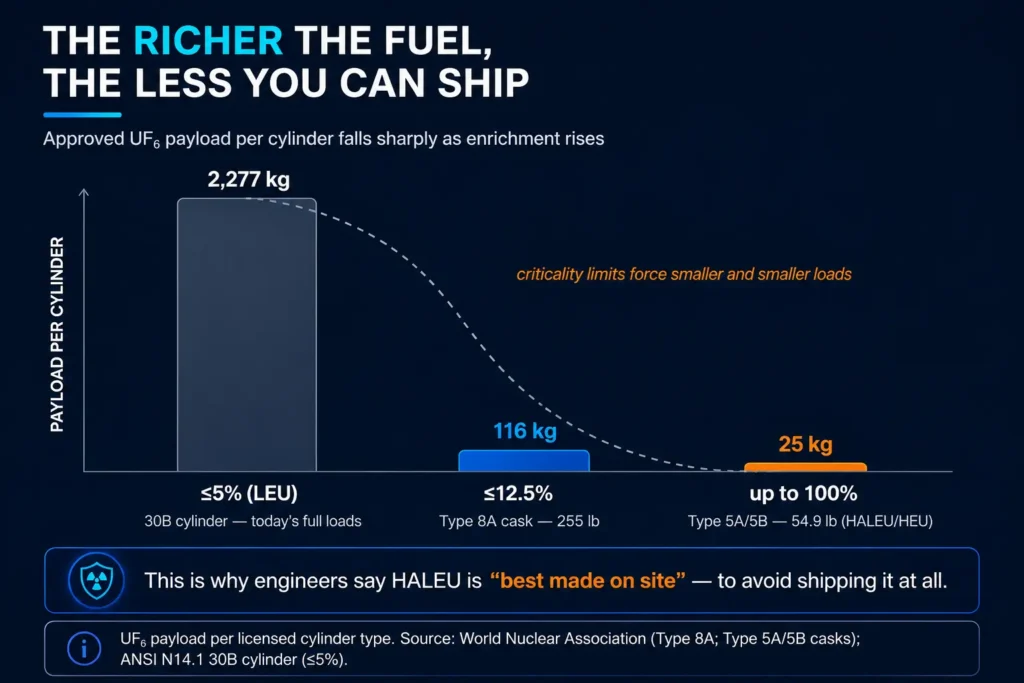
The first is transport. You’d assume that once you’ve made the fuel, shipping it is the easy part. It is not. The containers used to move uranium — heavy, engineered casks — are licensed with strict limits, and here’s the catch: the higher the enrichment, the smaller the payload each cask is allowed to carry.
There’s even a specific number that governs this, one only people inside the industry tend to use: the Criticality Safety Index (CSI). Every package of fissile material is assigned a CSI, and the regulations cap the total CSI you’re allowed to load onto a single vehicle. Richer fuel earns a higher CSI per package — so you hit that ceiling with fewer packages, and the truck or railcar leaves carrying far less actual uranium. The old high-enrichment casks are limited to a payload of only about 55 pounds.
The practical result is that, until very recently, there were essentially no approved containers that could move HALEU economically at the scale a commercial fleet will need. That is finally starting to change: the first high-capacity package — NAC International’s OPTIMUS-L — was certified by the NRC only at the very end of 2025, and the federal government is funding several more designs.
But there is still nothing that can move HALEU at full commercial-fleet scale economically. The industry is, quite literally, still building the boxes.
Why does the cask shrink as enrichment rises? CRITICALITY— and that’s the second obstacle, and the reason that CSI number exists in the first place. The entire job of handling fissile material outside a reactor is making absolutely certain it can’t accidentally start a chain reaction.
Richer material reaches that dangerous point with less mass and in more configurations, so every margin has to widen: more spacing, more neutron-absorbing structure, smaller batches, tighter accounting. That widening is exactly what a higher CSI encodes.
Higher enrichment means wider criticality safety margins at every single step — in the plant, in the cask, on the fabrication line — and every one of those margins quietly adds cost and complexity. Cross the 10% mark and the security and licensing requirements step up again.
This is why you’ll hear engineers say HALEU is “best made on site” — enriched, converted, and fabricated into fuel close to where it’ll be used, so you avoid shipping the touchy intermediate forms around the country. It’s a sensible answer, but it quietly rewrites the whole industrial map of how nuclear fuel gets made. None of this is in the brochure. All of it is in the schedule.
Who’s Racing to Solve the HALEU Problem?
The encouraging part of this story is that the bottleneck is now obvious to everyone, and money and talent are flooding toward it. A whole sub-industry is forming around a single question: who will make the West’s HALEU?
There’s Centrus, scaling up its Ohio plant. There’s General Matter, rebuilding capacity at the former Paducah site in Kentucky, and Orano, developing a new enrichment facility at Oak Ridge, Tennessee. Urenco has been cleared to enrich to higher levels in the United States and is building HALEU capacity in the UK.
That UK capacity now has its first commercial customer. In May 2026 Antares signed what Urenco called the world’s first multi-year HALEU supply contract — fuel for the microreactor line behind Mark-0, the reactor that went critical in Idaho. It is the clearest crack yet in the chicken-and-egg standoff: a developer finally placing a firm, long-term order. The catch is the calendar — the UK plant meant to fill it is not due online until 2031.
There are specialist fuel firms — notably X-energy’s TRISO-X, which just won the first NRC license in more than fifty years to fabricate HALEU fuel — turning raw material into finished TRISO fuel for the first demonstration reactors, some of which have already taken delivery of government-allotted material. And there’s a parallel race, backed by federal grants, just to design and license the new transport containers the whole system depends on.
After years working as a reactor engineer, one trend has become impossible to ignore: where the smart money is going. For years the glamour was all in the reactors — the novel coolants, the elegant cores. Increasingly, the people who understand this industry are betting on the unsexy layer underneath: enrichment, conversion, fabrication, transport. The reactor is the rocket. HALEU is the fuel. And right now, the world has far more rockets than fuel.
What HALEU Really Means for the Nuclear Revolution
Step back, and a pattern emerges that connects HALEU to everything else happening in advanced nuclear. We keep being told the breakthrough is the reactor — the molten salt, the traveling wave, the sealed microreactor. But the reactor was never really the hard part. The physics has been understood for decades. I’d stake my career on it, because I more or less do.
The hard part, again and again, turns out to be the boring, industrial scaffolding around the reactor: in the case of large plants, the construction; in the case of advanced reactors, the fuel.
A reactor without HALEU is a beautifully engineered machine with an empty tank. And a fuel that only a strategic rival can make, that no one has the boxes to ship, and that no enricher will mass-produce without a buyer, is not a footnote. It is the gate the entire revolution has to pass through.
So the next time you read a breathless headline about a reactor that will power a city or a data center by 2030, ask the quieter, more revealing question: where is its fuel coming from? Answer that, and you’ll understand more about the future of nuclear energy than almost any reactor spec sheet can tell you. The revolution won’t be decided only by what we can build. It’ll be decided by what we can feed.
Frequently Asked Questions
What does HALEU stand for?
HALEU stands for high-assay low-enriched uranium — uranium enriched to between 5% and just under 20% U-235. That’s richer than the 3–5% fuel in today’s power reactors, but still below the 20% threshold where uranium becomes weapons-usable.
Is HALEU weapons-grade?
No. HALEU is deliberately capped just below 20% U-235, the point at which uranium is classified as highly enriched (HEU) and becomes weapons-relevant. HALEU sits at the very top of the “low-enriched” band, which is why it’s tightly safeguarded — but it is not weapons-grade material.
What’s the difference between HALEU and regular reactor fuel?
Conventional reactors run on low-enriched uranium (LEU) at 3–5% U-235. HALEU is enriched to 5–20%. That higher concentration lets advanced reactors use smaller cores, run far longer between refuellings, and extract more energy from each load of fuel. Read full comparison: HALEU vs LEU
Why do advanced reactors need HALEU?
Most advanced reactors are smaller, hotter, and designed to run for years without refuelling. A compact core can’t fit enough fuel to stay critical on 5% uranium, so it needs the higher fissile density HALEU provides. By one industry count, about two-thirds of the SMR designs in development are built to run on it.
Why is there a HALEU shortage?
For years, Russia was effectively the only commercial-scale HALEU supplier. After the 2024 U.S. ban on Russian uranium (phasing out by 2028), the West was left racing to build its own supply. Enrichers won’t invest without firm orders, and reactor developers won’t order until supply is assured — a chicken-and-egg stall that government funding is now trying to break.
Who makes HALEU?
Historically, Russia was the only country producing HALEU at commercial scale, with China building capacity. In the West, the field is forming fast: Centrus (Ohio), General Matter (Kentucky), Orano (Tennessee) and Urenco are scaling enrichment, while X-energy’s TRISO-X fabricates finished HALEU fuel. As of 2026, almost none of it is yet at full commercial volume.
Is HALEU the same as HEU?
No. HEU (highly enriched uranium) is 20% U-235 and above — weapons territory. HALEU stops just short of that line, at under 20%. The gap looks small, but it’s one of the most carefully guarded thresholds in the nuclear world.
What does “high-assay” mean in HALEU?
“Assay” is the measured concentration of uranium-235 — the fissile isotope — in a batch of uranium. “High-assay” means a higher U-235 concentration than the fuel in today’s reactors: 5–20% U-235, versus the ≤5% used in conventional light-water plants. HALEU is still “low-enriched” because it stays below the 20% line — it simply sits at the high-assay end of that low-enriched band.
How is HALEU made?
Two ways. The main route is enrichment: uranium hexafluoride gas is spun through centrifuge cascades to raise the U-235 concentration into the 5–20% range, starting from either natural uranium or already-enriched LEU feed. The second is downblending — diluting surplus highly enriched uranium (HEU) from defence stockpiles down into the HALEU range. Much of the US government’s interim HALEU came from downblending, while long-term commercial supply will come from enrichment.
Is HALEU expensive?
Yes — far more than conventional reactor fuel. There is no transparent commercial market yet, so exact prices are uncertain, but a detailed 2023 industry analysis estimated HALEU production at roughly $23,700 per kilogram as an oxide and about $25,700 as metal — against a few thousand dollars per kilogram for ordinary low-enriched uranium. The premium comes from the extra enrichment effort, tighter criticality-safety and security margins, and specialised conversion steps.
What is HALEU deconversion?
Deconversion is the chemical step that turns enriched uranium hexafluoride (UF₆) — the gaseous form uranium is in straight after enrichment — into a stable solid, either a uranium oxide powder or uranium metal, that can be fabricated into fuel. It is the bridge between the enrichment plant and the fuel line, and for HALEU it is a recognised bottleneck: there is very little dedicated HALEU deconversion capacity, which adds to both cost and delay.
Sources and Further Reading
- U.S. NRC — High-Assay Low-Enriched Uranium (HALEU)
- World Nuclear Association — High-Assay Low-Enriched Uranium
- U.S. DOE — $2.7 billion to restore American uranium enrichment (Jan 2026)
- IAEA — HALEU: Power for a new generation of reactors
- NAC International — First HALEU TRISO fuel transport (OPTIMUS-L, Dec 2025)
- Uranium Enrichment – World Nuclear Association World Nuclear Association — Uranium Enrichment.
- IAEA-TECDOC-1529 Management of Reprocessed Uranium Current Status and Future Prospects
- https://www.energy.gov/ne/articles/us-department-energy-seeks-input-creation-haleu-availability-program U.S. Department of Energy Seeks Input on Creation of HALEU Availability Program
- https://www.iaea.org/bulletin/fuelling-the-future-building-fuel-supply-chains-for-smrs-and-advanced-reactors Fuelling the Future: Building Fuel Supply Chains for SMRs and Advanced Reactors
- https://www.ecfr.gov/current/title-49/subtitle-B/chapter-I/subchapter-C/part-173/subpart-I Criticality Safety Index
- https://www.ecfr.gov/current/title-10/chapter-I/part-71 Packaging And Transportation Of Radioactive Material
- https://www.energy.gov/ne/articles/triso-x-receives-nrc-special-nuclear-material-license-advanced-fuel-fabrication
TRISO-X Receives NRC Special Nuclear Material License for AFFF - https://www.world-nuclear-news.org/articles/us-regulator-issues-licence-for-triso-x-fuel-facility US regulator issues licence for TRISO-X fuel facility
- https://www.thirdway.org/blog/how-much-does-it-cost-to-develop-new-nuclear-fuel-capacity How Much Does It Cost to Develop New Nuclear Fuel Capacity?
About The Author
Elliot Marsh is a working reactor engineer with hands-on experience in reactor physics, core management, reactivity control, and nuclear fuel-cycle planning at an operating power station. He writes about nuclear energy for readers who want the engineering reality, not the press release.
Need content like this for your company?
I write white papers, technical explainers, and thought-leadership for nuclear vendors, reactor developers, and the agencies that serve them — accurate enough for engineers, clear enough for buyers.


