NQA-1 Explained: The Quality Standard Behind Every Nuclear Component
The short version. NQA-1 is the ASME standard that defines how nuclear quality assurance actually works — the method the industry uses to satisfy the NRC’s federal rule, 10 CFR 50 Appendix B. It’s also a big part of why a nuclear component costs more and takes longer than its industrial twin. Here’s what it is, how it fits with the regulation, and why it matters more now that SMRs are moving from paper to hardware.
A safety related pump for a nuclear plant and its ordinary industrial twin can come off production lines that look the same. Same casting, same impeller, same performance curve on paper.
One of them costs several times more and shows up on site months later. The difference isn’t the metal. It’s the stack of records that travels with it — documents proving that every step, from the melt to the final inspection, happened under a controlled program and can be traced back years after the part is installed.
That program has a name. In the United States, it’s ASME NQA-1.
If you’ve spent time inside a nuclear power plant, you already live with the downstream result of NQA-1 whether you think about it or not. The reason a valve replacement needs a specific pedigree, the reason procurement can’t just buy the commercial part off a distributor’s shelf, the reason a records room exists at all — that thread runs back to one quality assurance standard and the federal rule it was written to satisfy.
Most explanations of NQA-1 online are written by consultancies selling certification services, or they’re a dry recitation of the standard’s table of contents. Neither tells you what it actually is or why it makes nuclear behave the way it does. That’s the gap this piece is meant to fill.
What NQA-1 actually is
NQA-1 is the American Society of Mechanical Engineers standard titled “Quality Assurance Requirements for Nuclear Facility Applications.” The “NQA” stands for Nuclear Quality Assurance. The “-1” is the standard number, not a version — editions are tracked by year, like NQA-1-2019 or NQA-1-2022.
It is a consensus standard, which matters. ASME doesn’t write it alone. Utilities, vendors, national labs, and regulators sit on the committee and argue it out, edition by edition. That’s why it carries weight across the whole industry instead of being one company’s internal rulebook.
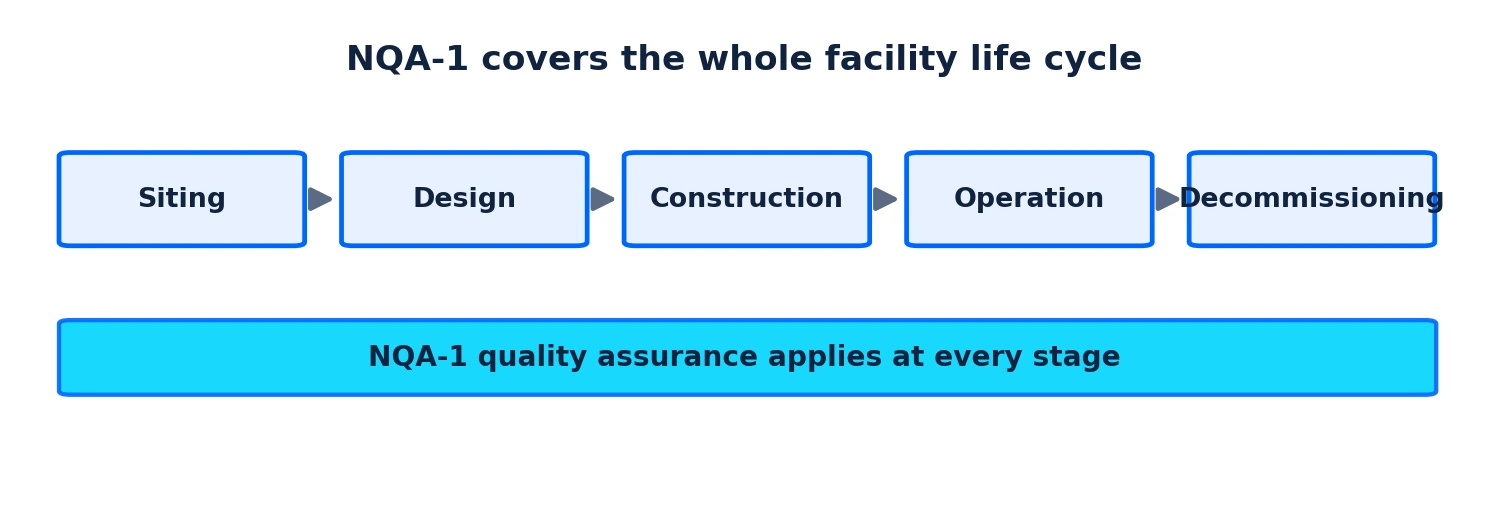
What it covers is the entire life of a nuclear facility — siting, design, construction, operation, and decommissioning. It isn’t limited to the old fleet either. The current editions were written to apply to large light water reactors and to advanced reactors and SMRs, which is the part that’s about to matter a great deal more than it used to.
The core idea underneath all of it is simple, and the regulation states it plainly. Quality assurance is “all those planned and systematic actions necessary to provide adequate confidence that a structure, system, or component will perform satisfactorily in service.” Confidence, in writing, that a safety part will do its job when it’s called on — possibly decades after anyone who built it has retired
NQA-1 and 10 CFR 50 Appendix B: the distinction almost everyone gets wrong
This is the single most common confusion, and it’s worth getting right, because the two things are not the same and people use the names interchangeably as if they were.
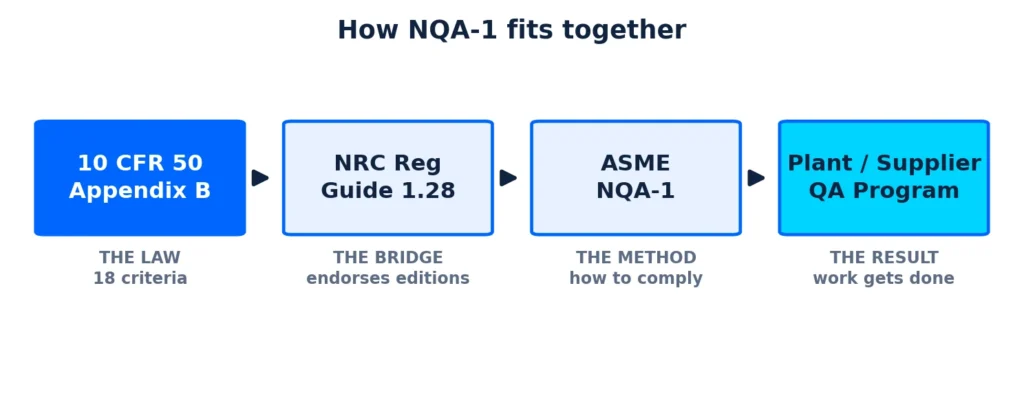
10 CFR Part 50, Appendix B is the law. It’s a federal regulation from the Nuclear Regulatory Commission, titled “Quality Assurance Criteria for Nuclear Power Plants and Fuel Reprocessing Plants.”
It has been the backbone of nuclear quality in the US for more than fifty years. Appendix B lays out eighteen criteria that a QA program must meet. But here’s the thing about Appendix B — it tells you what is required, not how to do it. It’s the destination, not the route.
NQA-1 is the route. It’s the industry standard that spells out, in operational detail, how you build a program that satisfies those eighteen criteria. Where Appendix B says “you shall control the design,” NQA-1 tells you what design control actually looks like in practice.
There’s a third piece that connects them, and it’s the piece nobody mentions. A regulation can’t just point at a private standard and call it law. So the NRC issues Regulatory Guide 1.28, “Quality Assurance Program Criteria (Design and Construction).”
In its current form, Revision 6 from September 2023, RG 1.28 formally endorses specific editions of NQA-1 — the 2017, 2019, and 2022 editions — as an acceptable way to meet Appendix B.
It even carves out an exception: one subpart on laboratory accreditation isn’t endorsed, and a separate industry document is pointed to instead. That’s the level of specificity the regulator works at.
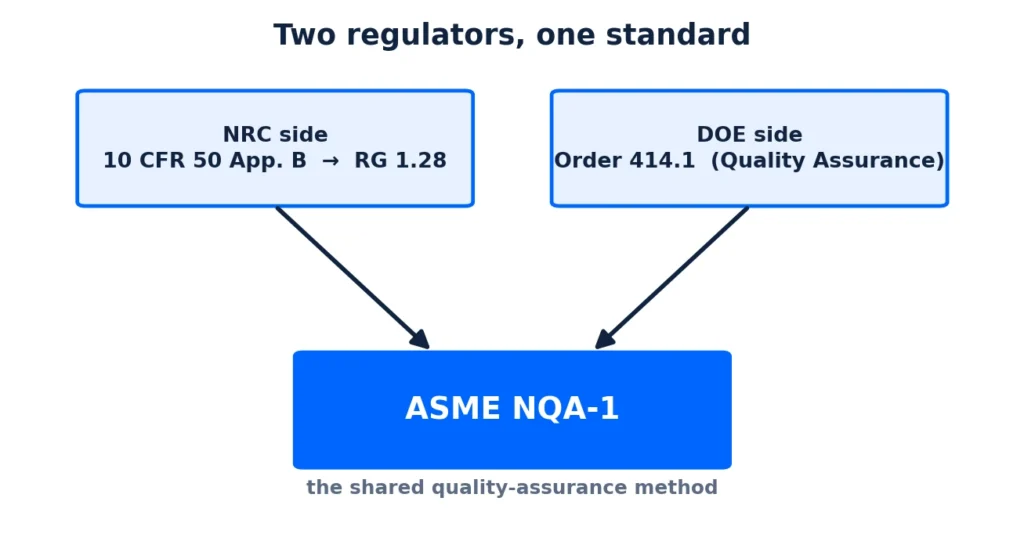
So the real relationship looks like this: Appendix B is the law, NQA-1 is the method, and RG 1.28 is the bridge the NRC uses to bless a particular edition of the method. Miss that middle link and the whole system looks more arbitrary than it is.
One detail that surprises people. Appendix B has eighteen criteria. NQA-1’s Part I is built around eighteen requirements. That alignment isn’t a coincidence — the standard was structured to map onto the regulation, right down to the last item on each list being audits.
The eighteen requirements, grouped so they make sense
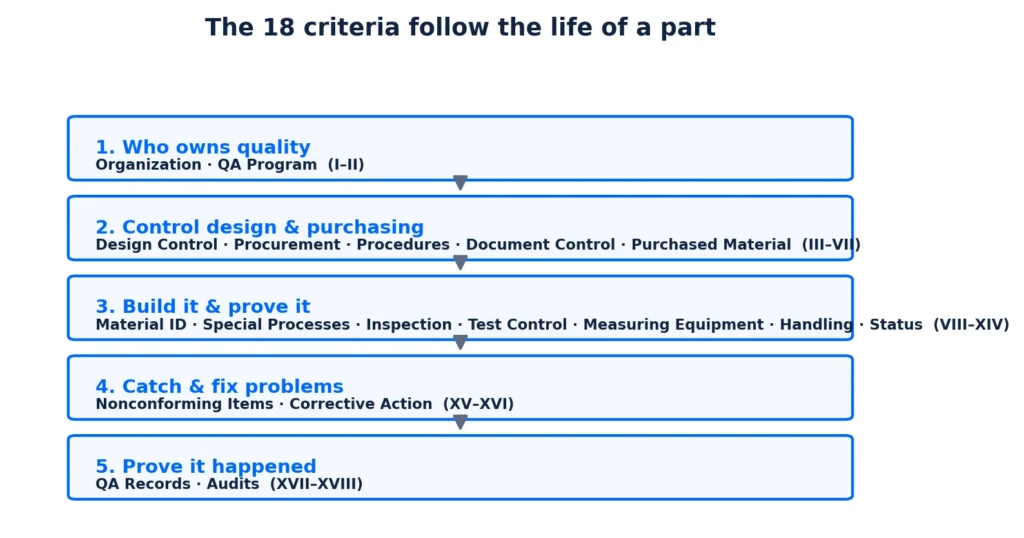
Reading NQA-1’s requirements as a flat list of eighteen items is how most people bounce off it. They aren’t eighteen unrelated rules. They’re one logical chain, and the chain follows the life of a part.
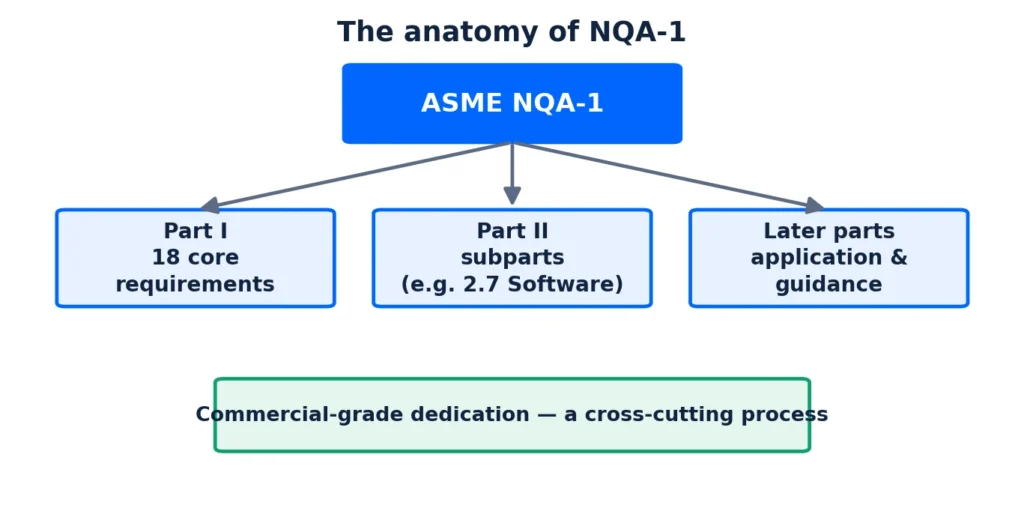
Those eighteen live in Part I of the standard. Part II adds subparts for specialized work — Subpart 2.7 covers software, for instance — and later parts extend the framework further, but Part I is the spine everything else hangs off.
It starts with who’s in charge. Criterion I (Organization) and Criterion II (Quality Assurance Program) establish that someone owns quality, with enough independence that they can stop work without a production manager overruling them, and that the whole program is written down.
Then it moves to controlling the design and what you buy. Design Control, Procurement Document Control, Instructions and Procedures, Document Control, and Control of Purchased Material (Criteria III through VII) make sure the design is verified, the purchase orders carry the right requirements down to suppliers, and the paperwork that governs the work is the current version — not a marked-up copy someone kept in a drawer.
Next comes building it and proving it as you go. Identification of Materials, Control of Special Processes like welding and heat treatment, Inspection, Test Control, Control of Measuring Equipment, Handling and Storage, and Inspection/Test Status (Criteria VIII through XIV) cover the physical work. This is where a weld gets its own traceable record and a calibrated gauge has to prove it was calibrated.
Then, catching and fixing what goes wrong. Nonconforming Materials (XV) and Corrective Action (XVI) deal with the reality that things fail inspection and mistakes happen. The point isn’t to pretend they don’t — it’s to catch them, contain them, and fix the root cause so they don’t repeat.
The chain ends where the whole thing is proven: Quality Assurance Records (XVII) and Audits (XVIII). The records are the evidence the other seventeen criteria were actually followed. The audits are the check that the program works as written rather than only on paper.
Why this makes nuclear slow and expensive — and why that’s mostly the point
Here’s where an operator’s view differs from a consultant’s.
The cost NQA-1 adds is real, and it’s large. A qualified nuclear supplier maintains an audited program, keeps records for the life of the plant, and passes that overhead into the price of every part.
When people say a nuclear-grade component costs many times its commercial equivalent, a big share of that gap is quality program overhead, not materials or machining.
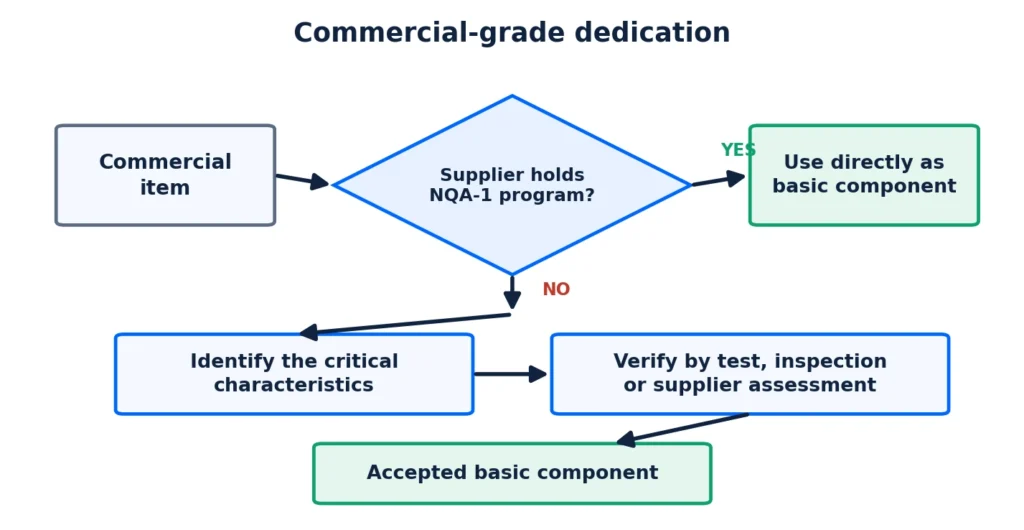
The most visible symptom of this is a mechanism called commercial-grade dedication. Suppose you need an ordinary industrial item — a relay, a fastener, a pump — for a safety application, and the manufacturer isn’t running an NQA-1 program. You can’t just install it.
You have to dedicate it: identify the critical characteristics that matter for the safety function, then verify those characteristics through testing, inspection, or supplier assessment until you have reasonable assurance the part will do its job.
Only then does that commercial item become a “basic component” you’re allowed to use. It’s a whole engineered acceptance process wrapped around a part you could otherwise buy in an afternoon.
[If you’re working through this yourself, our free commercial grade dedication tool screens the item under 10 CFR 21 and recommends an acceptance method for each critical characteristic.]
That sounds absurd until you remember why it exists. The entire structure is built so that if a defect turns up in one part, it can be traced — which lot, which supplier, which process — and reported across the fleet before it causes a problem somewhere else.
Traceability is the product. The paperwork isn’t bureaucracy for its own sake; it’s the mechanism that lets a latent flaw be found and contained years later.
Where the system actually breaks down is when people forget that. I’ve watched programs treat the documentation as the goal instead of the evidence — where a signature in the right box matters more than whether the work underneath it was done well.
That’s the failure mode NQA-1 can drift into, and it’s a fair criticism. But it’s a criticism of how the standard gets implemented, not of the logic behind it. The logic is sound. A reactor is one of the few machines where a hidden manufacturing defect can stay invisible for twenty years and then matter enormously. The standard is the industry’s answer to that specific problem.
Certification: what it actually involves
“Getting NQA-1 certified” is really two different things, and the phrase blurs them.
For a supplier, it means building a QA program that meets the standard and then passing an audit — often an ASME-administered certification, or a survey by the utility or EPC buying your parts.
The NRC runs its own vendor quality-assurance inspections on suppliers to the new-reactor fleet, so a program can be checked by the regulator as well as by its customers. The program has to be documented, staffed with qualified people, and demonstrated in practice, not just on paper.
Auditors themselves are qualified under the standard; a Lead Auditor has to meet specific training and experience requirements before signing off on anyone else’s program.
It is not a one-time stamp. Certification is maintained through periodic audits and surveillance, and it lapses if the program stops being followed. That recurring cost is part of why the qualified supplier base for nuclear components is smaller than the industry would like — which brings us to why any of this matters more now than it did a decade ago.
NQA-1 in the SMR and advanced-reactor era
For most of its history, NQA-1 was a settled background fact. The fleet was built, the supplier relationships were mature, and quality assurance was something that mostly ran itself.
That’s changing. A wave of small modular reactors and advanced designs is trying to move from paper to hardware, and every one of them needs qualified suppliers for their safety-related components.
The standard applies to them the same as it does to a gigawatt-scale plant — NQA-1’s own scope now explicitly names advanced reactors and SMRs. A developer with a brilliant reactor design still can’t ship a safety component until someone in the supply chain can produce it under a qualified program, with the records to prove it.
This is also where the standard reaches past the NRC’s world. On the federal side, the Department of Energy requires NQA-1 through its own Order 414.1 on Quality Assurance.
Revision D of that order requires nuclear safety software and safety-related work at DOE facilities to be done under NQA-1, and the order has since been updated again. So the same standard governs both commercial reactors licensed by the NRC and the DOE’s own nuclear work — two separate regulatory worlds pointing at one method.
The qualified supplier bottleneck is turning into one of the quieter constraints on how fast new nuclear can actually be built. You can design a reactor in a few years. Standing up a base of NQA-1-qualified suppliers who can forge, machine, weld, and document heavy components at volume takes longer — and it’s the kind of problem that doesn’t show up in a press release. That’s a thread worth pulling on its own, and it’s where the next pieces in this series are headed.
Frequently asked questions
What does NQA-1 stand for?
Nuclear Quality Assurance. It’s the ASME standard “Quality Assurance Requirements for Nuclear Facility Applications,” and the “-1” is the standard’s number, with editions tracked by year.
What is the difference between NQA-1 and 10 CFR 50 Appendix B?
Appendix B is the NRC’s federal regulation — the eighteen criteria a nuclear QA program must meet. NQA-1 is the ASME industry standard that spells out how to meet them. The NRC connects the two through Regulatory Guide 1.28, which endorses specific NQA-1 editions as an acceptable way to satisfy Appendix B.
What is 10 CFR 50 Appendix B?
It’s the federal rule titled “Quality Assurance Criteria for Nuclear Power Plants and Fuel Reprocessing Plants,” containing eighteen criteria covering organization, design control, procurement, inspection, corrective action, records, audits, and more. It applies to the structures, systems, and components that prevent or mitigate accidents.
What is NQA-1 certification?
It’s the process by which a supplier’s quality-assurance program is verified against the NQA-1 standard, usually through an ASME-administered certification or a customer audit. It’s maintained through periodic audits and lapses if the program isn’t kept up.
Is NQA-1 the same as ISO 9001?
No. ISO 9001 is a general quality-management standard used across all industries. NQA-1 is specific to nuclear facilities, with requirements — like commercial-grade dedication and lifetime records — that general standards don’t include.
Why is nuclear quality assurance so strict?
Because a manufacturing defect in a reactor component can stay hidden for years and then matter enormously. The strictness buys traceability: the ability to identify a flawed part, find every other part like it, and act before it causes harm.
Does NQA-1 apply to SMRs and advanced reactors?
Yes. Current editions explicitly cover advanced reactors and SMRs. Any safety-related component for a new design has to be produced under a qualified NQA-1 program.
Sources and Further Reading
- 10 CFR Part 50, Appendix B — Quality Assurance Criteria for Nuclear Power Plants and Fuel Reprocessing Plants (NRC / eCFR)
- ASME NQA-1 — Quality Assurance Requirements for Nuclear Facility Applications
- NRC Regulatory Guide 1.28, Revision 6 — Quality Assurance Program Criteria (Design and Construction)
- U.S. DOE Order 414.1 — Quality Assurance
- NRC — Quality Assurance oversight for new reactors
About The Author
Elliot Marsh is a working reactor engineer with hands on experience in reactor physics, core management, reactivity control and nuclear fuel cycle planning at an operating power station. He writes about nuclear energy for readers who want the engineering reality, not the press release.