NQA-1 vs ISO 9001: What Nuclear Work Demands That ISO 9001 Doesn’t
NQA-1 vs ISO 9001 is the question every shop runs into the moment it eyes nuclear work. The short version: one keeps your customers happy, the other keeps a reactor safe, and only one gets you through a nuclear plant’s door.
A shop owner emailed me last month, a week after his company finished the climb to ISO 9001:2026, the new edition that went live on September 16. New binders, surveillance audit booked, certificate on its way. A utility two counties over had posted a notice for machined components, and he wanted a straight answer to one question. Did his certificate get him through the door?
No. And it had nothing to do with how well his shop runs.
That conversation happens constantly, in some form, to anyone who makes parts and watches the nuclear build out with interest. The data center demand, the SMR orders, the restart projects, all of it needs suppliers, and a lot of capable shops are looking at that work for the first time.
ISO 9001 and NQA-1 look like relatives. Both are quality systems. Both run on procedures, records, audits, corrective action. So people assume NQA-1 is just ISO 9001 with a lead apron on, and that a solid 9001 program gets them most of the way there.
It doesn’t. NQA-1 vs ISO 9001 isn’t a lighter-versus-heavier version of one standard. The two were built to answer different questions, and once you see the questions, every other difference falls into place. Getting this wrong is expensive.
A shop that bids safety related work on the strength of its 9001 certificate can spend months and real money before the gap shows up, usually at an audit, which is the worst possible time to learn it.
Two standards, two different questions
Strip away the paperwork and ISO 9001 asks one thing: can you consistently deliver what you told your customer you would? That’s it. It’s a management system standard, written to fit a bakery, a logistics firm, or a bolt supplier equally well.
You adopt it because the market rewards it, a customer requires it, or you just want fewer defects walking out the door. The International Organization for Standardization publishes it, and accredited registrars issue the certificate.
The 2026 edition, out on September 16, keeps the familiar structure and adds some sensible things: quality culture and ethics language under leadership, a cleaner split between risk and opportunity, the climate wording carried over from the 2024 amendment. Read the whole thing and you won’t find the word “reactor.”
NQA-1 asks a harder question: can you prove, maybe forty years from now, that a safety related component will do its job when a reactor needs it? That’s a different burden.
It isn’t about satisfying a customer. It’s about protecting a safety function long after the purchase order is forgotten. Think about what that actually means. A part you ship in 2026 may still be in a nuclear power plant in 2066, and if an inspector then asks why a particular weld was accepted, the record has to answer, with the procedure, the qualified welder, the material certs, and the inspection results all traceable. ISO 9001 was never asked to carry that.
And NQA-1 doesn’t stand on its own the way 9001 does. In the United States it gets pulled into federal law. 10 CFR 50 Appendix B lays out eighteen criteria for quality assurance at nuclear plants, and NQA-1 is the consensus standard the industry uses to satisfy them.
The NRC endorses specific editions through Regulatory Guide 1.28; Revision 6, from September 2023, points to the 2017, 2019, and 2022 editions. On the federal side, the Department of Energy does the same through its Quality Assurance order, Order 414.1, updated to Revision F in August 2026. ASME writes the standard. The regulator gives it teeth.
So one standard is a market choice. The other is how you stay inside the law.
It’s worth saying what the 2026 revision did and didn’t change here, because the timing confuses people. The new edition is a real update for general quality management. It does not add a single nuclear requirement.
Quality culture language, a cleaner risk and opportunity split, climate considerations, none of it touches safety classification, dedication, or Part 21. A shop that moves from 9001:2015 to 9001:2026 is no closer to supplying a reactor than it was the week before. The gap to NQA-1 is exactly the same size.
Where ISO 9001 runs out
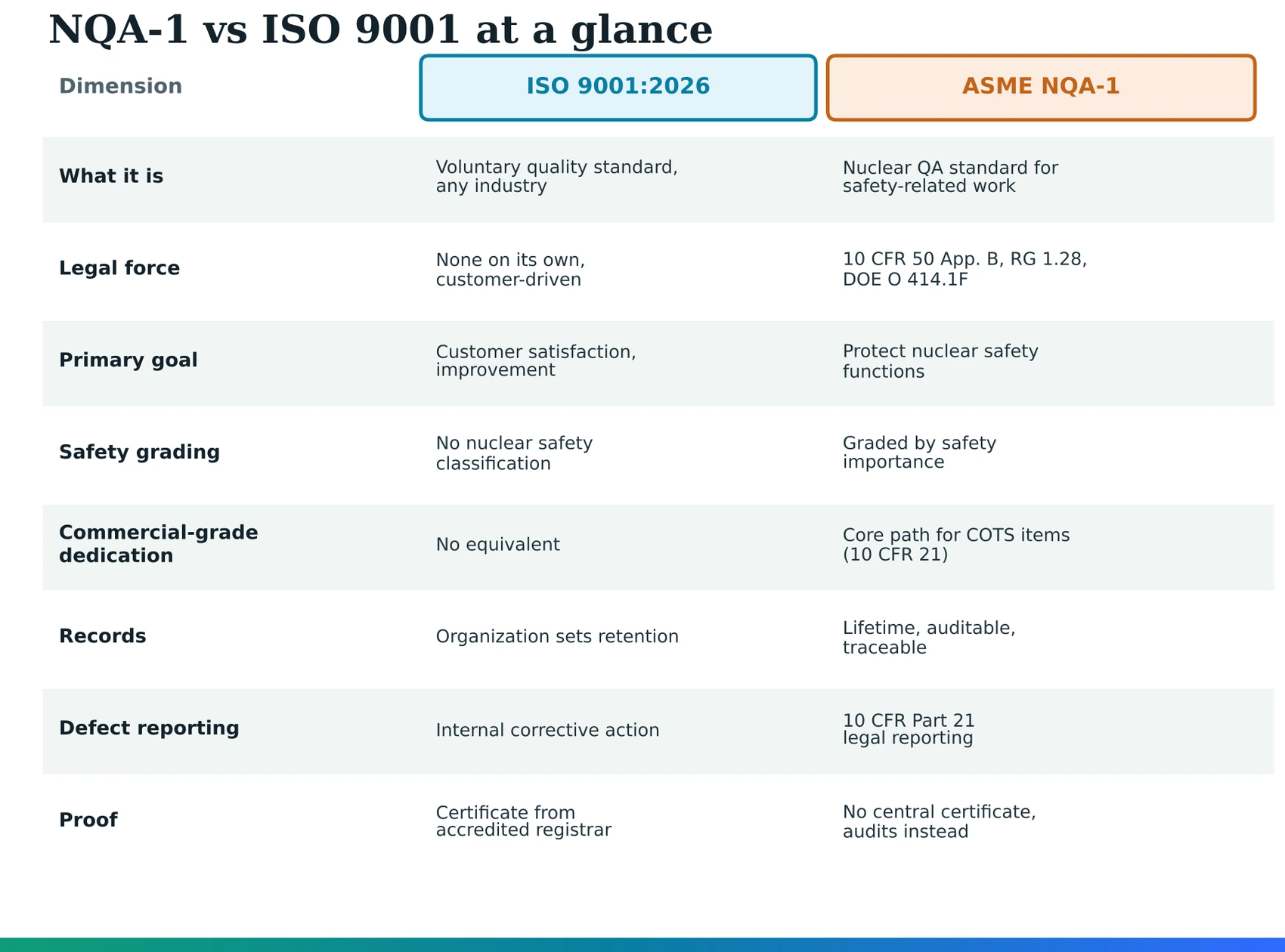
This is where the family resemblance ends. Four places, specifically.
Safety classification
NQA-1 makes you sort everything you touch by how much it matters to nuclear safety, then match the controls to the stakes. A pump that feeds emergency cooling lives in a different world from the bracket that holds a sign.
This graded approach runs through the whole program. ISO 9001 grades nothing by nuclear consequence. It can’t. It was never built to know the difference between a coolant boundary and a handrail.
Commercial-grade dedication
Here there’s no ISO equivalent at all, not even a distant one. A large share of what goes into a plant isn’t made to nuclear standards to begin with. It’s an ordinary pump, relay, or fastener bought from an ordinary supplier.
Dedication is the engineering process that takes that commercial item, identifies the handful of characteristics that actually matter for its safety function, and verifies each one with its own evidence until the part can legally be treated as a basic component.
Take a commercial circuit breaker headed for a safety related panel. The dedication asks which of its properties the safety function actually depends on, the trip setpoint, the interrupting rating, the response under a seismic load, and then proves each one, by test or inspection, rather than trusting the maker’s catalog sheet. It’s demanding, it’s heavily documented, and 10 CFR Part 21 sits behind it. ISO 9001 has nothing that looks like this.
Records that outlive the people who made them
Under ISO 9001 you decide how long to keep things, based on what the business needs. NQA-1 records are kept for the life of the plant, traceable and auditable, because someone may need to reconstruct why a weld was accepted decades after the welder retired. That single requirement reshapes how a shop handles paper.
The legal duty to report
Find a defect that could affect safety, and under Part 21 you have a legal obligation to tell the NRC. Under ISO 9001 you log it, fix it, and close it internally. Same finding. Completely different consequence.
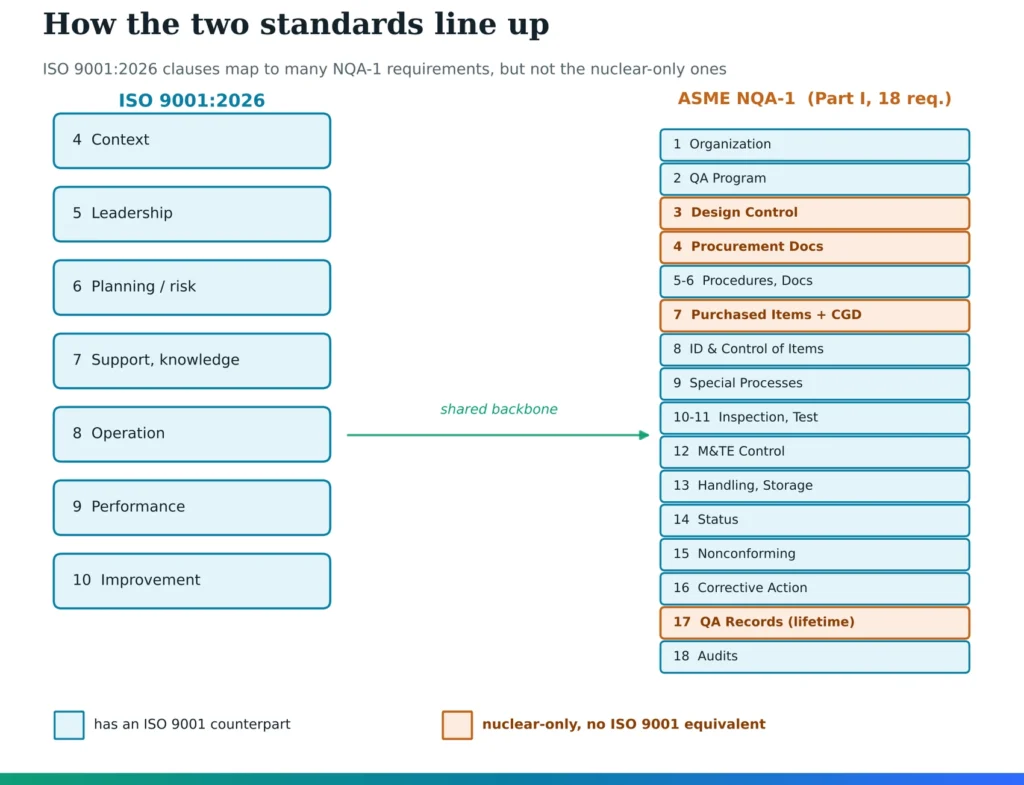
Map the two side by side and most of NQA-1’s eighteen requirements do have an ISO 9001 cousin. Document control, inspection, test control, measuring equipment, nonconforming items, corrective action, audits, the management system machinery is shared.
It’s the nuclear specific requirements, design control at the depth NQA-1 wants, procurement control, the dedication path, lifetime records, that have no counterpart in 9001. That gap is the whole story.
What the gap looks like at the first audit
The abstract differences get concrete fast when an ISO 9001 shop sits for its first nuclear supplier audit. I’ve watched the same findings come up again and again, and almost none of them are about the shop’s craftsmanship. They’re about the program.
The procurement documents are usually the first to show it. A 9001 purchase order buys a part. An NQA-1 purchase order has to flow quality requirements down to the sub-tier supplier, the right code edition, inspection rights, documentation deliverables, Part 21 applicability, and most shops entering nuclear have never written a PO that does that.
The auditor finds a part bought from a supplier who was never told it was going into a safety application.
Then the classification question lands. Which of your items and activities are safety-related, and where is that written down? A 9001 shop treats every job by the same procedures. It has no scheme that says this weld carries a safety function and that one doesn’t, so it can’t show it applied the right level of control to the right parts.
Records retention is a quieter finding but a telling one. The shop set its retention at seven years because that’s what its biggest commercial customer wanted. The audit expects lifetime of plant.
And when a commercial item shows up in a safety related assembly with no dedication package behind it, that’s not a paperwork gap, it’s a part that legally can’t be installed yet. None of these are about whether the shop can machine to tolerance. They can. The program just wasn’t built to answer nuclear questions.
So is ISO 9001 “enough”?
The honest answer, for anything safety-related: no. There’s no reading of the regulations where an ISO 9001 certificate alone lets you supply a basic component to a US plant. If a supplier believes otherwise, they’re headed for an expensive surprise at their first audit.
But “not enough” isn’t “worthless,” and this is where shops talk themselves into the wrong move in both directions.
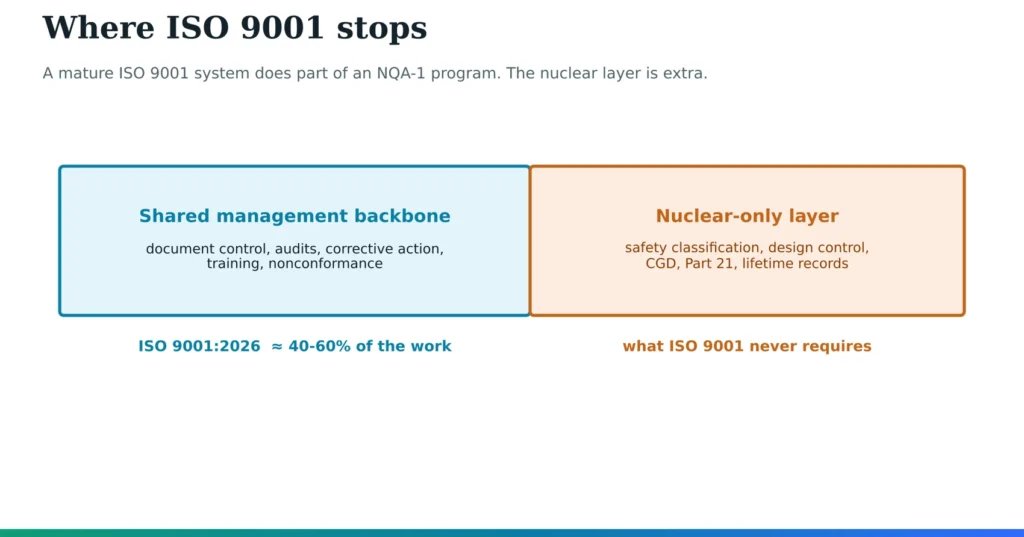
A mature ISO 9001 system does a real part of the job, call it 40 to 60 percent of an NQA-1 program, the management backbone. If your document control is clean, your internal audits actually find things, your corrective action process closes loops, and your training records hold up, you are not starting from zero.
You’ve built the frame. What’s missing is the nuclear layer bolted on top: safety classification, design and procurement control at NQA-1 depth, dedication, Part 21, lifetime records.
Be specific about what carries over, because it’s more than people expect. Your calibration and measuring equipment control transfers almost intact. Your internal audit program, the cadence, the trained auditors, the finding and closure loop, is the same muscle NQA-1 wants exercised.
Document control, nonconformance handling, and competence records all map across with adjustments rather than rebuilds. The honest framing for a 9001 shop isn’t “start over.” It’s “keep the engine, add the parts nuclear needs, and tighten the ones that were never stress tested at this level.”
The practical path is the sane one. Keep the ISO 9001 system you already run. Build the NQA-1 requirements onto it instead of standing up a second, parallel program. Then get audited by someone who counts, which is the step that actually turns you into a qualified supplier. That’s a real project, not a paperwork afternoon, and it has its own field guide.
What you don’t do is scrap a working 9001 system because it isn’t “nuclear enough.” It’s the foundation you build from, not the thing you throw away.
The certificate trap
One more place the 9001 habit trips people up. You can be “ISO 9001 certified,” full stop, because a registrar accredited under ISO/IEC 17021 issues that certificate. There is no equivalent for NQA-1.
No central body hands out an “NQA-1 certificate.” Compliance is shown through audits, a NUPIC joint audit, a utility’s own audit of you, or a registrar auditing you against the program. I’ve written separately about why that certificate myth refuses to die.
So when a vendor slides an “NQA-1 certificate” across the table, that’s your cue to ask harder questions, not to relax. At best they mean they passed an audit. At worst they don’t understand the standard they’re claiming to hold.
ISO 19443, the bridge most people miss
There’s a standard that sits between the two, and almost nobody outside the supply chain quality world brings it up. ISO 19443.
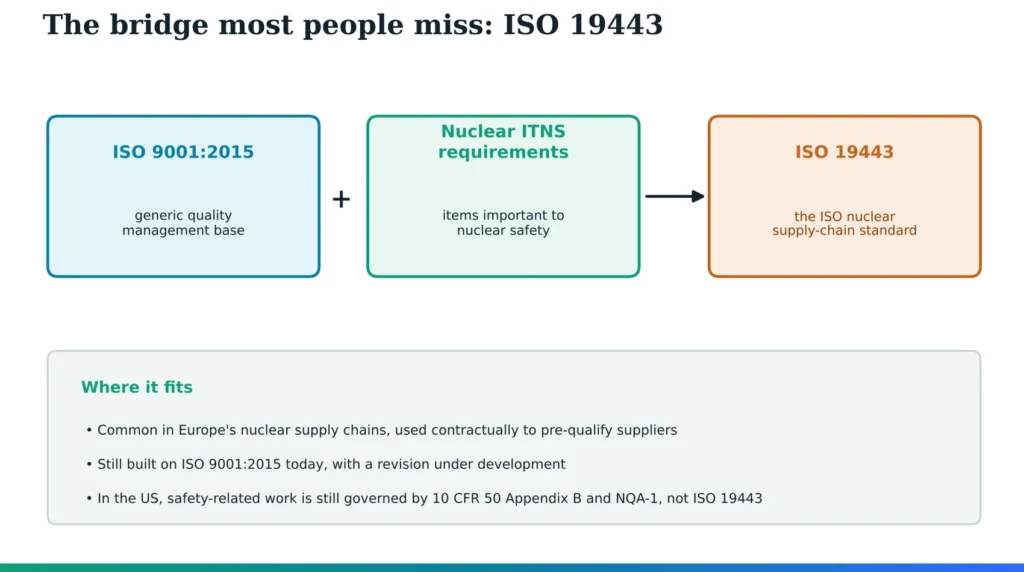
It’s ISO 9001 with nuclear specific requirements layered on, written for organizations supplying items and services important to nuclear safety, what the standard calls ITNS. If you’ve worked with European, and especially French, nuclear supply chains, you’ve seen it. Utilities and tier one vendors use it contractually to pre-qualify suppliers before an order is ever placed.
Two things are worth knowing. First, ISO 19443 is still built on ISO 9001:2015, with a revision under way, so it hasn’t caught up to the 2026 edition yet. Second, and this is the part that matters for a US shop, the standard is complementary to a country’s statutory and regulatory requirements, not a substitute for them.
Holding it does not satisfy Appendix B. For safety related work in the US, you’re still in NQA-1 territory. ISO 19443 can strengthen a bid, especially with international or European customers. It does not replace the regulatory program.
Which one does your shop actually need?
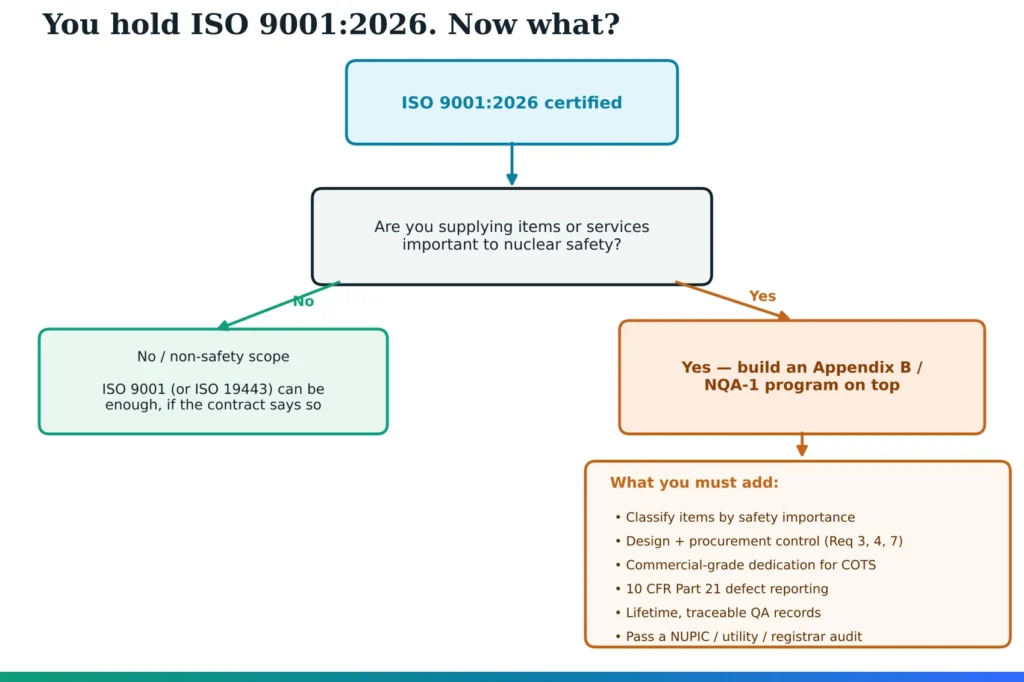
Start with one question: are you supplying items or services important to nuclear safety?
If the answer is no, if your scope is non safety balance of plant work, general industrial supply, or a customer who only asks for 9001, then ISO 9001 is likely all you need, with ISO 19443 as an optional edge if you’re chasing nuclear customers who value it. Don’t build an NQA-1 program you’ll never be audited against.
If the answer is yes, there’s no path around it. You need a quality program that meets Appendix B, which in practice means NQA-1, with everything that rides along: safety classification, design and procurement control, dedication for the commercial items you’ll inevitably buy, Part 21 reporting, lifetime records, and an audit you can pass.
If you want to see the shape of that program before you commit, the NQA-1 requirements checklist walks the eighteen requirements one at a time.
Most of that work, the part that stops shops cold, isn’t machining or welding. It’s documentation. Writing procedures that match how the shop actually runs, building the records structure, getting the program readable enough to survive an audit.
That’s the piece I spend most of my time on with suppliers, and it’s where a solid quality system quietly becomes a qualified one. If that’s the wall you’re staring at, that’s the work I do.
Frequently Asked Questions
Is NQA-1 the same as ISO 9001?
No. ISO 9001 is a voluntary, general quality management standard used in any industry, aimed at customer satisfaction and consistent delivery. NQA 1 is a nuclear specific quality assurance standard invoked by US regulation to protect safety functions. They share a management backbone, but NQA-1 adds requirements, safety classification, commercial grade dedication, lifetime records, Part 21 reporting, that ISO 9001 does not have.
Is ISO 9001 enough to supply nuclear parts?
For safety related components, no. An ISO 9001 certificate on its own does not qualify you to supply a basic component to a US plant. A mature 9001 system covers roughly 40 to 60 percent of an NQA-1 program, the management backbone, but you still have to add the nuclear layer and pass an audit.
Can a company be “NQA-1 certified”?
Not in the way companies are ISO 9001 certified. No central body issues an NQA-1 certificate. Compliance is demonstrated through audits, a NUPIC joint audit, a utility audit, or a registrar auditing against the program. Treat an “NQA-1 certificate” claim with caution.
Does NQA-1 replace ISO 9001?
No. In practice you build an NQA-1 program on top of an ISO 9001 base rather than replacing it. The 9001 system supplies the backbone; NQA-1 adds the nuclear-specific requirements regulation demands.
What is ISO 19443?
ISO 19443 applies ISO 9001 to the nuclear supply chain, for organizations supplying items and services important to nuclear safety (ITNS). It’s common in European supply chains and used to pre-qualify suppliers. It is complementary to regulatory requirements and does not, by itself, satisfy 10 CFR 50 Appendix B in the United States.
Do SMR and advanced-reactor suppliers need NQA-1?
For safety-related scope, yes. The same Appendix B and RG 1.28 framework applies to new builds, SMRs, and advanced reactors. As new vendors without a nuclear background enter the market, the graded approach and dedication become the gate they have to clear, not an optional extra.
Sources and Further Reading
- ISO, ISO 9001 Quality management (2026 edition overview)
- ISO 19443:2018, Quality management systems for the nuclear energy sector supply chain (ITNS)
- 10 CFR 50 Appendix B, Quality Assurance Criteria for Nuclear Power Plants and Fuel Reprocessing Plants
- 10 CFR Part 21, Reporting of Defects and Noncompliance
- NRC Regulatory Guide 1.28, Revision 6 (September 2023), Quality Assurance Program Criteria (Design and Construction)
- US NRC, Quality Assurance regulations for new reactors
- DOE Order 414.1F, Quality Assurance (2026)
- ASME Codes & Standards (publisher of NQA-1)
About the Author
Elliot Marsh is a working reactor engineer with hands on experience in reactor physics, core management, reactivity control and nuclear fuel cycle planning at an operating power station. He writes about nuclear energy for readers who want the engineering reality, not the press release.
Need content like this for your company?
I write white papers, technical explainers, and thought-leadership for nuclear vendors, reactor developers, and the agencies that serve them — accurate enough for engineers, clear enough for buyers.