How to Become NQA-1 Qualified: A Supplier’s Field Guide
The first time most shops meet NQA-1, it’s a line on a purchase order. “Supplier shall maintain a quality assurance program meeting ASME NQA-1.” Then someone goes looking for the certificate you buy to make that line go away, and finds out there isn’t one.
That is the part nobody tells you up front. NQA-1 isn’t a badge you purchase, and it isn’t a test you sit for an afternoon. It’s a quality program you build, run on real work, and then defend in front of an auditor.
For a machine shop, a valve maker, a software house, or an engineering firm that wants into the nuclear supply chain, the gap between “we do good work” and “we’re NQA-1 qualified” is wider than it looks, and it’s mostly made of paper.
Here’s what the path actually involves, how long it really takes, who signs off, and the places shops most often trip.
First, kill the “certificate” myth
There is no central body that hands out an NQA-1 certificate. ASME writes and sells the standard. It does not run a registration scheme the way ISO 9001 does, so no registrar stamps you “NQA-1 certified” for a fee and a surveillance visit.
When a vendor says it’s “NQA-1 certified,” what that really means is narrower and more useful: its program has been audited against NQA-1 and accepted by someone who matters, usually a utility customer, a joint audit body, or a third party registrar.
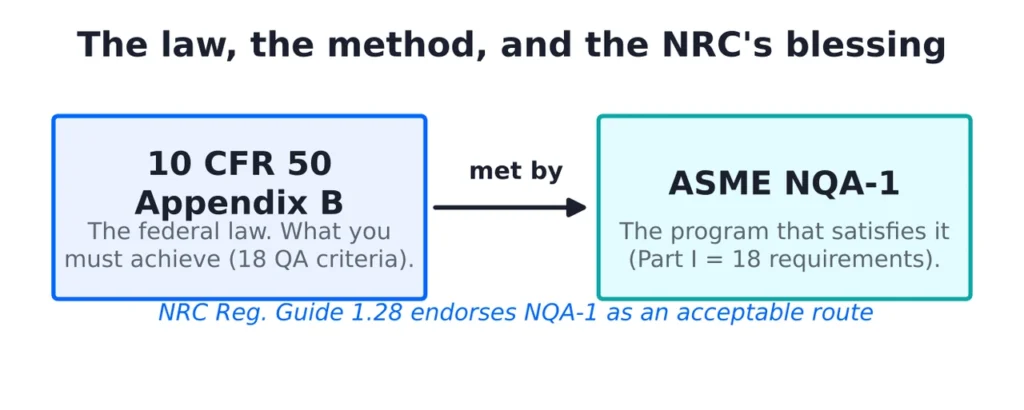
Why does the standard even exist? Because the federal rule behind it, 10 CFR 50 Appendix B, states eighteen quality criteria a licensee must meet, but says almost nothing about how. NQA-1 is the “how.”
The NRC then closes the loop in Regulatory Guide 1.28, which endorses NQA-1 as an acceptable way to satisfy Appendix B. Get those three relationships straight and the rest of this makes sense.
One more distinction worth nailing down, because it trips up newcomers constantly: a program qualification is not the same as dedicating a single part. If you only ever sell a handful of catalog items into nuclear, you may never need your own program at all. More on that near the end.
What you’re actually building
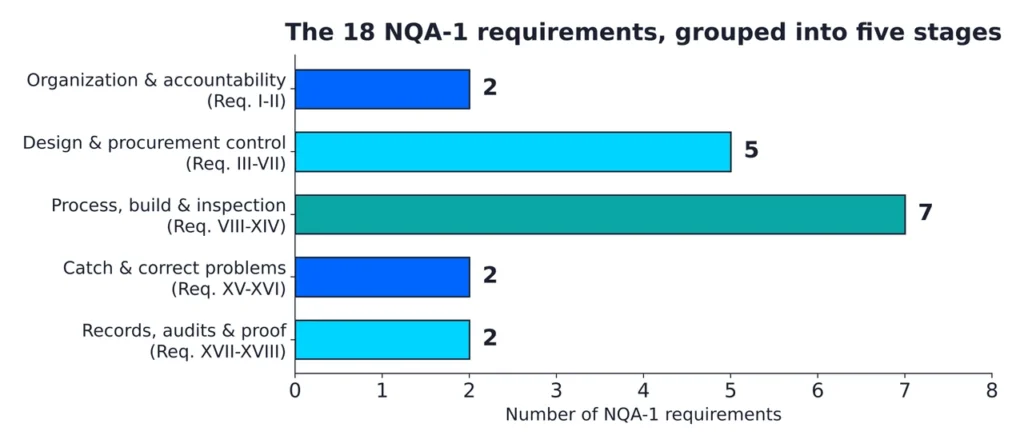
NQA-1 Part I is eighteen requirements. People hear “eighteen” and picture a flat checklist, which is the wrong mental model. They group into five stages that mirror how work actually flows through a shop: who’s accountable, how design and purchasing are controlled, how you build and inspect, how you catch and fix problems, and how you prove any of it happened.
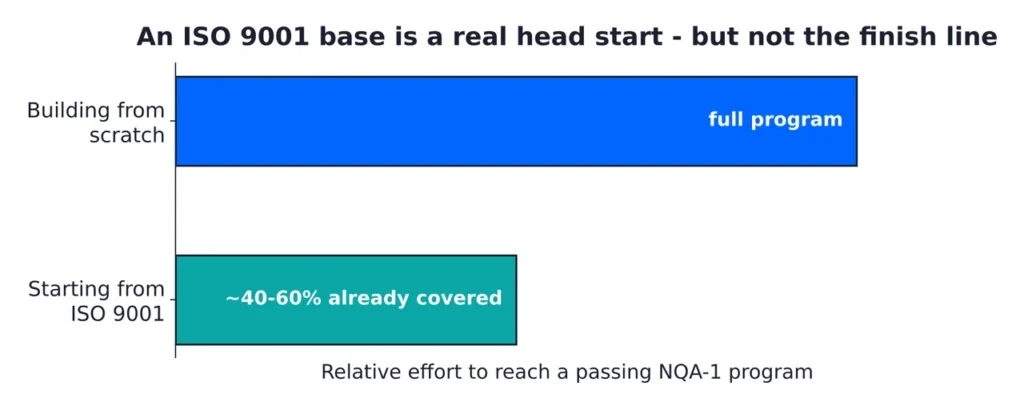
If you already run an ISO 9001 system, take some comfort: you’re maybe 40 to 60 percent of the way there. The management structure, document control, and basic corrective-action machinery carry over.
What doesn’t carry over is the nuclear-specific rigor, and that’s exactly where auditors push hardest: design control with independent verification, procurement that flows safety requirements down to your sub-suppliers, record retention measured in decades, a 10 CFR Part 21 process for reporting defects, and commercial-grade dedication when you buy off-the-shelf.
(If your customer is a federal site rather than a commercial utility, DOE Order 414.1 pulls in NQA-1 the same way.)
The six steps, in order
Every qualification I’ve watched go well followed the same arc. The shops that struggled almost always rushed step three.
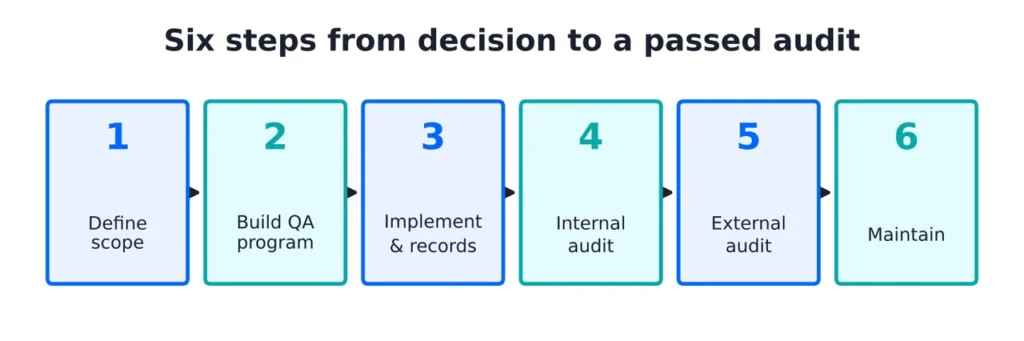
1. Define your scope honestly
Decide exactly what you’re qualifying before you write a word of the manual. Which products or services, and which of the eighteen requirements genuinely apply? A forging shop doesn’t need the design-control requirement in full.
A design house doesn’t need test control. Over-scoping is the most common way to burn money here, because every activity you claim adds procedures to write and surface area to audit. A tight scope is cheaper to build, faster to audit, and easier to defend.
2. Build the program to your real workflow
Write the QA manual and procedures around how your shop actually operates, not a template you bought. Auditors can smell a binder that nobody follows. The procedures have to describe the work your people really do, mapped to the applicable requirements, with the nuclear-specific pieces bolted on where they belong.
3. Run it, and generate records
This is the step that sets the calendar. NQA-1 lives or dies on objective evidence, and you can’t audit intentions. You need a body of completed work behind you: travelers, inspection records, nonconformance reports, corrective actions that were actually closed.
A manual written last month with no records behind it will not pass. Plan for several months of genuine operating history before you invite anyone in.
4. Audit yourself first
Run an internal audit against your own program, close the findings, and hold a documented management review. Do this properly and two things happen: you surface the gaps an external auditor would otherwise write up, and the clean internal trail becomes evidence in its own right that the program is alive.
5. Get audited by someone who counts
Acceptance comes through one of three doors, and which one you use depends on where you are in the chain.
6. Keep it alive
Acceptance isn’t permanent. Programs stay valid through periodic re-audits, surveillances, corrective-action tracking, and records kept current. Let it lapse and you’re not topping up, you’re starting over.
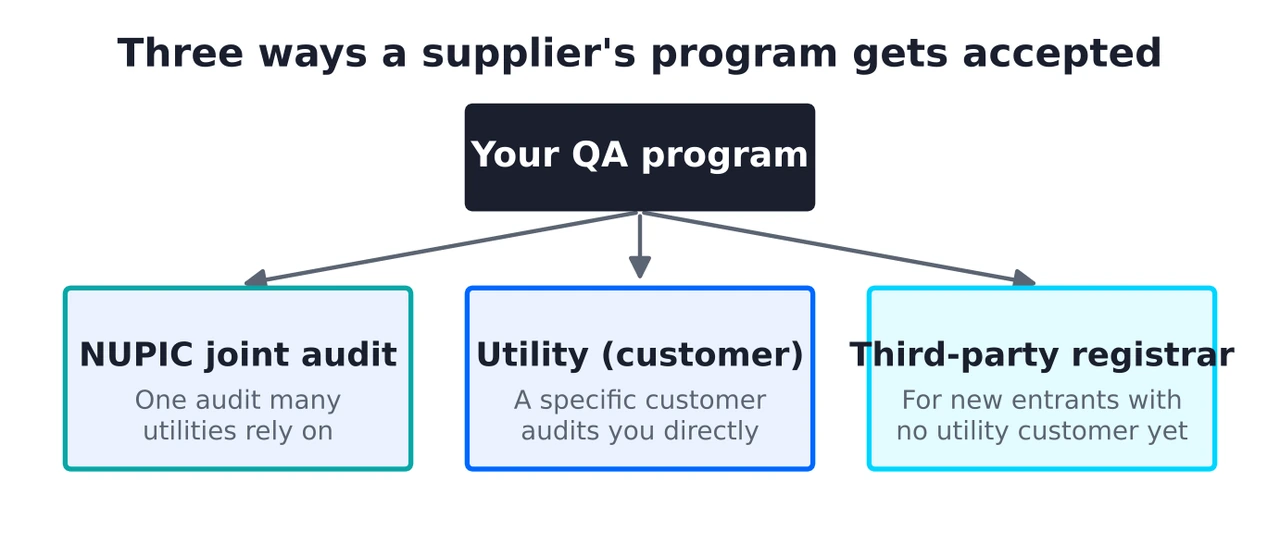
In the US commercial fleet, NUPIC, the Nuclear Procurement Issues Committee, runs joint supplier audits so dozens of utilities can rely on one audit instead of each sending a team.
A specific utility can also audit you directly, usually tied to a real purchase order. And for newer entrants, advanced reactor and small modular reactor suppliers who don’t yet have a utility customer, third-party registrars increasingly audit NQA-1 programs before that first relationship even exists.
How long, and what it costs
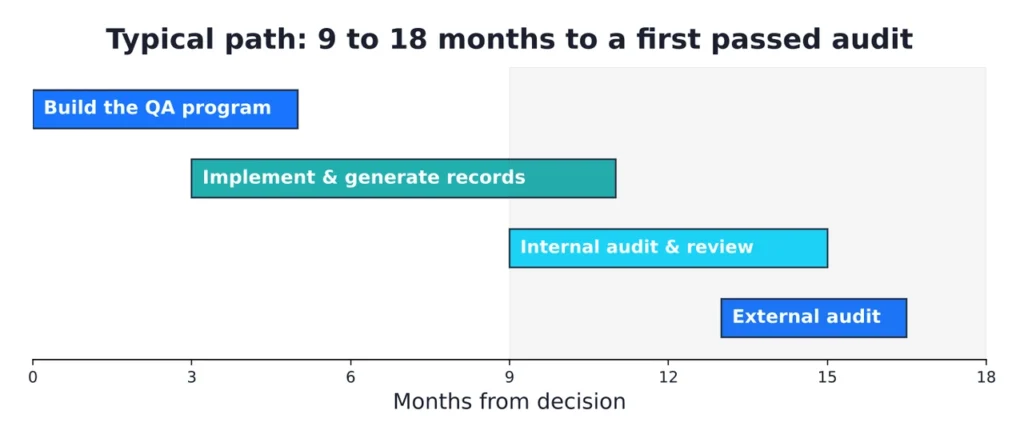
Plan on nine to eighteen months from the decision to your first passed audit. The single biggest variable is where you start. A shop with a mature ISO 9001 system and disciplined records moves fast; one building quality culture from scratch moves slowly, because you can’t buy operating history, you can only accumulate it.
There’s no sticker price, and anyone who quotes you one without seeing your shop is guessing. Cost scales with your starting maturity, the scope you’re qualifying, how much consultant and training help you bring in, the audit itself, and the ongoing maintenance you’ll carry afterward.
A narrow scope built on a solid ISO 9001 base is a different order of expense from a full program stood up from nothing.
Where shops actually fail
The findings repeat across audits, which is good news: you can design them out ahead of time.
- Records that don’t tie back. A procedure points to a record that’s missing, unsigned, or can’t be traced to the item it covers. Build traceability in from the first job instead of reconstructing it the week before the audit.
- Soft design verification. “Checked by engineering” is not verification. Design inputs, independent verification, and change control are the hardest requirement for a shop coming from outside nuclear, and auditors know exactly where to look.
- Procurement that doesn’t flow down. Buying safety-related items from unqualified sub-suppliers without passing the requirements down the chain, or without dedicating the item when that’s what the situation called for.
- Thin commercial-grade dedication. Accepting an off-the-shelf part without identifying and verifying its critical characteristics.
- Corrective action that never closes. Nonconformances logged and then abandoned, with no root-cause analysis and no trending.
- No Part 21 process. A missing procedure for evaluating and reporting defects is a standard early write-up.
When NQA-1 is the wrong answer
Sometimes the full program never pays back. If nuclear is an occasional sideline and you supply a few catalog parts, standing up and maintaining an NQA-1 program is a lot of overhead for a thin revenue line.
The part can still get into safety related service through commercial-grade dedication, a one-item-at-a-time acceptance process run by the buyer or a dedicating entity rather than a program on your side.
The rule of thumb I’d use: if nuclear is a core, recurring line of business, build the program. If you’re an occasional supplier of commercial items, let dedication carry the load. The two aren’t rivals. Plenty of qualified shops still lean on dedication for individual components they don’t make themselves.
Frequently Asked Questions
How do you become NQA-1 qualified?
You build a quality-assurance program that meets NQA-1’s eighteen requirements, run it on real work long enough to generate objective records, then pass an audit by a customer, by the NUPIC joint-audit program, or by a third-party registrar. There’s no certificate to buy.
Is there an official NQA-1 certificate?
No. ASME publishes NQA-1 as a consensus standard but runs no registration scheme. Acceptance of an NQA-1 program comes through customer, joint (NUPIC), or third-party audits, not a certificate issued by ASME.
How long does it take to become NQA-1 qualified?
Usually nine to eighteen months from decision to first passed audit. The timeline depends on how mature your existing quality system is, the scope you’re qualifying, and how much you commit. Shops starting from an ISO 9001 base move faster.
How much does NQA-1 certification cost?
There’s no fixed fee. Cost scales with your starting maturity, the scope of work you qualify, consultant and training support, the audit itself, and ongoing maintenance. A narrow scope on a solid ISO 9001 base costs far less than a full program from scratch.
Who audits NQA-1 compliance?
In the US, NUPIC runs joint supplier audits that many utilities rely on; individual utilities also audit suppliers directly; and third-party registrars audit programs for advanced-reactor and SMR suppliers who don’t yet have a utility customer.
Is NQA-1 the same as ISO 9001?
No. A mature ISO 9001 system covers part of an NQA-1 program, but NQA-1 adds the nuclear-specific requirements ISO 9001 never asks for. See the full NQA-1 vs ISO 9001 comparison for how the two map.
Do SMR and advanced reactor suppliers need NQA-1?
Yes. Current NQA-1 editions cover SMRs and advanced reactors, and DOE Order 414.1 pulls NQA-1 into federal nuclear work. Many new entrants get qualified through a third-party registrar before landing a utility customer.
Sources and Further Reading
- ASME NQA-1, Quality Assurance Requirements for Nuclear Facility Applications
- 10 CFR 50 Appendix B, Quality Assurance Criteria for Nuclear Power Plants and Fuel Reprocessing Plants (NRC)
- NRC Regulatory Guide 1.28, Rev. 6 (2023), Quality Assurance Program Criteria
- 10 CFR Part 21, Reporting of Defects and Noncompliance (NRC)
- DOE Order 414.1, Quality Assurance
- NUPIC, Nuclear Procurement Issues Committee (NRC overview)
- NeutronRise: NQA-1 Explained, the standard behind every nuclear component
- NeutronRise: Commercial Grade Dedication explained
About The Author
Elliot Marsh is a working reactor engineer with hands on experience in reactor physics, core management, reactivity control and nuclear fuel cycle planning at an operating power station. He writes about nuclear energy for readers who want the engineering reality, not the press release.
Need content like this for your company?
I write white papers, technical explainers, and thought-leadership for nuclear vendors, reactor developers, and the agencies that serve them — accurate enough for engineers, clear enough for buyers.