What is a Fast Reactor? Nuclear’s 70-Year-Old Reactor of the Future
On a December afternoon in 1951, in the high desert of Idaho, a small reactor called EBR-I lit four light bulbs. It was the first time in history that nuclear fission had produced usable electricity, the literal dawn of the atomic age. And here’s the detail almost everyone forgets: that very first power reactor was not the kind we mostly build today. It was a fast reactor.
Sit with that for a second, because it’s one of the great ironies of nuclear energy. The fast reactor was there at the very beginning. Scientists believed it was the future, a machine so efficient it could create more fuel than it consumed, powering civilization for thousands of years.
And yet, seventy years later, almost every reactor on Earth is a different design, while the fast reactor is still described, again and again, as the “reactor of the future.” How does a technology stay in the future for seven decades?
That question is the thread of this article, and the answer is genuinely fascinating, a story of brilliant physics, a fuel shortage that never came, a single dramatic safety test in the Idaho desert, and a comeback happening right now, driven by Bill Gates, Meta, and the AI boom.
I’m a reactor engineer, and the fast reactor is, to me, the most quietly important machine in nuclear energy: the family tree that Natrium, the traveling wave reactor, and most advanced designs all grow from. Let me show you what it actually is, starting with the one idea that makes the whole thing work, a choice about the speed of a neutron.
What Is a Fast Reactor? It All Comes Down to Neutron Speed
The short answer: A fast reactor is a nuclear reactor that runs without a moderator, so its neutrons stay at high speed instead of being slowed down. Those fast neutrons let it do two things ordinary reactors can’t breed new fuel from uranium-238, and destroy the longest-lived nuclear waste.
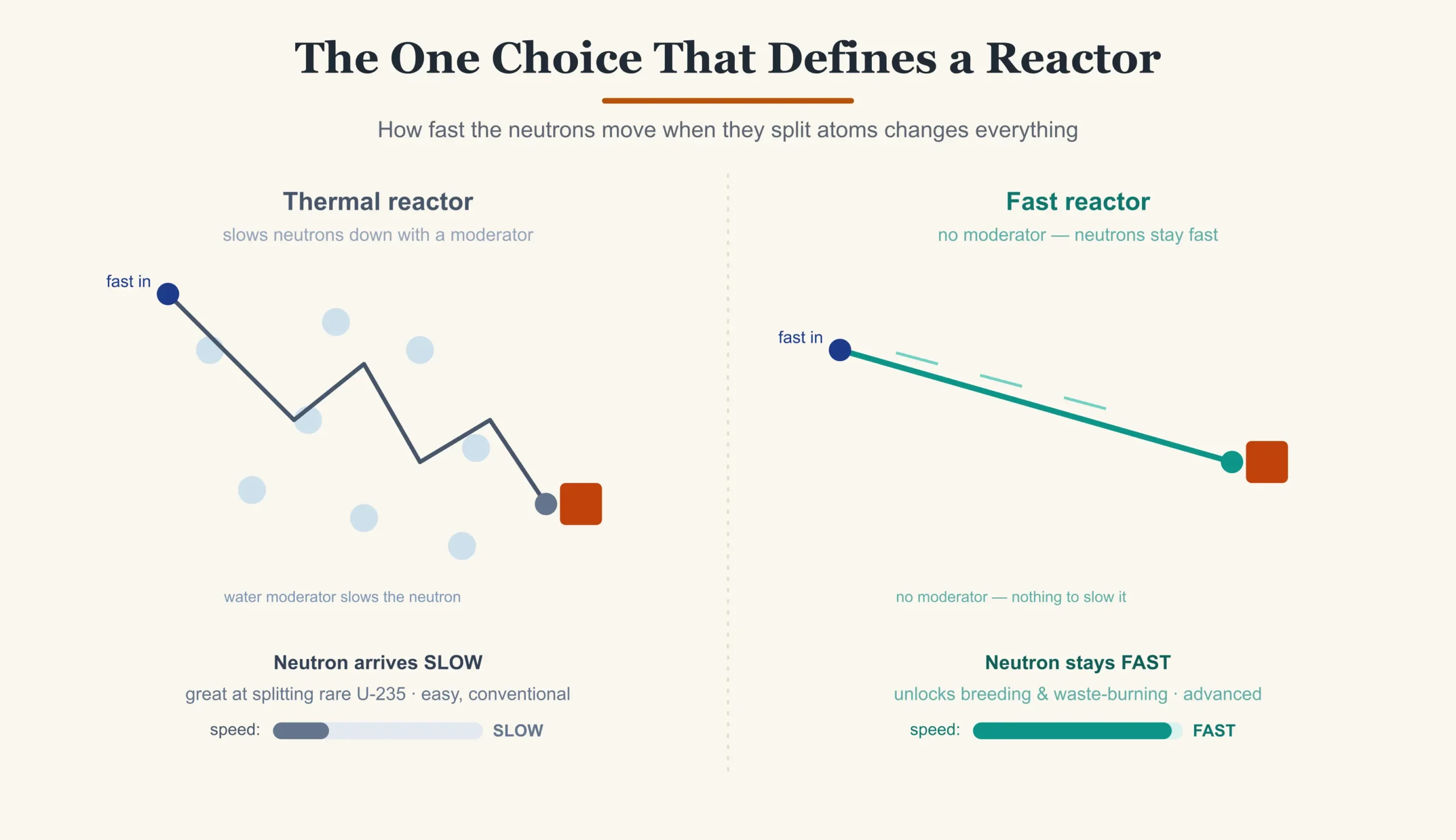
Every nuclear reactor runs on a chain reaction: a neutron splits an atom, which releases more neutrons, which split more atoms. The single most important thing about any reactor the thing that quietly determines almost everything else is how fast those neutrons are moving when they do their work. This is called the neutron spectrum, and reactors come in two flavors.
Most reactors on Earth are thermal reactors. They deliberately slow their neutrons down using a material called a moderator usually ordinary water. Why slow them? Because slow neutrons are very good at splitting uranium-235, the rare, easily-split isotope that makes up just 0.7% of natural uranium.
Slowing the neutrons is the path of least resistance: it makes a reactor easy to start and easy to run on lightly enriched fuel. The vast majority of the world’s power reactors work this way.
A fast reactor makes the opposite choice. It uses no moderator at all, letting its neutrons fly at their original, blistering speed hence “fast.” And “fast” is not a figure of speech: a neutron born in fission carries around 2 MeV and travels at roughly 20,000 kilometres per second, while a thermalised neutron in an ordinary reactor has been slowed to about 2 km/s and a mere 0.025 eV.
Same particle, nearly ten thousand times the speed. At first glance this seems harder, and it is: fast neutrons are less efficient at splitting that easy U-235, so a fast reactor needs more concentrated fuel to sustain itself, today for commercial designs like Natrium, that means HALEU, which costs far more to enrich than ordinary reactor fuel. So why on earth would you build one? Because what you lose in convenience, you gain in something far more powerful — and that power is the entire reason this 70-year story exists.
Why Bother Going Fast? The Two Superpowers
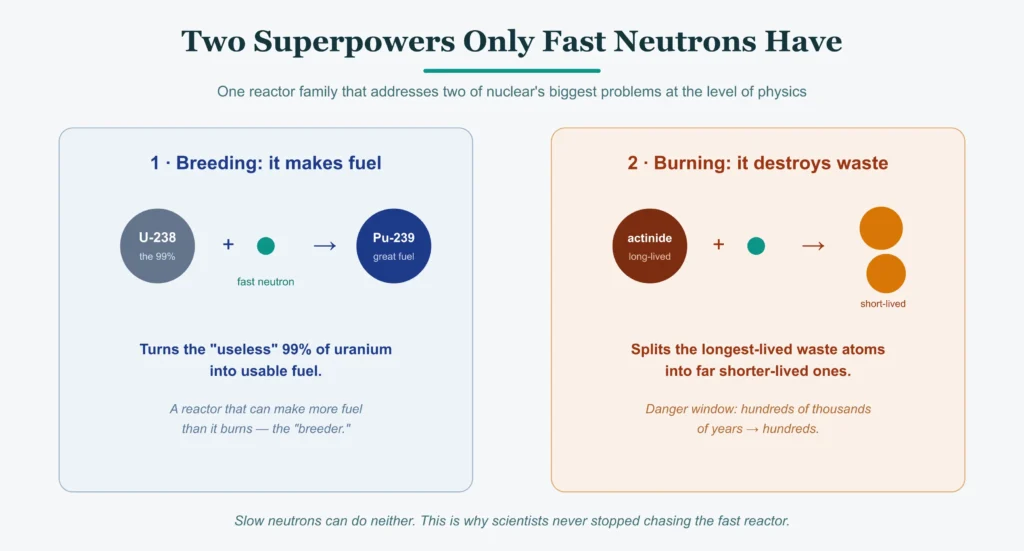
The short answer: Fast neutrons can breed new fuel from uranium-238, the 99% of uranium thermal reactors waste and they can split the long-lived actinides that make nuclear waste a problem for hundreds of thousands of years.
Here’s the payoff, and it’s the reason scientists fell in love with fast reactors before most of us were born. Fast, high-energy neutrons can do two things slow ones simply cannot and either one alone would be remarkable.
The first superpower is breeding. Remember that 99% of natural uranium is the “useless” kind, uranium-238, that thermal reactors mostly can’t burn? Fast neutrons are excellent at striking uranium-238 and transforming it into plutonium, a superb reactor fuel.
A fast reactor can be designed to create more fuel than it consumes, breeding fresh plutonium from material we currently throw away. This is the legendary “breeder reactor.” Think about what that means: a machine that makes its own fuel, unlocking the 99% of uranium the rest of the industry leaves on the table.
In the 1950s, when everyone feared the world would soon run out of minable uranium, this looked like nothing less than the key to limitless energy.
The second superpower is burning waste. The most troublesome ingredients in nuclear waste are heavy elements called actinides, with half-lives ranging from thousands to millions of years.
Slow neutrons tend to bounce off these stubborn atoms; fast neutrons can split them apart. That means a fast reactor can act as a kind of incinerator for the longest-lived nuclear waste, fissioning those near-immortal atoms into products that decay in centuries rather than geologic ages. One reactor family, two of the biggest problems in all of nuclear energy, fuel supply and long-lived waste addressed at the level of physics. Now you understand why they couldn’t let the idea go.
Why Are Almost All Fast Reactors Cooled by Liquid Sodium?
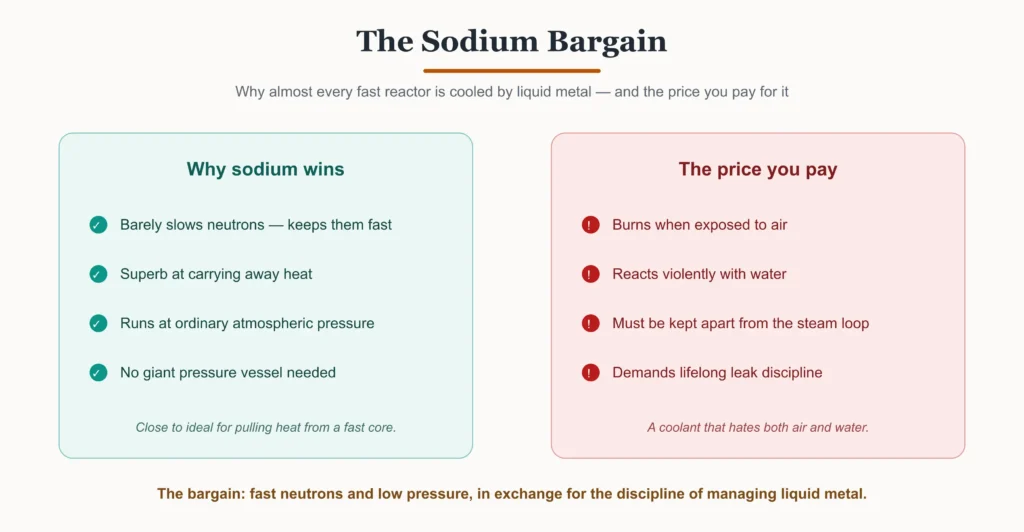
The short answer: Water can’t be used, because water slows neutrons down. Liquid sodium carries heat superbly, runs at atmospheric pressure (no pressure vessel required as in PWRs), and barely slows neutrons but it burns in air and reacts violently with water, so it must be kept apart from the steam loop for the life of the plant.
Now we hit a genuine engineering puzzle, and it’s where the fast reactor’s biggest trade-off lives. If you can’t use water to cool a fast reactor, what do you use? Water is the obvious coolant, it’s cheap, safe, and everywhere. But water is also a moderator: it slows neutrons down.
Pump water through a fast reactor and you’d kill the very speed that gives it its powers. You need a coolant that can carry away enormous heat without slowing the neutrons. And the champion, for seventy years, has been a surprising one: liquid metal. Specifically, molten sodium.
Sodium is, in many ways, a beautiful coolant. It’s a superb conductor of heat, it stays liquid across a huge temperature range, and critically, it barely slows neutrons at all, letting them stay fast. It also runs at ordinary atmospheric pressure, with none of the immense pressure a water reactor must contain, which removes a whole category of accident. For carrying heat out of a fast core, sodium is close to ideal.
But sodium has a personality, and I won’t sugarcoat it, because the honest trade-off is the whole point. Sodium burns when exposed to air, and reacts violently with water. A leak is a serious fire risk, and since a sodium reactor must eventually transfer its heat to water to make steam, engineers must keep the sodium and the water rigorously apart, forever.
This is the central bargain of the sodium-cooled fast reactor: you get a coolant that lets neutrons stay fast and runs at low pressure, in exchange for the lifelong discipline of managing a substance that hates both air and water.
Sodium changes how you steer the reactor, too. In a PWR you can dissolve a neutron poison boric acid, boron in solution straight into the coolant water as a “chemical shim,” trimming reactivity slowly as the fuel burns.
There is no equivalent in a sodium reactor: you cannot dissolve boric acid in liquid metal, and in a fast spectrum a dilute poison would be far less effective anyway. So a fast reactor leans almost entirely on its control rods where boron reappears in solid form, as boron carbide, often enriched in boron-10 to make up for the weaker absorption at high neutron energies. Sixty years of engineering have gone into winning that bargain and, mostly, we have.
Worth noting: the poison a fast reactor avoids dissolving is the deliberate kind. Every reactor, fast or thermal, also makes its own poison that no one adds on purpose, see xenon-135 poisoning.
Are Fast Reactors Safe? What Happened in Idaho in 1986
The short answer: In April 1986, engineers at EBR-II shut off the reactor’s cooling pumps at full power, disabled the automatic shutdown systems, and walked away. Physics alone shut the reactor down safely. Fast reactors demonstrated “walk-away safety” decades before the industry made it the goal.
The fast reactor never died, it just went quiet, kept alive by a handful of nations and one unforgettable afternoon in Idaho.
In April 1986, engineers at the EBR-II reactor ran a test that should be far more famous than it is. With the reactor running at full power, they deliberately shut off its cooling pumps, recreating the kind of loss-of-cooling failure that would later devastate Fukushima and then they stepped back and did nothing. No operator action. No emergency shutdown systems. They simply let the reactor face its worst nightmare alone.
And the reactor saved itself. As the fuel heated, its own physics reduced the reaction (the same negative reactivity feedback you can see stabilise a reactor in the Point Kinetics Simulator); the natural circulation of the sodium quietly carried the heat away; and the reactor powered down on its own, with temperatures never reaching dangerous levels anywhere in the system. Argonne National Laboratory ran the test twice, on 3 April 1986, to prove it wasn’t a fluke.
Read the date again. Weeks later, Chernobyl exploded. A fast reactor, decades ago, demonstrated the “walk-away safety” that the entire industry now treats as the holy grail, the same principle behind every modern passive-safety claim you’ll read about today.
If They’re So Good, Why Don’t We Have Them Everywhere?
The short answer: The fast reactor wasn’t beaten on technology. It was built for a uranium shortage that never arrived and once uranium turned out to be cheap and abundant, the simpler thermal water reactor won the market by default.
This is the heartbreak at the center of the fast-reactor story, and it has almost nothing to do with the technology working. It works.
The entire dream was built on one assumption: that the world would soon run out of cheap uranium, making the breeder’s fuel-making magic essential. That shortage never came. Prospectors kept finding uranium, lots of it, cheaply. And once uranium was abundant, the simpler, cheaper thermal water reactor, easier to build, easier to fuel, won the market almost by default.
The fast reactor wasn’t beaten because it was worse. It was sidelined because the problem it brilliantly solved turned out, for a few decades, not to be a problem. The most advanced reactor lost to the most convenient one.
Why Fast Reactors Are Suddenly Back
The short answer:
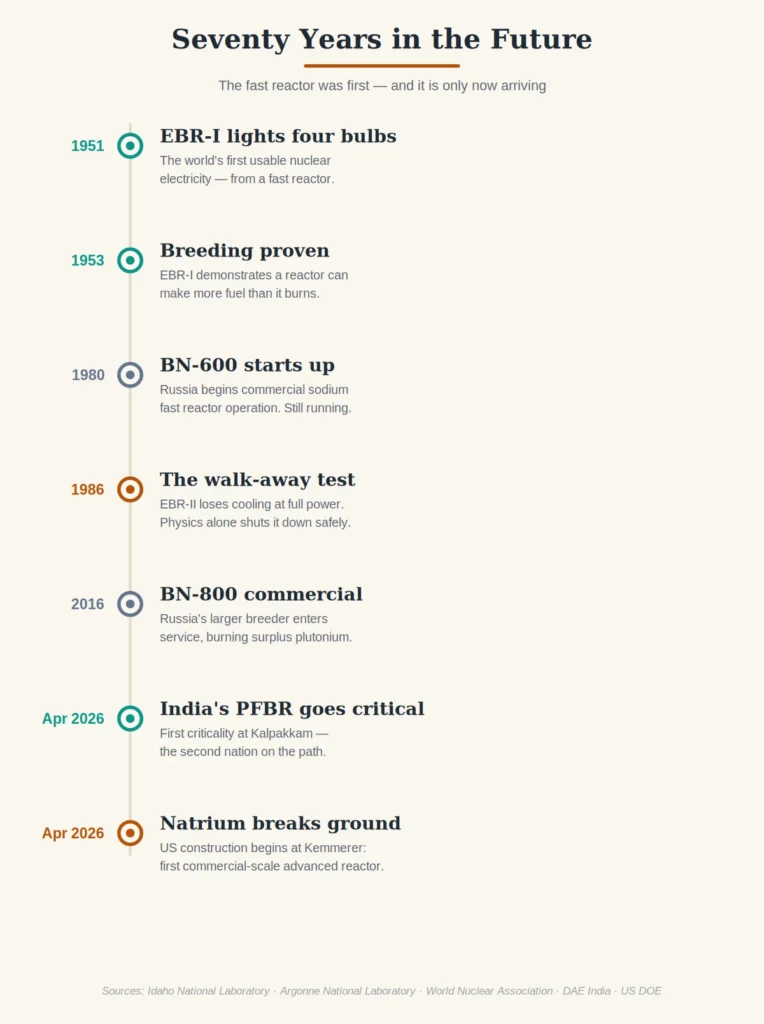
Three things changed spent nuclear fuel piled up with nowhere to go, energy security became urgent, and the AI boom created enormous demand for firm, carbon-free power. In 2026 the comeback stopped being theoretical: America’s first commercial-scale advanced reactor began construction, and India started up a fast breeder.
So why, after seventy years in the wings, is the fast reactor finally walking onto center stage? Because the world changed in exactly the ways that turn its old weaknesses into strengths. The very features that once seemed unnecessary are now precisely what everyone wants.
Three forces are pulling it back. Waste: decades of spent fuel are piling up with nowhere to go, and the fast reactor’s ability to burn actinides is newly precious. Energy security: breeding fuel from abundant depleted uranium means independence from fragile global supply chains. And the AI boom: the desperate hunt for vast, reliable, carbon-free power has sent the tech industry looking for exactly the kind of dense, firm generation a fast reactor provides. The fast reactor didn’t change. The world finally caught up to it.
And in 2026 that stopped being a prediction. In March, the U.S. Nuclear Regulatory Commission issued a construction permit for TerraPower’s Natrium plant at Kemmerer, Wyoming, the first ever granted to a commercial-scale advanced reactor, and the first for any non-light-water commercial reactor in more than forty years. Construction officially began in April.
Natrium backed by Bill Gates is, at its heart, a 345 MWe sodium-cooled fast reactor, the direct descendant of those Idaho machines, paired with molten-salt heat storage that lets it surge to 500 MW on demand.
And the AI connection is no longer a metaphor: in January 2026, Meta signed an agreement with TerraPower for as many as eight Natrium plants. The reactor that lit four bulbs in 1951 is being asked to power data centers.
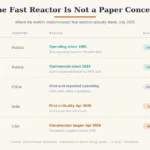
The Global Fast Reactor Scorecard (July 2026)
| Reactor | Country | Status |
| BN-600 | Russia | Operating since 1980; among the best operating records in Russia’s fleet |
| BN-800 | Russia | Commercial operation since 2016; burns surplus plutonium as MOX fuel |
| CFR-600 | China | First unit reported operating since around 2023; a second unit follows. China publishes little detail |
| PFBR | India | First criticality 6 April 2026; grid connection and commercial operation still ahead |
| Natrium (Kemmerer 1) | USA | Construction began April 2026; completion targeted around 2030 |
Read that table again. The fast reactor is not a paper concept. Russia has run them commercially for over forty years. India, in April 2026, became the second country on the path to a commercial-scale breeder. And America has finally started pouring concrete.
The Future That Was Always There
There’s a poetry to the fast reactor that I find genuinely moving as a reactor engineer. It was the first reactor to make electricity, and it may be among the most important to make our future. For seventy years it was too advanced for its time, a solution patiently waiting for the world to develop the right problems. Now those problems have arrived, all at once, and the oldest idea in nuclear power is suddenly the newest.
The next time you read about a Bill Gates reactor, or a tech company buying nuclear power for its data centers, you’ll know the real story underneath the headline: it traces straight back to four light bulbs glowing in the Idaho desert, and a choice about how fast to let a neutron fly.
Frequently Asked Questions
What is a fast reactor?
A fast reactor is a nuclear reactor that operates without a moderator, so its neutrons stay at high (“fast”) speed rather than being slowed down. Those fast neutrons allow it to breed new fuel from uranium-238 and to fission long-lived actinides in nuclear waste — two things conventional thermal reactors cannot do well.
What is the difference between a fast reactor and a thermal reactor?
A thermal reactor uses a moderator — usually water — to slow neutrons down, because slow neutrons split uranium-235 efficiently. A fast reactor uses no moderator, keeping neutrons fast. The trade-off: thermal reactors are simpler and run on lightly enriched fuel; fast reactors need more concentrated fuel but unlock breeding and waste-burning.
Why are fast reactors cooled by sodium instead of water?
Because water is a moderator: it would slow the neutrons and destroy the fast spectrum. Liquid sodium transfers heat superbly, stays liquid over a wide temperature range, barely slows neutrons, and operates at atmospheric pressure. Its drawback is that it burns in air and reacts violently with water, so it must be kept isolated from the steam loop.
Are fast reactors safe?
Fast reactors have demonstrated inherent, or “walk-away,” safety. In April 1986, engineers at EBR-II in Idaho cut the coolant pumps at full power with the automatic shutdown systems disabled, and the reactor shut itself down safely on physics alone. The main engineering risk is sodium fire, which is managed by keeping sodium rigorously separated from air and water.
What is a breeder reactor?
A breeder reactor is a fast reactor configured to produce more fissile fuel than it consumes, by converting fertile uranium-238 into plutonium-239 (or thorium-232 into uranium-233). India’s PFBR, which reached first criticality in April 2026, is a sodium-cooled breeder built on this principle.
Can fast reactors burn nuclear waste?
Partly, yes. Fast neutrons can fission the long-lived actinides that dominate spent fuel’s very-long-term hazard, converting them into fission products that decay over centuries rather than thousands to millions of years. This does not eliminate nuclear waste, but it can significantly reduce how long the most stubborn portion stays dangerous.
Is Natrium a fast reactor?
Yes. TerraPower’s Natrium is a 345 MWe sodium-cooled fast reactor paired with a molten-salt energy storage system. It received a U.S. NRC construction permit in March 2026 and began construction at Kemmerer, Wyoming, in April 2026.
How many fast reactors are operating in the world?
Very few. Russia operates two commercial sodium-cooled fast reactors (BN-600 and BN-800). China’s CFR-600 is reported to be operating. India’s PFBR reached first criticality in April 2026 and is working toward commercial operation. Most other fast reactors have been experimental or have been shut down.
What is the energy of a fast neutron?
A neutron born in fission carries about 2 MeV on average and travels close to 20,000 kilometres per second. By convention, neutrons above roughly 1 keV are called “fast.” In a working fast reactor the average neutron energy settles lower — a few hundred keV — because even sodium and steel steal a little energy on the way. A thermalised neutron, by contrast, has been slowed to about 0.025 eV and 2.2 km/s.
What are the disadvantages of a fast reactor?
Three, honestly. Sodium coolant burns in air and reacts violently with water, so it must be kept isolated from the steam loop for the life of the plant. Fast reactors need more concentrated fuel than thermal reactors. And they have historically been more expensive to build — which is why cheap, abundant uranium sidelined them for decades.
How does a fast neutron reactor work?
It runs a fission chain reaction without a moderator, so neutrons stay fast. Because water would slow them, a liquid metal — usually molten sodium — carries the heat away instead, at atmospheric pressure. That heat makes steam, which drives a turbine, exactly as in any other power plant.
Sources and Further Reading
- EBR-I first electricity, 20 December 1951 — Idaho National Laboratory and Argonne National Laboratory nuclear milestones.
- EBR-II inherent-safety tests, 3 April 1986 — Argonne National Laboratory.
- Fast reactor technology, BN-600 and BN-800 operating records, CFR-600 — World Nuclear Association: Fast Neutron Reactors.
- India’s PFBR first criticality, 6 April 2026 — Department of Atomic Energy, India and World Nuclear News.
- Natrium construction permit and design — U.S. Department of Energy and TerraPower.
- Neutron energies and speeds (fission neutrons ~2 MeV; thermal neutrons ~0.025 eV at 2,200 m/s) — Lamarsh, J. R., & Baratta, A. J., Introduction to Nuclear Engineering, 4th ed. (Pearson, 2017).
- Fast neutron spectrum, breeding, and waste-burning — IAEA: Fast Reactors.
- PWR soluble boron (“chemical shim”) — IAEA INIS: Enriched boric acid for PWR application.
- Boron carbide control rods in sodium fast reactors — Waltar, Todd & Tsvetkov, Fast Spectrum Reactors (Springer, 2012); see also Annals of Nuclear Energy on reactivity control system design in SFRs.
Where a project’s status is genuinely uncertain — China publishes little verifiable detail about CFR-600 — this article says so rather than overstating the case.
About the Author
Elliot Marsh is a working reactor engineer with hands-on experience in reactor physics, core management, reactivity control, and nuclear fuel-cycle planning at an operating power station. He writes about nuclear energy for readers who want the engineering reality, not the press release.
Need content like this for your company?
I write white papers, technical explainers, and thought-leadership for nuclear vendors, reactor developers, and the agencies that serve them — accurate enough for engineers, clear enough for buyers.