Commercial Grade Dedication: How an Off-the-Shelf Part Becomes a Nuclear Basic Component
The short version. Commercial grade dedication is the acceptance process that lets a plant install an ordinary industrial part in a safety application. You identify the handful of characteristics that actually matter for the safety function, verify each one by testing, inspection, survey, or performance history, and only then is the part legally a “basic component.” It is one of the most misunderstood, most underestimated steps in the nuclear supply chain — and if you sell into that chain, it is probably the wall you keep hitting.
A relay costs a few dollars from an industrial distributor. The same relay, installed in a reactor protection system, can carry a price and a lead time that make no sense to anyone who hasn’t worked inside the fence.
People assume the nuclear version is a different, better relay. Usually it isn’t. It’s the same part. What changed is the evidence stapled to it — proof that this specific relay will close its contacts when a trip signal arrives, verified on the record in a way a regulator will accept years later.
That evidence has a name and a legal process behind it. In the United States it’s called Commercial Grade Dedication, and the whole thing turns on a deceptively simple question: which properties of this part do we actually need to be sure about?
I’ve watched dedications done well, and I’ve watched them done badly enough that the part went back in the box. The difference is almost never the hardware. It’s whether the people doing the work understood what they were being asked to guarantee.
Where dedication fits — and where it doesn’t
If you’ve read our explainer on ASME NQA-1 or the piece on the nuclear supply chain bottleneck, you’ve already met dedication in passing. This is the article that takes it apart.
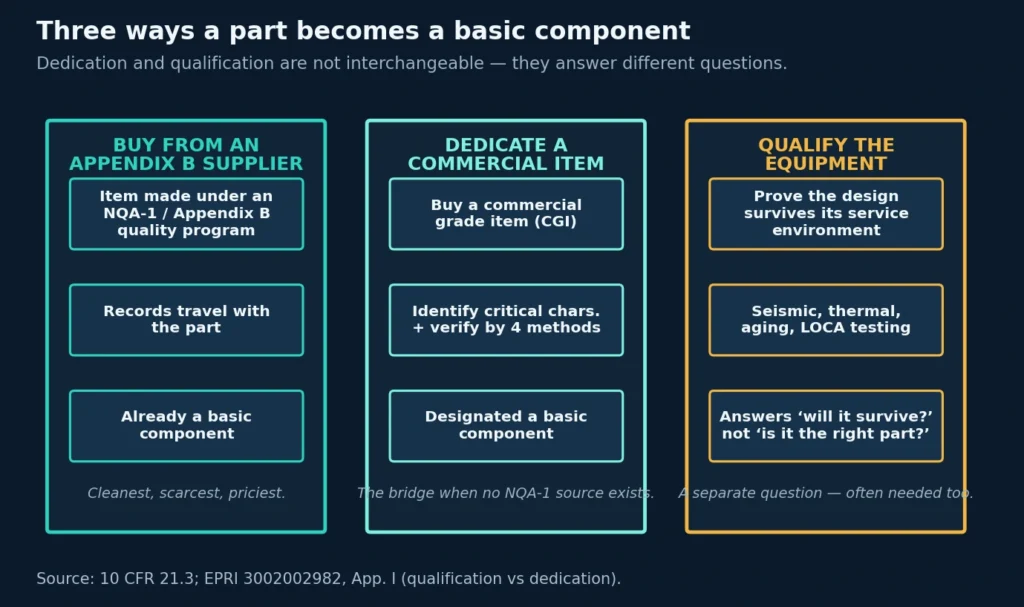
Start with the cleanest path, because it frames everything else. The simplest way to get a safety-related part is to buy it from a supplier who already runs a quality program meeting 10 CFR 50, Appendix B — usually built to the ASME NQA-1 standard.
That supplier controls the design, the materials, the special processes, the inspections, and the records, and the part shows up already carrying its pedigree. It arrives as a basic component. No dedication needed.
The problem is that this supplier base is thin, and getting thinner relative to demand. For whole classes of parts — a pressure transmitter, a circuit breaker, a valve actuator, a bearing — the manufacturer has no interest in maintaining an Appendix B program for a market that’s a rounding error next to its industrial business.
So the part you need exists, it’s well-made, it’s sitting in a warehouse. It just wasn’t built under a nuclear quality program. Dedication is the bridge across that gap — the engineered process that gives a commercial grade item the same standing as a part built under Appendix B from the start.
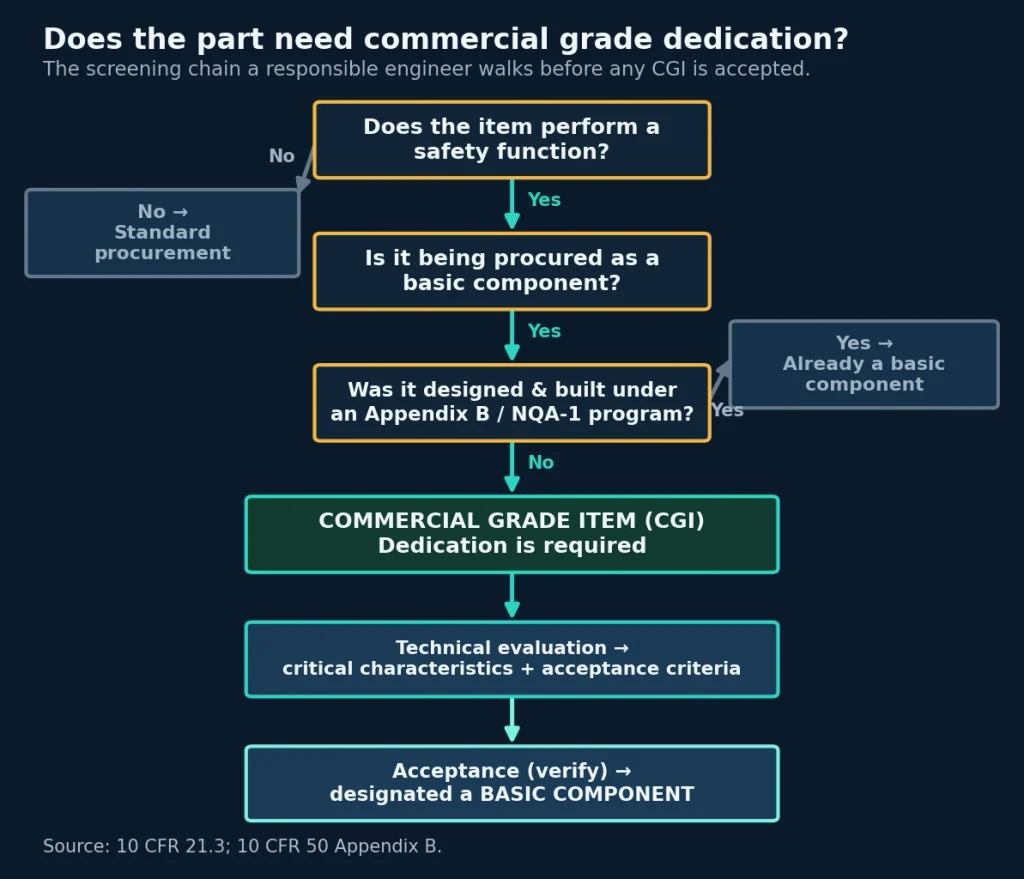
The regulator’s own words are worth reading, because they’re precise. The NRC defines dedication as “an acceptance process undertaken to provide reasonable assurance that a commercial grade item to be used as a basic component will perform its intended safety function and, in this respect, is deemed equivalent to an item designed and manufactured under a quality assurance program under appendix B.”
Three phrases in that sentence do all the work.
Reasonable assurance — not certainty, not zero risk, a defensible engineering judgment.
Intended safety function — you’re not proving the part is good at everything, only that it will do the one job safety depends on.
Deemed equivalent — after dedication, the law treats a dedicated commercial part and a purpose-built Appendix B part as the same thing. That equivalence is the entire point.
What “commercial grade item” and “basic component” actually mean
These two terms get thrown around loosely, and the sloppiness causes real procurement mistakes.
A commercial grade item, in the NRC’s definition, is a structure, system, or component that affects a safety function but “was not designed and manufactured as a basic component.” For plants outside the reactor world, it’s an item ordered from a catalog on the manufacturer’s published specifications — nothing custom, nothing nuclear-unique. The relay. The fastener. The off-the-shelf pump.
A basic component is the destination. It’s an item that affects a safety function tied to the big three: the integrity of the reactor coolant pressure boundary, the ability to shut the reactor down and keep it down, or the ability to prevent or mitigate an accident.
And here’s the line most people skip — the regulation says a basic component is either an item built under an Appendix B program, or a commercial grade item “which [has] successfully completed the dedication process.” Dedication is written into the definition itself. It’s not a workaround. It’s one of the two legitimate front doors.
There’s a subtlety in the commercial grade item definition that trips up buyers. An item stops being eligible if its design and manufacturing “require in-process inspections and verifications to ensure that defects or failures to comply are identified and corrected” — meaning one or more critical characteristics can’t be verified after the fact.
If you can’t confirm what matters by inspecting, testing, or surveying, you can’t dedicate it as an ordinary commercial item. That single clause quietly rules out a lot of parts people assume they can dedicate.
The two halves nobody separates cleanly
Dedication is two distinct activities, and confusing them is where programs start to rot.
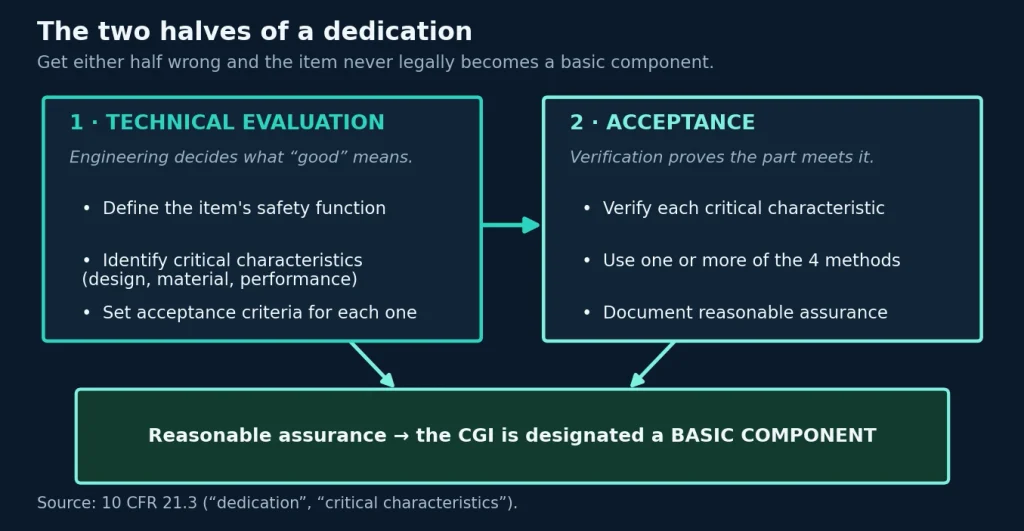
The first half is the technical evaluation. This is engineering work, and it’s the part that actually needs a nuclear brain in the room. You take the item’s safety function — what does this part have to do when it’s called on — and you work backward to the physical properties that determine whether it can.
Those properties are the critical characteristics. Then you set an acceptance criterion for each one: the specific value, range, or condition that counts as passing.
The second half is acceptance. Now you verify that this particular part, or this lot, meets the criteria you defined. That’s it. Acceptance is mechanical once the evaluation is right, and impossible to rescue when the evaluation is wrong.
I’ll say the uncomfortable part plainly, because it’s the failure mode I’ve seen most. Shops that get into trouble treat dedication as an inspection task — receive the part, check some dimensions, sign the form.
But if nobody did the hard thinking about which characteristics matter and why, the inspection is measuring the wrong things with confidence. A dedication package can be thick, neat, fully signed, and still worthless, because it verified the easy to measure properties instead of the safety-relevant ones.
Critical characteristics: the whole game is here
The NRC defines critical characteristics as “those important design, material, and performance characteristics of a commercial grade item that, once verified, will provide reasonable assurance that the item will perform its intended safety function.”
Read that as a filter, not a checklist. A part has hundreds of measurable properties. Almost none of them matter for safety. The job is to find the few that do and to be honest about which ones you’re leaving out.
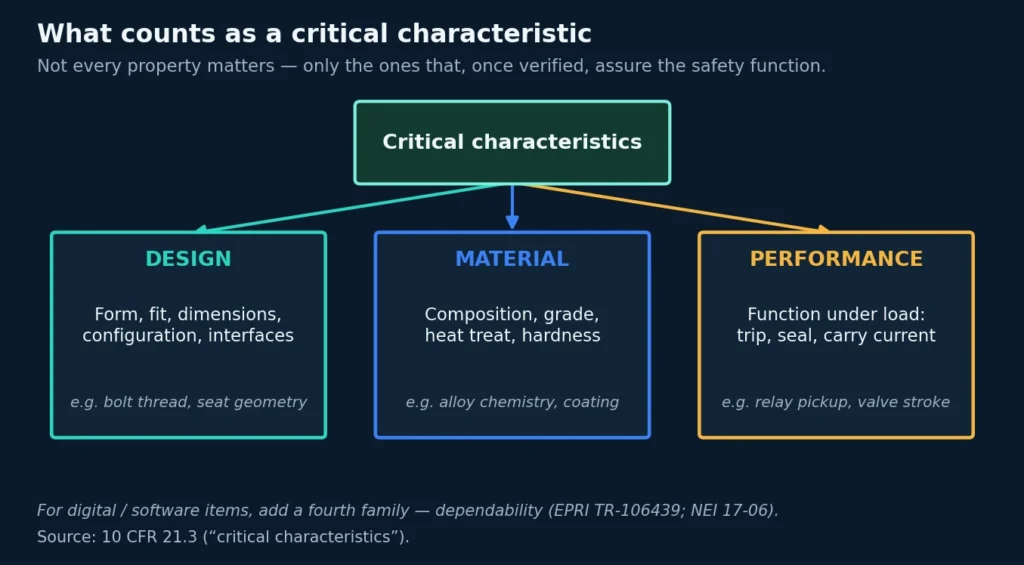
Take a check valve that has to close on reverse flow to isolate a safety system. Its critical characteristics might be the disc-to-seat geometry, the material and hardness of the sealing surfaces, the spring force, and demonstrated closure under flow.
The paint color, the catalog part number, the finish on the handwheel — none of that is critical. Verifying them proves nothing about the safety function, and time spent there is time stolen from the characteristics that count.
The Department of Energy’s dedication guidance makes a point practitioners internalize early: picking critical characteristics takes subject-matter expertise about the item, and procurement staff usually don’t have it for everything they buy.
Design engineering and procurement have to work the problem together. When a buyer picks characteristics off a template without an engineer who understands the part, you get dedications that look rigorous and aren’t.
There’s a judgment call baked in that the standards are honest about. As the industry’s own procurement engineering guidance puts it, reasonable assurance is “inherently subjective, and the judgment of reasonability may vary between different observers.”
Two competent engineers can dedicate the same part with different critical characteristics and both be defensible. That’s not a loophole — it’s an acknowledgment that engineering judgment, not a formula, sits at the center of this, which is why it can’t be automated away or handed to someone who’s never run the equipment.
The four acceptance methods
Once you know what to verify, you choose how. The regulation and its endorsed industry guidance recognize four acceptance methods, and most real dedications use a combination rather than a single one.
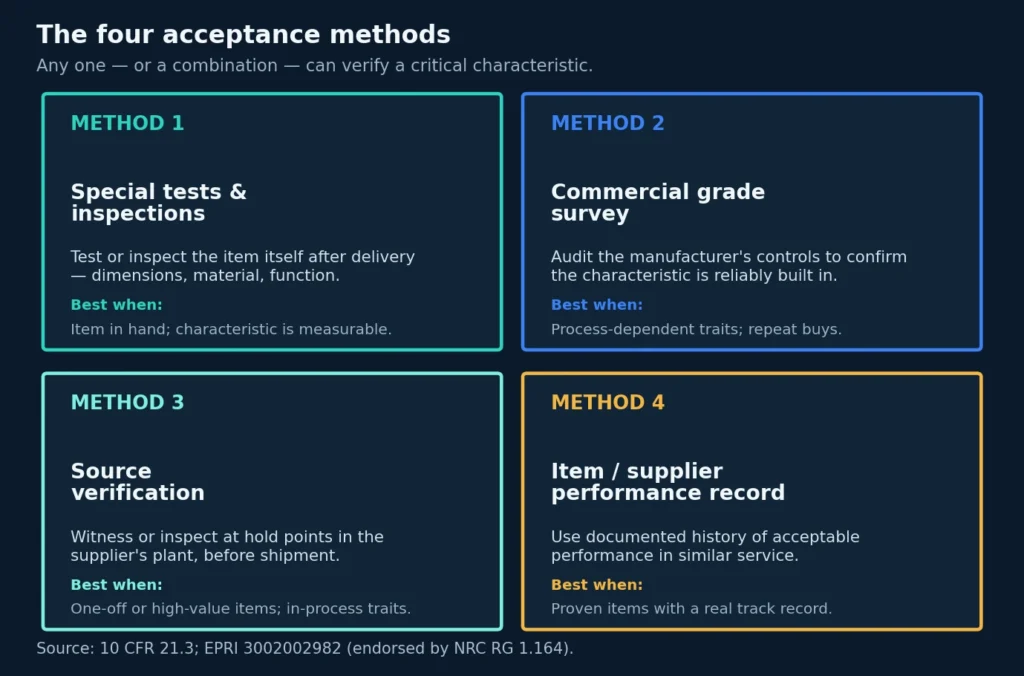
Method 1 — Special tests and inspections. You verify the characteristic on the item itself, after you have it. Measure the dimension, pull a sample for chemistry, functionally test the relay’s pickup voltage. This is the most direct method and the one people reach for first, but it only works when the characteristic is something you can actually see or measure on the finished part.
Method 2 — Commercial grade survey. Instead of testing the part, you audit the manufacturer’s process to confirm the characteristic is reliably built in every time. You go to the plant, look at how they control the thing that matters, and satisfy yourself the control is real.
This is how you handle characteristics that can’t be inspected on the finished item — a heat treatment, a cleanliness condition, a process you can’t reverse-engineer from the outside. It shines for repeat purchases, where the survey cost amortizes across many parts.
Method 3 — Source verification. You, or someone acting for you, witness or inspect at defined hold points in the supplier’s facility before the part ships. It’s the method for in-process characteristics on high-value or one-off items — you catch the critical step while it’s happening, because after the part leaves the floor you’d never be able to confirm it.
Method 4 — Item or supplier performance record. You lean on a documented history of the same item performing acceptably in similar service. This isn’t “we’ve used them for years and they’re fine” — it’s an auditable record that specifically supports the critical characteristics you care about. Real, but the hardest to defend if the record is thin.
The methods trace back to the NRC’s definition of dedication itself, which describes verification “by inspections, tests, or analyses performed by the purchaser,” supplemented by “commercial grade surveys; product inspections or witness at holdpoints at the manufacturer’s facility, and analysis of historical records.”
The detailed, workable version lives in EPRI 3002002982 — Revision 1 to the old NP-5652 and TR-102260 guidance, issued in 2014 — which the NRC formally endorses through Regulatory Guide 1.164. If you do this work for a living, that EPRI guideline is the document on your desk.
If you’re screening an actual part, our free [commercial grade dedication tool] walks the 10 CFR 21 eligibility check and points you to a defensible acceptance method for each critical characteristic — a quick way to pressure-test an approach before you build the full dedication package.
Who actually does the dedicating — and why this is a business
Here’s the part that matters if you’re trying to sell into nuclear.
The NRC is explicit about who can dedicate. The dedicating entity — the organization that performs the process and owns the responsibility — can be “the manufacturer of the item, a third-party dedicating entity, or the licensee itself.” Three different business models sit inside that one sentence.
The licensee — the utility — can dedicate parts in-house, and many do, running their own procurement engineering groups. The original manufacturer can decide to dedicate its own product and sell it as a basic component. Or a third-party dedicating entity can sit in the middle: buy commercial items, dedicate them, and sell qualified basic components to the fleet.
That third lane is a genuine industry. Companies exist whose entire value is that they’ll take a commercial part, do the technical evaluation and acceptance properly, carry the 10 CFR Part 21 reporting responsibility, and hand a utility a part it can install without doing the work itself.
The responsibility that comes with being the dedicating entity is not trivial, and it’s worth understanding before anyone treats this as easy margin. Under Part 21, the dedicating entity owns the obligation to identify and evaluate deviations, report defects and failures to comply for the dedicated item, and keep auditable records of the whole dedication.
You’re not just selling a part. You’re taking on a legal duty to tell the NRC if that part turns out to have a defect that could create a substantial safety hazard. That liability is exactly why the qualified dedicating base is smaller than the demand, and why a capable shop that learns to do this well has something valuable to sell.
If you manufacture industrial equipment and you’ve been watching nuclear demand climb — the restarts, the new builds, the SMR order books — dedication is one of the more realistic ways in.
You don’t have to stand up a full Appendix B production line on day one. But you do have to understand that dedication is a discipline, not a stamp, and that the ordinary quality records your commercial business runs on were never built to carry a nuclear safety argument.
Dedication is not qualification
These two words get used interchangeably by people who should know better, and mixing them up produces both wasted money and unqualified equipment.
Dedication answers: is this the right part, and does it meet the characteristics that matter? Qualification answers a different question: will this design survive the environment it has to work in? Qualification is the seismic testing, the thermal aging, the loss-of-coolant-accident (LOCA) conditions — proving the equipment keeps functioning through the worst day it might see. A part can be perfectly dedicated and completely unqualified for its service environment, and vice versa.
EPRI’s guidance is blunt on this, warning in its appendix on qualification versus dedication that trying to use one process to accomplish both is a mistake, because it can leave you with inadequately qualified equipment or a pile of unnecessary acceptance requirements. They’re separate questions. You often need both. You don’t get to substitute one for the other.
The digital wrinkle
Software and digital instrumentation break the neat physical picture, and the industry has spent years working out how to dedicate them.
For a digital device, the critical characteristics include something you can’t caliper: dependability — the confidence that the embedded software and logic will behave correctly and predictably.
You can’t fully test that by exercising the finished unit, and you can’t always survey it the way you’d survey a machining process. The NRC and industry built specific guidance for this, including EPRI TR-106439 for digital equipment and, more recently, an approach that lets an accredited IEC 61508 safety-integrity-level certification support the dependability characteristic, laid out in NEI 17-06.
There’s separate guidance again for dedicating design and analysis software as basic components. If your safety-related part has a microprocessor in it, dedication gets meaningfully harder, and it’s a specialty inside a specialty.
Why this exists at all
A reactor is one of the few machines where a hidden defect in a small part can stay invisible for years and then matter enormously. A relay that won’t close, a valve that won’t seat, a transmitter reading a few percent off — under normal operation you’d never know.
The failure reveals itself on the one day the safety function is demanded, which is the one day you can’t afford it. Dedication is the industry’s answer: a structured way to be sure, in advance and on the record, that the cheap commercial part will do its safety job when everything else has already gone wrong.
The NRC didn’t invent this in a vacuum. It grew out of hard experience with counterfeit and substandard parts entering the supply chain — which is why the agency issued Generic Letter 89-02 on detecting counterfeit and fraudulently marketed products, and Generic Letter 91-05 after inspections found real weaknesses in how licensees ran their dedication programs. The current NRC guidance carries that history forward. The process is strict because the failures it guards against actually happened.
Done well, dedication is one of the more elegant ideas in nuclear procurement — a way to use the entire industrial economy as a parts supplier without lowering the bar on safety. Done badly, it’s a stack of signatures wrapped around a part nobody really checked. The regulation can’t tell the difference. Only the engineering can.
Frequently asked questions
What does CGD stand for?
CGD stands for commercial grade dedication — the acceptance process that lets a commercial grade item be used as a nuclear basic component. You identify the item’s critical characteristics, verify them, and on that basis the item is treated as equivalent to a part built under a 10 CFR 50 Appendix B quality program.
What is the difference between a commercial grade item and a basic component?
A commercial grade item is an off-the-shelf part that affects a safety function but wasn’t designed or built under a nuclear quality program. A basic component is a part that’s cleared for safety-related use — either because it was built under an Appendix B program, or because a commercial grade item successfully completed dedication. Dedication is the process that turns the first into the second.
What are the four methods of commercial grade dedication?
Special tests and inspections (verify the item directly), commercial grade survey (audit the manufacturer’s process), source verification (witness at hold points before shipment), and item or supplier performance record (rely on documented history). Most dedications combine two or more, chosen to fit each critical characteristic.
What are critical characteristics in commercial grade dedication?
They’re the specific design, material, and performance properties that, once verified, give reasonable assurance the part will perform its safety function. The skill is selecting the few properties that matter for safety and setting a clear acceptance criterion for each — not measuring everything the part happens to have.
What is the difference between commercial grade dedication and qualification?
Dedication confirms you have the right part meeting the right characteristics. Qualification proves the design survives its service environment — seismic, thermal, aging, accident conditions. They answer different questions, a part often needs both, and one can’t substitute for the other.
Who can be the dedicating entity?
The manufacturer, a third-party dedicating entity, or the licensee itself. Whoever performs the dedication owns the 10 CFR Part 21 responsibility to evaluate deviations, report defects, and keep auditable records for the dedicated item.
Which regulation requires commercial grade dedication?
The framework lives in 10 CFR Part 21 and 10 CFR 50 Appendix B. Part 21 defines dedication, commercial grade item, basic component, critical characteristics, and dedicating entity. The NRC endorses the detailed industry method — EPRI 3002002982 — through Regulatory Guide 1.164.
Sources and Further Reading
- 10 CFR 21.3 — Definitions (dedication, commercial grade item, basic component, critical characteristics, dedicating entity), NRC / eCFR
- 10 CFR 50, Appendix B — Quality Assurance Criteria for Nuclear Power Plants, NRC / eCFR
- NRC — Commercial-Grade Dedication (vendor inspection overview)
- NRC Regulatory Guide 1.164 — Dedication of Commercial-Grade Items (endorsing EPRI 3002002982)
- NRC — Guidance on Implementation of 10 CFR Part 21 Requirements (RG 1.231, NEI 14-09)
- NRC — NEI 17-06, using IEC 61508 SIL certification in digital I&C dedication
- U.S. DOE — Commercial Grade Dedication Guidance
- EFCOG — Procurement Engineering Task Team FAQ (reasonable assurance and critical characteristics in practice)
- NeutronRise — Commercial Grade Dedication Tool — screen an item under 10 CFR 21 and get an acceptance-method recommendation
- NeutronRise — NQA-1 Explained: The Quality Standard Behind Every Nuclear Component
About The Author
Elliot Marsh is a working reactor engineer with hands on experience in reactor physics, core management, reactivity control and nuclear fuel cycle planning at an operating power station. He writes about nuclear energy for readers who want the engineering reality, not the press release.
Need content like this for your company?
I write white papers, technical explainers, and thought-leadership for nuclear vendors, reactor developers, and the agencies that serve them — accurate enough for engineers, clear enough for buyers.