Nuclear Supply Chain Bottleneck: Why the Forge Isn’t the Real Constraint
Ask almost anyone in the nuclear business right now where the buildout gets stuck, and you’ll hear the same word: forgings. The giant steel pressure vessels. The single companies that can press them. The idea has hardened into conventional wisdom — the reactor isn’t the bottleneck, the forge is.
I want to push back on that, because it’s half right in a way that’s actually misleading. The nuclear supply chain bottleneck is real, and it is getting worse as data centers and utilities line up for new capacity.
But if you spend time close to how these components are actually built and accepted, the forging press is not where the line jams. The presses exist. The tonnage exists. What doesn’t exist, in anything like the quantity the industry needs, is qualified capacity — steel that has cleared the machining, welding, inspection, and quality records gauntlet that turns a raw forging into a component a regulator will accept.
That distinction matters, and it’s the whole point of this piece.
What a Large Reactor Actually Asks of a Steelworks
Start with the physical demand, because the numbers explain why so few players exist.
A large Generation III+ reactor pressure vessel isn’t cast. It’s forged, from enormous steel ingots, under presses that most heavy industry never comes close to needing. According to the World Nuclear Association’s reference on heavy manufacturing, producing the pressure vessel for one of these units calls for forging presses of roughly 140 to 150 MN — that’s 14,000 to 15,000 tonnes of press force.
Vendors prefer the largest sections as single integral forgings, because every weld you eliminate is a weld you never have to inspect for the sixty-year life of the plant. When a unit is too big for a single forging, sections get welded together instead, and each of those joints becomes a lifetime inspection point.
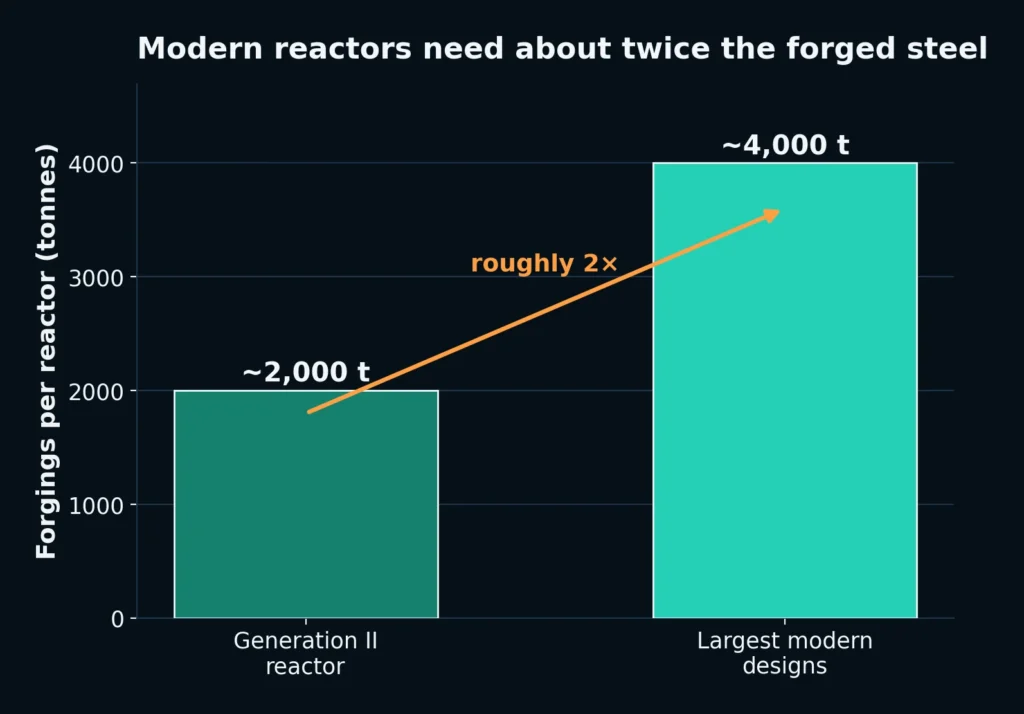
The mass has grown too. The WNA notes that a Generation II reactor might have needed around 2,000 tonnes of forgings. The largest modern designs need roughly twice that. So the industry is asking for bigger single pieces, in larger total tonnage, from a supplier base that was allowed to wither during the decades when almost nothing got built.
That’s the part everyone gets right. Heavy forging is hard, capital-intensive, and concentrated. Where the popular story goes wrong is in assuming the presses themselves are the wall.
The Forge Map Is Wider Than The Panic Suggests
Here’s the global picture of who can actually press these components, drawn from the WNA’s manufacturing data.
Japan Steel Works is the name everyone reaches for, and for good reason. Its Muroran works commissioned a 14,000-tonne hydraulic forging press able to handle ingots up to 670 tonnes, and its capacity had reached about twelve reactor pressure vessels by early 2011.
For years JSW was effectively the only place on earth that could pour and forge the very largest single ingots, which is where the “one factory holds up the nuclear revival” narrative comes from.
But look at the rest of the field:
- China First Heavy Industries runs a 15,000-tonne press alongside a 12,500-tonne one, and can handle a 715-tonne ingot — larger than JSW’s.
- Doosan in South Korea operates a 13,000-tonne press and brought a 17,000-tonne forging press online in 2010.
- OMZ Izhora in Russia has 15,000-tonne press capacity and works 600-tonne ingots.
- Le Creusot, France’s Framatome forge, runs an 11,300-tonne press and a 9,000-tonne press and can produce components up to 500 tonnes in a single piece.
- Sheffield Forgemasters in the UK has a 10,000-tonne open-die press taking 300-tonne ingots.
- Larsen & Toubro in India built a 9,000-tonne open-die press and has planned for 17,000-tonne capacity.
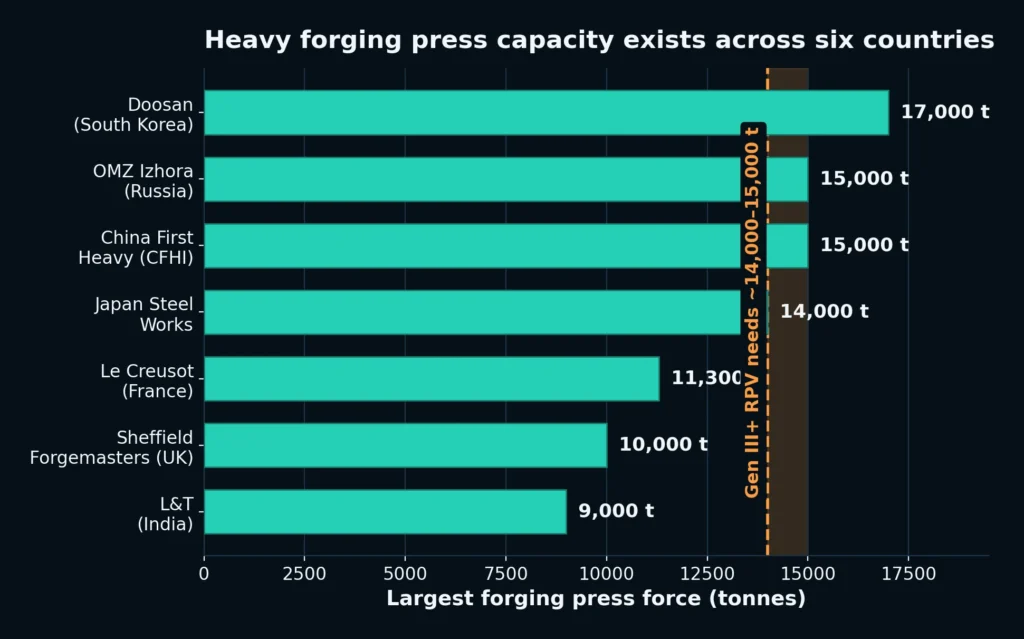
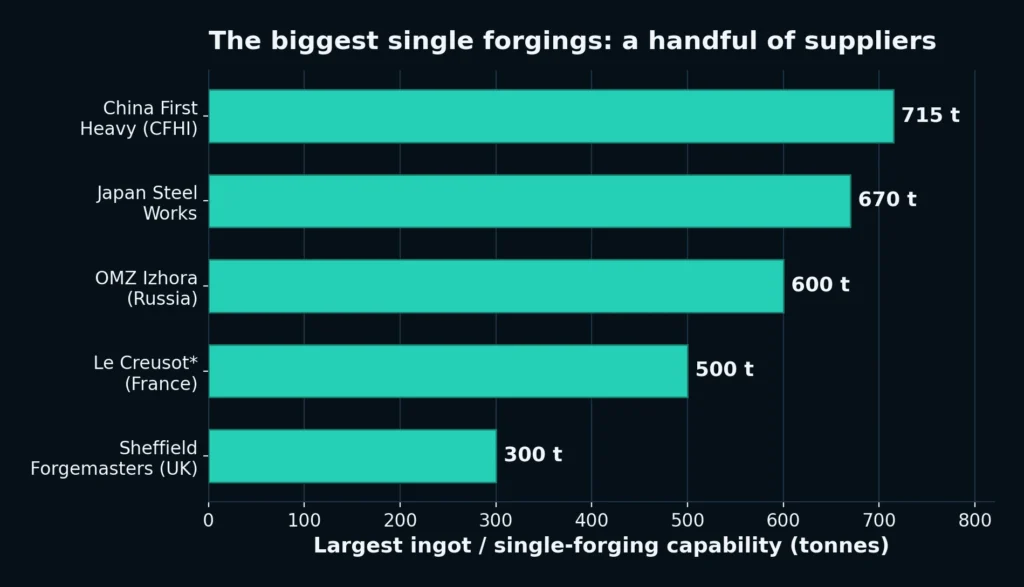
That is not a world with one forge. It’s a world with a handful of very serious ones, spread across six countries. Raw press capacity is concentrated, yes, and no Western democracy wants to depend on Russian or Chinese steel for safety-critical components.
Supply is politically awkward. But the physical ability to squeeze a 600-tonne ingot into a vessel course is not the scarce thing. Several companies can do it.
The Nuclear Scaling Initiative said as much in its March 2026 supply chain report: there is “adequate large forging capacity at select suppliers.” The report, covered by the American Nuclear Society’s Nuclear Newswire, then points at where the real constraint sits — and it isn’t the press.
Where It Actually Jams
The NSI report names the acute bottlenecks plainly: “machining, welding, finishing, inspection, and non-destructive examination (NDE).” These are the labor intensive, qualification-dependent steps that come after the forging leaves the press. And they throttle throughput far more tightly than press tonnage does.
Think about what has to happen to that forging before it becomes a certified component. It gets rough machined and heat treated. It gets welded, sometimes to other forgings, sometimes to nozzles and penetrations, by welders working to qualified procedures.
Every one of those welds gets examined — ultrasonic, radiographic, dye-penetrant — by inspectors whose own qualifications are documented and auditable. The material chemistry gets verified. And the entire chain of evidence gets recorded, because in nuclear the paperwork is not an afterthought to the part. The records are part of the deliverable.
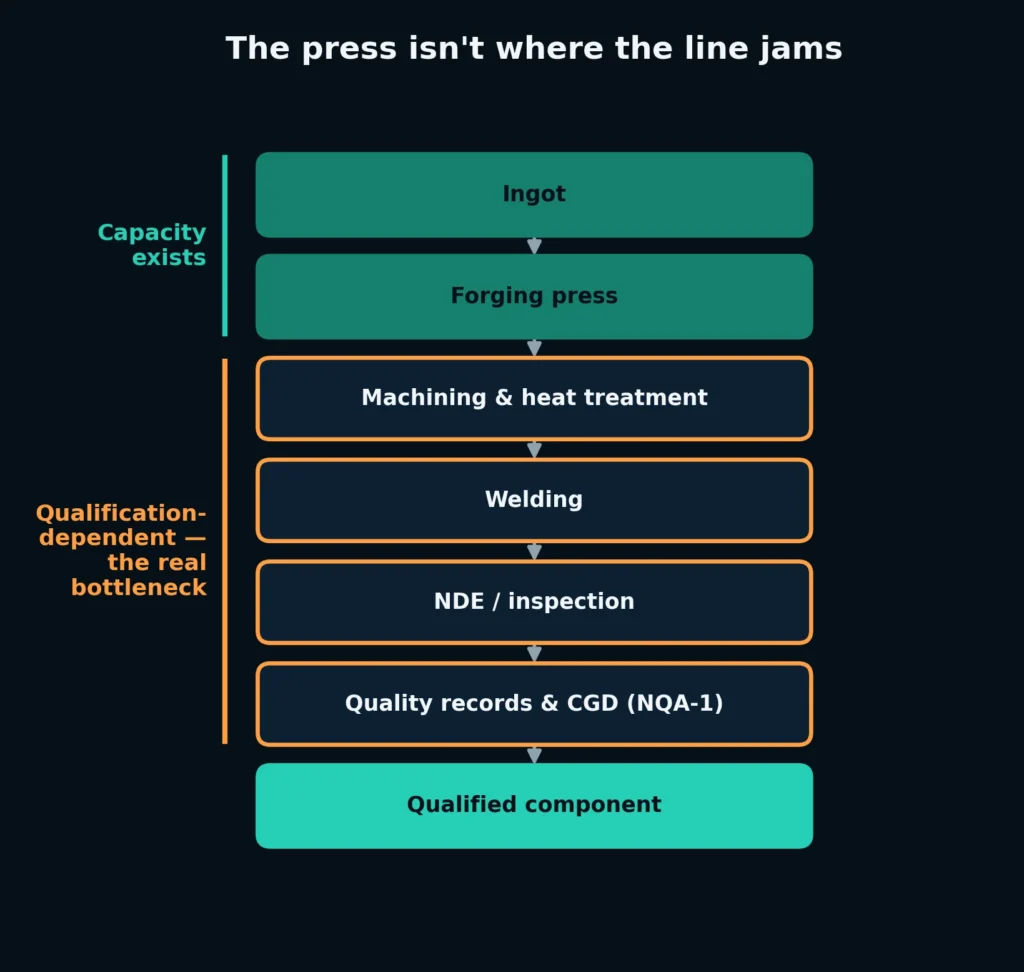
Non-destructive examination is a good example of why this throttles output. You can’t parallelize a skilled ultrasonic inspector the way you can add a second press. The examination is slow, it’s serial, it depends on a certified person reading real signals off a real part, and if something looks marginal the part waits while it’s re-examined or repaired and re-examined again.
Add welding on top — qualified procedures, qualified welders, preheat and post weld heat treatment, then inspection of every joint and you can see how a component spends far more of its life in finishing and acceptance than it ever spent under the press.
This is where NQA-1, the nuclear quality assurance standard, stops being an abstraction and becomes the actual rate limiter. A supplier can own a perfectly good press and still be unable to ship a nuclear component, because it hasn’t built and proven an NQA-1 quality program — controlled procedures, qualified personnel, calibrated equipment, traceable materials, and audit-ready records for all of it.
The NSI report is blunt about the effect: NQA-1 requirements “narrow the supplier base and slow expansion” when there’s no efficient, repeatable path to qualification.
That’s the gap. Not tonnage. Qualification.
A commercial forge that already makes big steel for the oil, gas, or defense markets can’t simply pivot into nuclear on a purchase order. It has to stand up a quality system, qualify its procedures, train and certify people, and if it’s supplying commercial grade items into a safety application — go through commercial grade dedication to bring those items into the nuclear program.
That process takes time measured in years, not weeks. And it’s exactly the part that doesn’t scale by buying a bigger press.
Commercial-grade dedication deserves a closer look, because it’s the mechanism most manufacturers underestimate. A part that was built to a normal industrial standard can’t just be certified into a nuclear safety function by paperwork alone.
The buyer has to identify the specific characteristics that matter for safety — a material property, a dimension, a heat-treatment condition and then verify each one by an accepted method, whether that’s testing, inspection, source surveillance, or an audited process history.
Every critical characteristic needs its own evidence. A shop that has never done this discovers that dedication is slow, detailed, and unforgiving of gaps, and that its ordinary quality records were never built to carry that weight.
There’s a reason experienced people in this industry treat the documentation as part of the component rather than a wrapper around it. If a weld inspection happened but the record is missing, ambiguous, or unverifiable, then for regulatory purposes the inspection effectively didn’t happen.
The part goes back into the queue. That’s not bureaucratic theater, it’s the difference between a component you can trust for sixty years and one you’re guessing about. It’s also why a missing signature can cost more schedule than a cracked forging.
France Is The Cleanest Proof That Capacity Isn’t The Same As Qualified Capacity
If you want a single case that shows why the “just build more presses” instinct misses the point, look at Le Creusot.
France has one of the most capable heavy forges in the Western world. It sits inside a country that gets around 70% of its electricity from nuclear and has an integrated industrial base most nations envy. Capacity was never France’s problem.
In April 2015, an anomaly turned up in the steel composition of the reactor vessel closure head and bottom head being made for the Flamanville EPR — a zone with higher-than-expected carbon concentration, which can reduce the steel’s toughness.
The investigation that followed didn’t just scrutinize one part. It exposed irregularities in the manufacturing records at the Le Creusot forge going back years. The French Nuclear Safety Authority, ASN, got involved, and Framatome had to comb through its own history.
The scale of that records review, reported by World Nuclear News, tells you where the real work lives. An initial survey identified about 6,000 records. Of those, 3,854 corresponded to forgings actually installed in nuclear plants.
Framatome analyzed 1,925 of them by the time it hit a completion milestone in July 2018. Forging at Le Creusot was suspended and only resumed after Framatome received approval in January 2018.
The eventual finding was reassuring on safety — none of the deviations examined called into question the serviceability of the components supplied — but the forge still lost years of production to a quality-records problem, not a metallurgical one it couldn’t physically solve.
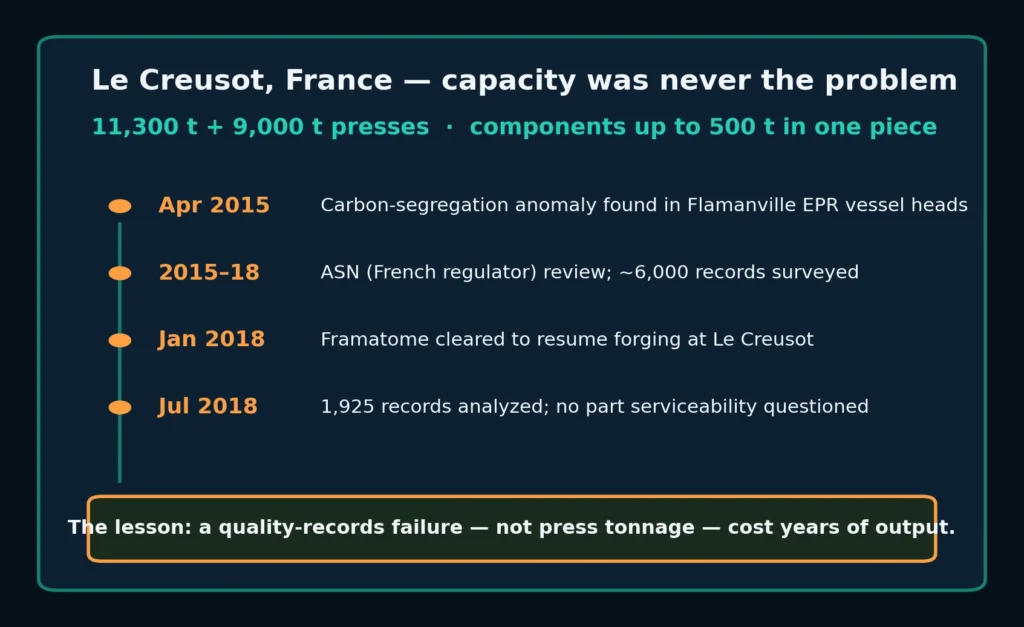
Sit with that. The country wasn’t short of press tonnage. It was tripped up by the documentation and quality-control layer, the same layer NQA-1 exists to govern. If the most established nuclear nation in Europe can lose years to a records failure at a forge that was never capacity-constrained, then the notion that presses are the binding limit doesn’t survive contact with the evidence.
The AI-demand Surge Makes The Qualification Gap Worse, Not The Press Gap
The reason any of this is urgent is demand. Hyperscale data centers are chasing firm, carbon-free power, and nuclear is suddenly back on the table — new builds, uprates, and restarts of shut reactors. Small modular reactors are being pitched directly at data center loads.
Here’s the twist most demand forecasts skip. SMRs don’t relieve the forging story the way people assume. Their vessels are smaller, so the raw press requirement eases. But you need many more of them, and a fleet of standardized small reactors multiplies the number of qualified welds, qualified inspections, and qualified suppliers the system has to produce and certify.
You’ve traded a small number of very large forgings for a large number of components that each still have to clear the same NQA-1 gate. The qualification bottleneck doesn’t shrink with reactor size. It scales with unit count.
That’s the part of the SMR economic case that tends to get waved away. Standardization helps — a repeated design lets a supplier qualify once and produce many. But somebody still has to do the qualifying first, and the pool of already qualified nuclear suppliers is thin.
The reason it’s thin is worth stating plainly, because it explains why this can’t be fixed overnight. The West spent roughly three decades building almost no new reactors. During that drought, forges retooled for other markets, quality programs lapsed, and the people who knew how to run a nuclear-grade production line retired without training replacements.
Qualification isn’t a document you file once. It’s a living program that needs continuous work to keep valid — audits, requalified procedures, current personnel certifications. Let it lapse and you’re not a dormant nuclear supplier, you’re a non-nuclear supplier who used to be one. Rebuilding that base is the actual project, and it’s measured in years of sustained orders, not a single stimulus check.
The bottleneck isn’t only steel
Forgings get the headlines, but the same qualification logic applies across the material chain, and the NSI report flags several parallel constraints worth watching.
Fuel is the obvious one. There’s no domestic commercial-scale HALEU supply chain yet — enrichment, deconversion, transport, and fabrication all need to be stood up before advanced reactors can run on the fuel they’re designed for.
Beyond fuel, the report singles out nuclear-grade graphite and enriched lithium-7 as strategic risks, because supply is concentrated in non allied foreign sources. And the workforce shortage runs straight through the same qualification wall: the scarce people aren’t just any machinists and welders, they’re nuclear-qualified machinists, welders, inspectors, and non-destructive examination specialists.
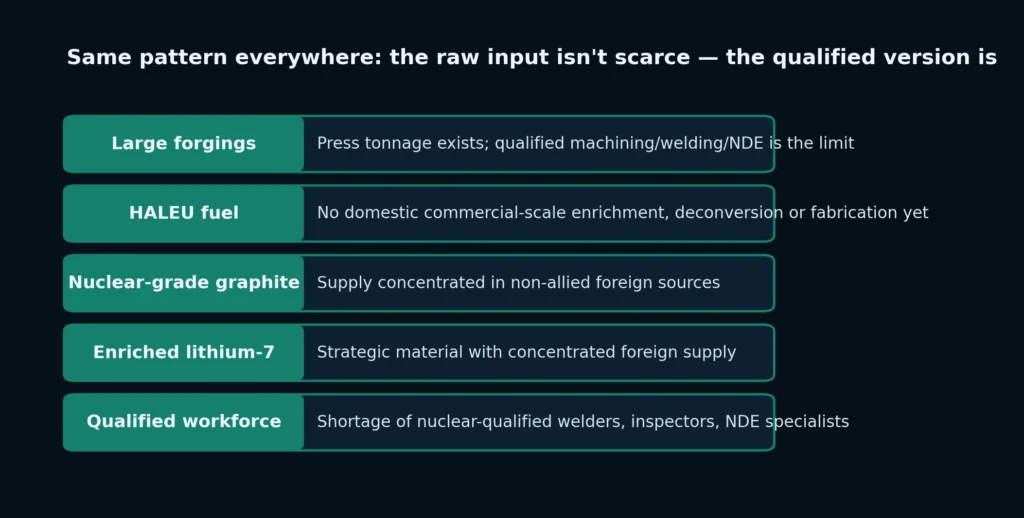
Notice the pattern. In every case, the raw commodity or the raw skill is not the hard part. The hard part is the qualified, certified, auditable version of it.
So What Actually Fixes This
If qualification is the constraint, then the fixes look different from “subsidize a new forge.” The NSI report’s recommendations point the right way, and I’d frame them like this.
Make qualification repeatable. The single most useful change is a standardized, predictable path for a capable manufacturer to become nuclear-qualified — clear requirements, a defined audit process, and reciprocity so a supplier doesn’t re-prove the same quality program from scratch for every customer.
When qualification is bespoke and unpredictable, capable shops simply stay out of the nuclear market, which is why the supplier base stays narrow.
Give suppliers a reason to invest. Standing up an NQA-1 program and dedicating a production line to nuclear is expensive, and no rational business does it on the strength of a maybe. Durable demand signals — long duration contracts, order books that survive a political cycle, risk sharing on first-of-a-kind work — are what convert a fence sitting forge or machine shop into a qualified nuclear supplier.
Standardize the designs. Every bespoke reactor design forces a fresh round of supplier qualification. A smaller number of repeated designs lets suppliers qualify once and produce at volume, which is the only way the qualified component throughput actually climbs.
None of that requires a bigger press. It requires treating the quality and qualification layer as the real product, which is what it has always been in this industry.
The short answer
The forge is a genuine chokepoint for the largest single components, and the concentration of that capability in a few countries is a real strategic vulnerability. I’m not waving that away. But if you’re trying to understand why nuclear components are slow and scarce, the press is the easy villain, not the accurate one.
The tonnage exists across at least six countries. What’s scarce is qualified capacity — the machining, welding, inspection, and quality-records machinery, governed by NQA-1, that turns steel into an accepted nuclear component.
Fix qualification, and you unlock the presses you already have. Build more presses without fixing qualification, and you’ll have expensive steel with nowhere qualified to finish it.
Frequently asked questions
Why is there a nuclear reactor forging bottleneck?
The largest reactor pressure vessels need forging presses of roughly 14,000 to 15,000 tonnes, and only a handful of facilities worldwide operate at that scale. But raw press capacity isn’t the tightest limit. The slower constraint is the qualified machining, welding, inspection, and quality-records work that turns a forging into an accepted nuclear component.
Who are the top pressure vessel manufacturers in the world?
Japan Steel Works, China First Heavy Industries, Doosan in South Korea, OMZ Izhora in Russia, Le Creusot (Framatome) in France, Sheffield Forgemasters in the UK, and Larsen & Toubro in India run the very large forging presses used for reactor pressure vessels. The biggest single ingots — around 670 to 715 tonnes — come from JSW and CFHI. For lighter SMR-class components, vendors such as BWXT also fabricate vessels.
How is a reactor pressure vessel made?
It starts as a large steel ingot, forged under a press into rings or a vessel shell, then machined, welded, heat-treated, and inspected. In nuclear, every one of those steps runs under a qualified quality program with full documentation — which is why the finishing and acceptance work, not the forging itself, sets the pace.
What is nuclear commercial grade dedication?
It’s the process of accepting a commercially made item into a nuclear safety application by identifying the characteristics that matter for safety and verifying each one through testing, inspection, or an audited process history. It’s how a non-nuclear part earns its place in a safety-related system, and it’s slow and evidence-heavy.
The full explainer is in Commercial Grade Dedication.”
What is NQA-1 and why does it slow the nuclear supply chain?
NQA-1 is the nuclear quality assurance standard that governs how safety-related components are made, inspected, and documented. It exists for good reasons, but it narrows the supplier base: a capable shop can’t ship nuclear components until it has stood up and proven a compliant quality program, which takes years. The full explainer is in NQA-1 certification and qualification.
Do small modular reactors solve the forging bottleneck?
They ease the raw forging demand, since their vessels are smaller. But a fleet of SMRs multiplies the number of qualified welds, inspections, and suppliers the system has to certify. The qualification bottleneck scales with unit count, not reactor size.
Can the United States make its own large reactor forgings?
The very largest single forgings are currently pressed abroad — in Japan, South Korea, China, and elsewhere. Rebuilding domestic heavy-forging and qualified-supplier capacity is part of what scaling US nuclear will take, and it’s a years-long effort rather than a quick fix.
Sources And Further Reading
- World Nuclear Association — Heavy Manufacturing of Power Plants
- Nuclear Scaling Initiative — Getting Ready to Scale: Addressing U.S. Nuclear Energy Supply Chain Constraints
- American Nuclear Society, Nuclear Newswire — NSI report addresses supply chain bottlenecks
- World Nuclear News — Review of Le Creusot records passes milestone
- Framatome — Le Creusot heavy components facility
- NeutronRise — NQA-1 Explained: How Nuclear Quality Assurance Works
About The Author
Elliot Marsh is a working reactor engineer with hands on experience in reactor physics, core management, reactivity control and nuclear fuel cycle planning at an operating power station. He writes about nuclear energy for readers who want the engineering reality, not the press release.
Need content like this for your company?
I write white papers, technical explainers, and thought-leadership for nuclear vendors, reactor developers, and the agencies that serve them — accurate enough for engineers, clear enough for buyers.