The Three Mile Island Restart: Part 1 —Engineering Hurdles
Can you really wake up a nuclear reactor that has sat dormant since 2019? The Three Mile Island Restart — Unit 1 now renamed the Crane Clean Energy Center — is one of the boldest engineering projects in the history of nuclear power. As a nuclear reactor engineer with years of core management experience, I can tell you it is far harder than the headlines suggest.
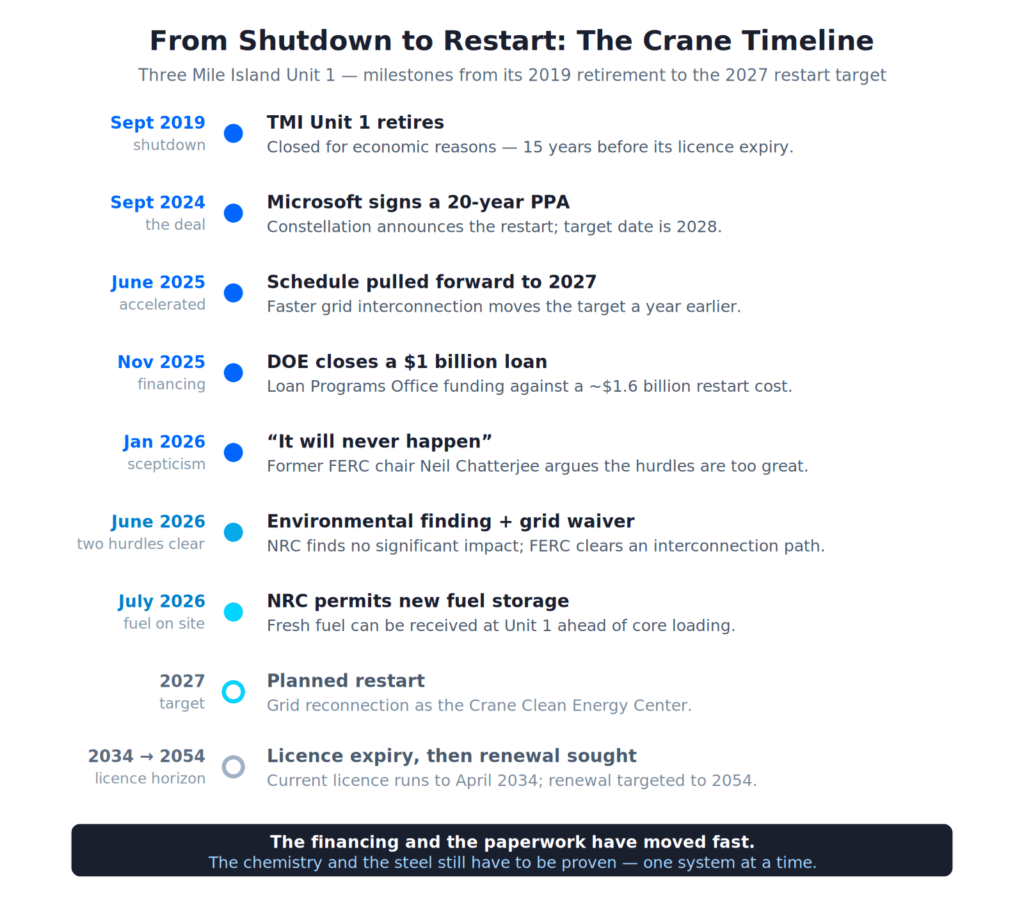
The deal behind it is historic. To feed its AI data centers around the clock, Microsoft signed a 20-year power purchase agreement with Constellation Energy covering the full output of Three Mile Island Unit 1, an 835 MW pressurized water reactor (PWR) shut down in 2019 for purely economic reasons.
Backed by that agreement and a $1 billion loan from the U.S. Department of Energy — closed in November 2025 through the DOE Loan Programs Office — Constellation is investing roughly $1.6 billion to bring the plant back to life by 2027.
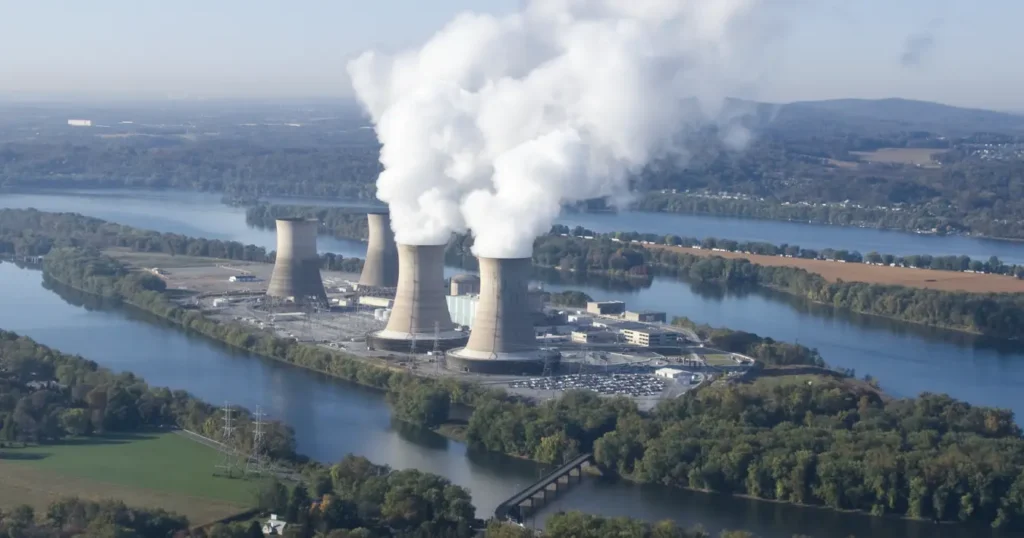
Public anxiety often spikes at the mention of Three Mile Island, but it is vital to separate history from current reality. The infamous 1979 partial meltdown occurred strictly at Unit 2, a separate reactor that is being decommissioned and will never return to service.
The current restoration project focuses entirely on Unit 1 — a reactor that generated power from 1974 until its retirement in 2019, and whose long-term operation the NRC and its operator have consistently treated as independent of the Unit 2 accident.
However, mainstream tech media remains heavily fixated on the financial and corporate side of this event. Mainstream headlines portray the restart as simply flipping an “ON” switch to instantly generate clean, carbon-free electricity.
The operational reality is far harsher. Waking up a nuclear giant that will have sat cold and dark for nearly eight years by its planned 2027 restart isn’t a simple mechanical task.
It is closer to bringing a woolly mammoth back to life — or attempting to start an automobile that has sat abandoned for close to a decade without flushing its fluids, expecting it to run smoothly at 100 miles per hour. Overcoming the massive engineering and technical hurdles of this restart requires a deep dive into the underlying plant physics.
Even seasoned energy insiders are split on whether it can be done. Neil Chatterjee, a former chairman of the Federal Energy Regulatory Commission (FERC), argued in a widely shared January 2026 opinion piece for The Hill that the restart “will never happen,” citing the regulatory, material, and logistical hurdles involved. He is right that the hurdles are real.
In the months since he wrote that, though, several of those hurdles have quietly fallen. In June 2026, the NRC issued a draft environmental assessment finding no significant environmental impact from the restart, and FERC approved the transfer of 760 MW of capacity interconnection rights from Constellation’s Eddystone plant, clearing the unit’s path back onto the PJM grid.
In July 2026, the NRC approved the amendment allowing Constellation to receive and possess new fuel and sealed neutron sources on site. None of that settles the physics — and the core licensing actions — the exemption, the operating licence and technical specifications, the security and emergency plans — are all still under NRC review.
But the pattern is telling: the obstacles that looked insurmountable from the outside have been falling one by one, on schedule. What remains is not a paperwork problem. It is a proof problem — and the proof is metallurgical.
But as a person who has managed a reactor core for a living, I believe the picture is more nuanced: some of these challenges are genuinely formidable, while others are overstated. I’ll walk through the biggest technical hurdles standing between this reactor and the grid. In this first part, we go inside the reactor itself — the chemistry and the steel. In Part 2, we turn to the people and the regulator.
Inside the Reactor: Where the Real Work Begins
In an operational nuclear power plant, the primary loop acts as a heat transfer medium operating under high temperature (~300°C) and high pressure (~15 MPa). It carries heat from fission happening in the fuel assemblies and then transfers it to the secondary loop, where the fluid is converted to steam to drive turbines and generate electricity.
These primary and secondary loops operate in a carefully balanced, highly controlled chemistry environment and thermal equilibrium. The moment a plant enters long-term decommissioning, that balance changes completely.
Restarting Three Mile Island Unit 1 isn’t about replacing broken parts; it’s about reversing years of environmental exposure across miles of intricate piping and heavy metal structures.
Hurdle#1 — The Stagnant Primary Loop: When Water Becomes a Chemical Enemy
In nuclear power reactors — specifically pressurized water reactors (PWRs) — there are two main means of reactivity, or power, control.
The first is the control rods, which provide rapid negative reactivity to meet the shutdown margin and safely scram the reactor during any transient. Think of them as the brakes on a car: the deeper you insert them into the core, the more they reduce power.
The other means of reactivity control is soluble boron in the form of boric acid (H3BO3), also known as chemical shim, dissolved in the primary coolant to provide smooth reactivity control without altering the neutron flux profile.
Now you may think: why specifically “boron,” and not any other chemical? Three properties make it ideal.
Neutron poison. Boron-10 has a huge appetite for thermal neutrons — an absorption cross-section of roughly 3,840 barns. It soaks up excess neutrons through the 10B(n,α)7Li reaction, providing bulk reactivity control.
Counterbalancing excess reactivity. A fresh core is deliberately loaded with more fissile material than criticality requires. A high boron concentration at the beginning of the cycle (BOC) holds that excess reactivity down, and operators dilute it gradually as the fuel burns up toward the end of the cycle (EOC).
That same excess reactivity is also what lets an operator override a xenon transient and restart during the pit early in a cycle, something that gets much harder near end-of-cycle. (See xenon-135 dead time for how the reactor’s self made poison drives that.
Uniform, distributed control. Unlike control rods, dissolved boron acts homogeneously throughout the entire core — it controls power without distorting the axial or radial neutron flux profile.
So the chemistry of the primary coolant is not incidental — it is an engineered system. Which brings us to the actual problem: why is stagnation the real enemy?
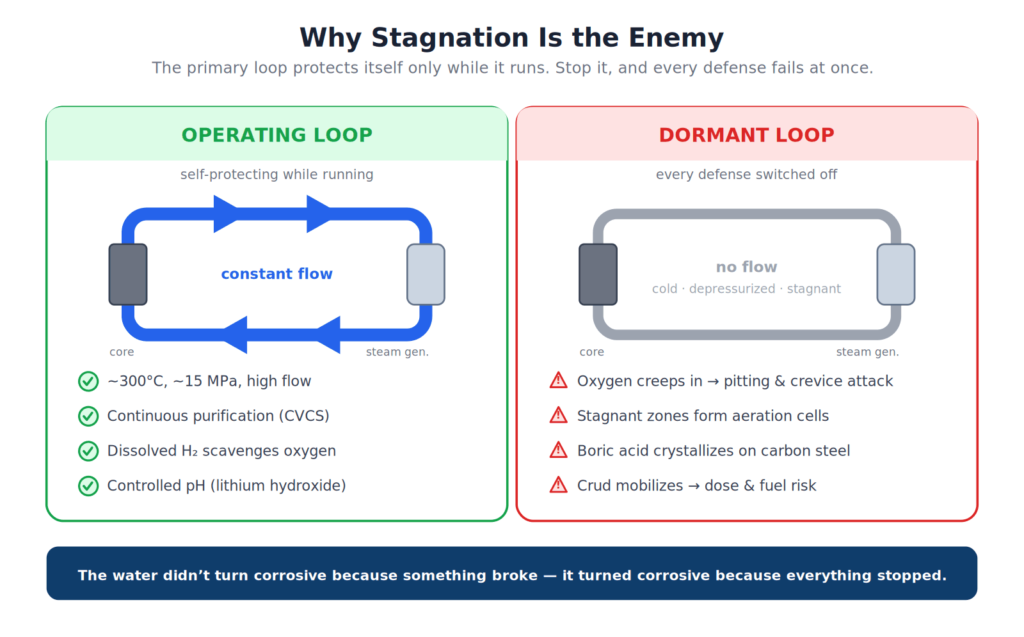
An operating primary loop is self-protecting. At ~300°C and ~15 MPa, with constant flow of hundreds of thousands of gallons per minute, continuous chemical and volume control system (CVCS) purification, controlled boron dilution, dissolved hydrogen overpressure scavenging oxygen, and lithium hydroxide holding pH at the optimised ~7.1–7.4 (at temperature) that minimises corrosion product transport — every mechanism reinforces the others. Stop all of that, and every protective mechanism disappears at once.
Oxygen Ingress
Operating chemistry keeps dissolved O2 at parts-per-billion levels. In stagnant, depressurised water at ambient temperature, oxygen creeps in through vents, seals, and maintenance openings. Oxygenated, stagnant water against stainless steel and Alloy 600/690 raises the risk of localised attack, pitting and crevice corrosion, especially where chlorides concentrate.
Stagnant Zones
With no flow, dead legs, low points, instrument lines, steam generator tube U-bends, and crevices (tube-to-tubesheet joints, weld roots, under deposits) develop their own micro-chemistry. Oxygen-rich and oxygen-depleted regions sitting millimetres apart form differential aeration cells, a classic localised corrosion driver.
Boric Acid Crystallisation and Carbon Steel Degradation
Concentrated boric acid solutions left cold and still can stratify, and where slow leakage or evaporation occurs at gaskets and seal surfaces, boric acid concentrates and crystallises. Wet boric acid concentrate is aggressive to carbon steel and low-alloy steel.
At the Davis-Besse plant in Ohio, leaking borated water silently ate a football-sized cavity through roughly six inches of carbon steel in the reactor pressure vessel head — leaving only a coin-thick layer of stainless steel cladding between the reactor coolant and the containment atmosphere. It remains the industry’s clearest lesson in what borated water does when it is allowed to sit where nobody is looking.
Crud and Corrosion Product Redistribution
Over years of power generation, a thin, highly stable oxide layer — known as crud — deposits along the internal surfaces of the loop. Stagnation, followed by the turbulent dynamics of refilling and flushing, mobilises this inventory. Upon restart, this causes two major headaches for engineers:
- Radiological dose: Cobalt-58 and Cobalt-60 trapped in the crud relocate to accessible piping, spiking radiation fields for maintenance workers.
- Fuel performance: Dislodged crud can redeposit on fresh fuel assemblies, leading to Crud-Induced Power Shifts (CIPS) or localised fuel cladding degradation.
What the Restart Team Faces
Bringing a stagnant loop back to life is essentially a massive, meticulously documented chemistry and inspection campaign. Before the loop can ever see boron for criticality again, engineers must execute a strict recovery protocol:
- System-by-system flushes: Refilling the loops with ultra-pure, demineralised, chemistry-controlled water while restoring oxygen scavenging and re-establishing the proper pH.
- Strict sampling: Rigorous laboratory analysis of the water to ensure chlorides and sulfates are well within safe thresholds.
- Eddy-current testing (ECT): Verifying the structural integrity of the steam generator tubes. Constellation inspected the steam generator tubing in Spring 2024 — the first examination since the 2019 shutdown — and reported that the degradation found had not challenged structural or leakage integrity during the plant’s final operating cycle. That establishes a baseline, not a clearance: the NRC issued a request for additional information in November 2025, and the review remains open.
- Volumetric inspections: Performing ultrasonic and visual inspections of critical welds, low points, and historic dead legs.
- Boric acid system requalification: Re-testing the storage tanks, heat-traced piping, and transfer pumps. Because boric acid is prone to crystallisation, these systems are notorious for blockages even in operating plants, making their verification vital.
The primary water didn’t become an enemy because a component failed; it became an enemy because everything stopped. Primary coolant chemistry is a dynamic equilibrium, not a stored state. Managing that transition from static vulnerability back to dynamic protection is the hidden hurdle of any reactor restart.
Hurdle #2 — Steel That Turns to Glass: Vessel Embrittlement and Pressurized Thermal Shock
To understand why this hurdle stands apart from the others, you first have to understand what the reactor pressure vessel actually is.
Almost everything else in a nuclear plant can be replaced. Pumps are rebuilt, valves are swapped, and even the massive steam generators — components the size of a house — have been replaced at plants around the world. The fuel itself is exchanged every cycle. There is a repair path for nearly every part.
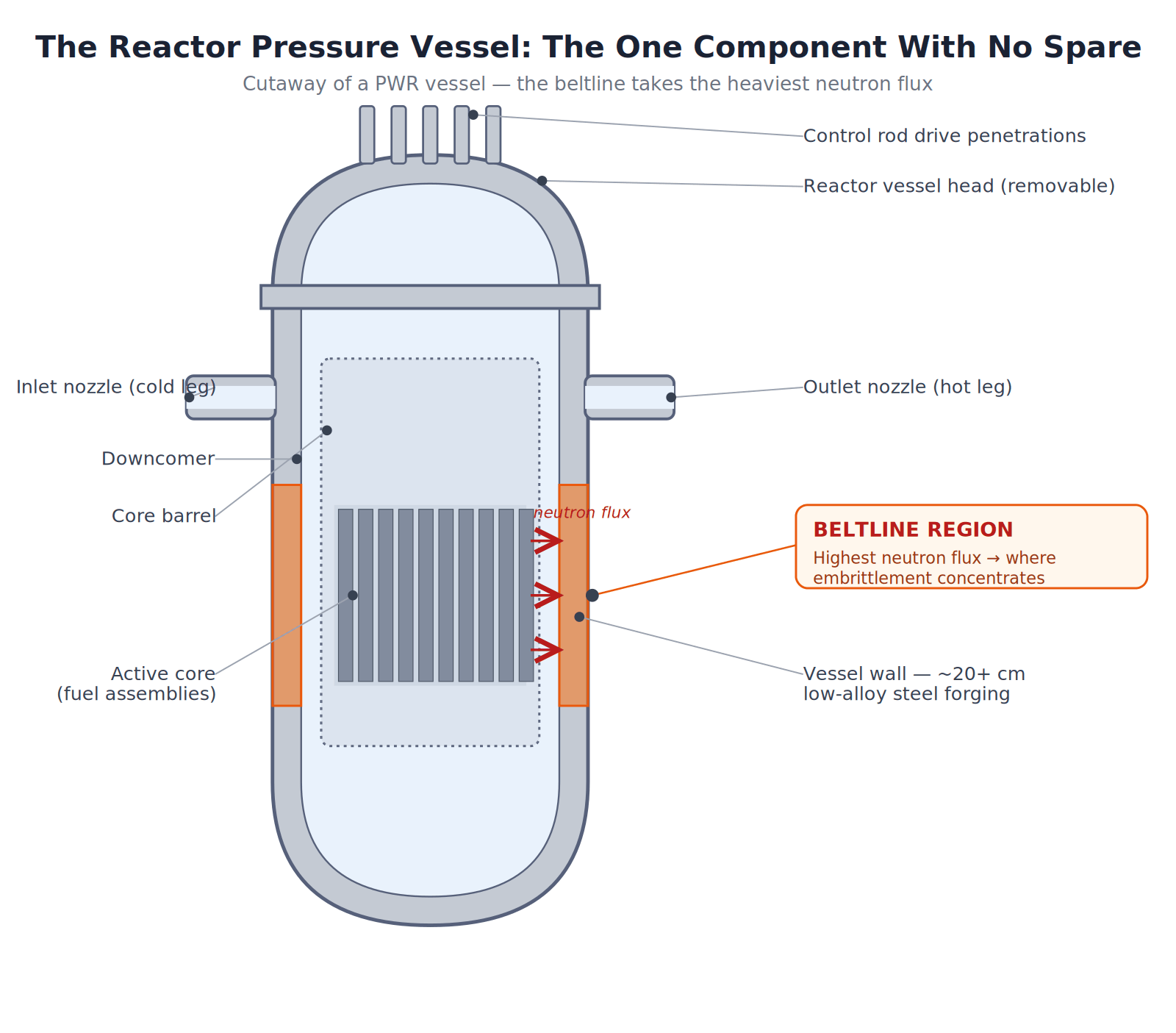
The reactor pressure vessel (RPV) is the one exception. It is a single forging of low-alloy steel, often more than 20 centimetres thick, built to contain the entire nuclear reaction and hold the primary coolant at more than 150 times atmospheric pressure. It is the steel heart of the plant, and there is no spare. You cannot order a replacement, and you cannot cut one open to fix it from the inside.
In reactor engineering and core management, we treat the reactor pressure vessel as the one truly untouchable component — the single part you never trade off against anything else, because it defines the entire operating life of the plant. Every other safety margin in the plant ultimately exists to protect it.
That single fact is what makes embrittlement the hurdle that can end a restart before it begins. Every other problem on this list has a solution — a flush, an inspection, a part replacement. If the vessel cannot be qualified, there is no fix and no fallback. The project simply stops.
There’s a natural assumption that a reactor sitting idle for years must slowly deteriorate — that the steel “ages” in the dark, growing more fragile with every passing winter. For the reactor pressure vessel, that assumption is wrong, and understanding why is the key to this entire hurdle.
Embrittlement is caused by neutron bombardment. It is damage done by the reactor running, not by the reactor sitting. No operation means no neutron flux, and no flux means no new damage. Since its shutdown in 2019, Three Mile Island Unit 1 has been sitting in exactly the embrittlement state it had on its final day of operation — not one neutron worse.
So the real challenge was never that dormancy harmed the vessel. The challenge is forward-looking. Unit 1’s renewed operating licence runs to April 2034, and Constellation has notified the NRC that it intends to pursue a subsequent renewal that would extend operation to 2054 or beyond.
To justify that, the company must prove the vessel still holds enough toughness in reserve to withstand decades of additional bombardment yet to come. The question isn’t “how much did the idle years cost us?” It’s “how much margin is left in the steel?”
So if dormancy didn’t harm the vessel, what does? The answer is the reactor’s own neutrons.
A reactor pressure vessel is forged from tough low-alloy steel — the kind of metal that bends and stretches before it ever breaks. That ductility is a safety feature. A ductile material gives warning: it deforms visibly and absorbs enormous energy before failing. This is exactly the behaviour you want from the one component you can never replace.
Embrittlement steals that toughness, one neutron at a time. During operation, fast neutrons (those above roughly 1 MeV) slam into the steel’s atomic lattice and knock atoms out of position. Over years, these displacements seed microscopic copper- and nickel-rich clusters that pin the steel’s internal structure in place, making it harder for the metal to flex. The steel grows stronger in hardness but poorer in toughness — and a material that can’t flex doesn’t bend before it breaks. It cracks suddenly, the way glass does.
Engineers track this decline through a single, telling number: the ductile-to-brittle transition temperature. It marks the point where the steel switches from tough-and-forgiving to brittle-and-dangerous. In a fresh vessel, that transition sits far below any temperature the plant will ever see, so the steel is always safely ductile in service. The problem is that the transition temperature doesn’t stay put.
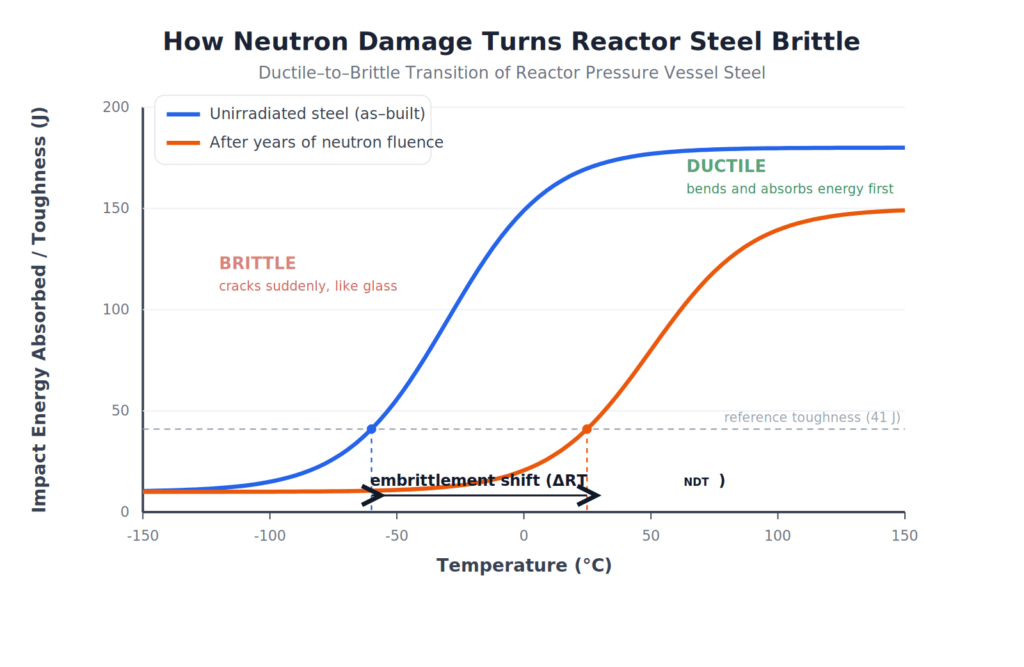
As neutron fluence accumulates over the decades, that transition temperature creeps steadily upward — the steel stays brittle up to hotter and hotter temperatures, narrowing the safe operating window.
The graph above shows it plainly: the orange curve is the same steel after years of exposure, its entire transition shifted to the right. Nothing about the vessel looks different from the outside. That invisible rightward march is the slow glassing of the steel — and it is the real, permanent legacy of a reactor’s operating life.
Here is the part that surprises people: a heavily embrittled vessel is not, by itself, a vessel in danger. As long as the steel is kept hot — above its transition temperature — it stays ductile and behaves exactly as designed. An embrittled vessel can run safely for years, because under normal operating conditions the steel is always on the tough side of that line.
The danger only appears when something forces the vessel cold and hot at the same time — a sudden thermal jolt against a wall still under pressure. That single scenario is what the entire embrittlement analysis is really built to guard against.
To see why this is the hurdle that matters for the Three Mile Island restart, we need to look at two things in turn: first, how the damage actually accumulates in the steel over a vessel’s life, and then the one accident scenario a brittle vessel genuinely fears.
How Neutron Fluence Embrittles the Core Beltline
Not all of the vessel ages equally. Embrittlement concentrates in one narrow band of steel called the beltline — the section of wall that sits level with the active core — and understanding why comes down to a single idea: dose.
The damage a vessel suffers isn’t set by how intense the bombardment is at any one moment. It’s set by the total dose absorbed over its entire life. Engineers call that accumulated dose the neutron fluence — the running total of high-energy neutrons (above roughly 1 MeV) that have passed through each square centimetre of steel. Flux is the rate; fluence is the odometer. And like an odometer, it only ever climbs.
That odometer climbs fastest directly beside the core.
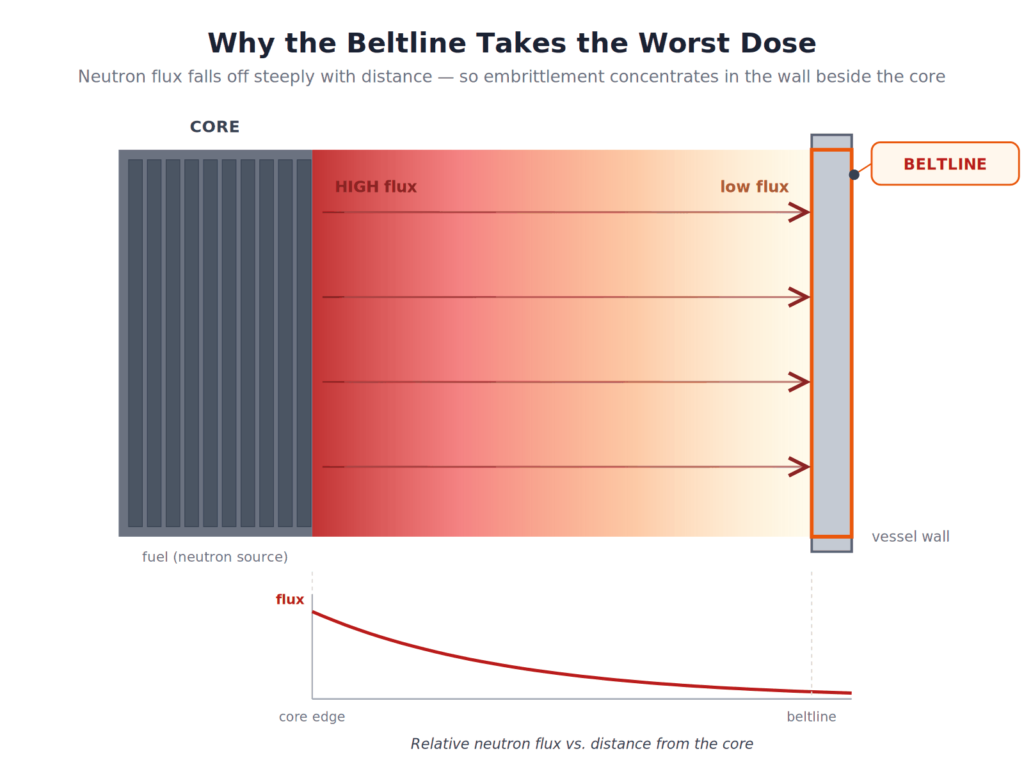
Fast neutrons stream outward from the fuel, and their numbers fall off steeply with distance and with height above or below the fuel column. The beltline wraps the vessel wall around the core’s mid-height, standing in the most intense part of that flux.
A few feet higher, up at the nozzles, the steel sees only a small fraction of the same dose. This is why the entire embrittlement question collapses to one narrow band — the rest of the vessel barely ages at all.
But fluence alone doesn’t decide a vessel’s fate. Two pieces of identical steel given the same dose can embrittle very differently, depending on their chemistry. The culprits are trace elements left over from how the steel and its welds were made — chiefly copper and nickel. Copper is the chief villain: under irradiation it forms those toughness-robbing clusters far more readily.
And here is the detail that often decides a vessel’s limit: the weakest feature is frequently not the forged plate but the weld seams running through the beltline, where the filler-metal chemistry can be worse than the plate it joins. Older vessels, fabricated before the industry fully understood copper’s role, sometimes carry higher levels in exactly those welds.
That history is not abstract at Three Mile Island. Unit 1 is a Babcock & Wilcox vessel, and B&W built their beltline seams by submerged-arc welding under a flux called Linde 80 — the material that became the industry’s textbook case of copper-driven embrittlement. The copper did not come from the flux, which is chemically neutral. It came from the weld wire itself, which was copper-plated, shedding variable amounts of copper into every bead laid down.
The numbers are public. Across the fifteen weld wire heats used in B&W vessels, copper content runs from 0.16 to 0.34 percent by weight. Unit 1’s beltline welds SA-1526 and WF-25, both drawn from heat 299L44, sit at 0.34 percent — and the plant’s own technical specifications identify that pair as the limiting weld metals. That is the highest of the fifteen. A second heat present in the vessel, WF-70, carries 0.32 percent.
This is not a hidden problem. B&W’s owners, Constellation among them, have run a dedicated working group on these welds for decades, pulling surveillance capsules and testing them precisely because everyone understood what that chemistry meant. But it does sharpen the question.
There is a further twist, and it cuts the other way. That same working group’s case to the NRC was not that these welds are dangerous — it was that the old code method had been treating them too harshly, assigning unrealistically pessimistic starting values because it leaned on Charpy data rather than direct fracture toughness testing. Measured properly, the Linde 80 welds came out tougher than the rulebook had assumed.
So the honest reading is not that Unit 1’s vessel is fragile. It is that the margin here is a statistical band rather than a fixed number. Against the regulator’s trend curve, this weld class comes out conservative overall — the guide over-predicts the toughness shift by roughly 5°C (9°F) on average.
But the scatter around that average runs close to 16°C (28°F), and Unit 1’s heat sits on the unfavourable side of it: Unit 1’s heat has two irradiated measurements on record, and they straddle the prediction: one came back 11°C below the guide’s forecast, the other 5°C above it. Both well inside the band, pulling in opposite directions.
Comfortably within the band, and evidence of nothing wrong. It is simply a reminder that projecting this vessel to 2054 means projecting through a band that wide, on the most copper-rich weld metal in the group. That is precisely why the surveillance capsules exist — and precisely why the long-horizon case deserves scrutiny rather than assumption.
This is precisely what a restart qualification scrutinises. For Three Mile Island Unit 1, the decisive numbers are the copper and nickel content of its specific beltline plates and welds, and the fluence those materials will have absorbed by the end of the intended licence period.
The accumulated dose is frozen at its 2019 value — not one neutron was added during the shutdown — so the analysis is entirely forward-looking: project the future dose onto the known material chemistry, and ask whether the toughness margin still holds.
There is also no easy undo. Short of a specialised thermal annealing process — essentially baking the vessel to coax its atomic structure partly back into order, done only a handful of times in the industry’s history — embrittlement is a one-way street. Every neutron that struck the beltline left its mark, and those marks remain exactly as they were on the reactor’s last day at power.
So the beltline arrives at the restart carrying a known, fixed inheritance of damage and a calculable projection of damage still to come. On its own, that inheritance is dangerous only under one specific condition — the cold, pressurised jolt the next section examines.
Pressurized Thermal Shock: The One Accident a Brittle Vessel Fears
Now we can name the threat the whole analysis is built around. It’s called pressurized thermal shock, or PTS — and the unsettling part is that it’s triggered by the plant’s own safety systems doing exactly what they’re designed to do.
Picture the vessel running normally: the steel wall is hot, around 290°C, and comfortably ductile. Now imagine an accident that calls for emergency cooling. Safety injection floods the vessel with cold water to keep the core covered. That’s the correct, life-saving response — but it means dumping cold water against a hot wall that is still holding full pressure.
Two stresses arrive at once. The sudden chill makes the inner surface of the wall want to contract against the still-hot steel behind it, which puts the inner surface under sharp tension. At the same time, the system pressure is pushing outward on that same wall. Cold-induced tension and pressure stress stack on top of each other, precisely at the inner surface — and precisely where the steel is most embrittled.
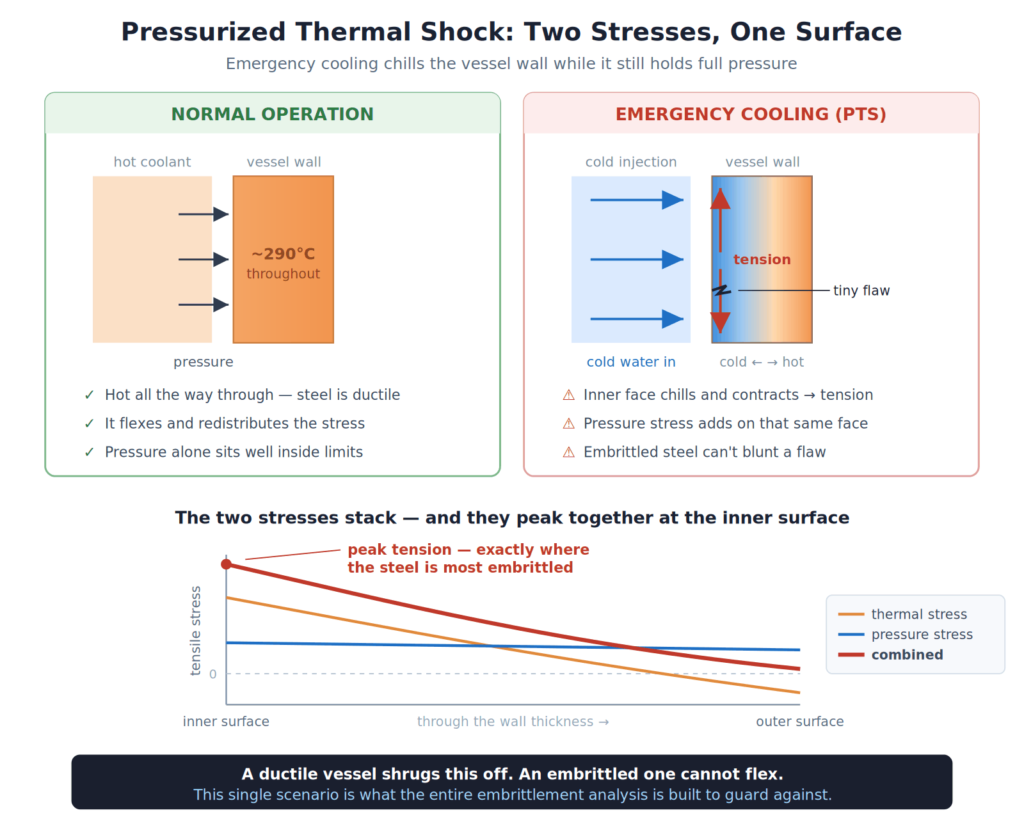
This is why cold water, normally the hero, becomes the villain. A ductile vessel shrugs off this combination; the steel flexes and redistributes the stress. An embrittled vessel can’t flex. If a small flaw exists at that inner surface — and vessels are assumed to have tiny flaws — the worry is that the brittle steel could let that flaw run rather than blunt it. For the one component with no spare, that is the failure mode that governs everything.
So the entire embrittlement question reduces to a single, answerable test: across the plant’s licensed life, does the vessel’s transition temperature stay low enough that even a worst-case cold-shock event can’t propagate a flaw? Regulators capture this as a screening limit — a reference temperature the beltline must not exceed. Stay under it, and the vessel is qualified. Cross it, and you don’t.
The elegant part is how engineers see this coming decades in advance. They don’t wait for the vessel itself to tell them — they use surveillance capsules: small coupons of the exact same beltline steel and weld metal, sealed inside the reactor but positioned closer to the core than the wall is.
Sitting in a more intense flux, the coupons absorb their dose faster than the vessel — they live in the vessel’s future. Periodically an irradiated capsule is pulled and its coupons are impact-tested, giving a real, measured transition-temperature shift that either confirms the predictions or flags a problem while there’s still ample margin. It’s a way of fast-forwarding the steel’s aging so the real wall never holds a surprise.
For the Three Mile Island restart, this is exactly the work that has to be shown. The vessel’s accumulated dose is frozen at its 2019 value, so the task is a forward projection: take the measured surveillance data and the beltline’s specific copper and nickel chemistry, project the fluence out to the end of the intended operating period, and demonstrate the reference temperature still sits safely under the screening limit — with margin to spare for the cold-shock scenario.
So how hard is this hurdle, really? Here the honest engineer’s answer cuts both ways. Unit 1 operated for the better part of five decades and was retired in sound condition, well inside its limits, and not one neutron of additional damage occurred while it sat idle.
On those facts, qualifying the vessel for a near-term restart is a demanding analysis, but not a physical cliff — this is closer to rigorous paperwork than to a vessel on the edge of failure. That’s where claims of an impossible, insurmountable barrier are overstated.
But the harder, more honest question lives further out. The economic case for this restart leans on running the plant for decades, potentially to 2054. The further you project the fluence, the closer the reference temperature creeps toward its limit, and the less margin remains for that worst-case cold shock. The real engineering scrutiny isn’t “can it restart?” — it’s “how long can it safely run before embrittlement, not economics, sets the retirement date?” That is a serious question, and it’s the right one to watch.
A Plant Frozen in Time
Step back from the details, and the two engineering hurdles of Part 1 share a single root. The stagnant loop and the embrittled vessel are not signs of a plant that broke. They are signs of a plant that was frozen.
When Unit 1 shut down in 2019, time effectively stopped inside it. The coolant chemistry, once held in constant dynamic balance, went still and began to corrode. The vessel steel, damaged over decades of operation, simply stopped — frozen at exactly the embrittlement it carried on its final day at power, not one neutron worse. Neither problem is a surprise, and neither was caused by failure. They are the quiet consequences of stillness.
That is the honest engineering verdict on this half of the story. Both hurdles are demanding, document-heavy, and unforgiving of shortcuts — but neither, on the evidence so far, is a wall.
The corrosion is inspectable and reversible. The embrittlement sits within its limits for a near-term restart, the real caution being how long the plant can safely run, not whether it can come back at all. These are the troubles of a plant that stopped — and stopping, unlike failing, can be undone.
But a reactor is far more than its steel and its coolant. It is a living system, run by highly trained people and governed by a cautious institution. And those two forces — the workforce that scattered when the plant went dark, and a regulator that has never faced a restart quite like this one — are where the next, and arguably harder, hurdles lie.
That is where Part 2 begins: the human and regulatory wall standing between Three Mile Island and the grid.
Frequently Asked Questions
Why is Three Mile Island being reopened?
Microsoft signed a 20-year power purchase agreement with Constellation Energy in September 2024 to buy the output of Unit 1 for its AI data centres. The reactor was retired in 2019 for economic reasons, not safety ones, so the plant itself was in sound condition when it closed. A $1 billion Department of Energy loan, closed in November 2025, covers most of the roughly $1.6 billion restart cost.
Can a shut-down nuclear plant actually be restarted?
Technically yes, but no fully shut-down US commercial reactor had ever been returned to service before this wave of restart projects, which is why the effort draws scepticism. The engineering obstacles are real but specific: restoring primary coolant chemistry after years of stagnation, requalifying the reactor pressure vessel against embrittlement limits, and rebuilding a licensed operating crew. None of these is a physical impossibility, but each requires extensive documented proof to the regulator.
Is the reactor that melted down in 1979 being restarted?
No. The 1979 partial meltdown happened at Three Mile Island Unit 2, a separate reactor that is being decommissioned and will never operate again. The restart concerns Unit 1, an independent reactor on the same site that generated power from 1974 until 2019.
What happens to a nuclear reactor when it sits idle for years?
The reactor stops accumulating neutron damage the moment it shuts down, so vessel embrittlement is effectively frozen at its final operating value. The coolant systems, however, get worse. Without flow, purification, oxygen scavenging and pH control, dissolved oxygen creeps in, stagnant crevices develop aggressive local chemistry, boric acid can crystallise on carbon steel, and settled corrosion products remobilise when the loops are refilled.
What is reactor pressure vessel embrittlement?
Fast neutrons above roughly 1 MeV knock atoms out of position in the vessel steel, seeding copper- and nickel-rich clusters that make the metal harder but less tough. This pushes the ductile-to-brittle transition temperature upward over the plant’s life, narrowing the window in which the steel behaves ductilely. The damage concentrates in the beltline, the band of wall level with the active core, and it cannot be reversed except by rarely used thermal annealing.
What is pressurized thermal shock?
Pressurized thermal shock, or PTS, is the accident scenario an embrittled vessel is analysed against. Emergency safety injection floods the vessel with cold water while it is still at full pressure, so thermal contraction stress and pressure stress stack up at the inner wall surface — exactly where the steel is most embrittled. Regulators require the beltline reference temperature to stay below a screening limit so that even this worst case cannot propagate a flaw.
When will Three Mile Island restart?
Constellation is targeting 2027, a year earlier than the 2028 date announced with the original Microsoft agreement. As of mid-2026 the project had cleared a draft NRC environmental finding of no significant impact, a FERC approval transferring capacity interconnection rights from another Constellation plant, and NRC authorisation to store new fuel on site. Final restart authorisation from the NRC is still outstanding.
Sources and Further Reading
- U.S. NRC — Christopher M. Crane Clean Energy Center — restart licensing and inspection status
- U.S. NRC — Three Mile Island Unit 1 renewed operating licence DPR-50 (expires April 2034)
- U.S. NRC — NRC Finds No Significant Environmental Impact from Proposed Crane Clean Energy Center Restart https://www.nrc.gov/sites/default/files/cdn/doc-collection-news/2026/26-061.pdf
- World Nuclear News — Constellation secures USD1 billion loan for reactor restart
- World Nuclear Association — https://world-nuclear.org/information-library/safety-and-security/safety-of-plants/three-mile-island-accident
- World Nuclear News — Three Mile Island restart project ahead of schedule
- U.S. NRC — https://www.nrc.gov/docs/ML2613/ML26135A004.pdf
- U.S. NRC — https://www.nrc.gov/docs/ML0227/ml022760172.pdf
- U.S. NRC — Radiation Embrittlement Of Reactor Vessel Materials https://www.nrc.gov/docs/ML0037/ML003740284.pdf
- U.S. NRC — Initial RTndt Of Linde 80 Weld Materials https://www.nrc.gov/docs/ML0222/ML022200555.pdf
- U.S. NRC — Impacts of Embrittlement on Reactor Pressure Vessel Integrity from a Risk-Informed Perspective https://www.nrc.gov/docs/ML2131/ML21314A228.pdf
- The national news — https://www.thenationalnews.com/future/technology/2026/07/13/ai-nuclear-power-three-mile-island/
- U.S. DOE — Energy Department closes loan to restart nuclear power plant in Pennsylvania
- U.S. DOE — Crane Restart — Energy Dominance Financing project page
- U.S. DOE — DOE/EIS-0574: Crane Clean Energy Center Restart Project environmental review
- American Nuclear Society — Crane restart boosted by $1B LPO loan
- E&E News / POLITICO — Three Mile Island restart closes in on NRC approval
- Utility Dive — DOE loans Constellation $1B to restart Three Mile Island nuclear unit
- Utility Dive — Constellation’s Three Mile Island restart gets boost with FERC waiver
- The Hill — Neil Chatterjee: Microsoft wants to resurrect Three Mile Island. It will never happen.
- Constellation Energy — US government backs Constellation’s plan to launch the Crane Clean Energy Center
- Reuters (syndicated) — Three Mile Island nuclear plant reboot fast-tracked to 2027
About The Author
Elliot Marsh is a working reactor engineer with hands-on experience in reactor physics, core management, reactivity control, and nuclear fuel-cycle planning at an operating power station. He writes about nuclear energy for readers who want the engineering reality, not the press release.