Boron Control Rods: What They’re Made Of, How They Work, and the Graphite-Tip Flaw That Doomed Chernobyl
At 1:23 in the morning on 26 April 1986, an operator at Chernobyl Unit 4 pressed the button that was supposed to shut the reactor down. For the first few seconds, it did the opposite. Power surged. The control rods — the one system every reactor keeps in reserve to kill the chain reaction — briefly fed it instead.
That sentence still sounds wrong to people who work with reactors, and it should. A control rod’s whole reason to exist is to stop fission, fast, when nothing else will. So how does the ultimate safety device make an accident worse?
The answer isn’t in the boron. It’s in a short piece of graphite bolted to the end of each rod, and in a design decision that looked clever on paper.
To see how that happened, it helps to know what a control rod really is — not the cartoon of a metal stick, but the actual material, the physics it runs on, and the choices that decide whether it saves a core or wrecks it. I spend my working life around reactor cores and fuel, so let me walk through it the way a reactor engineer thinks about it.
What a control rod actually does
Reactors have two different tools for holding a chain reaction steady, and people mix them up constantly. One is a slow, even dial. The other is a fast, physical brake. Control rods are the brake.
In a pressurized water reactor (PWR) the slow dial is boric acid dissolved in the primary coolant — “chemical shim.” It sits everywhere in the water at once, trims reactivity gently as the fuel burns, and doesn’t distort the shape of the power in the core.
I wrote about that side of boron’s job in a separate piece. Control rods are the opposite kind of tool: a solid slug of neutron absorbing material on a drive mechanism. Push it into the core and it soaks up neutrons right where it sits, and power drops in seconds. Pull it out and power climbs. Local, fast, and mechanical.
One thing worth being precise about: an operator never turns power up or down directly. They move reactivity (see our point reactor kinetics simulator and watch reactor’s power variation with changing reactivity).
They nudge the balance between neutrons being born and neutrons being lost and the core’s temperature feedback and its delayed neutrons decide how fast power actually follows. A control rod is how you make a big, deliberate change to that balance in a hurry.
In practice, a PWR spends most of its life with the control rods almost all the way out. The boric acid does the slow trimming as the fuel burns down, and the rods hang near the top of the core, ready.
They’re sorted into groups with different jobs: control or regulating banks that make the small, everyday adjustments — following a load change, holding temperature — and shutdown banks that stay parked out of the reactor core, doing nothing at all until the day you need every bit of negative reactivity at once. That “doing nothing, ready for everything” role is the one that matters most.
What they’re made of, and why
The whole engineering problem of a control rod comes down to one demand: find a material that swallows slow neutrons greedily and survives being cooked inside a reactor for years. Three materials have earned the job, and they made very different bargains to get there.
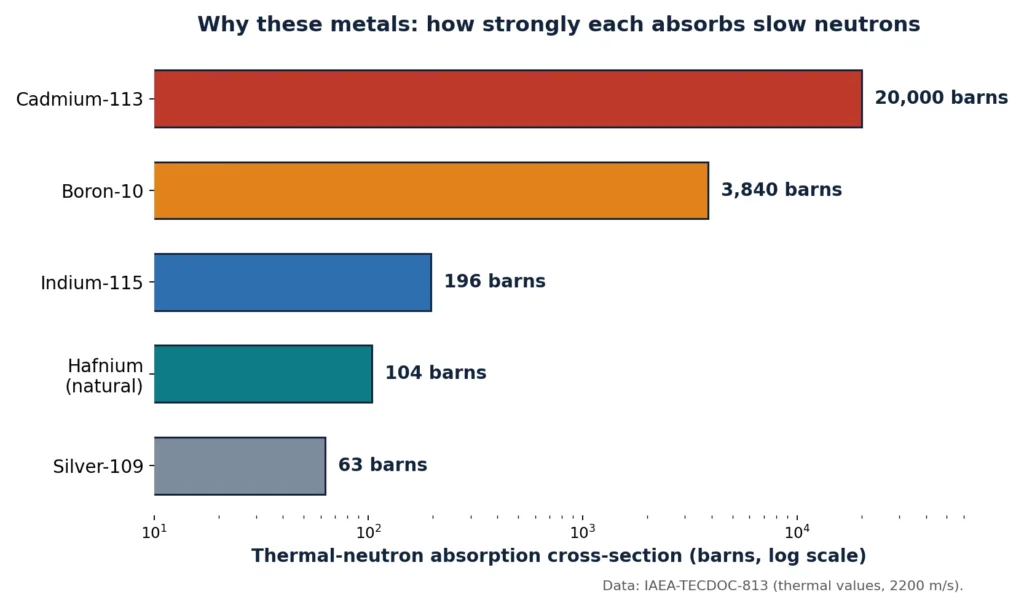
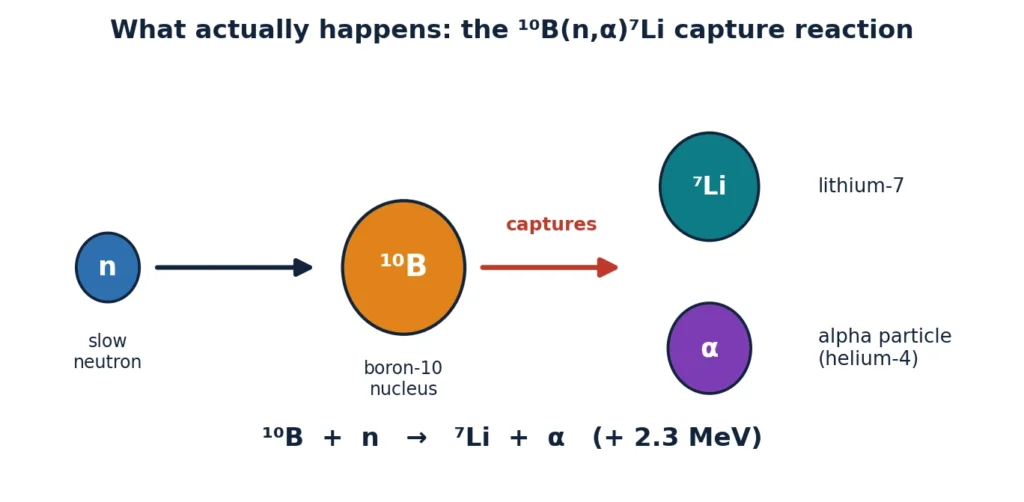
Start with boron carbide, B₄C — the workhorse. The absorbing is done by boron-10, one of the two natural boron isotopes, and it’s good at it: a thermal-neutron (having average kinetic energy of 0.025 eV) absorption cross-section of roughly 3,840 barns.
When a slow neutron hits a boron-10 nucleus it doesn’t just bounce — the nucleus captures it and breaks into a lithium-7 nucleus and an alpha particle, both harmless, carrying off the energy.
Boron carbide melts at about 2,450 °C, so it shrugs off reactor temperatures, and the boron is often enriched in boron-10 to pack more absorber into less space (IAEA). It shows up in BWR blades, in the tips of many PWR rods, and — as we’ll get to — it was the absorber at Chernobyl.
Then there’s silver-indium-cadmium, the standard absorber in a PWR’s rod cluster control assemblies (RCCAs). The recipe is oddly specific — 80% silver, 15% indium, 5% cadmium — and the reason it’s an alloy at all is the interesting part.
No single one of those metals covers the whole neutron spectrum. Cadmium is a monster at the slow end (cadmium-113 sits near 20,000 barns), indium catches neutrons in a middle resonance band, and silver fills in around them. Blend the three and you get a rod that absorbs across a wide range of neutron energies.
The catch is temperature: the alloy melts at only about 800 °C, which is low for something whose job includes worst-case accidents (IAEA-TECDOC-813).
The third option is hafnium, and it wins on durability rather than raw appetite. Its cross-section is far smaller than boron’s — around 100 barns for the natural metal — but hafnium has a trick: as its main absorbing isotope captures neutrons, the isotopes it turns into keep absorbing too. It doesn’t burn out quickly the way you’d expect. It also resists corrosion and lasts, which is why pure hafnium rods have run for years in test reactors and why some Japanese BWRs swapped boron carbide for it.
The downsides are cost and a tendency to take up hydrogen and swell, though a surface treatment tames that (IAEA).
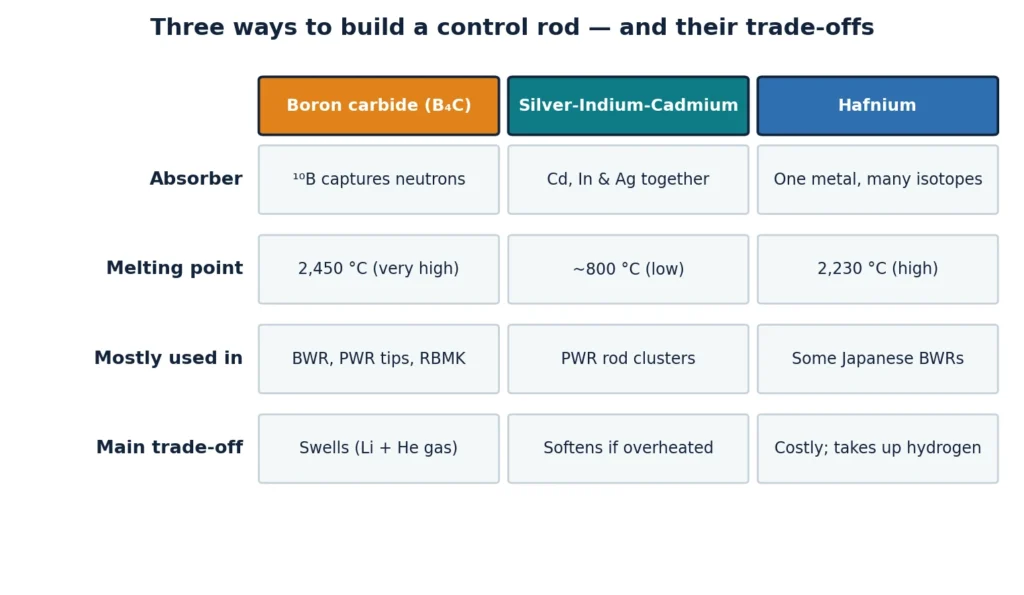
That last point is the one I’d underline. Cadmium has the biggest number on the chart, but nobody makes a solid cadmium rod — it melts too easily and burns out too fast. The right answer is never “the strongest absorber.” It’s the material that keeps absorbing, holds its shape, and survives the day everything goes wrong.
A quick point that trips people up: boron shows up in a reactor in more than one form, and control rods are only one of them. Boron carbide can also be sealed into the fuel itself as a fixed “burnable” absorber that slowly disappears over the cycle, and boron can ride around dissolved in the coolant.
Those are different tools with different jobs. A control rod is the one you can move — the one you can slam into the core in seconds — which is exactly why its material has to take abuse that a dissolved chemical never will.
PWR vs BWR: same job, opposite design
Here’s a detail that surprises people who assume all reactors are basically the same inside: pressurized water reactors (PWRs) drop their control rods in from the top, and boiling water reactors (BWRs) drive theirs in from the bottom. Same physics, opposite geometry, and both choices are forced by the plant.
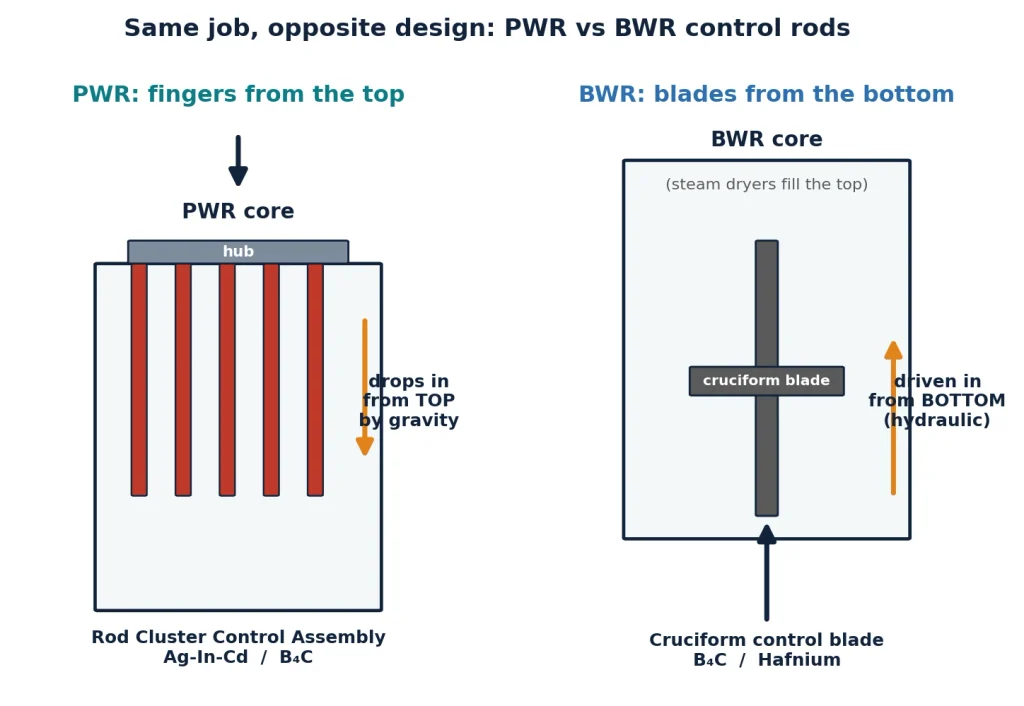
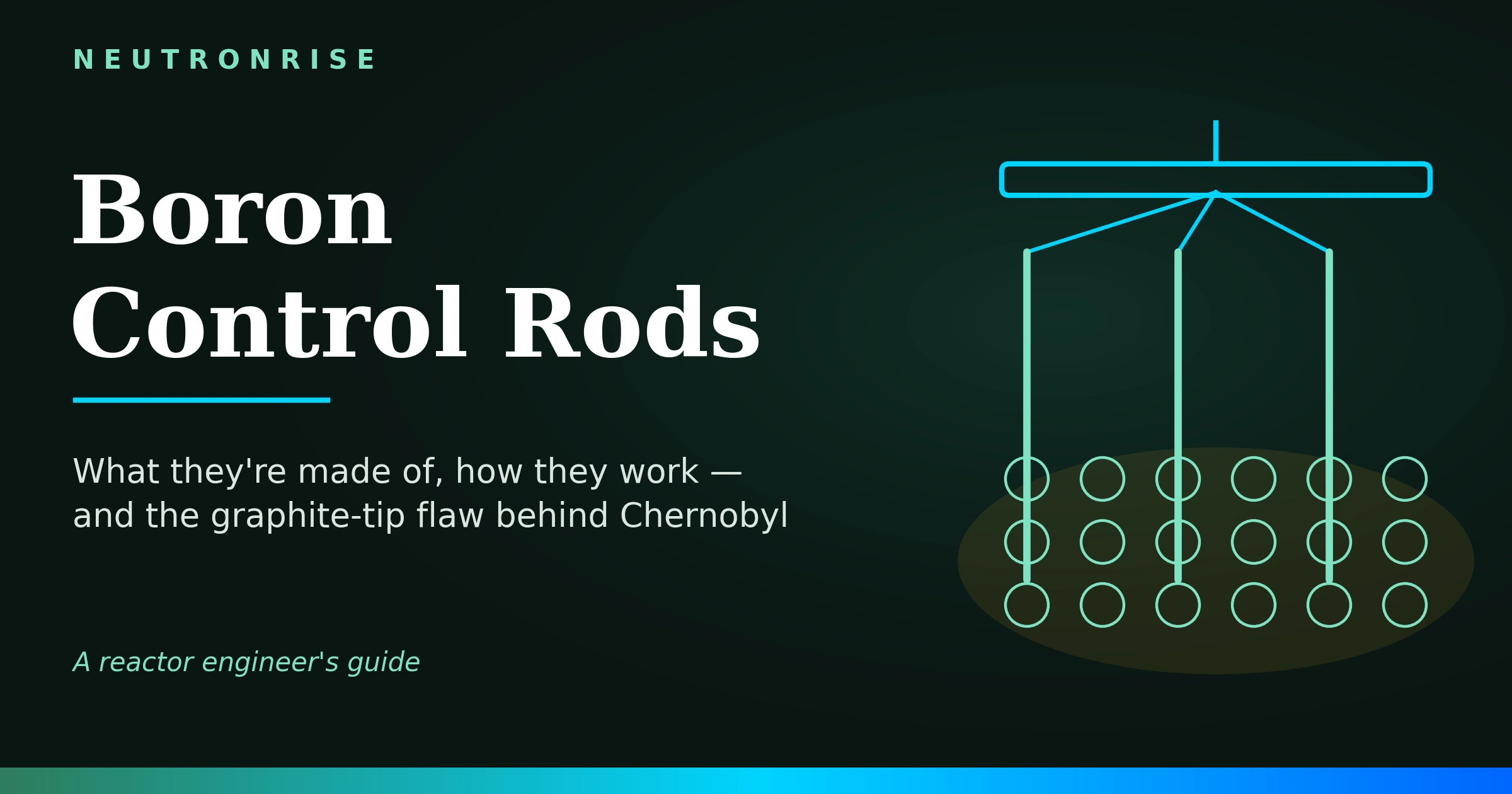
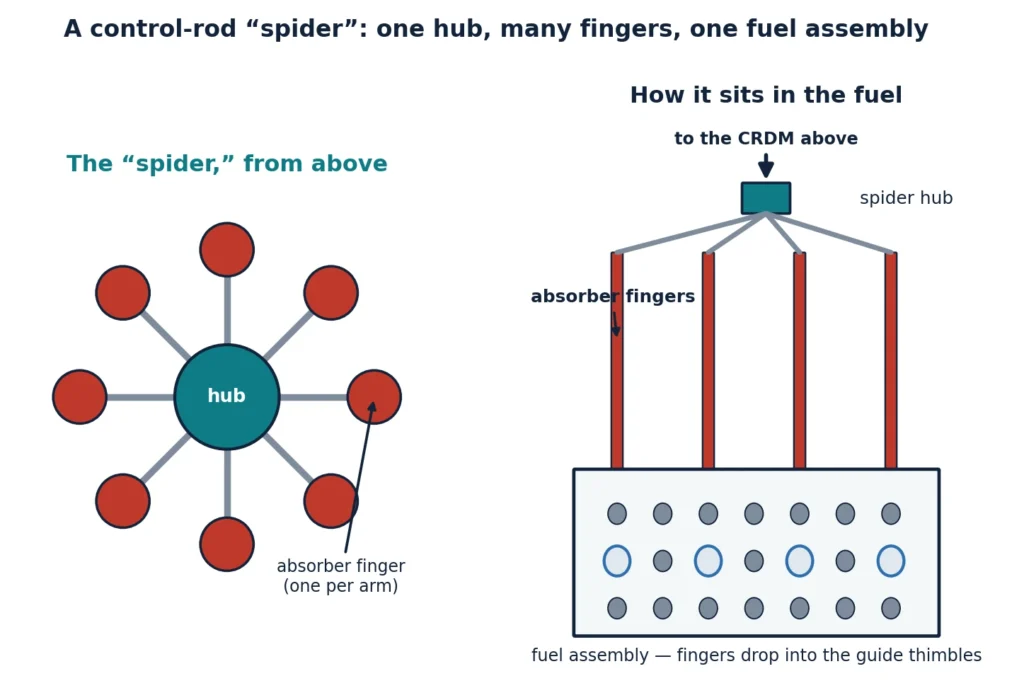
A PWR uses rod cluster control assemblies — RCCAs: bundles of thin absorber fingers hanging from a single hub, or spider, positioned to slide straight down into guide tubes woven through a fuel assembly. I’ve had one in my hands. On a refueling floor you guide a fresh assembly and its RCCA into position by hand as the crane moves it — steadying it, lining the fingers up with the guide tubes.
And here’s the part that surprises people: fresh fuel and a fresh control rod aren’t the glowing, keep-your-distance hazard the movies promise. New uranium fuel is only weakly radioactive, and it’s sealed inside its cladding, so there’s nothing loose to contaminate you.
You wear gloves — but they’re there to protect the fuel from you, from a stray fingerprint or bit of grit, not you from the fuel. That changes completely once an assembly has spent time in the core: irradiated fuel is intensely radioactive and stays underwater or behind heavy shielding for good reason. Fresh, though, you can walk right up to it.
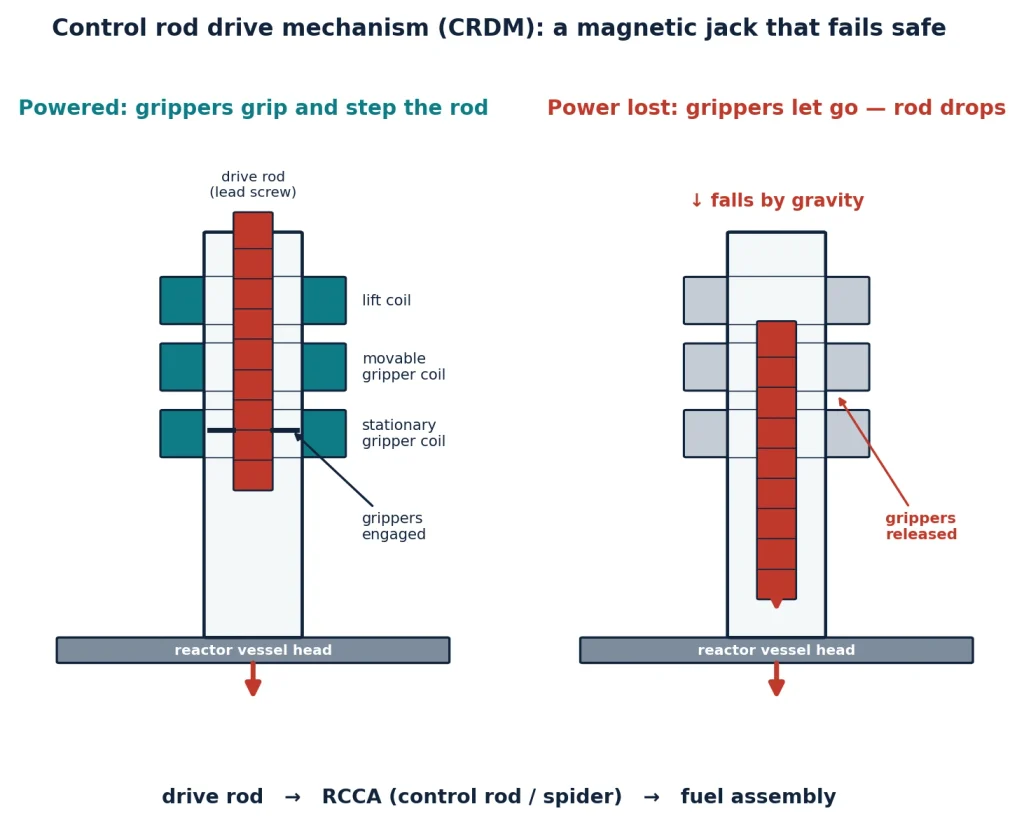
Up in the vessel head, each RCCA hangs from a control rod drive mechanism — the CRDM — held in place by an electromagnet. That detail matters more than it looks. Cut the power to the magnet — on purpose, or because the plant just lost electricity — and the rod drops into the core under its own weight. No pump, no signal, no operator required. The safest action is the one gravity does for free.
Speed is the point. When a PWR trips, the rods are designed to be fully into the core within a few seconds of the magnets letting go — fast enough to outrun almost anything the reactor can do.
And they’re sized with margin to spare. Regulators don’t let you count on every rod working; the core has to go safely subcritical even if the single most valuable rod jams fully withdrawn. That “stuck-rod” rule quietly shapes how much absorber a plant carries and how the rods are grouped.
A BWR can’t do that, because the top of a BWR vessel is crowded with steam separators and dryers — there’s no clear path for a rod to fall through from above.
So BWRs use cruciform control blades, cross-shaped blades that fit into the gaps between four fuel bundles, and they’re pushed up from underneath by a hydraulic system, backed by high-pressure accumulators that can slam them home even if normal power and pressure are gone (NRC Reactor Concepts (R-100) Training Course).
You can’t drop a rod upward, so a BWR pays for its geometry with a more complex drive. Neither design is “better.” Each is the honest answer to where the empty space in the vessel happens to be.
The graphite tip that doomed Chernobyl
Now back to that button. Chernobyl was an RBMK — a Soviet graphite-moderated design with little in common with the water reactors above — and its control rods carried boron carbide as the absorber. Nothing wrong with that. The problem was what sat on the bottom end of each rod: a length of graphite called a displacer.
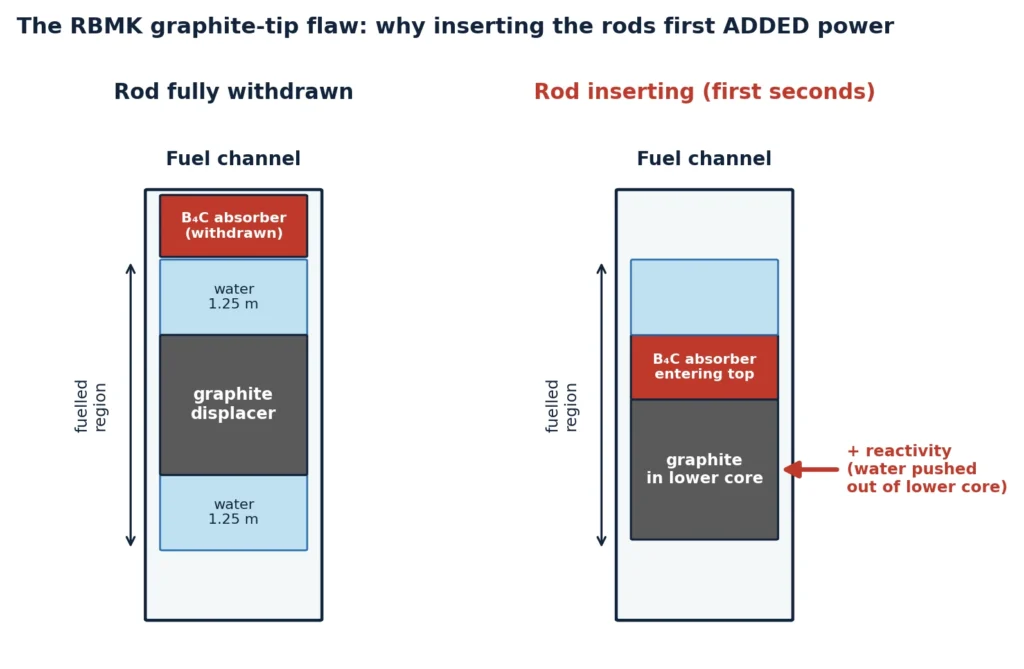
The displacer had a purpose. Water absorbs a few neutrons, and graphite doesn’t. So when the rod was pulled out, the graphite kept water from flooding the empty channel below it, which made the rod “worth” more when it was needed.
With the rod fully withdrawn, that graphite section sat centered in the fuelled part of the core, with about 1.25 metres of water at each end (World Nuclear Association).
Watch what happens on a scram. The rod starts dropping. The graphite tip is at the bottom, so graphite is the first thing to enter the lower part of the core — and as it slides in, it shoves out the water that had been sitting there absorbing neutrons.
For a moment, the bottom of the core has less absorber in it, not more. That’s a local jolt of positive reactivity, in the lower core, in the first seconds of a shutdown that was supposed to be doing the reverse.
On the night of the accident the reactor was already in a fragile, unstable configuration, and that jolt was enough to help tip it over before the boron could catch up with it (IAEA INSAG-7).
The part that still stings, reading the record, is that this wasn’t a surprise from nowhere. The same positive-scram effect had shown up at Ignalina in 1983. It was documented. The operating restrictions that might have covered it were never imposed, and the issue faded (WNA).
The lesson I take from it isn’t “boron is dangerous” — boron carbide is a perfectly good absorber, and it was doing exactly what boron does. The lesson is that a control rod is a whole system, not a slug of absorber.
Get the geometry wrong — what enters the core first, what it pushes out of the way — and the best absorber in the world will still fail you, because it never got the chance to work.
Most days, none of this drama shows. A PWR loses power and its rods fall in on their own. A BWR fires its blades up into the core and the reaction dies. The comforting picture — rod in, reactor quiet — is usually exactly right. Chernobyl is the reminder that “usually” is carried by design decisions most people never see. The boron did its job that night. The graphite just got there first.
Frequently Asked Questions
Why is boron used in control rods?
Boron-10 has a large appetite for slow neutrons — a cross-section around 3,840 barns — and when it captures one it breaks into harmless lithium and an alpha particle. It’s cheap, well understood, and as boron carbide it survives reactor heat (melting near 2,450 °C). That combination is hard to beat.
Why are some boron control rods tipped with graphite?
Only RBMK reactors did this. The graphite “displacer” on the bottom of each rod kept neutron-absorbing water out of the channel when the rod was withdrawn, which raised the rod’s worth. The side effect — graphite pushing water out of the lower core as the rod inserted — added reactivity at the start of a scram and was central to the Chernobyl accident. Water reactor rods are not built this way.
Why are boron and cadmium both used in control rods?
They’re good at different neutron energies. Cadmium (specifically cadmium-113) is a fierce absorber of the slowest neutrons — near 20,000 barns — while boron works across a wider energy range and tolerates far higher temperatures. A PWR’s silver-indium-cadmium alloy combines cadmium, indium and silver so the rod absorbs across the spectrum, not just one slice of it.
How do boron control rods work?
Pushing an absorber into the core removes neutrons from the chain reaction, so fewer survive to cause the next round of fission and power falls. Pull the rod out and more neutrons live, so power rises. Rods don’t set power directly — they change reactivity, and the core’s feedbacks decide how fast power follows.
What are PWR control rods made of?
Usually a silver-indium-cadmium alloy (about 80% silver, 15% indium, 5% cadmium), sometimes with boron carbide, arranged as clusters of thin fingers — rod cluster control assemblies — that drop into the fuel from the top and are held up by electromagnets so they fall in on loss of power.
Sources and Further Reading
- IAEA, Advances in Control Assembly Materials for Water Reactors (IAEA-TECDOC-813) — absorber materials, alloy compositions and cross-sections.
- World Nuclear Association, Chernobyl Accident — Sequence of Events — RBMK control-rod design and the positive-scram effect.
- IAEA, INSAG-7: The Chernobyl Accident — Updating of INSAG-1 — the authoritative technical account.
- M.W. Kennard, LWR Control Assembly Designs: A Historical Perspective (via OSTI) — PWR and BWR control-assembly design.
- U.S. NRC, GE BWR/4 Technology — Fuel and Control Rods System — BWR cruciform blades and drive.
- NeutronRise, Why Nuclear Reactors Run on Poison — the chemical-shim side of boron.
About The Author
Elliot Marsh is a working reactor engineer with hands on experience in reactor physics, core management, reactivity control and nuclear fuel cycle planning at an operating power station. He writes about nuclear energy for readers who want the engineering reality, not the press release.
Need content like this for your company?
I write white papers, technical explainers, and thought-leadership for nuclear vendors, reactor developers, and the agencies that serve them — accurate enough for engineers, clear enough for buyers.