How to Find and Vet an NQA-1 Certified Supplier
You need a part for a safety-related job. You search “NQA-1 certified supplier,” and the top results are vendor pages with a badge that says exactly what you hoped to find. The temptation is to stop there. Don’t.
A supplier claiming NQA-1 and a supplier you can actually put into a safety-related application are two different things, and the gap between them is where procurement engineers get burned. The badge is a starting point. What follows is how to find real NQA-1 suppliers, and more importantly, how to tell whether a given one holds up for your scope.
The short version
- One public place lists NQA-1 certified companies: ASME’s Certificate Holder Search.
- Utilities also run joint supplier audits (NUPIC, NIAC), but those records are member access, not public.
- A certificate or an audit is a screen. Under 10 CFR 50 Appendix B, you still have to qualify the supplier for your component and put them on your Approved Suppliers List.
What “NQA-1 certified supplier” actually means
NQA-1 is the ASME standard Quality Assurance Requirements for Nuclear Facility Applications. Its 18 Part I requirements aren’t arbitrary; they’re drawn straight from the 18 criteria in 10 CFR 50 Appendix B, the NRC’s quality assurance rule.
The current edition is NQA-1–2024, issued in July 2024, though older editions stay in use because licensees lock their programs to specific versions.
For years the honest answer to “is there an NQA-1 certificate?” was no — NQA-1 was a standard you complied with, not something you got stamped. That changed.
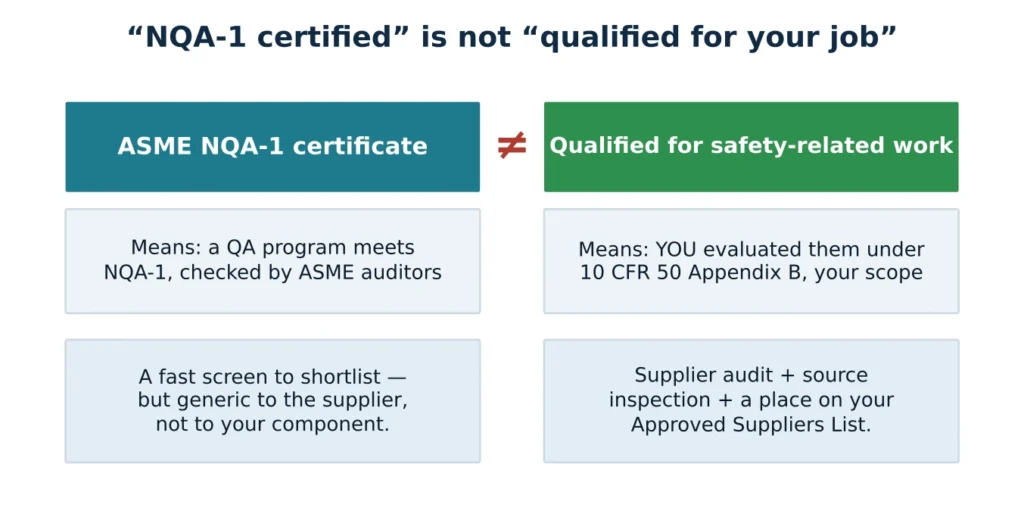
ASME has run an NQA-1 Certification Program since 2012. ASME auditors assess a supplier’s quality program against the standard, and a passing audit earns an NQA-1 Quality Program Certificate. So the phrase has a precise meaning today: a company whose QA program ASME has certified.
Read that word again. Program. The certificate covers how the supplier runs quality across its organization. It says nothing about the specific valve body, weldment, or calibration service you’re about to buy, and nothing about whether that work fits the safety function you need. That distinction is the whole game.
Where to actually find NQA-1 suppliers
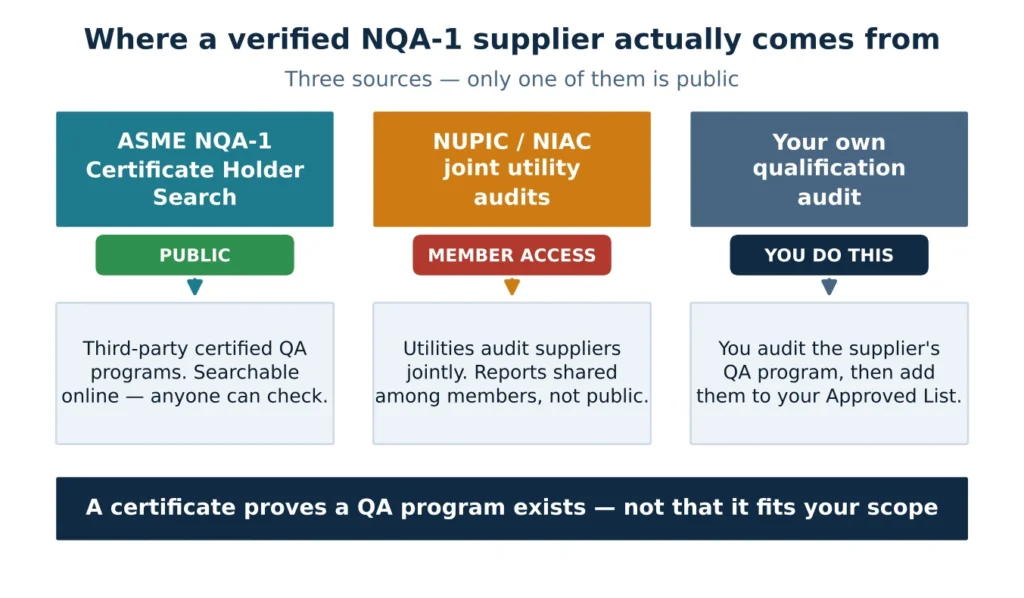
Three places, and they’re not equal.
ASME’s Certificate Holder Search
It is the one list anyone can open. From ASME’s NQA-1 certification page you can locate certified companies and confirm a certificate is real rather than taking a logo on a brochure at face value. Start here. It’s the fastest way to separate companies that have actually been through an ASME audit from ones that just reference the standard in their marketing.
NUPIC and NIAC joint audits
These are where most of the real supplier qualification in this industry happens, and they’re mostly invisible from the outside. NUPIC — formed in 1989 by domestic and several international utilities — runs a joint audit process so member utilities don’t each separately audit the same vendor.
The NRC periodically observes NUPIC audits and treats the program as an acceptable alternative to its own vendor inspections. NIAC runs a similar joint-assessment program. The catch: those audit reports are shared among members, not published. If you’re a utility or working through one, you can pull the audit. If you’re an outside buyer, you can’t just browse the list.
Your own Approved Suppliers List
This is where a supplier ultimately has to land before you procure safety-related work from them. No external list removes that step. More on that below.
One term worth clearing up, because people search it: there’s no “NQA-1 registrar” the way ISO 9001 has accredited registrars issuing certificates. ASME issues the NQA-1 certificate directly, and the joint-audit programs are run by the utilities themselves.
By capability: machining, fabrication, welding, testing
Most of the long-tail searches — NQA-1 machine shop, NQA-1 fabricators, NQA-1 welding and heat treatment, NQA-1 testing laboratory — are really one question: does a given shop’s certified scope cover the process I need? A machine shop certified for NQA-1 machining isn’t automatically covered for welding or for nondestructive examination.
Heat treatment, coatings, and testing each carry their own process controls and qualifications. When you read a certificate, read the scope line, not just the headline. A supplier can be entirely legitimate and still be wrong for your part because the process you need sits outside what they were audited for.
How to verify a supplier’s NQA-1 claim is real
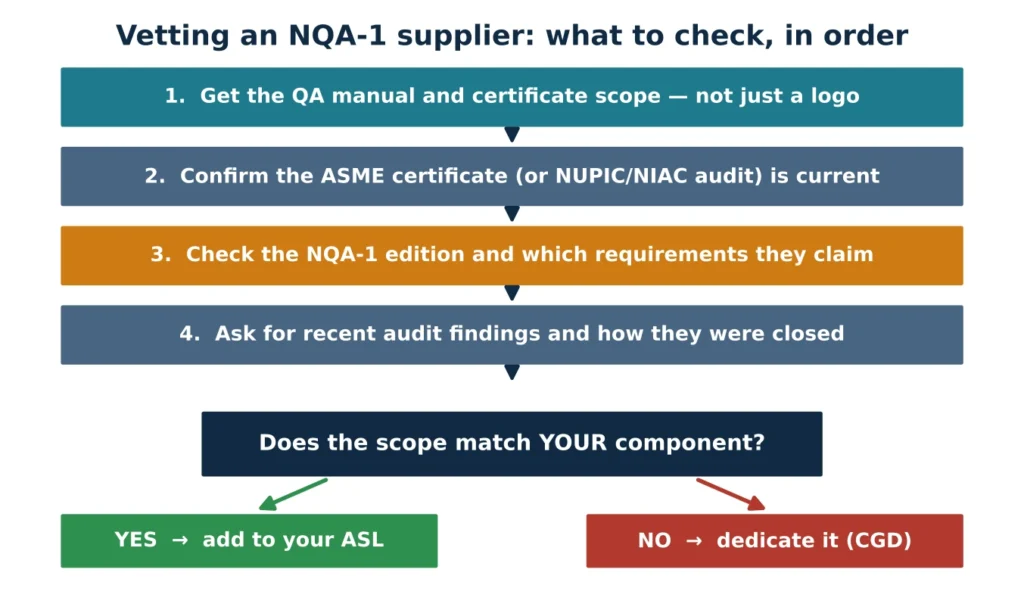
This is the part no directory does for you. A certificate tells you a program passed an audit on some date, for some scope. Turning that into “I can buy this part and defend it” takes a few concrete checks.
Get the actual quality manual and the certificate, and read the scope — not a logo on a capabilities sheet. Confirm the ASME certificate (or the NUPIC/NIAC audit) is current, and that its scope covers your item class.
Check which edition of NQA-1 they’re certified to and which of the 18 requirements they’re claiming, because a supplier doing commercial-grade work doesn’t carry the same requirement set as one building basic components. Ask for recent audit findings and, more telling, how they closed them — a supplier with zero findings either isn’t being audited hard or isn’t being honest.
Then the gate that actually matters: does the scope map to your component and its safety function? If yes, you run your own qualification — the supplier audit, source inspection where warranted, and a place on your Approved Suppliers List.
10 CFR 50 Appendix B puts that responsibility on the purchaser, and a vendor’s certificate doesn’t transfer it. Criterion VII is explicit that you control purchased material, equipment, and services; Criterion XVIII expects audits to verify it. A certificate is evidence you weigh, not a license you inherit.
Need a second set of eyes on a supplier’s QA program?
Vetting a certificate scope against a real safety function, reading a quality manual for the gaps that matter, or standing up a supplier-qualification process — this is the kind of work I do for teams sourcing nuclear components. If you’re weighing a supplier and want an engineer’s read before you commit, let’s talk.
Talk to NeutronRise →Red flags when you’re vetting a supplier
A handful of signals should slow you down.
“We’re ISO 9001, so we’re basically NQA-1.” No. ISO 9001 is a real quality system, but it doesn’t carry several things nuclear work demands — the gaps between the two are specific and they show up at the first audit. A supplier that conflates the two hasn’t done safety-related work.
No audit history, or reluctance to share findings. A scope on the certificate that’s narrower than the work you’re placing. A certificate referencing an edition the supplier can’t quite pin down.
And the subtle one: “certified” used loosely, where a trained individual or a single qualified procedure gets stretched into a claim about the whole program. Read carefully and the loose claims fall apart quickly.
If you can’t find an NQA-1 supplier: dedicate the item
Sometimes the best shop for a part simply isn’t NQA-1, and for emerging components that’s common — the supply base hasn’t caught up to demand. There’s a regulated path for that. You buy the item commercial-grade, then dedicate it: identify the critical characteristics that matter for the safety function and verify them, so the commercial item can serve as a basic component.
It’s more work on your side, and it shifts the burden of proof onto your dedication process rather than the supplier’s certificate, but it’s how a lot of real nuclear procurement actually gets done when the certified supplier doesn’t exist. If you want the whole picture of why qualified capacity — not forging capacity — is the real constraint, I’ve written about the supply-chain bottleneck separately.
And if you’re on the other side of this — a supplier trying to get qualified rather than a buyer trying to vet one — the path to becoming NQA-1 qualified is its own process. You can also run your program against the 18-requirement checklist to see where the gaps are before an audit finds them.
Frequently Asked Questions
Is there an official list of NQA-1 certified suppliers?
There is one public list: ASME’s Certificate Holder Search, which shows companies whose quality programs ASME has certified against NQA-1. The other place supplier audits live is the NUPIC and NIAC joint-audit programs run by nuclear utilities, but those audit records are shared among member utilities, not published.
What does “NQA-1 certified supplier” actually mean?
It means a company whose quality assurance program has been certified by ASME as conforming to the ASME NQA-1 standard. ASME auditors assess the program and, on a successful audit, issue an NQA-1 Quality Program Certificate. It certifies the program, not any individual part, and not your application.
Is an ASME NQA-1 certificate enough to use a supplier for safety-related work?
No. Under 10 CFR 50 Appendix B, the purchaser is responsible for evaluating and qualifying its suppliers for the specific item and safety function. A certificate, or a NUPIC/NIAC audit, is strong supporting evidence, but you still have to qualify the supplier for your scope and place them on your Approved Suppliers List.
How do I verify a supplier is really NQA-1 qualified?
Ask for the quality manual and the certificate scope, confirm the ASME certificate or joint audit is current and covers your item class, check which NQA-1 edition and which of the 18 requirements they claim, and review recent audit findings and how they were closed. Then confirm the scope maps to your component before you qualify them.
Who runs NQA-1 supplier audits?
ASME performs the audits behind its NQA-1 certification. Separately, nuclear utilities run joint supplier audits through NUPIC (formed in 1989) and NIAC, which the NRC periodically observes as an acceptable alternative to its own vendor inspections. Individual purchasers also run their own qualification audits.
Can an ISO 9001 supplier do nuclear safety-related work?
Not on the strength of ISO 9001 alone. ISO 9001 doesn’t cover several things NQA-1 requires, such as 10 CFR 21 reporting or the depth of records and control nuclear work demands. A commercial supplier can still serve safety-related needs through commercial-grade dedication, where the critical characteristics of the item are verified.
What is the current edition of NQA-1?
The current edition is ASME NQA-1–2024, issued in July 2024. Earlier editions still in active use include 2008/2009a, 2015, 2017, 2019, and 2022, because licensees reference specific editions in their quality programs.
Sources and Further Reading
- ASME — Nuclear Quality Assurance (NQA-1) Certification & Certificate Holder Search
- ASME — NQA-1 Certification Program (launched 2012)
- U.S. NRC — NUPIC and Industry Interactions
- eCFR — 10 CFR Part 50, Appendix B (Quality Assurance Criteria)
- NeutronRise — NQA-1 Explained
- NeutronRise — Commercial Grade Dedication
- NeutronRise — NQA-1 vs ISO 9001
About the Author
Elliot Marsh is a working reactor engineer with hands on experience in reactor physics, core management, reactivity control and nuclear fuel cycle planning at an operating power station. He writes NeutronRise, covering reactor physics, nuclear quality, and the supply chain behind new build. He works with teams on supplier qualification and nuclear technical writing.
Need content like this for your company?
I write white papers, technical explainers, and thought-leadership for nuclear vendors, reactor developers, and the agencies that serve them — accurate enough for engineers, clear enough for buyers.