Can SMRs Actually Power AI Data Centers? The Honest Answer Is About Timing
Can (SMRs) power AI data centers? In the last two years, the biggest companies on Earth have bet billions of dollars that SMRs can power AI data centers. Microsoft, Amazon, Google, Meta — names that built their empires on software — have collectively committed on the order of 9.8 gigawatts of nuclear capacity, across roughly a dozen announced projects, to feed the data centers behind the AI boom. Most of that is riding on SMRs. The headlines write themselves: “SMRs will power the age of AI.”
And the case for it is genuinely compelling — so compelling I’ve written about why small modular reactors and AI look almost made for each other, right down to the specific advanced designs, like TerraPower’s Natrium, already being lined up for data centers.
AI needs enormous, constant, carbon-free power; that’s exactly what a reactor provides. So you’d think this article would be a victory lap. It isn’t. Because there’s a question hiding inside all that excitement that almost nobody is asking honestly, and as a reactor engineer it’s the only one I care about: not whether SMRs are a good answer for AI, but whether they can actually arrive in time to be the answer.
That distinction is everything, and it’s the whole point of this article. The fit is excellent. The timing is the problem. Let me show you why a technology can be exactly right and still, for now, be just out of reach — and what’s quietly powering AI in the meantime while we wait for the reactors to show up.
First, the Fit: Why SMRs and AI Data Centers Are a Great Match
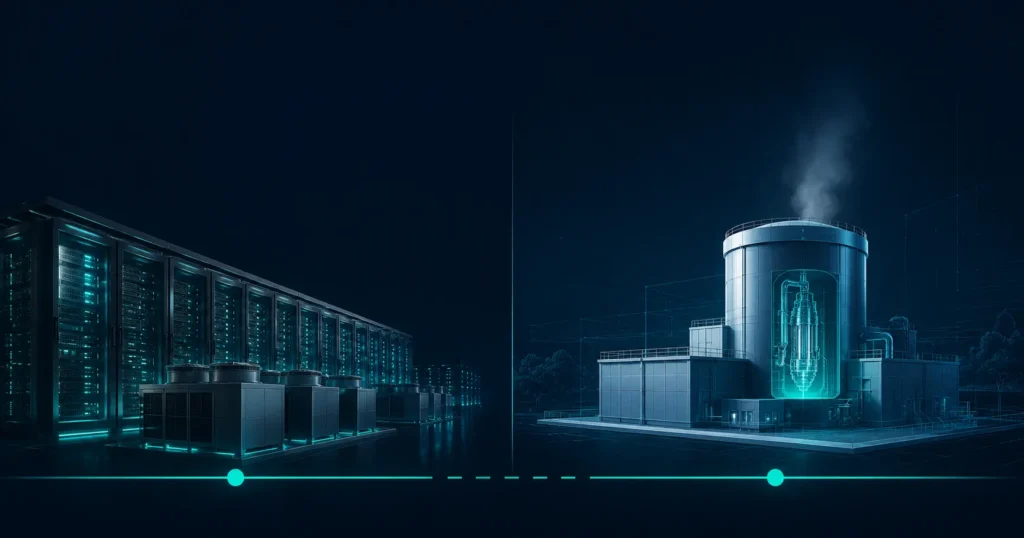
Let me be clear up front, because the rest of this article will sound cautious and I don’t want that mistaken for cynicism: the reason everyone is excited is correct. A data center needs power that is large, available every second of every day, and carbon-free — and it increasingly needs that power right where it sits, not piped across a strained grid.
An SMR (a reactor of up to 300 MWe, per the IAEA and the World Nuclear Association) answers all of that: a compact source of round-the-clock, zero–carbon electricity that can, in principle, be built next to the facility it powers. Compared to wind or solar, it doesn’t stop when the weather changes. If you sat down to design the perfect dedicated power source for an AI campus, you might well sketch something that looks a lot like an SMR.
So the excitement is justified and the bet is rational. I want to honor that before I complicate it — because the complication isn’t about whether SMRs are good. It’s about when.
The Catch: AI Needs Power Now — SMRs Arrive in the 2030s
Here is the entire problem in two sentences. The AI power crunch is happening right now — data centers are being built this year, and demand is screaming. But the SMRs meant to power them are, almost without exception, not arriving until the late 2020s at the very earliest, and mostly the 2030s. The need and the solution are separated by a gap of years — and in a race this fast, years are an eternity.
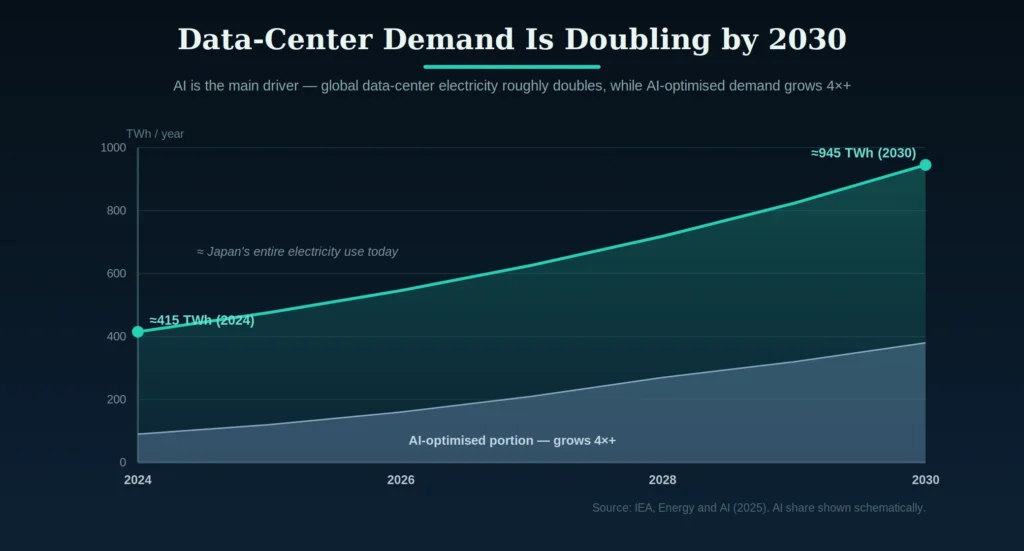
The demand side isn’t speculative. The International Energy Agency projects that data-center electricity use will roughly double from about 415 TWh in 2024 to around 945 TWh by 2030 — slightly more than Japan’s entire electricity consumption today — with the AI-optimised portion growing more than fourfold. That surge is landing now, not in 2030s.
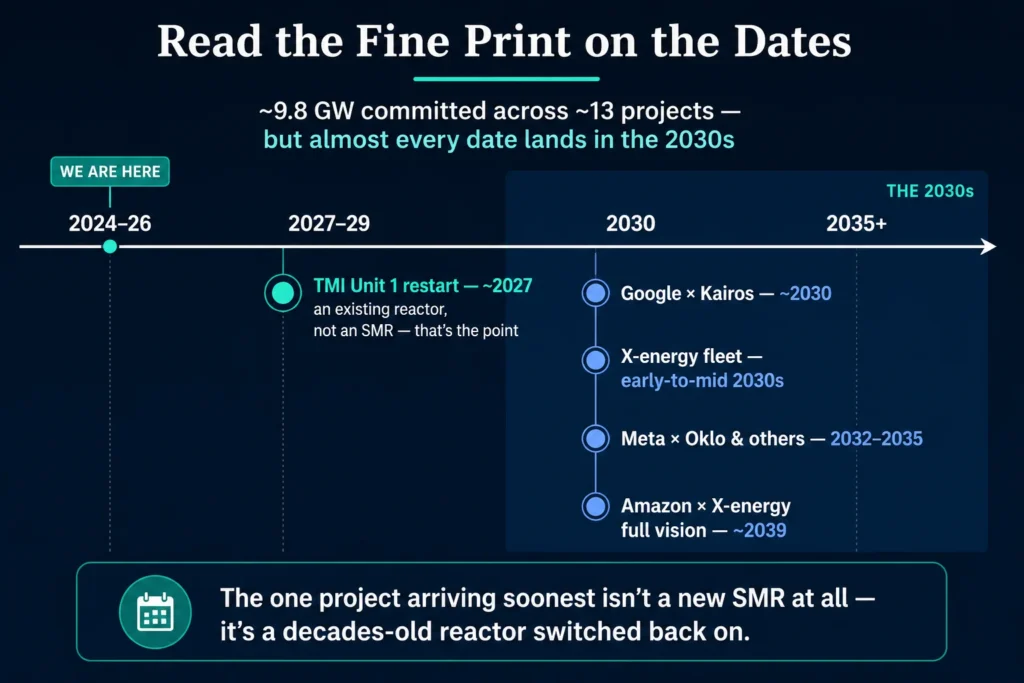
Now look at the actual deals, and the pattern is unmistakable. Google’s Kairos Power reactors are targeted to bring the first unit online around 2030, with the full ~500 MW fleet by 2035. Amazon’s X-energy partnership talks about a multi-gigawatt vision stretching out toward 2039, with first units around 2030. Meta’s ~6.6 GW of commitments — its TerraPower and Oklo units — cluster in the 2032–2035 window.
These aren’t reactors you switch on next quarter. They’re commitments to build first-of-a-kind machines that, realistically, deliver power toward the end of the decade and beyond — while the AI demand they’re meant to serve is here today. As of 2026, not a single SMR is yet powering a data center anywhere in the world.
When Will SMRs Be Ready to Power Data Centers?
The short answer: The earliest first-of-a-kind (FOAK) SMR units for data centers are targeted for around 2030 (Google’s Kairos Power, some Oklo units), with most larger deployments landing in the early-to-mid 2030s. No SMR is powering a data center yet. The first new nuclear electrons dedicated to AI actually arrive earlier — in 2027 — but from a restarted existing reactor, not an SMR.
Plot the marquee deals on a calendar and the gap becomes visual. The Crane Clean Energy Center, former TMI, restart (more on that below) targets 2027. The first purpose-built SMRs — Kairos, Oklo — aim for roughly 2030. TerraPower’s Natrium unit for Meta aims for around 2032. Amazon’s larger X-energy fleet stretches toward 2039. Against that, the AI demand curve is already climbing steeply. Supply is chasing demand up a hill it started late.
Why Are SMRs Taking So Long?
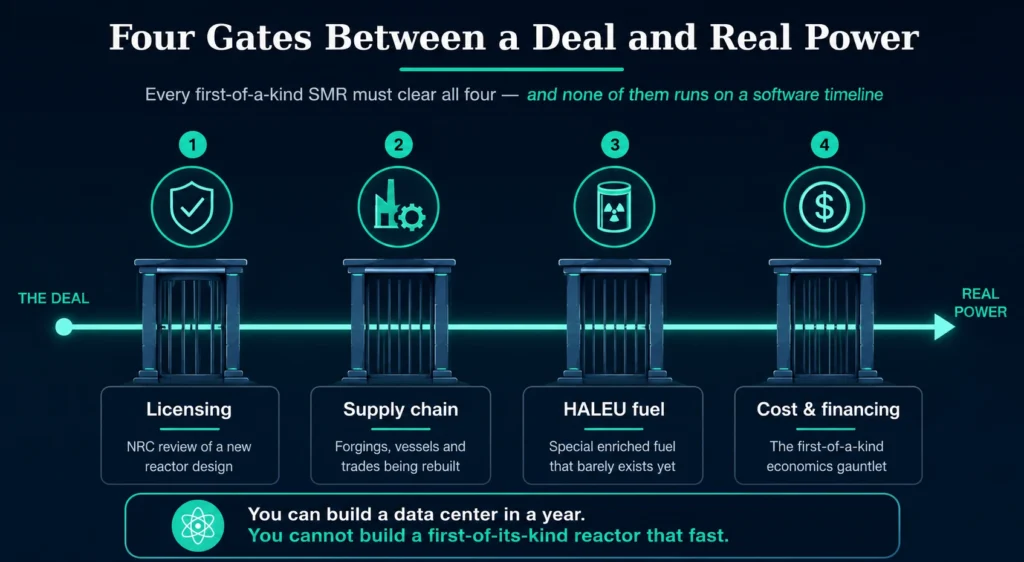
Because everything I’ve written about before lands on these projects at once. A first-of-a-kind reactor has to clear four hard gates, and none of them runs on a software timeline:
- Licensing. Every SMR headed for a data center is a new design that must be licensed by a careful regulator. This is the single largest timeline constraint on any project. There is one route that moves faster: Antares‘ Mark-0 microreactor went from design to criticality in under a year under a DOE test-reactor pathway rather than full NRC licensing. But that authorises a physics demonstration on a federal site — not a commercial reactor selling power to a data center. The fast lane exists; it just doesn’t lead where the data centers need to go.
- Supply chain. The heavy-nuclear manufacturing base — forgings, pressure vessels, skilled trades — is still being rebuilt after decades of stagnation.
- HALEU fuel. Many advanced designs (X-energy, Kairos, Oklo, TerraPower) need high-assay low-enriched uranium (HALEU), which barely exists commercially yet and costs far more to enrich. Fuel scarcity already pushed TerraPower’s Natrium from a 2028 target toward 2030+.
- Cost and financing. The first-of-a-kind economics that killed promising reactors before still have to be survived — the gauntlet that sank NuScale’s UAMPS project in 2023.
You can stand up a data center in a year or two. You cannot stand up a first-of-its-kind nuclear plant that fast, no matter how much money you throw at it. The calendar of heavy nuclear construction simply does not bend to the urgency of a tech roadmap.
What Powers AI Data Centers Until SMRs Arrive?
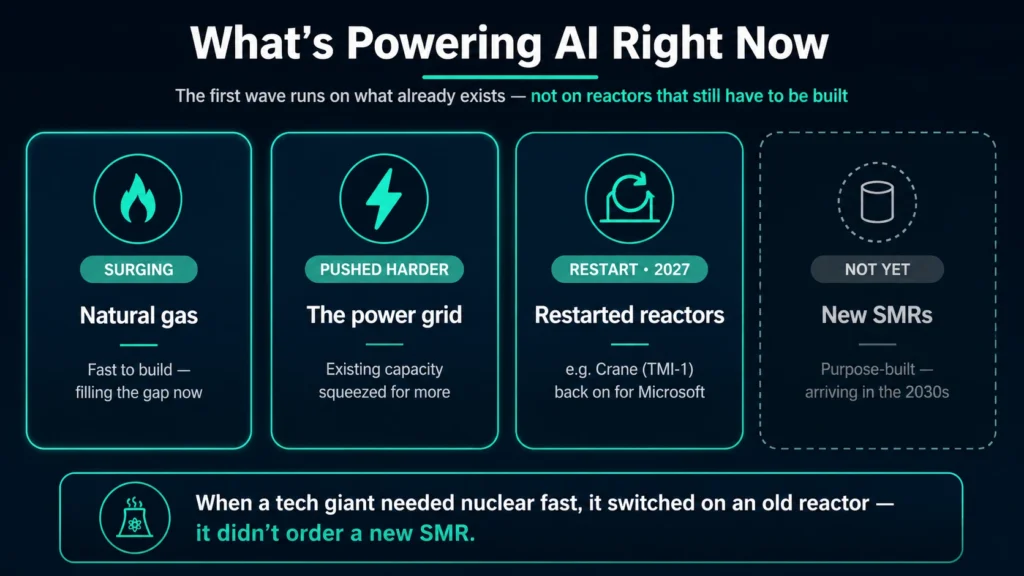
The short answer: In the near term, AI is running on what already exists or can be built fast: surging natural gas, a harder-pushed grid, and restarted existing reactors — most notably the Three Mile Island Unit 1 restart, now the Crane Clean Energy Center, due back online in 2027 under a deal with Microsoft.
This is the question the hype skips, and it’s the most important one. If AI needs power today and SMRs won’t arrive for years, then something else is keeping the data centers running right now — and that something tells you the real story of this decade.
The power is coming from the unglamorous and the already-built. Natural gas is surging because it can be built quickly. The existing grid is being pushed harder. And, most tellingly, the industry is reaching for nuclear plants that already exist rather than ones that have to be invented.
The clearest symbol is the restart of Three Mile Island Unit 1 — the same site synonymous with nuclear fear since 1979, now renamed the Christopher M. Crane Clean Energy Center. Constellation is bringing the ~835 MW pressurised-water reactor back specifically to feed data-center demand under a 20-year power purchase agreement with Microsoft, backed by a $1 billion Department of Energy loan that closed in November 2025.
The restart has actually been accelerated to 2027, roughly a year ahead of the original plan. Notice the logic: when a tech company needed nuclear power soon, it didn’t order a fleet of new SMRs — it paid to switch a proven, decades-old reactor back on. That single decision is the most honest commentary on SMR timing you’ll find anywhere. The fastest nuclear power is the reactor you don’t have to build.
The Honest Verdict: SMRs Are the Second Wave, Not the First
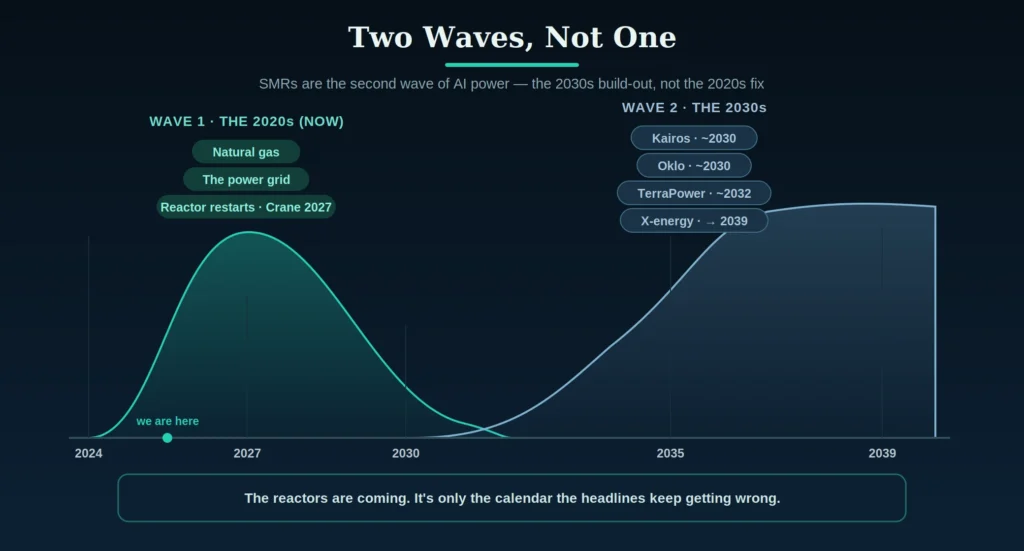
So can SMRs power AI infrastructure? Here’s my answer as a reactor engineer, and it’s neither the breathless yes of the headlines nor a dismissive no. SMRs are very likely a real and important part of how AI gets powered — but they are the second wave, not the first. They are the answer to AI’s power needs in the 2030s, not the solution to its crisis in the 2020s.
Think of it as two distinct phases. The first wave — happening now — is powered by what already exists or can be built fast: gas, the grid, and restarted reactors like Crane. The second wave — arriving over the 2030s — is where the SMRs the tech giants are funding today finally come online, purpose-built beside the data centers they serve.
The billions being committed right now aren’t wasted or naive; they’re seeds planted for a harvest that comes later. The mistake is only in the timing of the headlines, which talk as if the harvest were already here.
And there’s a deeper optimism buried in this, which is why I land on hopeful rather than skeptical. The AI boom may turn out to be the best thing that ever happened to SMRs. For decades the technology’s fatal problem was simple: nobody wanted to be the first customer, so the first-of-a-kind reactor never got funded.
AI changed that overnight. The tech giants have the money, the urgency, and the appetite to be that first customer — to absorb the painful cost of the early reactors so the cheaper later ones can exist. AI isn’t just waiting on SMRs. It may be the force that finally drags them across the valley that killed them for fifty years. That’s worth being patient for.
So the next time you see a headline promising that small reactors are about to power the AI revolution, you’ll know how to read it. Not as a lie — as a postcard from a few years in the future. The reactors are coming. The fit is real. The money is real. It’s only the calendar that the excitement keeps getting wrong. SMRs can absolutely help power AI infrastructure. Just not yet — and knowing the difference between ‘yes’ and ‘yes, soon’ is the whole game.
Frequently Asked Questions
Can SMRs power AI data centers right now?
Not yet. As of 2026, no small modular reactor is powering a data center anywhere in the world. Every SMR aimed at data centers is a first-of-a-kind design still in licensing, construction, or demonstration. The fit is excellent, but the first purpose-built units are not expected online until around 2030, with most landing in the early-to-mid 2030s.
When will SMRs be ready to power data centers?
The earliest first-of-a-kind units — Google’s Kairos Power reactors and some Oklo microreactors — target roughly 2030. Larger deployments (X-energy, TerraPower, additional Kairos units) cluster in the early-to-mid 2030s. Google’s full Kairos fleet is targeted for about 2035; Amazon’s larger X-energy vision stretches toward 2039.
Why are SMRs taking so long to build?
Four gates: NRC licensing of a new reactor design, a nuclear supply chain still being rebuilt, scarce HALEU fuel that many advanced designs need, and the first-of-a-kind cost-and-financing gauntlet. HALEU scarcity alone pushed TerraPower’s Natrium from a 2028 target toward 2030+. None of it moves at software speed.
What powers AI data centers until SMRs arrive?
In the near term, natural gas (which can be built quickly), a harder-pushed existing grid, and restarted existing reactors. The clearest example is Three Mile Island Unit 1 — now the Crane Clean Energy Center — being brought back for Microsoft in 2027 under a 20-year deal. When a tech company needed nuclear power fast, it restarted a proven reactor rather than ordering new SMRs.
How much nuclear power have tech companies committed to AI?
As of 2026, roughly 13 announced projects total on the order of 9.8 GW of nuclear capacity for AI infrastructure, per industry trackers. Meta leads with up to about 6.6 GW; Microsoft, Google, and Amazon have each signed at least one deal. Much of it depends on SMRs that have not yet been built.
What is an SMR in AI?
In the AI context, an SMR (small modular reactor) is a compact reactor — up to 300 MWe — that tech companies want to build next to their data centers as a large, 24/7, carbon-free power source. “In AI” just refers to this use case. As of 2026 these are contracted but not yet operational; the first are targeted for around 2030.
Are SMRs a good fit for AI data centers?
On paper, close to ideal. A data center needs large, 24/7, carbon-free power, ideally sited right next to the facility — which is exactly what an SMR is meant to provide, unlike weather-dependent wind or solar. The reservation is not about suitability; it is entirely about timing.
Sources and Further Reading
- https://smrintel.com/nuclear-data-center-deals/ Every Nuclear-Powered Data Center Deal in 2026
- Data-center electricity demand (~415 TWh in 2024 → ~945 TWh by 2030; AI portion 4×) — https://www.iea.org/reports/energy-and-ai/executive-summary (IEA, Energy and AI).
- SMR definition (up to 300 MWe) and technology overview — https://www.iaea.org/newscenter/news/what-are-small-modular-reactors-smrs (IAEA).
- https://www.kairospower.com/google Kairos Power and Google
- https://www.world-nuclear-news.org/articles/google-and-kairos-power-team-up-for-smr-deployments-in-us-first World Nuclear News
- https://www.aboutamazon.com/news/sustainability/amazon-smr-nuclear-energy Amazon News
- https://www.world-nuclear-news.org/articles/amazon-updates-smr-progress-with-new-images-of-proposed-plant Amazon updates SMR progress
- https://www.world-nuclear-news.org/articles/meta-announces-landmark-agreements-for-new-nuclear Meta announces ‘landmark’ agreements for new nuclear
- https://www.utilitydive.com/news/meta-nuclear-deal-oklo-vistra-terrapower-ai-data-centers/809215/ Meta inks nuclear deals for up to 6.6 GW from Oklo, Vistra, TerraPower
- SMR definition, designs, and status — https://world-nuclear.org/information-library/nuclear-power-reactors/small-modular-reactors/small-modular-reactors (World Nuclear Association).
- https://www.energy.gov/edf/crane-restart EDF Project: Crane Restart
- https://www.constellationenergy.com/news/2025/11/us-government-backs-constellations-plan-to-launch-crane-clean-energy-center-adding-835-mws-of-new-baseload-power-to-the-grid.html
- Three Mile Island Unit 1 / Christopher M. Crane Clean Energy Center restart status — https://www.nrc.gov/info-finder/reactors/ccec (US NRC).
- https://www.constellationenergy.com/news/2025/09/one-year-later-crane-clean-energy-center-still-in-the-spotlight-and-ahead-of-schedule.html One Year Later: Crane Clean Energy Center Still in the Spotlight and Ahead of Schedule
- IAEA on SMRs becoming a reality (Grossi) — https://www.world-nuclear-news.org/articles/smrs-becoming-a-reality-says-grossi (World Nuclear News).
About the Author
Elliot Marsh is a working reactor engineer with hands-on experience in reactor physics, core management, reactivity control, and nuclear fuel-cycle planning at an operating power station. He writes about nuclear energy for readers who want the engineering reality, not the press release.
Need content like this for your company?
I write white papers, technical explainers, and thought-leadership for nuclear vendors, reactor developers, and the agencies that serve them — accurate enough for engineers, clear enough for buyers.
