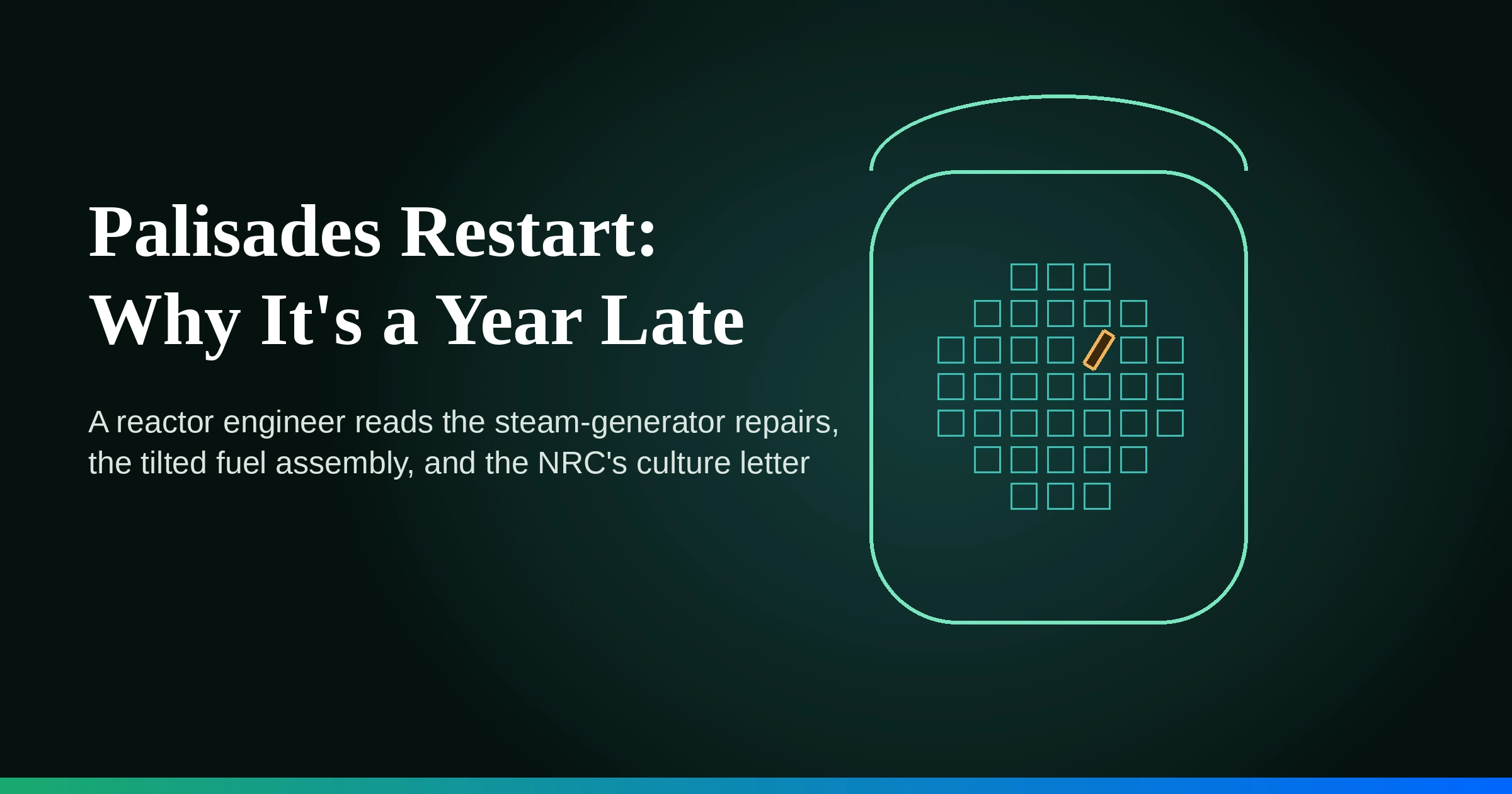
Palisades Nuclear Plant Restart: Why It’s a Year Late, Read by a Reactor Engineer
The Palisades nuclear plant restart was supposed to put power on the grid in October 2025. As of mid-November 2026 the reactor vessel is still being loaded, the NRC has a corrective-action plan on its desk about the plant’s safety culture, and the only hard date anyone will commit to is a March 2027 power-supply contract. Here is what actually went wrong, in the order it went wrong: the steam generators, a fuel assembly that tipped over inside the core, and a quality-assurance department that stopped feeling safe to speak up.
Restart status — updated 13 November 2026
- Plant mode: Mode 6 (Refueling). Core loading resumed in late October after the tilted assembly was recovered.
- Official restart date: none. Holtec’s line is “when all required work is complete.” Energy Secretary Chris Wright said on 29 October he hopes for “the end of November.”
- Hard deadline: March 2027, the date Holtec’s power-purchase counterparties are contracted for.
- Open regulatory items: NRC root-cause review of the fuel-handling event; Holtec’s chilled-work-environment corrective-action plan (due 13 November).
I am a reactor engineer at a pressurized water reactor fleet. During refueling outages I am the person standing over the open core directing where each fuel assembly goes, so the Palisades fuel-loading story is not abstract to me.
I have no inside knowledge of Palisades; everything below comes from NRC documents, Holtec’s own releases, and the trade press. What I can add is the reading an engineer gives those documents.
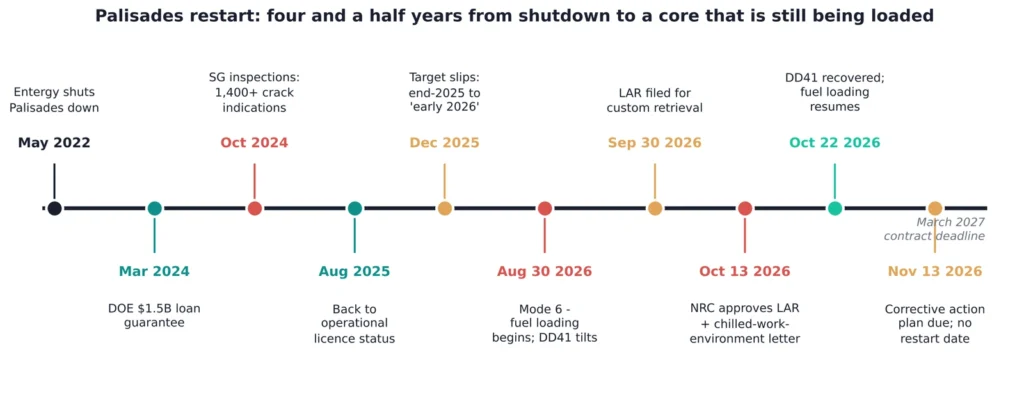
How the schedule slipped, target by target
Entergy shut Palisades down on 20 May 2022 after 50 years and had the core unloaded by 10 June, according to World Nuclear News.
Holtec bought the plant to decommission it, then reversed course, and in late 2023 started filing the licensing actions needed to bring it back. The NRC reauthorized the power-operations licensing basis in July 2025, and on 25 August 2025 the plant formally returned to operational status, the first US plant ever to come back from decommissioning on paper.
The dates Holtec gave for power are worth lining up, because the pattern tells you something:
| When stated | Restart target | What moved it |
|---|---|---|
| 2024 | October 2025 | Steam-generator inspection findings |
| Mid-2025 | “Fourth quarter 2025” | Tube sleeving campaign not finished |
| December 2025 | “Early 2026” (Feb/March) | Remaining project work, NRC questions on repairs |
| Spring 2026 | “When the plant is ready for long-term operations” | No date given at all |
| August 2026 | “This year,” per CEO Kris Singh | Fuel loading began 30 August |
| September 2026 | “Before March 2027” | Fuel assembly DD41 tilted; loading paused |
| October 2026 | “Before the end of this year,” per DOE Secretary Wright | Assembly recovered; NRC culture letter issued |
Notice that the company’s own statements got vaguer as the project went on while the political statements got more specific. That is the opposite of what you want to see.
In early November, Axios reported that the project was roughly a year behind, that Holtec had cut hundreds of workers, and that leadership had been reshuffled, with Chief Nuclear Officer Fadi Diya moved across to run the company’s SMR program. Holtec did not dispute the delay and called leadership transitions “a normal part of managing a project of this scale.”
The money at stake is public: a $1.5 billion DOE loan guarantee, a $300 million Michigan state grant, and the first-of-a-kind precedent for every other restart in the queue.
If you want the general physics of why a reactor can sit cold for years and still come back, I covered that in Can You Restart a Nuclear Reactor?. This article is about why this particular one is late.
Delay one: the steam generators were worse than anyone had priced in
Palisades is a first-generation Combustion Engineering PWR. Its steam generators are original equipment, and their tubes are made of an alloy that the industry later learned is prone to stress-corrosion cracking.
When Holtec ran eddy-current inspections in 2024, the filing it sent the NRC reported more than 1,400 indications of corrosion cracking across more than 1,000 tubes. An NRC call summary from the time records that Holtec warned the inspection itself would take “many months” to finish.
Two repair options exist for a flawed tube. You can plug it, which takes it out of service and permanently removes that bit of heat-transfer area. Or you can sleeve it: insert a shorter tube of a better alloy inside the flawed span, expand it to seal against the parent tube, and keep the tube in service.
Plugging is simple and conservative. Sleeving preserves capacity but adds a new joint that has to be inspected for the rest of the plant’s life.
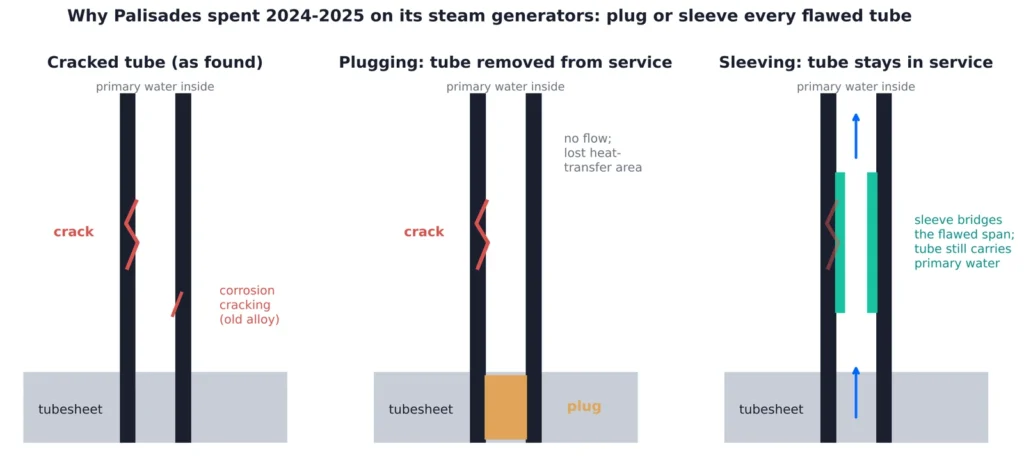
Holtec chose a mix, and had to get a licence amendment to revise the Technical Specifications so that sleeving was an allowed repair, with its own plugging criteria for flaws found in a sleeve or sleeve-to-tube joint.
The NRC’s later position, cited by The Nation, was that the extent of inspection and repair, combined with agency oversight, “provide reasonable assurance that tube integrity will be maintained.”
That phrase, reasonable assurance, is the regulatory standard, not a guarantee. What it means in practice is a steam-generator program with a tighter inspection interval than a plant with new generators would carry.
A Palisades critic, former plant engineer Alan Blind, told CNBC that an incident there “would be devastating for the entire industry.” He is right about the stakes even if you disagree with his conclusion.
The same tube-integrity question is the one Three Mile Island is working through, which I wrote up in the TMI engineering-hurdles piece; I will not repeat the metallurgy here.
By July 2026 Holtec announced that the major refurbishment projects were done: reactor vessel inspections, head-penetration replacements, the steam-generator tube campaign, primary-system decontamination and passivation, and operator training. New fuel was on site. From the outside, the plant looked ready to load.
Delay two: the fuel assembly that tipped over
This is the part I want to spend time on, because the news coverage got the facts right and the meaning mostly wrong.
What happened, per Holtec and the NRC
Palisades entered Mode 6, the refueling condition, and began loading fuel into the reactor vessel on 30 August 2026. The core holds 204 fuel assemblies, a mix of fresh fuel and partially burned assemblies left over from the plant’s last operating cycles.
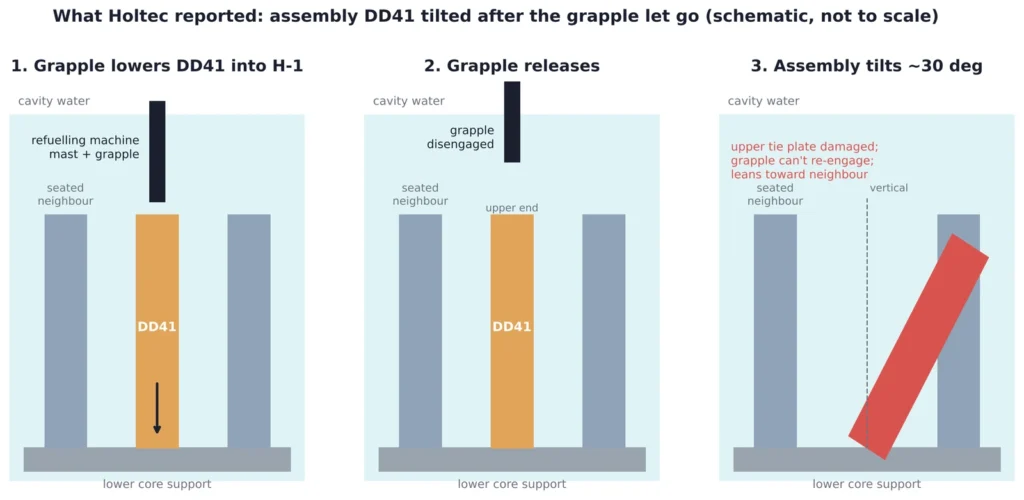
Holtec’s own progress report says the first eight assemblies went in by the next day. Then, in the company’s words from its Holtec Highlights report: “one fuel assembly tilted from its upright position after it had been placed, and the fuel-handling machine grapple had been disengaged.”
The licence amendment request Holtec later filed, summarized by ANS Nuclear Newswire, gives the details the press release did not: the assembly was DD41, it was placed in core location H-1, it came to rest at roughly 30 degrees from vertical, its fuel rods kept their integrity, and no neighbouring assembly was affected.
Visual inspection found damage to the upper tie plate severe enough that the refueling machine’s grapple could no longer engage it. That last fact is the whole reason the recovery took seven weeks.
Why “after the grapple released” matters
A PWR fuel assembly is a tall, slender thing: at Palisades, a 15×15 lattice of 216 rods, about 12 feet long, weighing over a thousand pounds. It stands upright because its lower end fitting seats on pins in the lower core support structure and its neighbours constrain it on four sides.
The refueling machine lowers it on a mast, the operator confirms it is seated by load-cell reading and by camera, and only then releases the grapple.
An assembly that tilts after release was not fully seated when the operator let go. The usual reasons are an interference at the lower end fitting, a neighbour not quite square, debris, or a pin alignment issue.
When I am directing fuel moves, the load cell dropping to zero and the camera showing the nozzle flush are the two signals we require before the grapple opens. Something in that verification step did not catch the problem at H-1. The NRC has said it is still looking into why the assembly tipped, and that is the question that matters, more than the recovery.
Two things are worth saying plainly.
First, this was not a radiological event. The assembly stayed under tens of feet of borated water, the NRC said the event did not meet its reporting thresholds, and NRC inspectors had been watching every fuel move since loading began.
Second, it was a bigger deal than Holtec’s three-week silence suggested. Holtec did not acknowledge the event publicly until 21 September, after a news report forced it, and that gap is part of why the culture letter a month later landed the way it did.
The recovery: why it needed a licence amendment
Normal fuel handling at a PWR never leaves the water. An assembly travels from the core, through the transfer tube, into the spent fuel pool, submerged the entire way. The transfer system is built around a vertical assembly held by a grapple on its upper end fitting. With that fitting damaged, none of the approved equipment could pick DD41 up.
Holtec’s engineering group designed and built a custom fuel movement device and a fuel transfer canister in about two weeks, then filed a licence amendment on 30 September asking for one-time permission to use them.
The NRC approved it on 13 October. The route, from the NRC’s and ANS’s descriptions, was this: the containment polar crane lifts the assembly with the custom device while keeping it under at least 10 feet of water in the cavity; the assembly is laid horizontally inside the engineered canister; the canister is sealed, drained, and taken out of containment through the equipment hatch; a trolley carries it across the auxiliary building; and a single-failure-proof crane rotates it upright and lowers it into the spent fuel pool.
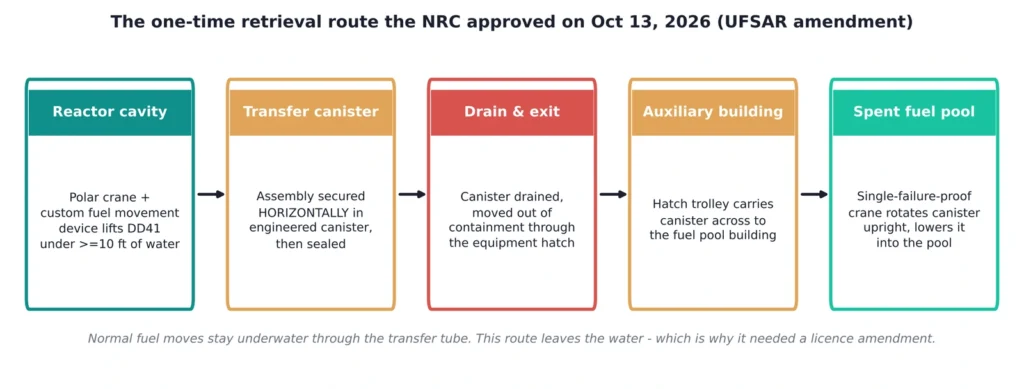
The reason this needed a licence amendment rather than a procedure change is that the plant’s updated final safety analysis report describes how fuel is handled and what accidents that handling could cause.
A dry, horizontal assembly moving through an equipment hatch is not in that analysis. Holtec had to show the canister would contain any release if the assembly were dropped, and the NRC had to agree before the lift.
Critics, including Union of Concerned Scientists’ Edwin Lyman, pointed out that moving fuel out of water carries risk that the normal route does not. That is true, and it is why the amendment was reviewed rather than rubber-stamped. The lift happened on 21 October and went cleanly; DD41 is now in the spent fuel pool and loading resumed.
What the news coverage missed: one damaged assembly can cost you four
Here is the part no one outside core design talks about, and it bears directly on how much more work Palisades may have ahead.
A PWR core is not loaded as 204 independent decisions. It is designed in a symmetric pattern so that the power distribution comes out balanced. Most plants design to quarter-core symmetry, where the core is split into four quadrants and each position in one quadrant has three mirror-image twins in the other three.
Some design to eighth-core symmetry, where each position has seven twins. The published literature on reload design puts it directly: for each assembly in a quarter-core position there are four, and in an eighth-core position eight, assemblies with the same neutronic properties in the core.
Palisades specifically moved from eighth-core to quarter-core symmetric patterns years ago, for a reason recorded in an NRC safety evaluation: quarter-core symmetry gave the designers more freedom to keep high-power fuel away from the vessel wall and reduce fast neutron fluence on an embrittlement sensitive vessel.
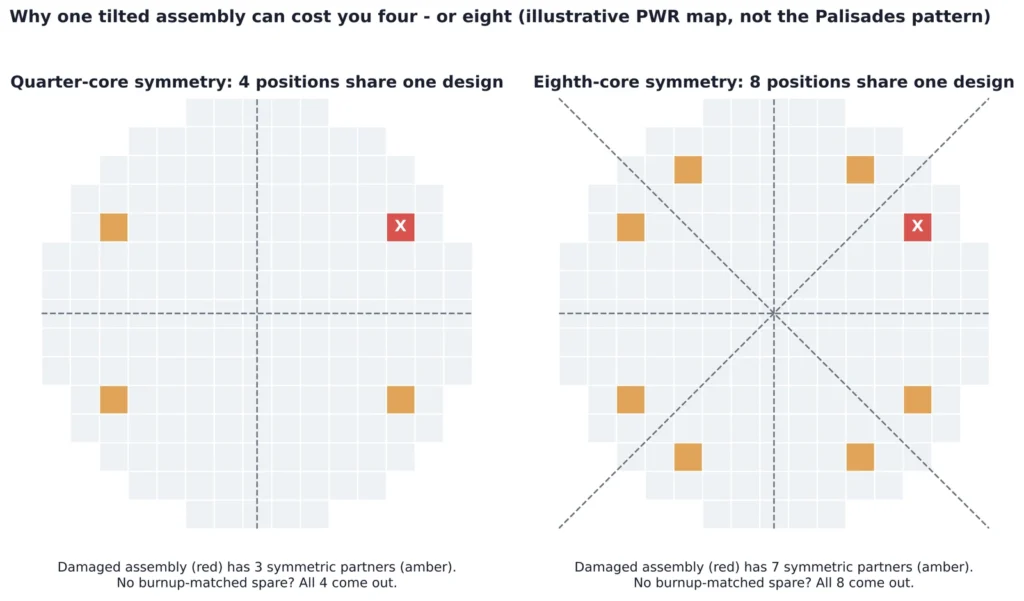
Now apply that to DD41. Palisades designs to quarter-core symmetry, so H-1 has three twins elsewhere in the core, four assemblies in total that were chosen to carry the same enrichment and burnup; the eighth-core case in Figure 5 is background, not the Palisades situation.
Column 1 is also the periphery, where a low-leakage pattern parks its highest-burnup fuel, which fits DD41 being a previously used assembly. DD41’s burnup, and therefore its reactivity, is specific.
The core designer has two options. If there is a spare assembly in the pool with essentially the same enrichment and burnup, it slots into H-1 one-for-one and the pattern holds.
If there is not, the honest fix is to pull all four symmetric positions and replace them with a matched set, because an asymmetric core has to be re-analyzed for power peaking, quadrant power tilt limits, and shutdown margin, and that analysis takes longer than the fuel move does.
Palisades does have a pool of discharged assemblies from the final cycles to choose from, which is the one real advantage a restart has over a new core. But whether a burnup-matched spare existed, and whether the core design had to change, is something Holtec has not said.
The NRC has also not reported whether the lower core structure at H-1 was inspected for damage from a thousand-pound assembly leaning on it for seven weeks. Those two unanswered questions are, to me, the real schedule risk left in the fuel load.
Those two unanswered questions are, to me, the real schedule risk left in the fuel load. I described how this design liaison works day to day in What a Reactor Engineer Actually Does.
Delay three: the chilled work environment letter
On 13 October 2026, the same day it approved the fuel-recovery amendment, the NRC issued Holtec a chilling-effect letter. The letter itself is public.
The finding: the inspection team “substantiated the presence of a chilled work environment within the supply chain and quality assurance departments at Palisades.”
Employees in those two groups told inspectors they hesitated to raise safety concerns through all available channels for fear of retaliation. The biggest challenge staff named was “work planning, coordination, and communication.”
The NRC’s press release was careful to limit it: no violations, no significant plant safety issues, two departments only, and the agency does not expect it to affect the planned restart. Holtec has to brief staff, commission an independent evaluation, and file a corrective action plan within 30 days, which puts it due around 13 November.
Chilling-effect letters are rare; David Lochbaum, who tracked these for decades at UCS, called this one very rare. And the two departments it names are not random.
Supply chain and quality assurance are the groups that decide whether a replacement part is qualified, whether a commercial-grade item has been properly dedicated, and whether work can stop when the paperwork does not support it.
The letter says the concerns covered “equipment procurement and qualification, work control procedures and whether quality assurance can operate independently.”
If you have read my NQA-1 explainer, you will recognize that independence of the QA organization is not a nicety; it is Criterion I of 10 CFR 50 Appendix B. A restart project under commercial schedule pressure is exactly where that independence gets tested, and a qualified-parts supply chain under pressure is where shortcuts get proposed.
Add to that an October 2025 event in which a worker fell from the refueling bridge into the cavity water, and an August 2026 NRC inspection report with two low-level violations, and you have a picture of a project with more schedule than margin. None of these individually stops a restart. Together they explain why the NRC wrote the letter when it did.
What is left before Palisades makes power
With DD41 out and loading resumed, the remaining sequence is the standard one, and it is not short:
- Finish the core load. All 204 assemblies, each verified by serial number and position against the design, then a full-core map by underwater camera before the head goes on.
- Reassemble the vessel. Head on, studs tensioned, head-penetration leak checks on the new nozzles.
- Mode 5 to Mode 3. Fill and vent, heat up the primary on reactor coolant pump heat to normal operating temperature and pressure, and run the hot-shutdown surveillances.
- Mode 2 and initial criticality. Approach to criticality on boron dilution and rod withdrawal, with 1/M monitoring, then low-power physics testing: critical boron, rod worths, moderator temperature coefficient. I walked through that sequence in How a Nuclear Reactor Starts Up, and after four years cold, with a mixed core of fresh and burned fuel, every one of those measurements has to match the design prediction within tolerance before anyone raises power.
- Power ascension. Stepped increases with flux maps at each plateau, steam-generator performance checks on the sleeved tubes, and the turbine-generator back on the grid.
At a plant that runs every 18 months, this is a known three-to-four-week stretch. At a plant that has not been critical since May 2022, with crews that have not done it together, with sleeved steam generators under first-cycle scrutiny, and with an NRC resident staff that just wrote a chilling-effect letter, I would not bet on the short end of that range.
Will it restart by December? An honest read
The Energy Secretary’s “end of November” is a hope, not a schedule, and the NRC’s own words should be weighed more heavily: the agency said on 13 October that the culture finding is “not expected to affect the planned restart.”
That is confidence in the plant’s technical state, not a date. From the technical side, nothing public suggests a showstopper. The steam-generator question has been argued and settled under reasonable assurance; the fuel assembly is out; the corrective-action plan is procedural.
What the record does suggest is that Holtec’s restart dates have been optimistic every single time, by months, and that the two unanswered engineering questions, the root cause at H-1 and any core-design consequence of losing DD41, are the kind that quietly add weeks.
My read: criticality in the first quarter of 2027 is more likely than power in 2026, and the March 2027 contract date is the one that is actually driving the project. If they beat it, it will be because the fuel load and startup physics went cleanly, and that is the part I would watch most closely.
The bigger point for the industry is the one the NRC itself made at its Regulatory Information Conference: Palisades is the template. Duane Arnold in Iowa and Three Mile Island Unit 1 are both watching how much of this schedule was first-of-a-kind learning and how much was avoidable. The restart case I made in Can You Restart a Nuclear Reactor? still stands: the physics allows it. Palisades is the proof that the physics was never the hard part.
Frequently Asked Questions
When will the Palisades nuclear plant restart?
There is no official date. Holtec says the plant will return to service when all required work is complete and federal requirements are met. Energy Secretary Chris Wright said on 29 October 2026 that he hopes for the end of November 2026. The contractual deadline to supply power is March 2027. Based on the remaining fuel load, vessel reassembly, heat-up, and startup physics testing, early 2027 is a more realistic expectation than 2026.
What happened to the fuel assembly at Palisades?
On 30 August 2026, during core loading, a partially used fuel assembly designated DD41 tilted about 30 degrees after the refueling machine’s grapple had released it in core location H-1. The fuel rods stayed intact and no other assembly was affected, but the upper tie plate was damaged so the normal grapple could not retrieve it. The NRC approved a one-time licence amendment on 13 October 2026 for a custom lifting device and transfer canister, and the assembly was moved to the spent fuel pool on 21 October. Fuel loading then resumed.
Was the Palisades fuel loading incident dangerous?
No radiation was released and no one was hurt. The assembly stayed submerged in borated water inside the reactor cavity, and the NRC determined the event did not meet its formal reporting thresholds. The recovery route did take the sealed canister out of water, which is why it needed NRC review and approval before the lift.
Why did the NRC send Holtec a chilled work environment letter?
An NRC inspection in 2026 found that employees in the Palisades supply chain and quality assurance departments were hesitant to raise safety concerns for fear of retaliation. The 13 October 2026 letter found no violations and no significant plant safety issues, and the NRC said it does not expect the finding to affect the restart. Holtec must file a corrective-action plan within 30 days and have the work environment independently evaluated.
Why was the Palisades restart delayed in the first place?
The first and largest delay came from the steam generators: 2024 inspections found more than 1,400 corrosion-cracking indications in over 1,000 tubes, requiring a sleeving and plugging campaign and a licence amendment. Later delays came from remaining refurbishment work, NRC questions on the repairs, the August 2026 fuel-assembly incident, and a leadership and workforce reshuffle reported in November 2026.
Who owns the Palisades nuclear plant?
Holtec International, through its Palisades Energy subsidiary, bought the plant from Entergy in 2022 for decommissioning and then chose to restart it. The restart is supported by a $1.5 billion US Department of Energy loan guarantee and a $300 million State of Michigan grant. Holtec also plans two SMR-300 small modular reactors on the same site.
Sources and Further Reading
- NRC, NRC Approves Palisades License Amendment Request, 14 Oct 2026.
- NRC, NRC Issues Chilling Effect Letter to Holtec, 13 Oct 2026; letter ML26286A257.
- NRC, Palisades licence amendment: Technical Specifications to support repairing steam generator tubes by sleeving (ML25149A013).
- NRC, Palisades safety evaluation on quarter-core symmetric loading patterns and the PIDAL incore analysis (ML20095G752).
- Holtec International, Progress Report on Palisades’ March to Startup, Sep 2026.
- ANS Nuclear Newswire, NRC reviews LAR on Palisades fuel loading incident; NRC allows alternate approach to removing tilted fuel assembly; RIC session on reactor restarts.
- World Nuclear News, Fuel loading under way for Palisades restart, 1 Sep 2026; Palisades re-enters operational status, Aug 2025.
- Michigan Public, Fuel loading to resume at Palisades after workers remove damaged fuel assembly, 22 Oct 2026.
- CNBC, Michigan nuclear plant shows the challenges the U.S. will face in safely restarting old reactors, Mar 2025.
- Latitude Media, Is nuclear finally moving faster?, 12 Nov 2026 (summarizing Axios reporting on Palisades delays).
- Utility Dive, Palisades restart on track for October 2025, Sep 2024.
- Annals of Nuclear Energy, Automatic PWR loading pattern design using ant colony algorithms (quarter- and eighth-core symmetry).
About The Author
Elliot Marsh is a working reactor engineer who takes commercial reactors critical and with hands-on experience in reactor physics, core management, reactivity control and fuel-cycle planning at an operating power station. He writes about nuclear energy for readers who want the engineering reality, not the press release.
Need content like this for your company?
I write white papers, technical explainers, and thought-leadership for nuclear vendors, reactor developers, and the agencies that serve them — accurate enough for engineers, clear enough for buyers.