What a Reactor Engineer Actually Does
Ask most people what a reactor engineer does and they picture someone sitting at a desk doing paperwork about a reactor. The reactor I work on runs about 40 feet from where I’m standing when we load it, and during a refueling outage I’m up on the deck above it, in a dosimeter, calling where every fuel assembly goes.
That’s the part that surprises people. A reactor engineer isn’t a back-office calculation job, and it isn’t the person flipping switches either. It’s a specific role with its own hands-on work, and most explanations of nuclear jobs skip right over it. So here’s what a reactor engineer does — start to finish, from the inside.
First, the part everyone gets wrong: engineer vs. operator
When a reactor goes critical, two different people are doing two different jobs, and they get confused constantly.
The reactor operator holds a license from the Nuclear Regulatory Commission and physically runs the plant. Their hands are on the controls. They move the rods, line up the valves, start the pumps. If something has to happen to the reactor right now, they’re the ones who make it happen.
I’m the reactor engineer. I don’t touch the controls. What I do is analyze the core design, predict exactly how it should behave, and then — during a startup — direct the moves and check that the reactor is doing what my numbers said it would.
The operator asks “how much dilution, and when do we pull rods?” and I’m the one with the answer. They execute. I verify.
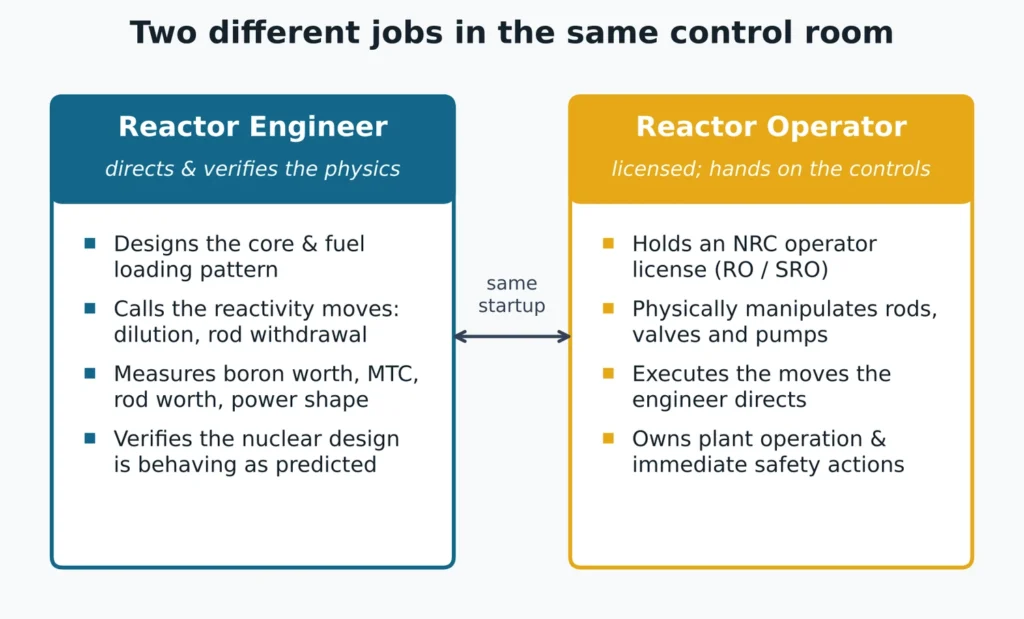
That distinction matters because it shapes everything else I do. My product isn’t a running plant. My product is a core design that behaves on the day exactly the way I predicted it would on paper, months earlier.
The quiet part of the job: watching the core all cycle long
Most of the year there’s no outage and no startup. The reactor just runs. That doesn’t mean I’m idle — it means I’m measuring.
A reactor core isn’t uniform. Power is produced unevenly across it, and that distribution shifts as fuel burns and as conditions change. My job is to keep an eye on the shape of it. That means regular flux maps — detectors moved through the core to measure where the power actually is — and comparing that measured shape against what the design predicted. If the two drift apart, I want to know why before it becomes a problem.
A few of the things I track on a routine basis:
- Core power distribution and flux mapping — is power peaking where I expect, and within limits?
- Axial flux — how power is split between the top and bottom of the core, which xenon loves to push around after a power change.
- Quadrant power tilt — is one quarter of the core running hotter than the others? A small tilt is normal; a growing one is a question that needs an answer.
- Critical boron concentration — the boron level in the coolant that holds the reactor exactly critical, which creeps down predictably as fuel depletes. If the measured value walks away from the predicted curve, that’s a signal.
- Excore nuclear instrumentation — the detectors outside the vessel that the operators watch continuously, which I help keep calibrated against the real power.
- Power Coastdown Strategies — in order to operate the reactor at low power beyond design fuel cycle length , If needed.
None of this is dramatic. It’s bookkeeping against physics. But it’s the bookkeeping that catches the thing you didn’t expect, and in this field the things you didn’t expect are the ones worth catching early.
Before the outage: the design problem
Long before any fuel moves, there’s a design question to settle: when we open the reactor and reshuffle it, where does every fuel assembly go?
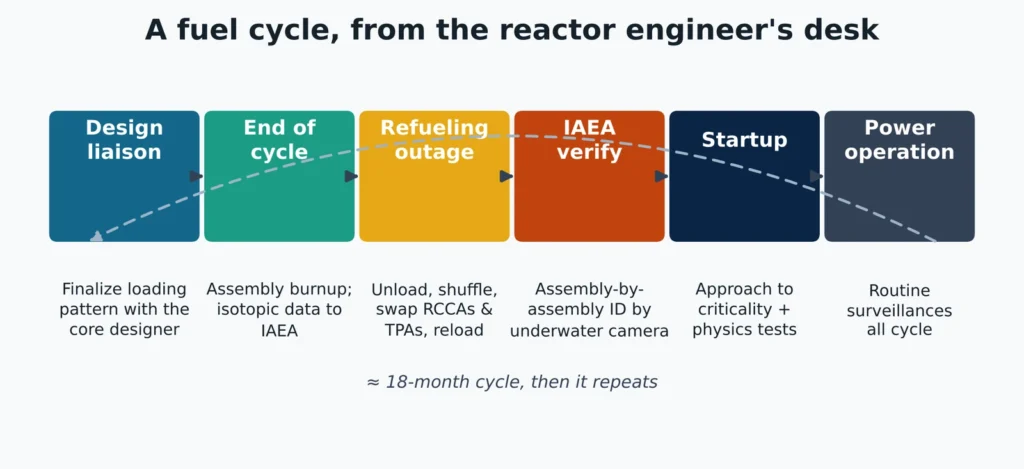
This is where I work closely with the fuel and core designer. We finalize the loading pattern — the map of which assemblies are fresh, which are once burnt, which are twice burnt, and exactly which position each one sits in.
what happens when an assembly does not seat ? See my Palisades explainer on this
It’s not arbitrary. Modern cores use low leakage patterns, where the most burned assemblies tend to sit toward the outside and fresher fuel sits inboard, to flatten power, reducing neutron fluence on reactor pressure vessel (RPV) and get more energy out of each kilogram of uranium.
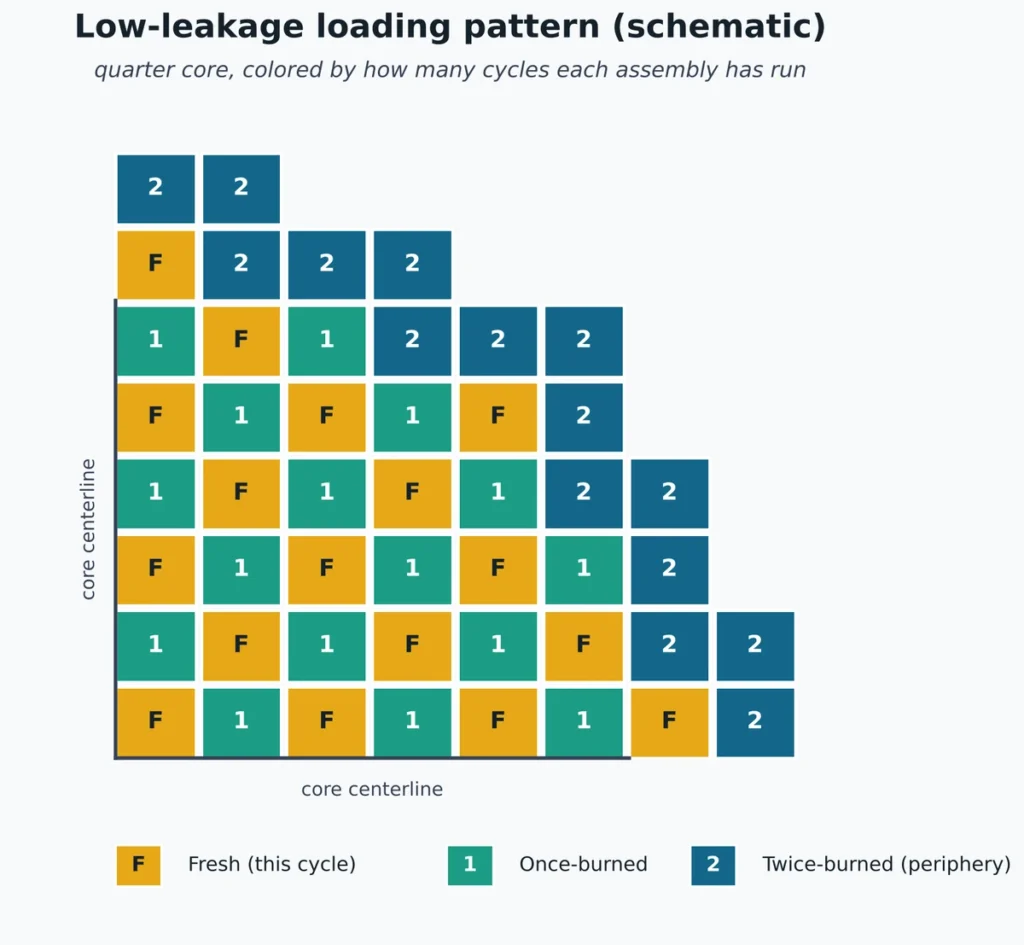
At the end of a cycle, I also account for where the fuel ended up. Every discharged assembly has a burnup — how much energy it produced — and an isotopic inventory that goes with it.
That inventory matters beyond our plant: the International Atomic Energy Agency uses discharge data as part of tracking nuclear material, and providing it accurately is part of my responsibility.
The outage: standing over an open core
When the plant shuts down for refueling, the reactor engineering work gets physical. The vessel head comes off, the cavity floods, and the core sits open under water. I put on a dosimeter and go in.
The fuel moves happen on my watch. There’s a core unloading sequence, a shuffle of partially burned assemblies to new positions, and then the fresh fuel goes in, an exchange of core components — the rod cluster control assemblies (RCCAs) or control rods and the thimble plug assemblies (TPAs) get moved around to match the new pattern.
Every move follows the loading pattern we finalized months earlier. My job is to make sure each assembly ends up exactly where the design says it belongs, because a single assembly in the wrong spot is a real problem, not a rounding error.
Watching a few hundred fuel assemblies get rearranged under thirty feet of water, one at a time, is slow and exacting. It’s also, honestly, one of the better views in the job.
Verifying the core with IAEA inspectors
After the core is fully loaded, before we button the vessel back up, there’s a step a lot of people don’t know happens: we verify the core assembly by assembly, with IAEA safeguards inspectors standing right there.
Each fuel assembly carries an identification number. Using an underwater camera, the inspectors and I confirm the identity of the assemblies against the records — checking that what’s in the core is exactly what’s supposed to be in the core, and that nothing has gone missing or been substituted.
The IAEA has its own tools for this kind of work, including Cherenkov viewing devices that use the faint blue glow of irradiated fuel to tell real spent fuel from a dummy.
It’s meticulous and a little tedious, and that’s the point. The international system that keeps civilian nuclear material accounted for runs, in part, through moments exactly like this one — an engineer and an inspector looking at the same serial number on the same assembly and agreeing it’s where it should be.
Startup: taking the reactor critical
This is the part I’d happily talk about for an hour, so I’ll keep it tight here and point you to the full write-up.
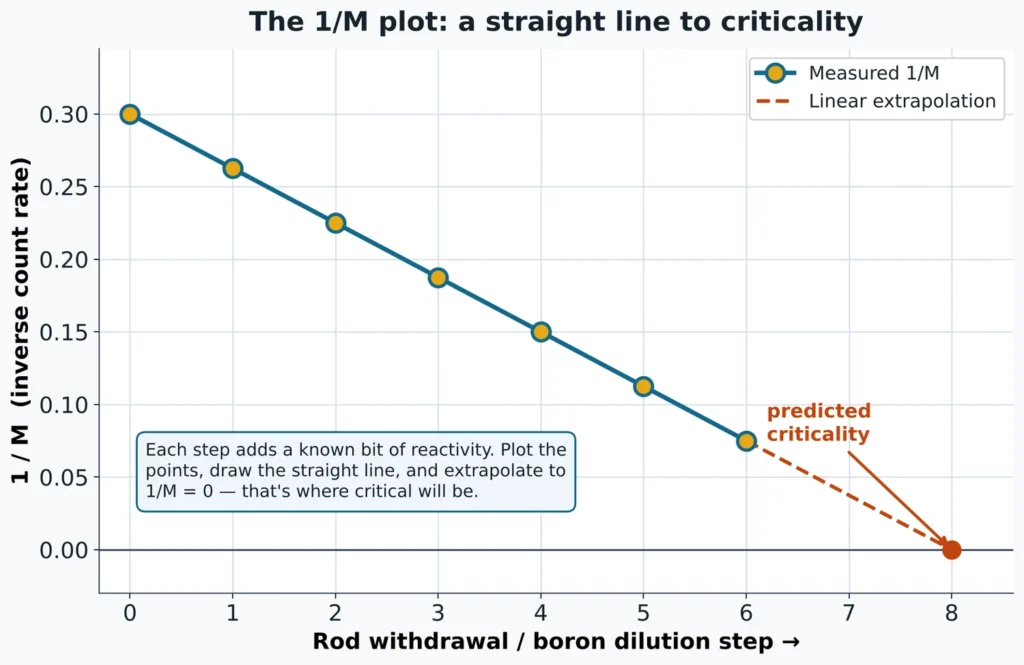
Once the reactor is reassembled, I set up my workstation in the main control room and brief the shift supervisor and operators on how criticality will go: how much we’ll dilute the boron, when to start withdrawing rods, and roughly where the rods should be when the reactor comes critical. Then we start, and I watch the neutrons.
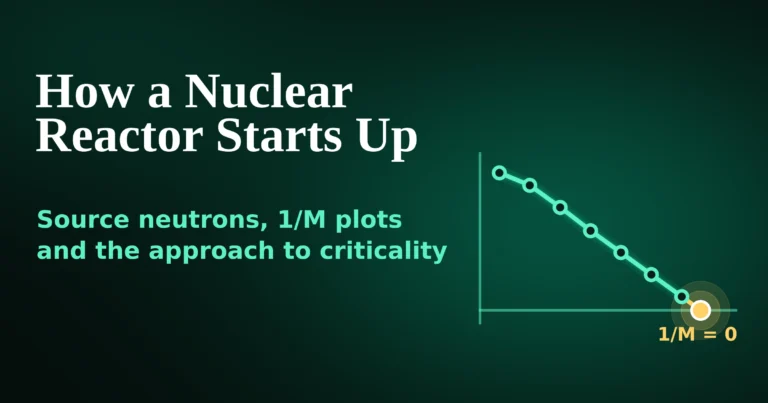
The core is subcritical at first, with just source neutrons multiplying. As we add reactivity step by step, the count rate climbs, and I track it on a 1/M plot — inverse count rate against our moves.
The curve bends toward zero, and extrapolating it tells us where criticality will be before we actually get there. That’s the whole trick to doing this safely: you predict the floor before you reach it.
What makes this controllable at all is delayed neutrons. A tiny fraction of fission neutrons — about 0.65% for uranium-235 — don’t appear instantly; they come out seconds to minutes later, from decaying fission products. That small delayed fraction stretches the reactor’s response from microseconds to something a human can actually manage. Without it, this job wouldn’t exist in anything like its current form.
I’ve written more on how reactivity gets controlled in the first place, and on the boron and control rods that do the controlling.
Once we’re critical, I keep power low — below the point (also know as doppler heating point or point of heat addition) where the fuel starts heating meaningfully — so that temperature feedback doesn’t distort the measurements I’m about to take.
At this hot zero power (HZP) condition I run the startup physics tests: the critical boron endpoint, the moderator temperature coefficient (it has to come out negative, so a rise in coolant temperature pushes power down, not up. I have shown it in this video on our YouTube channel), the worth of the control rods, and the power distribution.
These tests are standardized — PWR reload startups follow ANSI/ANS-19.6.1 — and they’re the final confirmation that the core I designed on paper is the core that’s now sitting in the vessel.
Want the full startup sequence? The approach to criticality, delayed neutrons, and the moment at the panel get their own detailed walkthrough in How a Nuclear Reactor Starts Up. This article is about the whole job; that one is about the startup itself.
About the radiation — since everyone asks
I stand over an open reactor core and the spent fuel pool, I eat lunch on site, and I live close enough to see the containment building on my drive in. People assume that adds up to a lot of radiation. It doesn’t.
I wear a dosimeter every time I go in, and over a full year my occupational dose comes in well under what I’d pick up from a couple of long flights to see family. The regulatory limit for a radiation worker in the US is 50 mSv per year; the limit for a member of the public from licensed operations is 1 mSv per year. In the older US units that’s 5 rem and 100 millirem; here’s how sieverts and rem compare.
Real worker doses sit far below the occupational cap, because the whole radiation protection program is built around keeping exposure as low as reasonably achievable (ALARA)— the time-distance-shielding discipline that governs every move in the fuel building.
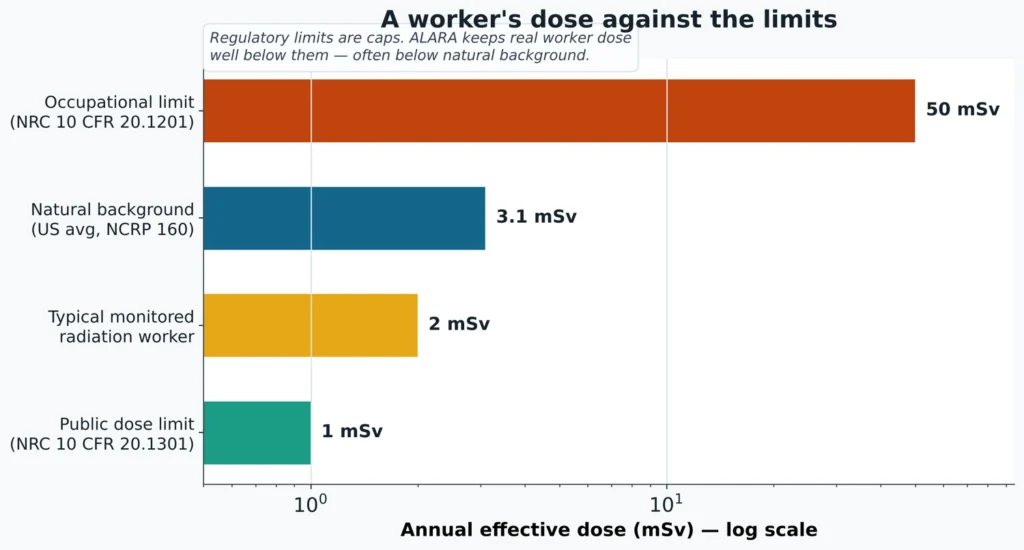
If you want the full picture of what radiation doses actually mean and where real harm starts, I went deep on it in How Much Radiation Is Actually Dangerous?
So how do you become one?
There’s no single path, but the common thread is physics. In my case it was a physics degree, then a master’s in nuclear science and technology, then years on a commercial pressurized water reactor fleet learning the core management and reactivity side of the work from people who’d done it for decades.
The classroom gets you the neutron transport, the kinetics, the reactor theory. Everything after that — reading a neutron flux map at a glance, knowing when a quadrant tilt is nothing and when it’s something, calling a startup with a control room full of people waiting on your number — comes from doing it, next to people who already can.
You don’t learn to take a reactor critical from a textbook. You learn it standing at the panel, the first few times with someone more experienced watching over your shoulder, until one day the someone watching is you.
Frequently asked questions
Is a reactor engineer the same as a reactor operator?
No. A reactor operator is licensed by the NRC and physically runs the plant — their hands are on the controls. A reactor engineer designs the core, predicts its behavior, directs the physics during a startup, and verifies that the reactor matches the design. The operator executes; the engineer designs and checks.
What does a reactor engineer do day to day?
Outside of outages, most of the work is plant surveillances: flux mapping and core power distribution, axial flux and quadrant power tilt, tracking critical boron concentration against the predicted curve, and supporting the excore instrumentation. During an outage and startup, the work shifts to fuel moves, core verification, and startup physics testing.
Do reactor engineers work in the control room?
During a reactor startup, yes. The engineer sets up a workstation in the main control room, briefs the operators on how criticality will proceed, and directs the reactivity moves while watching the neutron count rate. Outside of startups, much of the work is in the plant and at the desk.
What degree do you need to be a reactor engineer?
Typically a degree in nuclear engineering or physics; many reactor engineers hold a graduate degree in a nuclear or radiation field. Beyond the degree, the role is learned on the job through core management and startup experience on an operating plant.
Is working near a reactor dangerous because of radiation?
Occupational dose for reactor engineering work is tightly controlled and monitored with a personal dosimeter. In practice, a year’s occupational dose is usually a small fraction of the regulatory limit, and often less than natural background radiation, because the radiation protection program is built around keeping exposure as low as reasonably achievable.
Sources and Further Reading
- U.S. NRC — 10 CFR 20.1201, Occupational dose limits for adults
- U.S. NRC — 10 CFR 20.1301, Dose limits for individual members of the public
- U.S. DOE — Fundamentals Handbook: Nuclear Physics and Reactor Theory (DOE-HDBK-1019)
- U.S. DOE / OSTI — Optimization of core reload design for low-leakage fuel management in PWRs
- NCRP — Report No. 160, Ionizing Radiation Exposure of the Population of the United States
- American Nuclear Society — ANSI/ANS-19.6.1, Reload Startup Physics Tests for Pressurized Water Reactors
- IAEA — Safeguards and verification and safeguards in practice
About The Author
Elliot Marsh is a working reactor engineer who takes commercial reactors critical and with hands-on experience in reactor physics, core management, reactivity control and fuel-cycle planning at an operating power station. He writes about nuclear energy for readers who want the engineering reality, not the press release.
Need content like this for your company?
I write white papers, technical explainers, and thought-leadership for nuclear vendors, reactor developers, and the agencies that serve them — accurate enough for engineers, clear enough for buyers.