Radiation Units Explained: Sieverts, Grays, Rem and Roentgen, With Real Examples
Quick answer:
- Gray (Gy) measures how much radiation energy your body absorbed.
- Sievert (Sv) measures how much harm that energy is likely to do.
- Rad and rem are the older American versions of those two: 1 Gy = 100 rad, and 1 Sv = 100 rem.
- Roentgen (R) is older still. It measures how much X-rays or gamma rays ionize the air, not your body. For everyday safety work, 1 R is treated as about 10 mSv.
- For gamma rays and X-rays, 1 gray works out to 1 sievert.
If that’s all you needed, the radiation dose converter will do the arithmetic for you. If you want the radiation units explained properly, so that “3.6 roentgen” or “7 mSv” stops sounding like a foreign language, read on.
Why there are so many radiation units
I’m a reactor engineer. During a refueling outage I stand over an open reactor core with a dosimeter clipped to my chest. That dosimeter reads in millirem. The textbook on my desk uses grays and sieverts. And the old survey meters in the training lab still read in roentgen per hour.
Three units, one job. And I haven’t even mentioned becquerels yet.
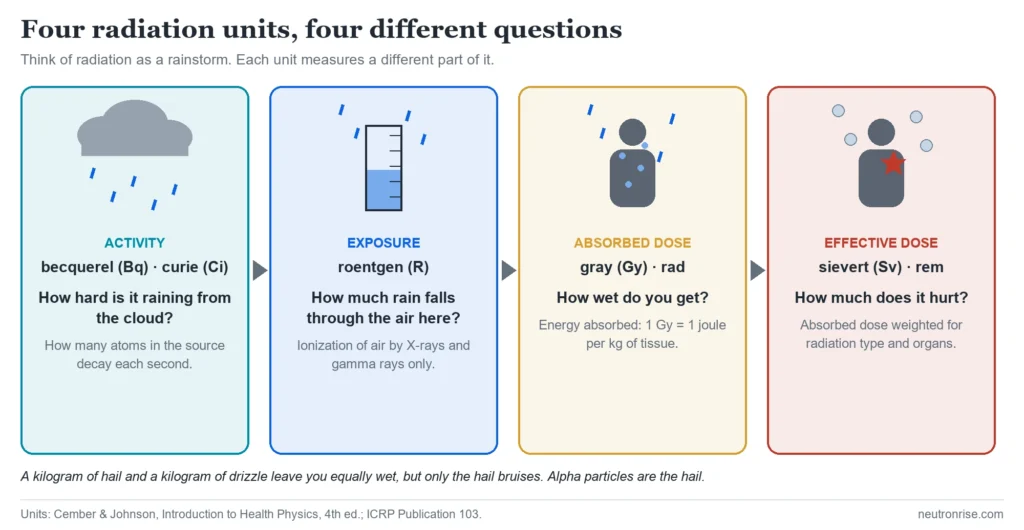
The reason is not that physicists enjoy confusing people. Each unit answers a different question about the same radiation:
- How much radiation is the source giving off?
- How much of it is passing through the air where you’re standing?
- How much energy did your body actually soak up?
- How much harm is that energy likely to do?
On top of that, there are two systems: the modern international units (becquerel, gray, sievert) and the older American ones (curie, rad, rem, roentgen). Four questions times two systems is how you end up with eight units on one topic.
The rain analogy that makes it click
Picture a rainstorm.
- The cloud is the radioactive source. How hard it’s raining from the cloud is its activity, measured in becquerels (Bq) or curies (Ci). One becquerel is one atom decaying per second.
- The rain gauge in your yard measures how much rain is falling through the air at that spot. That’s exposure, measured in roentgen (R). It only works for X-rays and gamma rays, and it measures their effect on air.
- How wet you get is the absorbed dose: how much energy actually lands in your body. That’s the gray (Gy) or the rad. One gray is one joule of energy in one kilogram of tissue.
- How much it hurts depends on more than how wet you get. A kilogram of drizzle and a kilogram of hailstones leave you equally wet, but only one of them leaves bruises. That weighted “harm” number is the sievert (Sv) or the rem.
Keep that picture in mind. Every confusing radiation number you’ll ever see is answering one of those four questions and every one of the radiation units below belongs to one of them.
Becquerel and curie: how active is the source?
The becquerel counts atoms decaying per second. It describes the source, not you.
A banana contains roughly 15 becquerels of potassium-40. Your own body contains several thousand becquerels, mostly potassium-40 and carbon-14, simply because you’re made of the same elements as everything else. None of that tells you anything about harm on its own.
You’ve probably met this unit without noticing. In the US, a home radon test reports picocuries per liter (pCi/L), and the EPA recommends fixing your home at 4 pCi/L or above. That’s an activity unit: how much radioactive gas is in the air of your basement.
One important point most unit converters get wrong: you cannot convert becquerels to sieverts with a single factor. A becquerel of radon you breathe in, a becquerel of cesium in a sealed source across the room, and a becquerel of potassium in a banana all give very different doses.
To get from activity to dose you need to know which isotope it is, how far away you are, how long you’re exposed, and whether it’s inside or outside your body. That’s a calculation, not a unit conversion. For a sealed gamma source, the gamma dose-rate and shielding calculator does exactly that calculation.
Roentgen: what does it measure, and why do converters disagree?
The roentgen is the oldest unit here, named after Wilhelm Röntgen, who discovered X-rays. It measures how many ions X-rays or gamma rays create in a kilogram of air (1 R = 2.58 × 10⁻⁴ coulomb per kilogram).
It’s the rain gauge, not the person standing in the rain. Because it’s defined in air, there’s no single exact factor that turns roentgen into a dose to a human body. That’s why you’ll find three different answers online:
| Conversion you see online | Where it comes from |
|---|---|
| 1 R = 10 mSv (0.01 Sv) | Radiation-protection convention: 1 R ≈ 1 rad ≈ 1 rem. Round, simple, slightly cautious. |
| 1 R = 8.77 mGy | The energy 1 R deposits in air (air kerma). |
| 1 R ≈ 9.3–9.6 mGy | The energy deposited in soft tissue (muscle) for typical gamma energies. |
None of them is a typo. They answer slightly different questions. For safety work, 1 R ≈ 10 mSv is the one to remember. The radiation dose converter uses that by default and lets you switch to the air-kerma value if your instrument is calibrated that way.
One more catch: the roentgen only applies to X-rays and gamma rays. There’s no such thing as a roentgen of alpha particles or neutrons.
Gray and rad: how much energy did your body absorb?
The gray (named after British physicist Louis Harold Gray) is the honest physics number: joules of radiation energy per kilogram of tissue. The rad (“radiation absorbed dose”) is the older unit: 1 Gy = 100 rad.
Here’s a real-world place you’ll see it. If you’ve had a CT scan, the dose report usually lists numbers in milligray, labelled CTDIvol (mGy) and DLP (mGy·cm). Those describe the radiation the scanner put out, in gray. The millisievert figure your doctor quotes is an estimate worked out from them.
The gray also matters for big, sudden doses. Radiation sickness, burns and the “lethal dose” thresholds are all set in grays, because at those levels what counts is raw energy destroying cells. I go through those thresholds in How Much Radiation Is Actually Dangerous?
Sievert and rem: how much harm will it do?
Grays have one blind spot: they treat all radiation the same. Biology doesn’t.
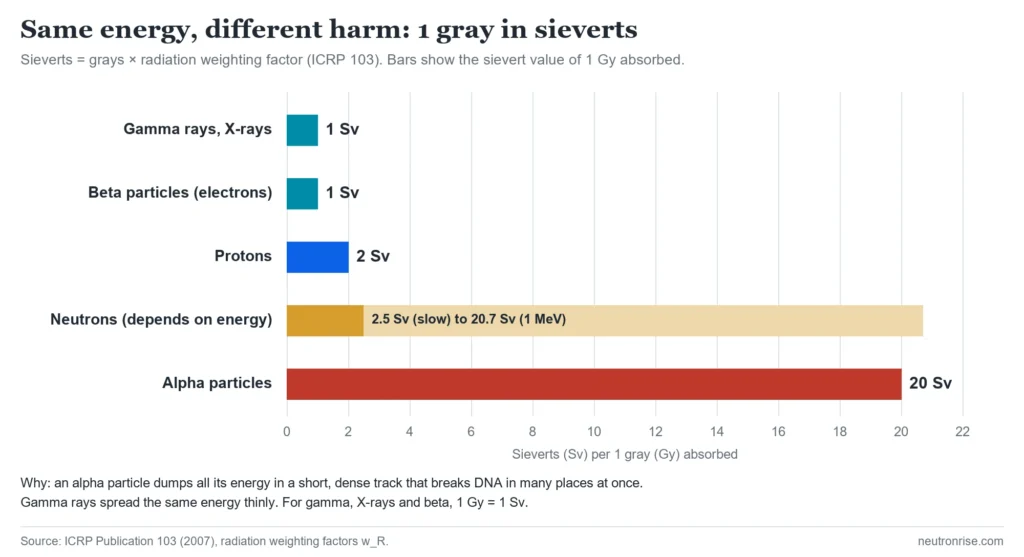
An alpha particle is big and heavy. It dumps all its energy in a tiny, dense track, like a hailstone. A gamma ray spreads its energy thinly, more like drizzle. Same joules, very different damage to DNA.
So the sievert (named after Swedish medical physicist Rolf Sievert) multiplies the gray by a radiation weighting factor:
| Radiation | Weighting factor | 1 Gy equals |
|---|---|---|
| Gamma rays, X-rays | 1 | 1 Sv |
| Beta particles (electrons) | 1 | 1 Sv |
| Protons | 2 | 2 Sv |
| Neutrons | about 2.5 to 20, depending on energy | 2.5–20 Sv |
| Alpha particles | 20 | 20 Sv |
Values from ICRP Publication 103.
The “effective dose” version of the sievert goes one step further and also weights for which organs were hit, so that a dose to the whole body and a dose to one hand can be compared on the same scale.
The rem (“roentgen equivalent man”) is the American version: 1 Sv = 100 rem. US regulations still use it. The NRC limits the public to 100 millirem a year from licensed sources, which is 1 mSv. Radiation workers are limited to 5 rem a year, which is 50 mSv.
Sievert vs gray, in one line: for gamma rays, X-rays and beta, they’re the same number. For alpha particles and neutrons, the sievert number is bigger, because the damage is bigger.
How much is 1 mSv, really?
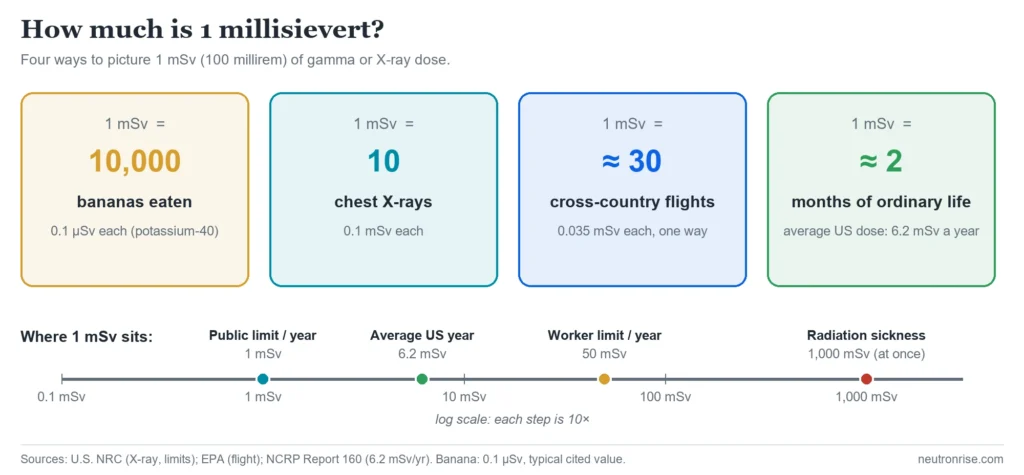
A millisievert is one thousandth of a sievert, and it’s the unit you’ll meet most. Some anchors:
| Dose | In rem | Real-world example |
|---|---|---|
| 0.1 µSv | 0.01 mrem | Eating one banana |
| 35 µSv | 3.5 mrem | One cross-country flight in the US |
| 0.1 mSv | 10 mrem | One chest X-ray |
| 1 mSv | 100 mrem | Public dose limit from nuclear facilities, per year |
| 6.2 mSv | 620 mrem | Average American’s total yearly dose, from nature and medicine |
| 7 mSv | 700 mrem | One CT scan of the chest |
| 50 mSv | 5 rem | Yearly limit for US radiation workers |
| 100 mSv | 10 rem | Lowest dose where large studies can see a cancer-risk increase |
| 1,000 mSv (1 Sv) | 100 rem | Radiation sickness begins, if received all at once |
Sources: U.S. NRC, EPA, NCRP Report 160.
So 1 mSv is about ten chest X-rays, or about thirty cross-country flights, or roughly two months of the radiation an average American already gets. It’s a real dose, and a small one.
Dose vs dose rate: the “per hour” that changes everything
This is the mistake behind most radiation panic online. µSv and µSv/h are different things.
- µSv is a dose: how much you received, total.
- µSv/h is a dose rate: how fast it’s building up. It’s the speedometer, not the odometer.
Turn on a Geiger counter almost anywhere on Earth and it will read somewhere around 0.05 to 0.2 µSv/h. That’s natural background. Leave it running for a year (8,766 hours) at 0.2 µSv/h and the total is about 1.75 mSv.
A rate on its own never tells you the dose. You always have to ask: for how long? The “Dose rate & time” tab in the converter does the multiplication, and it also turns Geiger counter counts per minute (CPM) into µSv/h.
What “3.6 roentgen” really meant at Chernobyl
If you’ve seen HBO’s Chernobyl, you know the line. Shift supervisor Dyatlov is told the reading is 3.6 roentgen, and shrugs it off as “not great, not terrible.”
Now you have the tools to see what was really going on.
First, it’s a rate, not a dose. The meters the crew had topped out at 0.001 roentgen per second, which is 3.6 roentgen per hour. The needle wasn’t reading 3.6. It was pinned at the end of its scale. The high-range instruments that could have measured the real level were inaccessible or destroyed in the explosion. “3.6” was the meter saying at least this much, and I can’t tell you how much more.
Second, what would 3.6 R/h actually do? Using the protection convention, 1 R ≈ 10 mSv, so 3.6 R/h is about 36 mSv per hour.
- After one hour, that’s roughly 360 chest X-rays’ worth. The show’s line about “400 chest X-rays” is about right if you stand there for an hour.
- It’s a lot for one hour, but nowhere near deadly.
- Dyatlov’s shrug would have been reasonable, if the number had been real.
Third, the real number. Estimates of the radiation inside parts of the reactor building that night run to about 20,000 roentgen per hour, more than 5,000 times what the meter showed.
- In grays, that’s in the region of 175 to 200 Gy per hour.
- The dose that kills about half of people without treatment (the LD50, 3 to 4 Gy) would arrive in roughly a minute.
Months later, in December 1986, workers measured the hardened lava below the reactor, the “Elephant’s Foot”, at about 8,000 to 10,000 roentgen per hour. At that rate a lethal dose takes two or three minutes.
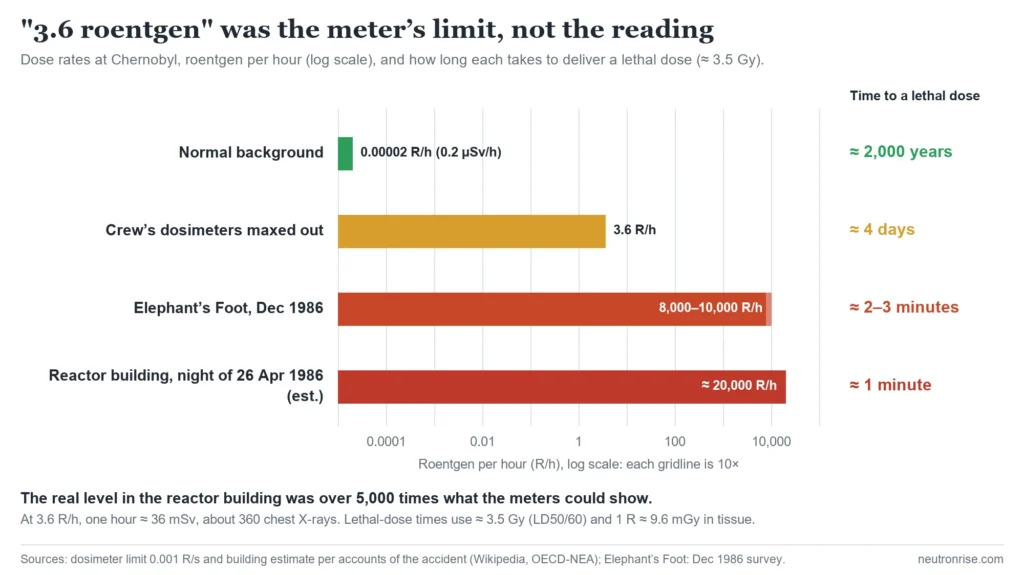
That gap, between 3.6 and 20,000, is the whole tragedy in one unit. The men in the control room weren’t just unlucky. They were reading a rate off an instrument that couldn’t show them the truth, and making decisions as if it could. (If you want the reactor-side story of that night, I cover the graphite-tip flaw in the control rods in Boron Control Rods: How They Work and the Chernobyl Flaw.)
Radiation units explained: The cheat sheet
| What you want to know | SI unit | US unit | Conversion |
|---|---|---|---|
| How active is the source? | becquerel (Bq) | curie (Ci) | 1 Ci = 37 billion Bq |
| How much is passing through the air? (X/gamma only) | coulomb per kg | roentgen (R) | 1 R ≈ 10 mSv (protection rule) |
| How much energy did the body absorb? | gray (Gy) | rad | 1 Gy = 100 rad |
| How much harm will it do? | sievert (Sv) | rem | 1 Sv = 100 rem |
And three rules of thumb that cover most real situations:
- For gamma rays and X-rays, 1 Gy = 1 Sv = 100 rem. Medical imaging and most reactor radiation fall in this group.
- mSv × 100 = mrem. So 1 mSv = 100 mrem, and 50 mSv = 5 rem.
- Always check for “/h”. A rate is not a dose until you multiply it by time.
If a number still doesn’t make sense, type it into the radiation dose converter. It shows the same dose in every unit, compares it to bananas, X-rays and flights, and marks it on a dose ladder from everyday life to lethal.
Frequently Asked Questions
What is a sievert in simple terms?
A sievert is a measure of how much biological harm a dose of radiation is likely to cause. It takes the energy your body absorbed (in grays) and weights it for the type of radiation. One sievert is a large dose. Everyday doses are measured in millisieverts (thousandths) and microsieverts (millionths).
What is the difference between sievert and gray?
Gray measures the energy absorbed per kilogram of tissue. Sievert measures the expected harm from that energy. For gamma rays, X-rays and beta particles, 1 Gy = 1 Sv. For alpha particles, 1 Gy = 20 Sv, and for neutrons it’s between about 2.5 and 20 Sv depending on their energy.
What is the difference between rad and rem?
They are the older American versions of gray and sievert. Rad measures absorbed energy (1 Gy = 100 rad). Rem measures biological harm (1 Sv = 100 rem). For gamma rays and X-rays, 1 rad = 1 rem.
How do you convert roentgen to sievert?
For radiation-protection purposes, 1 roentgen is treated as about 1 rem, which is 10 mSv or 0.01 Sv. Physically, 1 R deposits 8.77 mGy in air. The roentgen only applies to X-rays and gamma rays.
How much is 1 mSv of radiation?
About ten chest X-rays, thirty cross-country flights, or around two months of the natural and medical radiation an average American receives. It is also the yearly limit for public exposure from nuclear facilities.
What did 3.6 roentgen mean at Chernobyl?
It was the maximum reading of the dosimeters the crew had: 0.001 roentgen per second, or 3.6 roentgen per hour. The real level in parts of the reactor building was estimated at about 20,000 roentgen per hour, enough to deliver a lethal dose in about a minute.
Can you convert becquerels to sieverts?
Not with a single factor. Becquerels describe how active a source is; sieverts describe the dose a person receives. Going from one to the other requires knowing the isotope, the distance, the exposure time, and whether the material is inside or outside the body.
What are the main radiation units?
There are four kinds of radiation units, each with an SI and an older US version: activity (becquerel, curie), exposure in air (coulomb per kilogram, roentgen), absorbed dose (gray, rad) and effective dose (sievert, rem). For health questions, the sievert and its US equivalent, the rem, are the ones that matter most.
Sources
- Cember, H. & Johnson, T. E. Introduction to Health Physics, 4th ed. McGraw-Hill, 2009. Unit definitions and roentgen-to-dose conversions.
- ICRP Publication 103 (2007). Radiation weighting factors.
- U.S. NRC, Doses in Our Daily Lives and 10 CFR Part 20 dose limits.
- U.S. EPA, Radiation Sources and Doses and radon action level.
- NCRP Report No. 160 (2009), Ionizing Radiation Exposure of the Population of the United States.
- Chernobyl dosimeter limits and in-building dose-rate estimates: accounts summarized in the Wikipedia article on the Chernobyl disaster and the OECD-NEA Chernobyl: Assessment of Radiological and Health Impacts. Elephant’s Foot readings: widely reported December 1986 survey figures.
About the Author
Elliot Marsh is a working reactor engineer who takes commercial reactors critical and with hands-on experience in reactor physics, core management, reactivity control and fuel-cycle planning at an operating power station. He writes about nuclear energy for readers who want the engineering reality, not the press release.
Need content like this for your company?
I write white papers, technical explainers, and thought-leadership for nuclear vendors, reactor developers, and the agencies that serve them — accurate enough for engineers, clear enough for buyers.