How Much Radiation Is Actually Dangerous?
Ask how much radiation is dangerous and you’ll get two kinds of answer. One is a shrug: “any amount is bad.” The other is a government table nobody reads. Neither helps. So here’s the version I’d give a friend.
The short answer: your body already handles the radiation of ordinary life without noticing it — about 6.2 millisieverts a year, most of it from radon in the ground and medical scans. Real harm doesn’t start until a dose arrives that is hundreds to thousands of times larger, and arrives fast. The number matters, but so does the clock.
I’m a reactor engineer. I take reactors critical. And during a refueling outage, I’m the one responsible for the fuel — making sure every assembly moves exactly where the nuclear design says it should.
That means I clip a dosimeter to my chest, walk into the reactor building, and stand directly over an open reactor core, and over the spent fuel pool, directing the moves and watching them happen. Everyone on that job wears the same badge.
Nobody there is scared of radiation. They respect it, they measure it, and they know the one thing most arguments about it skip: a dose is not a yes-or-no thing. It’s a quantity, on a scale that runs from “a banana” to “fatal in a week.” Once you can see that whole scale at once, the fear sorts itself out.
First, the word “radiation” is doing too much work
People use one word for three different quantities, and that’s where most of the confusion starts. I go through every one of them, rem and roentgen included, in radiation units explained.
Becquerels measure how active a material is — how many atoms are decaying each second. A smoke detector, a granite countertop, your own body all put out becquerels. That number tells you nothing about harm on its own.
Grays measure energy actually absorbed — how many joules land in each kilogram of tissue. This is closer to what matters, but it still ignores that an alpha particle and a gamma ray do very different damage for the same energy.
Sieverts fix that. A sievert is the gray, weighted for the kind of radiation and the tissue it hits, so that one sievert of anything carries roughly the same biological risk. This is the unit worth learning. Doses to the public are small, so we live in millisieverts — thousandths of a sievert, written mSv.
For the reactor and medical radiation most people worry about — gamma rays and beta particles — one gray is about one sievert. I’ll use mSv from here on, because that’s the number on the dosimeter and on your scan report. If your number is in rem, rad, gray or roentgen, the radiation dose converter I built will translate it into mSv.
What a normal year actually looks like
The average person in the United States absorbs about 6.2 mSv a year, and the split surprises almost everyone. Half of it is natural. The other half is medicine.
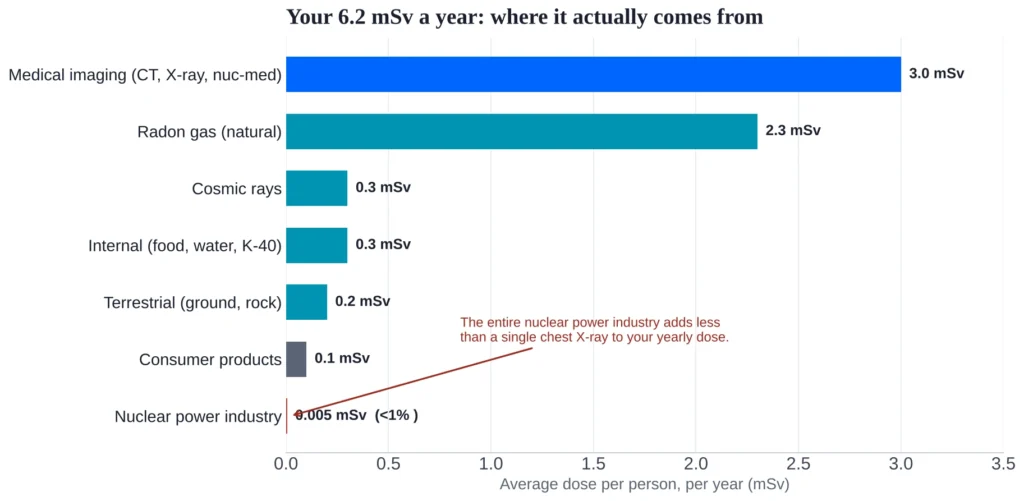
Radon alone — a gas that seeps out of soil and rock and collects in basements — gives the average American about 2.3 mSv, more than a third of the yearly total. Medical scans add roughly 3.0 mSv on average, driven mostly by CT. Cosmic rays, the ground under your feet, and the potassium in your own muscles round out the rest.
The nuclear power industry? Under 0.01 mSv for the average member of the public — the thinnest sliver on the chart, below weapons-test fallout still drifting from the 1950s. That’s not industry spin. It’s the NRC’s own accounting, built on the NCRP’s national survey. If radiation from reactors were a real part of your dose, it would show up here. It doesn’t.
The dose ladder: from a banana to a lethal dose
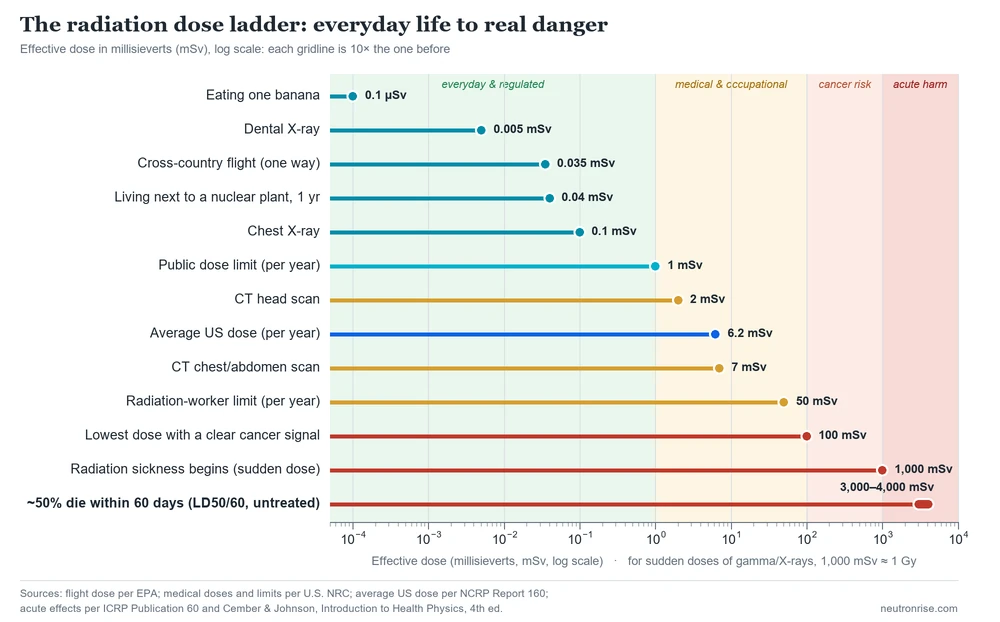
Numbers in isolation don’t mean much. “Seven millisieverts” sounds like either nothing or a catastrophe depending on who’s talking. So put everything on one scale — and because that scale spans a factor of ten million, it has to be a logarithmic one.
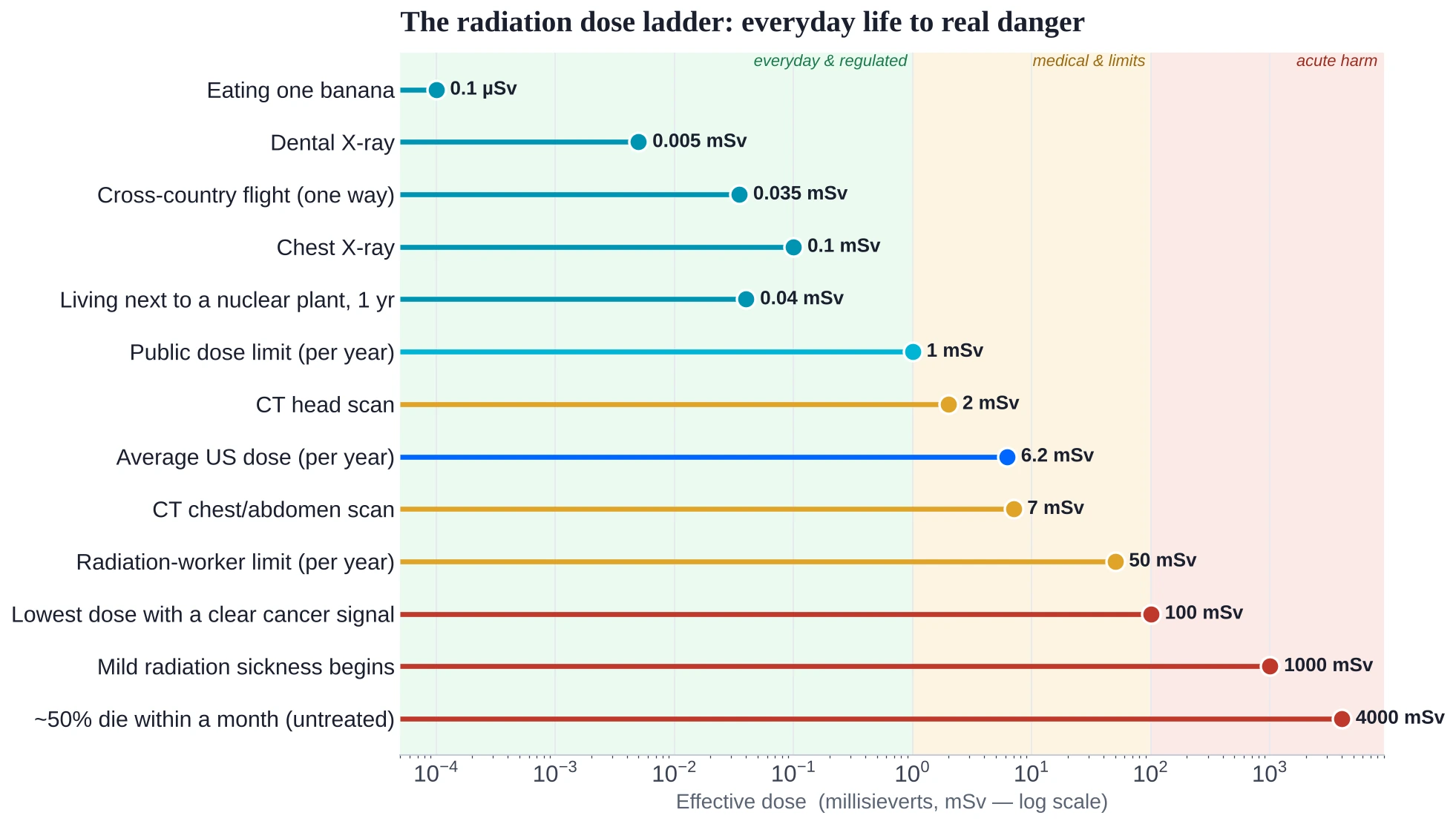
Eat a banana and you’ve taken on about 0.0001 mSv, from the trace of radioactive potassium in it. A dental X-ray is 0.005. Fly coast to coast and cosmic rays give you 0.02 to 0.05 mSv on the way. A chest X-ray, about 0.1. Living right next to a nuclear plant for a full year adds somewhere around 0.04 mSv — less than that one flight.
A CT scan of your chest or abdomen is where the numbers climb: about 7 mSv in a few minutes, more than your natural background for the whole year. That’s not a reason to refuse a scan your doctor needs. It’s a reason to notice that the radiation people fear from power plants is a rounding error next to the radiation they walk into willingly at the hospital.
Keep climbing and you reach the doses that actually injure. And that’s the part worth slowing down on.
Want to see where your own number lands? Type any dose into the radiation dose converter and it marks it on this same ladder, in bananas, chest X-rays or CT scans. Keep climbing and you reach the doses that actually injure. And that’s the part worth slowing down on.
So where does it start to hurt?
Radiation harms you in two completely different ways, and mixing them up is the single most common mistake in these conversations.
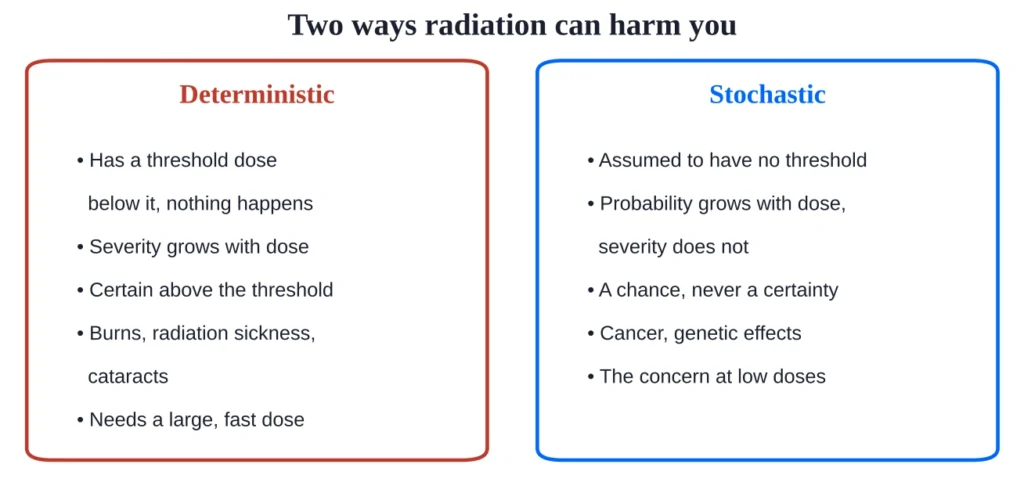
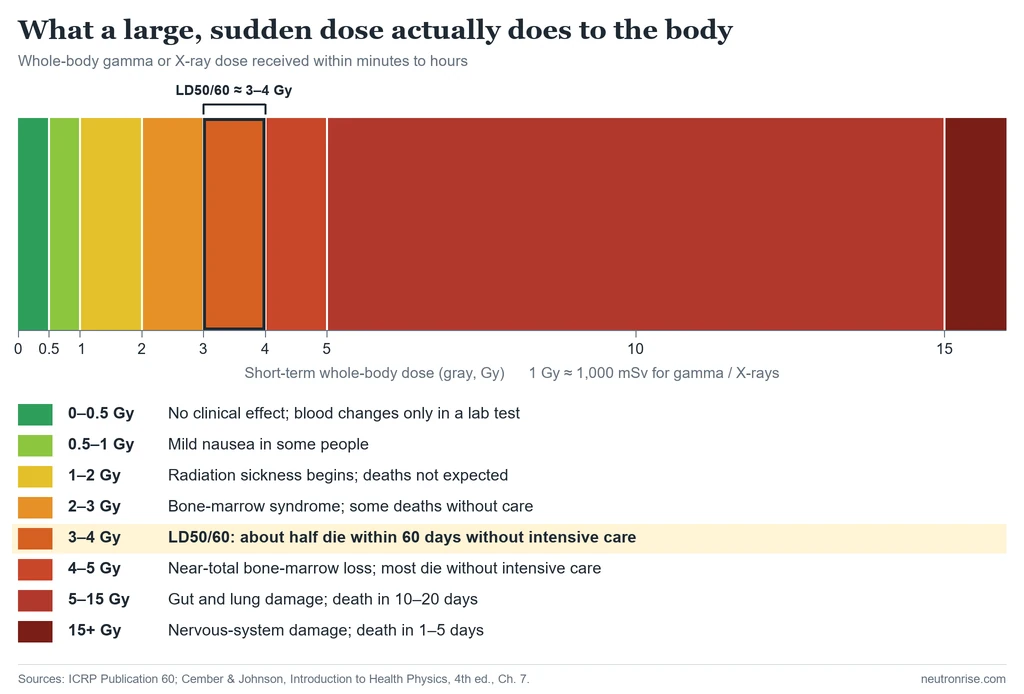
Deterministic effects are the burns and the sickness. They have a floor: below a threshold dose, nothing happens at all, because your body repairs the damage as fast as it’s done. Cross the threshold and the effect is not only certain, it gets worse with every additional gray. This is what “radiation poisoning” means, and it takes a large dose delivered quickly.
| Dose (gray) | Effect |
|---|---|
| < 0.5 Gy | No clinical effect; blood changes only show up in a lab test |
| 0.5–1 Gy | Mild nausea in some people |
| 1–2 Gy | Radiation sickness (acute radiation syndrome) begins; deaths not expected |
| 2–3 Gy | Bone-marrow syndrome; some deaths without medical care |
| 3–4 Gy | LD50/60: about half die within 60 days without intensive care |
| 4–5 Gy | Near-total loss of bone marrow; most die without intensive care |
| 5–15 Gy | Gut and lung damage; death in 10–20 days |
| > 15 Gy | Nervous-system damage; death in 1–5 days |
For gamma and X-rays, 1 Gy ≈ 1,000 mSv. Sources: ICRP Publication 60; Cember & Johnson, Introduction to Health Physics, 4th ed., Ch. 7.
Below about 0.5 Gy — 500 mSv, delivered all at once — a healthy adult shows no clinical symptoms, maybe a dip in blood counts you’d only catch in a lab. Some people feel nauseous between 0.5 and 1 Gy. True radiation sickness, acute radiation syndrome, starts at about 1–2 Gy.
Around 3 to 4 Gy, without intensive medical care, about half of those exposed die within 60 days — mostly from bone-marrow failure, which takes weeks to kill. That’s the number health physicists call the LD50/60.
Above about 7 Gy the marrow can’t recover on its own. Between roughly 5 and 15 Gy the gut lining fails too, and death comes in 10 to 20 days; above 15 Gy, it comes within days. The SL-1 operators in 1961 and the worst-exposed firefighters at Chernobyl received doses in these ranges.
You will not meet them standing next to a cooling tower, getting a scan, or living downwind of a plant. It takes a reactor excursion, a lost industrial source, or a weapon.
Stochastic effects are the other rulebook, and they’re the honest source of worry at low doses. Here the damage is a mutation that your body didn’t repair perfectly — one that might, years later, become a cancer. More dose doesn’t make the cancer worse. It makes it more likely. It’s a dice roll, not a guarantee, and that’s exactly what makes it hard to pin down.
The hard part: low doses and cancer
Here’s where I’ll be straight with you, because most sources won’t.
Above roughly 100 mSv, we can measure an increase in cancer risk in large populations. The survivors of Hiroshima and Nagasaki, studied for eighty years, are the backbone of that number.
Below 100 mSv, the increase — if there is one — is too small to see against the enormous background of cancers that happen anyway. Not “proven safe.” Not “proven harmful.” Invisible to the tools we have.
So what do we do about the region we can’t measure? We assume the worst reasonable case. The rule used to set every dose limit is called linear no-threshold: draw a straight line from the high dose data down through zero, and assume risk keeps scaling all the way down with no safe floor. It’s the red line above.
It is almost certainly conservative — real biology repairs low dose damage, and some researchers argue small doses are even slightly protective (the green “hormesis” line). But when you’re writing rules that protect millions of people, you don’t bet on the optimistic curve. You bet on the cautious one, and you accept that you’re probably overstating the risk.
That choice has a strange consequence worth understanding. Because the linear model assumes no safe dose, you can take a tiny per-person risk, multiply it by a huge population, and generate scary-sounding “projected deaths” from doses far too small to ever measure.
That math is a planning tool, not a body count. When you see it quoted as if those deaths were observed, treat the source with suspicion. The National Academies’ BEIR VII report lays out both the model and its limits honestly; a lot of the people citing it don’t.
Why the same number can be harmless or deadly
One dose, delivered two ways, is two different things. This is the piece the charts can’t show you.
Your 6.2 mSv a year is spread across 365 days. Cells take the hits one at a time, with hours and days in between to repair. The same 6.2 mSv delivered in a single second wouldn’t kill you either — it’s still small — but the comparison scales.
A hundred millisieverts spread over a career is managed routinely. A hundred millisieverts in an instant is a reportable event. Four gray over a lifetime is just normal aging. Four gray in an afternoon is often fatal.
The rule of thumb I’d give anyone: for the doses in ordinary life, worry about the total and don’t lose sleep over it. For the doses that cause acute harm, the rate is everything — and you will essentially never encounter those rates outside an accident.
This is also why the protective playbook is so simple: time, distance, shielding. Less time in a field, more distance from the source, more mass in between. It’s the same logic whether you’re a radiographer, an astronaut, or an engineer near a fresh fuel assembly — and it’s the logic behind the gamma dose-rate and shielding calculator I built if you want to put real numbers on it.
How the limits are set — and how much room they leave
The NRC caps public exposure from licensed operations at 1 mSv per year above background — about a sixth of what you already get from nature and medicine without thinking about it. Radiation workers like the crews I work with can take up to 50 mSv per year, though in practice almost all of them come in far below it.
Look back at the dose ladder and notice where those limits sit. The public limit is below a single CT scan. The worker limit is half the dose where we can first detect any cancer effect at all, and a tenth of the dose where acute symptoms begin.
These aren’t lines drawn at the edge of danger. They’re drawn with a wide margin on the safe side of a threshold we already can’t see — exactly the conservatism the linear model builds in.
The bottom line
How much radiation is dangerous? Enough that your body can’t repair it before it adds up — and in practice that means a large dose, delivered fast. Acute harm needs hundreds of millisieverts at once.
A measurable bump in cancer risk needs about a hundred. The radiation of normal life — flights, scans, the ground, a reactor down the road — lives three or four orders of magnitude below that, in a range where the honest scientific answer is “too small to measure.”
Respect radiation. Measure it, shield against the real sources, and take a doctor’s scan when you need it. But the fear that attaches to the word rarely matches the number behind it. Once you can read the number, most of the fear has nowhere left to stand.
I’ll say this part from my own life, not a chart. I live close enough to a working plant to see the containment on my drive in. I eat lunch on site most days — same coffee, the same vending-machine snacks, the same routine as any office building.
We don’t scan our food. Nobody holds their breath in the parking lot. The dosimeter on my chest spends most of the year reading less than the flight I take to visit family. That isn’t me being brave about radiation. It’s that the dose simply isn’t there to worry about. When you work inside the thing people fear, the fear is the first thing to go.
Whether it’s actually safe to live next to a nuclear plant — and what a recent cancer study really found — is its own question. I’ll take that one on separately.
Frequently Asked Questions
How much radiation is dangerous to humans?
Below a sudden whole-body dose of about 0.5 Gy (roughly 500 mSv), a healthy adult shows no clinical symptoms; radiation sickness begins at 1–2 Gy. About 3–4 Gy delivered at once is fatal to half of those exposed within 60 days without intensive care. A measurable rise in cancer risk appears above about 100 mSv. Everyday doses sit far below all of these.
How much radiation is safe per year?
There’s no sharp line, but useful anchors: the average person already receives about 6.2 mSv a year, the NRC limits added public exposure from licensed sources to 1 mSv a year, and radiation workers are limited to 50 mSv a year. These limits are set well below any dose known to cause harm.
Is a CT scan dangerous?
A chest or abdominal CT delivers around 7 mSv — about a year’s worth of natural background in a few minutes. That’s a real dose, but far below any level that causes immediate harm, and the benefit of a scan your doctor orders almost always outweighs the small theoretical risk. The point is to avoid unnecessary scans, not needed ones.
What dose of radiation will kill you?
A short, whole-body dose of about 3–4 Gy (roughly 3,000–4,000 mSv for gamma rays) kills about half of those exposed within 60 days without intensive medical care — the LD50/60. Above about 7 Gy the bone marrow can’t recover on its own, and above roughly 10 Gy survival is extremely rare. These doses only occur in criticality accidents, unshielded-source emergencies, or nuclear weapons.
Is natural background radiation harmful?
There’s no evidence that normal background radiation harms people. It’s the baseline every human has lived in for all of history — radon, cosmic rays, and the elements in the ground and in our own bodies — and it sits far below any measurable risk threshold.
Does living near a nuclear power plant increase your radiation dose?
Barely. Routine operation adds on the order of 0.01–0.04 mSv a year to a near neighbour — less than a single cross-country flight, and a small fraction of natural background. The whole industry contributes under 0.01 mSv to the average person’s yearly dose.
Sources and Further Reading
- U.S. NRC — Doses in Our Daily Lives
- U.S. NRC — Man-Made Sources & dose limits (10 CFR 20)
- U.S. EPA — Radiation Sources and Doses and the personal dose calculator
- NCRP — Report No. 160, Ionizing Radiation Exposure of the Population of the United States (2009)
- National Academies — BEIR VII: Health Risks from Exposure to Low Levels of Ionizing Radiation (2006)
- IAEA — Acute whole-body dose effects
- Cember, H. & Johnson, T. E. Introduction to Health Physics, 4th ed. McGraw-Hill, 2009 — Ch. 7, acute radiation syndromes (Table 7-4, after ICRP Publication 60).
About the Author
Elliot Marsh is a working reactor engineer who takes commercial reactors critical and with hands-on experience in reactor physics, core management, reactivity control and fuel-cycle planning at an operating power station. He writes about nuclear energy for readers who want the engineering reality, not the press release.
Need content like this for your company?
I write white papers, technical explainers, and thought-leadership for nuclear vendors, reactor developers, and the agencies that serve them — accurate enough for engineers, clear enough for buyers.