Do Small Modular Reactors Really Produce More Nuclear Waste?
An honest look, from a person who manages reactor cores for a living, at the neutron physics behind the claim, the study everyone cites, and what the fuel cycle actually demands.
There is a claim about small modular reactor waste that stops people mid-sentence when they first hear it: a reactor a fraction the size of a conventional one might leave behind more nuclear waste, not less according to a 2022 Stanford led study measured against the electricity it produces.
It sounds like a contradiction. Smaller machine, smaller mess, surely? That instinct is exactly why the claim is worth unpacking carefully, because the answer sits at the boundary between marketing and neutron physics and those two things do not always agree.
I work on an operating nuclear power generating station. Core management and reactivity control are the parts of the job I live in day to day, so waste and fuel are not abstractions to me; they are the front and back ends of a fuel cycle I actually plan around.
So let me give you the version I would give a new engineer on my own team: not the brochure, not the scare story, but what the geometry does, what the data says and where reasonable people still argue.
If you are new to the technology itself, I laid out what an SMR is and why the industry is betting on it in my main explainer, Small Modular Reactors: The Nuclear Revolution That Hasn’t Happened Yet. This piece goes one level deeper, into the part most explainers skip.
Start With the Geometry, Not the Politics
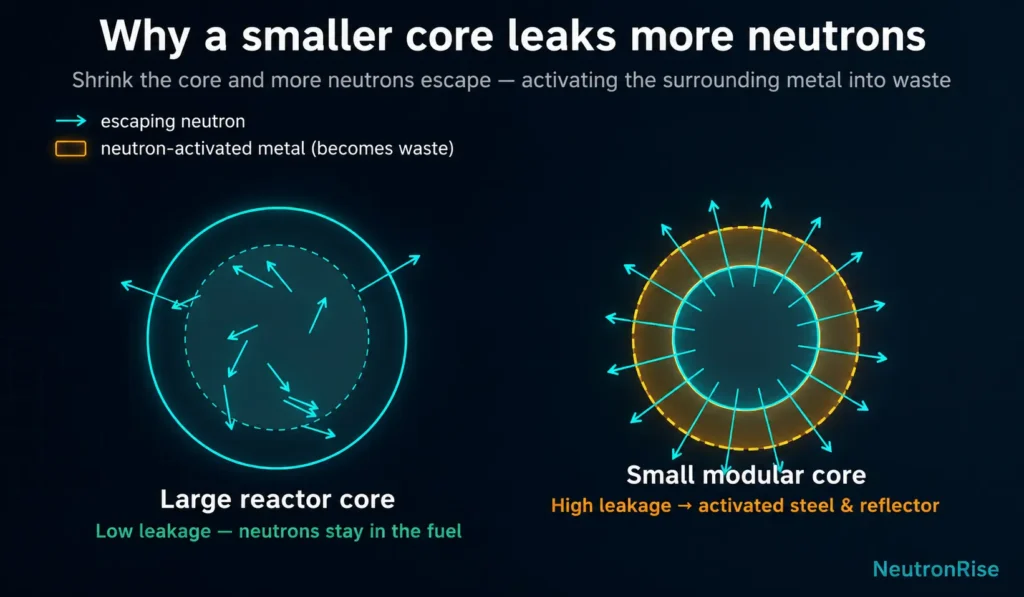
Every argument about SMR waste traces back to one unglamorous fact of reactor physics: surface area to volume ratio.
Nuclear fission happens in the volume of the core. But neutrons, the particles that keep the chain reaction going, leak out through the surface. Shrink a reactor and its volume falls faster than its surface area, so proportionally more neutrons reach the edge and escape before they ever strike another uranium atom. A smaller core is, in the language I use at work, a leakier core.
That leakiness is not a defect. It is geometry doing what geometry does. And in some ways it is even a feature: the same small size that leaks neutrons also makes decay heat easier to remove, which is part of why so many SMR designs can lean on passive safety. But leakage has a cost, and the cost lands on the waste ledger in two ways.
First, to stop a leaky core from bleeding away the neutrons it needs to stay critical, designers wrap it in a neutron reflector a shell of steel, beryllium or graphite that bounces escaping neutrons back toward the fuel.
That shell earns its keep, but it stands directly in the neutron flood. Over years of operation, those neutrons transmute the reflector and the structural steel around it into radioactive isotopes. The metal itself becomes waste. This is neutron activation, and it is the quiet driver behind a lot of the numbers you are about to see.
Second, a leaky, small core often can’t burn its fuel as thoroughly as a big one before the chain reaction sags. Fuel that comes out “less used up” means more spent fuel discharged for every unit of energy you actually sold to the grid.
None of this is controversial physics. The International Atomic Energy Agency states it plainly in its own technical work on the SMR fuel cycle because of the small core volume, an SMR runs at higher neutron leakage than a large reactor and its spent fuel carries a proportionally higher management burden as a result. When a UN nuclear agency and a group of academic critics agree on the mechanism, the mechanism is real. The argument is about how much it matters.
The Study Everyone Cites — and What It Actually Says
In 2022, a paper landed in the Proceedings of the National Academy of Sciences that became the reference point for this entire debate. It was written by Lindsay Krall, Rodney Ewing, and Allison Macfarlane and that last name matters, because Macfarlane is a former chairman of the U.S. Nuclear Regulatory Commission. This was not a fringe pamphlet.
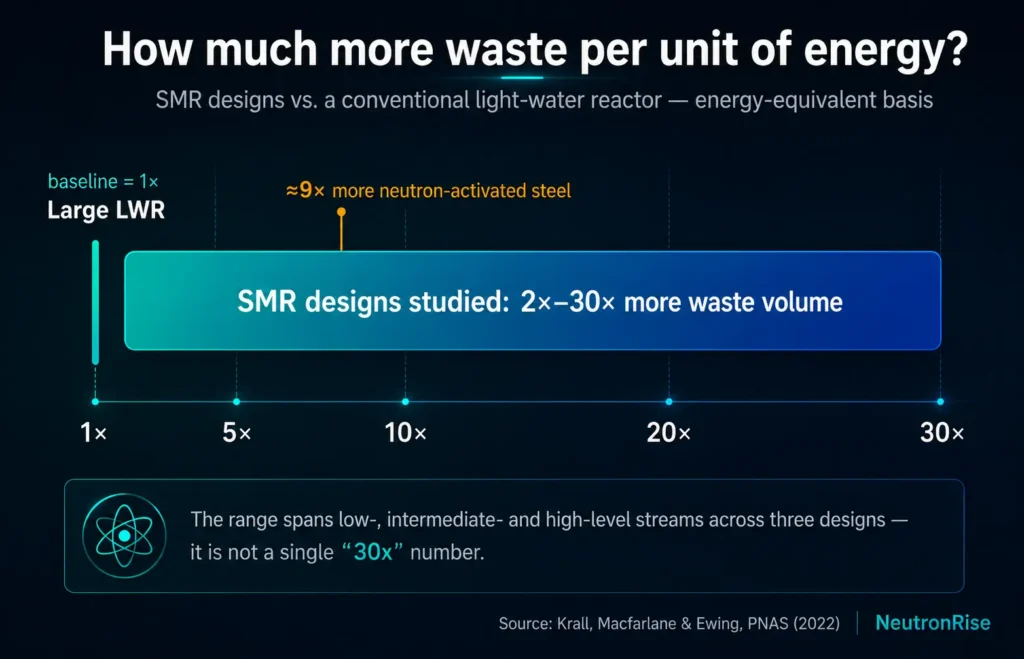
The team took three specific, real SMR designs, a sodium cooled fast reactor, an integral pressurized water design and a molten salt reactor and compared their waste streams against a conventional 1,100-megawatt pressurized water reactor, all on an energy-equivalent basis. Their headline finding, the one you’ll see quoted everywhere, usually stripped of context:
SMRs could increase the volume of nuclear waste needing management and disposal by a factor of 2 to 30.
Two things about that number deserve your attention, because they usually get lost.
It is a range, not a verdict, and it is about volume of waste needing management, not a single “30 times more waste” headline. Different waste streams behave differently low level, intermediate level and high level material each move independently. The 30x ceiling applies to particular designs and particular streams, not to every SMR ever proposed.
And the mechanism is exactly the geometry we just walked through. Ewing put one figure on it that stuck with me: some SMR designs could generate on the order of nine times more neutron activated steel than a conventional plant. That is the reflector and structure activation problem, quantified. It is not the fuel being wasteful. It is the metal around the fuel becoming radioactive.
Where the Study Is Strong and Where It’s Genuinely Contested
Here is where an honest article has to slow down, because the internet turned this paper into a weapon and a punching bag within about a week, and neither reaction was fair.
What the study got right is the physics. Higher leakage, more activation, more spent fuel per unit energy for low burnup designs; that direction of travel is sound and the IAEA’s own back end work points the same way.
The study also did something the industry had largely avoided: it looked hard at the back end of the fuel cycle, the part that vendors’ glossy roadmaps tend to wave past. Designing a reactor is the fun part. Figuring out where its irradiated steel and complex spent fuel go for the next hundred thousand years is not and it had been under studied. On that, the authors were simply right to force the conversation.
What is fairly contested is the reach of the conclusion. The paper analyzed three designs out of dozens under development and then generalized. The specific integral PWR design it modeled was an earlier, smaller version than the one that design’s developer later brought forward, so at least some of the numbers describe a machine that has since evolved.
Critics also point out that the study assumed a once through, no recycling fuel cycle; reprocessing and recycling can shrink some of these streams, though and the authors are right about this, recycling transforms waste, it does not make it vanish and it carries its own cost and proliferation baggage.
My own read, for whatever a working core engineer’s opinion is worth: the study is a valid and useful warning about a real physical tendency, not a proof that every SMR is a waste disaster. The truth is design specific. A blanket “SMRs make more waste” is as lazy as the “SMRs solve waste” marketing it was pushing back against.
It’s Not Just the Back End: The HALEU Fuel Question
Waste is the back end of the fuel cycle. But SMRs also lean on the front end in a way the current reactor fleet does not, and no honest treatment of “waste and fuel” can stop at spent fuel.
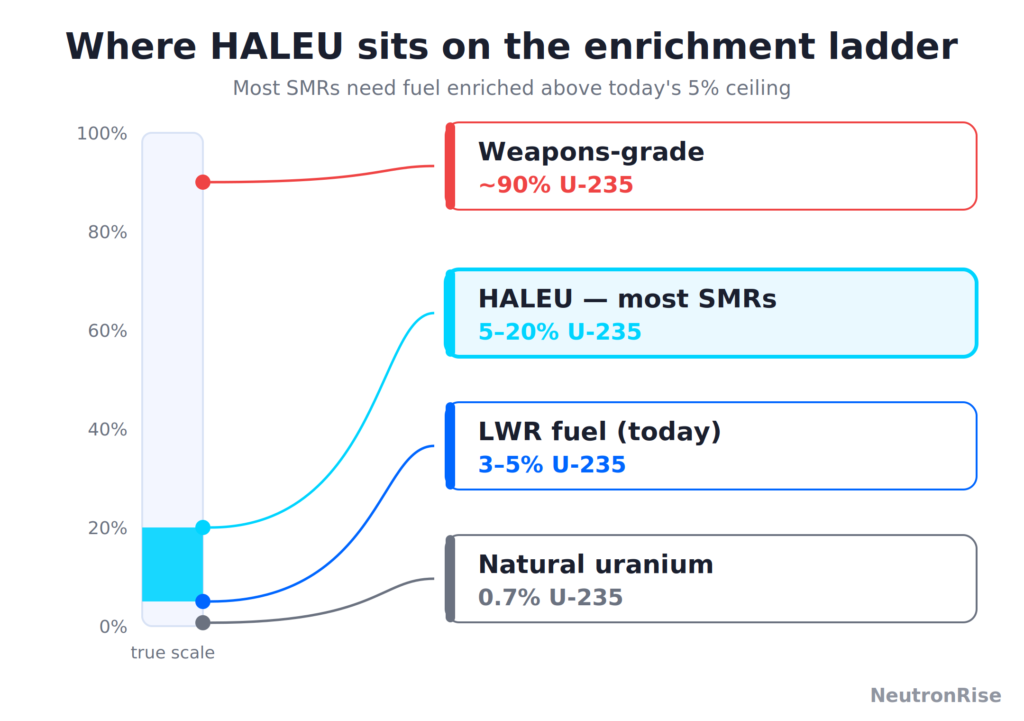
Most SMR and advanced designs more than half of those in development, by the World Nuclear Association’s count, are designed to run on HALEU: high assay low enriched uranium. Where today’s reactors use fuel enriched to roughly 3-5% uranium-235, HALEU sits between 5% and 20%, as the NRC defines it.
That higher enrichment is what lets the core be small, run longer between refuelings, and this is the honest counterpoint to the whole waste story, often extract more energy per kilogram, which can actually reduce spent fuel volume per unit of energy.
So the fuel is a genuine two sided coin and I want to be precise about it rather than pick a side. On the plus side, higher burnup means fewer fuel assemblies discharged for the same electricity.
On the minus side, reaching 5-20% takes substantially more enrichment work per kilogram, which means more separative work, more depleted uranium tails left behind at the front end and a fuel that sits closer, not close, but closer to the enrichment levels that raise security and non proliferation questions.
And there is a hard supply chain reality underneath all of it: HALEU is not yet widely available commercially and for years the only countries with the infrastructure to make it at scale were Russia and China. A reactor fleet can’t run on a fuel that doesn’t exist in volume.
I went deep on this specific bottleneck in HALEU: The Fuel That Could Make or Break the Nuclear Revolution, so I’ll keep it tight here. The point for this article is narrow, when someone tells you SMRs “reduce waste,” ask them which end of the fuel cycle they mean. The answer is frequently different at the front and the back.
Which SMR Designs Handle Waste Best and Worst
Because the waste story is design specific, the useful question isn’t “are SMRs bad for waste” but “which kind of SMR, and how did they plan for it.” A quick tour from a materials-and-neutronics point of view:
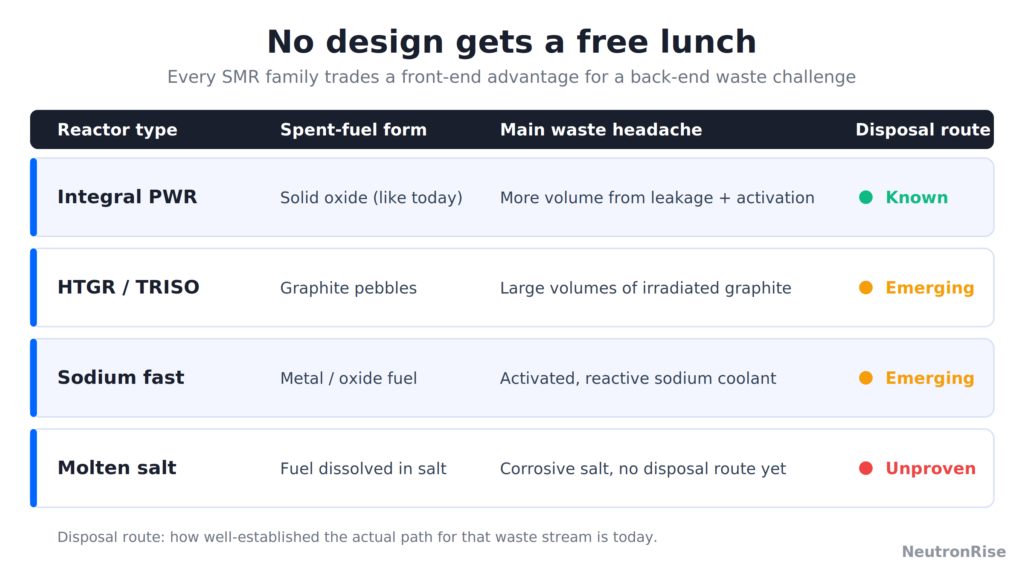
Integral pressurized water designs are the most conventional. Their spent fuel looks broadly like today’s fuel, which means the disposal pathway is at least understood, even if the per energy volume runs higher because of leakage and reflector activation. The devil you know.
High temperature gas cooled reactors using TRISO pebble fuel are fascinating and awkward. TRISO’s coated particles are superb at locking fission products inside but a pebble bed core produces a large volume of graphite bearing spent fuel and irradiated graphite is its own disposal headache that the industry has wrestled with since the earliest reactors.
Sodium cooled fast reactors: the family that includes TerraPower’s Natrium carry the added complication of chemically reactive sodium coolant that has itself been activated, which can’t simply be treated like water. Fast reactors can, in principle, burn down some long-lived actinides, which is a real waste advantage on the isotope side; the trade is the reactive coolant problem. (If fast reactors are new to you, I explain the concept in What Is a Fast Reactor?)
Molten salt reactors may be the hardest of all on the back end. Dissolving fuel directly into a salt is elegant for operations, but it produces a chemically complex, corrosive, tritium- and fission product laden salt waste with no established disposal route. Elegance up front, difficulty at the end.
Notice the pattern: nearly every design trades a front end or operational advantage for a back end complication. That is not cynicism. It is conservation of difficulty, and it is the most reliable rule I know in this field.
The Honest Verdict
So, do small modular reactors produce more nuclear waste?
For several credible designs, on a per unit of energy basis, yes: more waste volume and a chemically messier mix, driven mostly by neutron leakage and the activated metal it leaves behind rather than by anything wasteful about the fuel itself. That finding is real, it is grounded in physics I’d stake my professional judgement on and the industry spent too long pretending the back end would sort itself out.
But “more waste” is not the same as “more dangerous,” and it is nowhere near “dealbreaker.” Nuclear waste, uniquely among energy waste streams, is contained, counted and managed rather than dumped into the sky. Most of it sits in passively cooled dry casks with a four-decade record of no public harm.
The United States has produced more than 88,000 metric tons of commercial spent fuel over six decades and it fits, conceptually, on a single football field. A larger volume of a well managed material is a real engineering and cost problem. It is not an existential one.
What the waste question really exposes is the same thing this whole technology keeps running into: SMRs are not a physics breakthrough, they are an engineering and industrial bet. The neutrons are behaving exactly as they always have.
Whether SMR waste becomes a manageable line item or a genuine liability will be decided the same way SMR economics will be, by the unglamorous discipline of planning for the hard part before you pour the concrete, not after. As the IAEA has argued, the time to design the back end of the fuel cycle is at the very beginning, not the end.
The reactors that take that seriously will be fine. The ones that treat waste the way the industry treated cost as tomorrow’s problem will learn the same expensive lesson, again.
Frequently Asked Questions
Do small modular reactors produce more nuclear waste than traditional reactors?
For several studied designs, yes, more waste volume per unit of energy, by a factor of roughly 2 to 30 according to a 2022 PNAS study. The main driver is neutron leakage from the smaller core, which activates the surrounding steel and reflector into radioactive waste, plus lower fuel burnup in some designs. It is design-specific, not universal.
Why do smaller reactors leak more neutrons?
Geometry. Fission happens in the core’s volume, but neutrons escape through its surface. A smaller core has more surface area relative to its volume, so proportionally more neutrons leak out before sustaining the chain reaction. Designers add neutron reflectors to compensate, and those reflectors become activated waste over time.
Does HALEU fuel reduce nuclear waste?
Partly, on the back end. Because HALEU is enriched to 5–20% (versus 3–5% for conventional fuel), reactors can extract more energy per kilogram, discharging fewer spent-fuel assemblies per unit of electricity. But the higher enrichment demands more work at the front end, leaves more depleted-uranium tails, and depends on a supply chain that is still being built. It is not a clean win in either direction.
What happens to spent fuel from SMRs?
Before any of that, freshly discharged fuel spends years cooling in a spent fuel pool — and if that cooling ever stopped, this is how long it would take to boil. The same fundamental pathway as today: interim storage, then eventually a deep geologic repository, none of which is fully built out anywhere yet. The complication is that some SMR spent fuel and activated components are chemically more complex than conventional fuel, so existing storage and disposal approaches may need adapting, especially for molten salt and sodium cooled designs.
Are small modular reactors bad for the environment?
Compared to fossil fuels, no they are low carbon, and their waste is contained rather than emitted. Compared to conventional nuclear, the waste picture is a genuine trade off some designs handle worse, not a categorical failure. The honest framing is that SMRs shift where the difficulty sits in the fuel cycle, not that they are environmentally disqualifying.
Which SMR type produces the most difficult waste?
By most measures, molten salt reactors face the toughest back end: a chemically complex, corrosive salt with no established disposal route. High temperature gas reactors face large volumes of irradiated graphite. Sodium cooled fast reactors deal with activated, reactive coolant. Integral pressurized water designs are the most conventional, with the best-understood disposal pathway.
Sources and Further Reading
- Krall, Macfarlane & Ewing, “Nuclear waste from small modular reactors,” Proceedings of the National Academy of Sciences (2022) — the central study — https://www.pnas.org/doi/10.1073/pnas.2111833119
- Stanford Report summary and Ewing’s neutron-activated-steel figure — https://news.stanford.edu/stories/2022/05/small-modular-reactors-produce-high-levels-nuclear-waste
- IAEA, Considerations for the Back End of the Fuel Cycle of Small Modular Reactors, TECDOC-2040 (2023) — https://www.iaea.org/publications/15519/considerations-for-the-back-end-of-the-fuel-cycle-of-small-modular-reactors
- IAEA Bulletin, “Small Modular Reactors: A Challenge for Spent Fuel Management?” (2019) — https://www.iaea.org/newscenter/news/small-modular-reactors-a-challenge-for-spent-fuel-management
- U.S. Nuclear Regulatory Commission, “High-Assay Low-Enriched Uranium (HALEU)” — https://www.nrc.gov/materials/new-fuels/haleu
- World Nuclear Association, “High-Assay Low-Enriched Uranium (HALEU)” — https://world-nuclear.org/information-library/nuclear-fuel-cycle/conversion-enrichment-and-fabrication/high-assay-low-enriched-uranium-haleu
- OECD Nuclear Energy Agency, High-Assay Low-Enriched Uranium: Drivers, Implications and Security of Supply (2024) — https://www.oecd-nea.org/jcms/pl_96126/high-assay-low-enriched-uranium-drivers-implications-and-security-of-supply
- IAEA, “Fuelling the Future: Building Fuel Supply Chains for SMRs and Advanced Reactors” (2023) — https://www.iaea.org/bulletin/fuelling-the-future-building-fuel-supply-chains-for-smrs-and-advanced-reactors
- Interview: Small modular reactors get a reality check about their waste https://thebulletin.org/2022/06/interview-small-modular-reactors-get-a-reality-check-about-their-waste/
Where figures cite a specific study, the numbers are that study’s reported here with their context intact, not stripped for effect. In SMR waste, the missing context is usually where the misinformation lives.
About The Author
Elliot Marsh is a working reactor engineer with hands-on experience in reactor physics, core management, reactivity control, and nuclear fuel-cycle planning at an operating power station. He writes about nuclear energy for readers who want the engineering reality, not the press release.
Need content like this for your company?
I write white papers, technical explainers, and thought-leadership for nuclear vendors, reactor developers, and the agencies that serve them — accurate enough for engineers, clear enough for buyers.