Small Modular Reactors: The Nuclear Revolution That Hasn’t Happened Yet
What is a small modular reactor
A small modular reactor (SMR) is a nuclear reactor that produces up to 300 megawatts of electricity — roughly a third of a conventional plant — and is assembled from factory-built modules shipped to the site instead of being constructed piece by piece in the field. The IAEA defines the class by that 300 MWe-per-unit ceiling.
In September 2024, Microsoft made a bet that left half of Silicon Valley blinking in disbelief. The company agreed to buy the entire output of a nuclear reactor at Three Mile Island — the very site that, decades earlier, had become shorthand for everything Americans feared about atomic power. The reactor in question, Unit 1, had been sitting cold and silent for years. Microsoft wanted it switched back on. It’s a move that only makes sense once you understand the technology waiting in the wings behind it — the small modular reactor.
On the surface, it made no sense. Why would one of the most valuable companies on Earth tie its future to a 1970s-era reactor? The answer has almost nothing to do with nuclear nostalgia and everything to do with a problem that barely existed a decade ago: artificial intelligence is starving for electricity.
Every frontier AI model is trained on tens of thousands of power-hungry chips running day and night. A single hyperscale data center can now draw as much electricity as a mid-sized city — and the industry is building them as fast as it can pour concrete. Suddenly the question the world thought it had answered came roaring back: where is all this round-the-clock, carbon-free power supposed to come from?
Wind and solar are booming, but the sun sets and the wind drops. Natural gas is dependable but burns carbon. Big conventional reactors deliver exactly the kind of steady baseload power a data center craves — but they cost a fortune and take the better part of a decade to build.
And that is the door the Three Mile Island deal quietly kicked open. Restarting a decades-old reactor is only a stopgap, though — Unit 1 is a full-size pressurized water reactor, not a new design. The real prize is the technology the nuclear industry has been promising for years — the one supporters call the future of clean energy, and critics call a reactor that has spent two decades being “five years away.”
It’s the small modular reactor. And here’s the honest truth, from a person who works on reactors for a living: both the believers and the skeptics are right. To understand why, you first have to understand what an SMR actually is — and, just as importantly, what it isn’t.
What Is a Small Modular Reactor, Exactly?
The short answer: A small modular reactor (SMR) is a nuclear reactor of 300 megawatts or less, designed to be built from components mass-produced in a factory and assembled on site — rather than constructed piece by piece as a one-off megaproject. The physics is conventional; the manufacturing is the innovation.
Strip away the marketing and a small modular reactor is two simple ideas bolted together: make it smaller, and build it in a factory.
The “small” part is about power. A conventional reactor pumps out somewhere between 1,000 and 1,600 megawatts of electricity. Most SMRs aim for 50 to 300 megawatts — roughly a third or less of a traditional unit. Some shrink further still: anything under about 20 megawatts is usually called a microreactor.
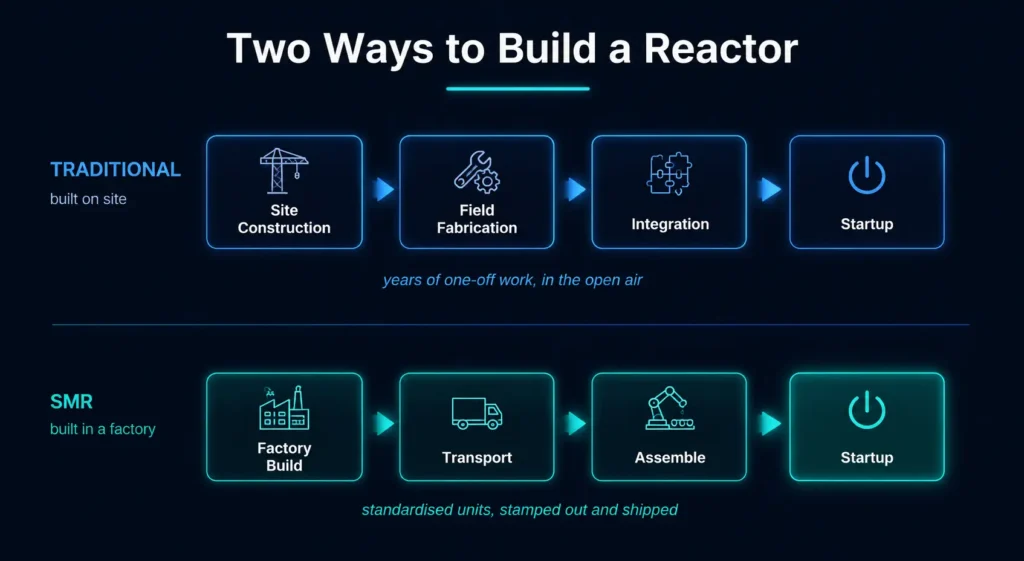
But “small” isn’t the clever bit. The “modular” part is where the real ambition lives. A traditional nuclear plant is a one-off megaproject — a sprawling construction site swarming with tens of thousands of workers, millions of components, and years of fabrication done out in the open air, in the rain, in the cold, against a moving schedule.
SMR developers want to flip that on its head. Instead of building everything on site, they want major components stamped out in a factory, shipped by rail or truck, and bolted together when they arrive.
Think of the difference between building a ship inside a shipyard versus nailing it together plank by plank on the open beach. The physics inside the reactor stays familiar, the reaction held steady— fission heats water, water makes steam, steam spins a turbine (a few, like sodium– or gas-cooled SMRs, swap the coolant, but the idea is the same).
What changes completely is the philosophy of how you build the thing. As a reactor engineer, that distinction matters more than any spec sheet: SMRs aren’t a new kind of nuclear. They’re a new kind of manufacturing.
Why Did Traditional Nuclear Get So Expensive?
The short answer: Not because of uranium, which is cheap but because building a one-off gigawatt-scale plant is staggeringly hard to manage. Every delay cascades through thousands of interlocking tasks. Vogtle in Georgia ran past $30 billion; Finland’s Olkiluoto-3 arrived over a decade late.
Here’s the part most SMR explainers skip, and it’s the part that actually matters. Nuclear didn’t get expensive because uranium is expensive, uranium is cheap. It got expensive because building the plants became staggeringly hard to manage.
Two projects tell the whole story. The Vogtle expansion in Georgia, America’s most recent large build, ended up costing more than $30 billion and ran years behind schedule. Finland’s Olkiluoto-3 became a byword for delay, arriving more than a decade late after a parade of cost overruns. The engineering was never the impossible part.
The impossible part was choreographing a one-off megaproject where every slipped deadline cascaded through thousands of interlocking activities, and every late design change rippled outward through dozens of safety-critical systems.
I’ve watched a smaller version of this dynamic up close on an operating plant. Complexity doesn’t add up, it multiplies. The moment systems, procedures, and safety requirements start interacting, coordination becomes the real adversary, not the technology. And the bigger the project, the harder that coordination gets.
SMRs are a direct attack on exactly that problem. The pitch is almost stubbornly simple: instead of one giant bespoke reactor, build many small identical ones. Build one. Learn from it. Build the next one better. Repeat until it’s boring because boring, in nuclear construction, is the goal.
It’s the same logic that turned aircraft from hand-built curiosities into mass-produced machines. Whether reactors can actually follow that path is the single biggest unanswered question in the industry.
Why Tech Giants and Governments Are Betting on SMRs
The short answer: Because AI data centers need enormous, 24/7, carbon-free power, and SMRs can in theory be built quickly, right next to the demand. By 2026 the four largest U.S. tech companies had committed to more than 10 gigawatts of new nuclear capacity.
Picture yourself planning a new AI data center. You need power every hour of every day not when the sun cooperates, not when the wind picks up, but every single second, forever. Now picture a cluster of four SMRs humming away next door, doing precisely that.
That’s the daydream pulling in the biggest names in tech. Because they’re small, SMRs could in theory be planted right where the power is needed beside a data center, a steel mill, a mining operation, or a remote town that the grid never quite reached. No decade-long transmission saga. No 1.6-gigawatt commitment before you’ve turned a single profit.
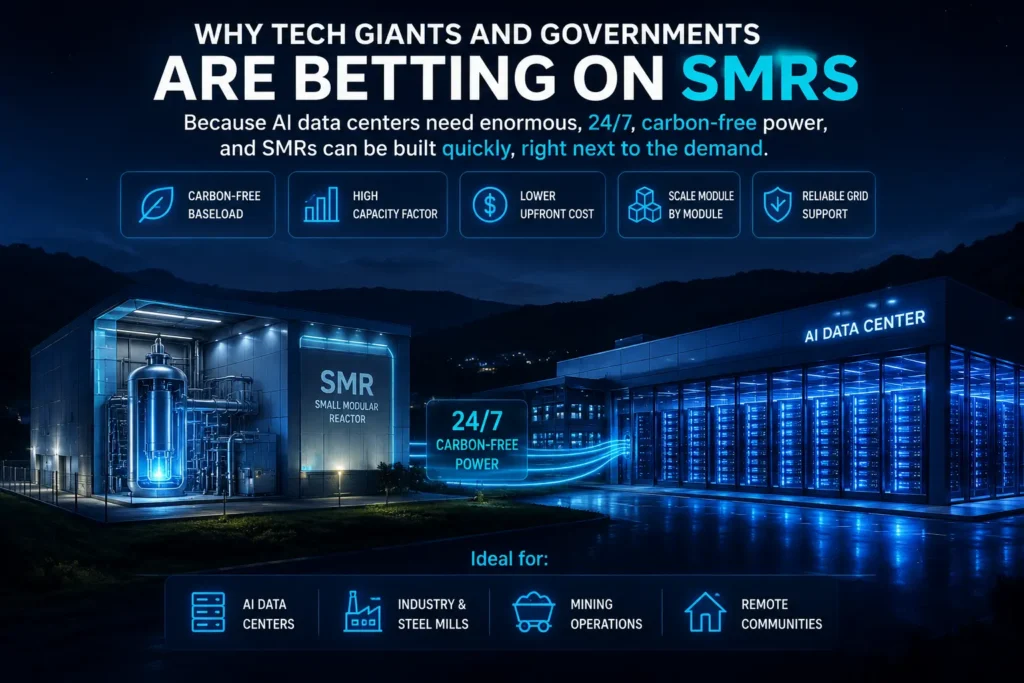
This isn’t hypothetical anymore. In October 2024, Google signed on to commission a fleet of SMRs from Kairos Power, with the first targeted for around 2030. By 2026, the four largest U.S. tech companies had collectively committed to around 10 gigawatts of possible new nuclear capacity an astonishing figure, driven almost entirely by AI’s bottomless appetite for electricity.
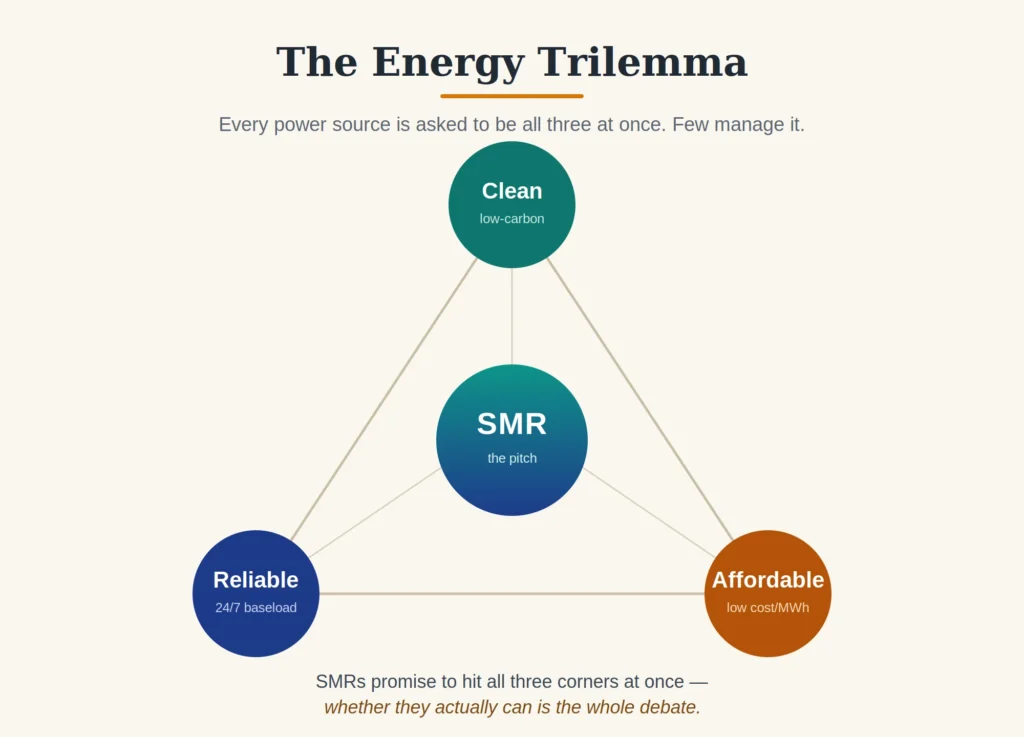
When you lay the benefits out on paper, the appeal is obvious: carbon-free baseload, high capacity factors, a smaller upfront cheque, the ability to scale module by module, and rock-steady grid support.
On paper, it reads like the perfect power source for an electrifying world. Hold onto that phrase, though on paper. That’s exactly where the trouble starts.
The Catch: Why SMRs Are Harder Than They Look
The short answer: Shrinking a reactor introduces new problems, less fuel per core tightens the economics, and the promised savings only appear if you build many identical units. The first one (the “first-of-a-kind”) is always brutally expensive; the savings live in volume nobody in the West has yet achieved.
This is where enthusiasm runs headlong into physics. A lot of the public conversation quietly assumes an SMR is just a big reactor that someone shrank in the wash. It isn’t, and the shrinking introduces problems of its own.
A smaller core holds less fuel, which tightens every economic margin you have to work with. That same small core also leaks more neutrons which some studies link to a surprisingly large waste footprint. Manufacturing tolerances that were forgiving at gigawatt scale suddenly aren’t. And the supply chain has to pivot from building one heroic megaproject to churning out standardized units like a production line, a completely different industrial muscle, and one almost nobody in the West has actually built yet.
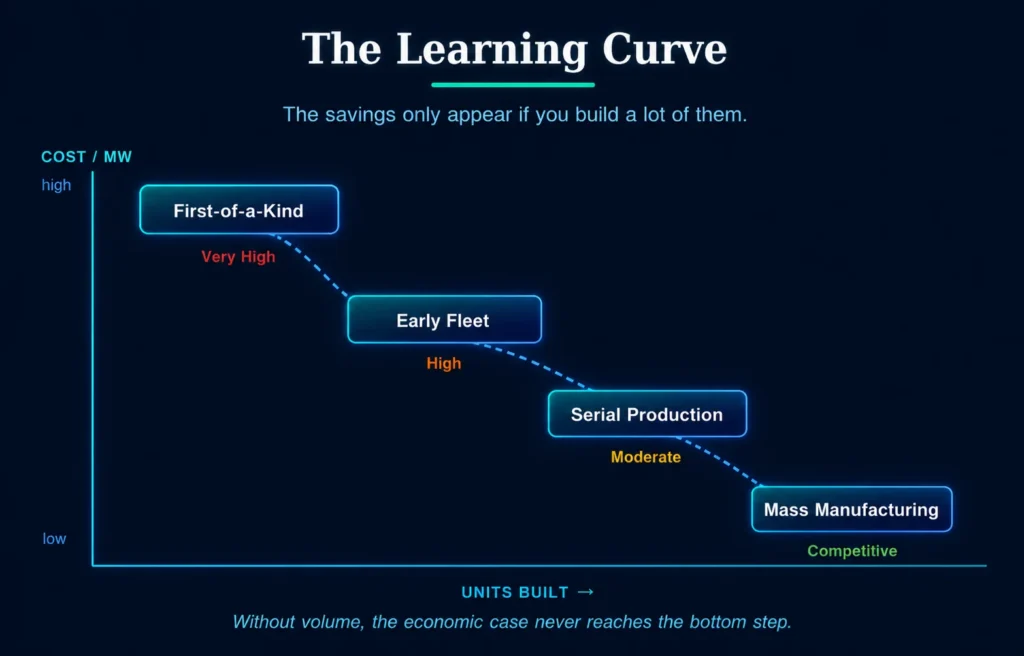
But the deepest catch is economic, and it has a name: the learning curve. The promised cost savings only show up if you build a lot of these things. The first reactor what engineers call the first-of-a-kind, or FOAK is almost always brutally expensive. The second is a little cheaper. The hundredth might be dramatically cheaper. Take away the volume, and the entire economic argument for SMRs quietly deflates.
Are Small Modular Reactors Actually Cheaper? The Cost Reality
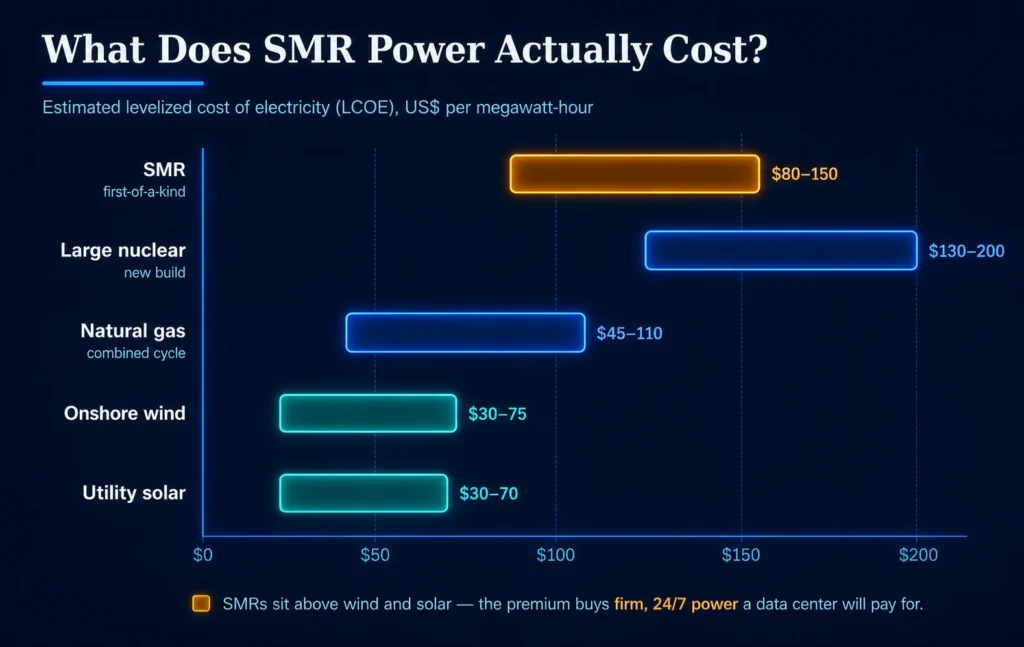
The short answer: Not yet. Early SMR projects are landing at a levelized cost of electricity somewhere in the rough range of $80 to $150 per megawatt-hour above wind and solar, and only competitive with gas in the narrow role of firm, always-on power. The flagship U.S. project, NuScale’s, saw costs climb from $5.3 billion to $9.3 billion before it was cancelled in 2023.
This is the question that decides everything, so let’s deal in numbers instead of hope. That $80–150 range sits comfortably above today’s wind and solar, which land closer to $30–70 and matches gas only in the one role SMRs are actually being bought for: firm, 24/7 power. That premium is the price of the very thing data centers are willing to pay for: electricity that never blinks.
And there’s a cautionary tale every honest SMR article has to tell. The flagship U.S. project NuScale’s plant with a Utah municipal power group was supposed to prove the whole model. Instead, its estimated cost climbed from around $5.3 billion toward $9.3 billion, and in 2023 the partners walked away. It was the clearest real-world signal yet that the brochure economics and the construction-site economics are not the same animal.
The reason cuts to the heart of why I stay cautious. Big reactors are expensive per project but cheap per megawatt, because of a brutally simple rule engineers have known for a century: economies of scale. Double a reactor’s size and its cost does not double.
SMRs are trying to out-run that rule by swapping economies of scale for what you might call economies of multiples winning back through repetition what they give up in size. It’s a genuinely clever bet. But as of 2026, no Western developer has actually proven it at scale. Until one does, the cost case rests on a spreadsheet, not a track record.
Which Companies Are Building SMRs in 2026?
The short answer: The names to know are NuScale (the only NRC-approved U.S. design), GE Hitachi’s BWRX-300 (the first SMR under construction in North America, at Darlington, Canada), TerraPower, X-energy, Rolls-Royce SMR, and China’s Linglong One — on track to be the world’s first land-based commercial SMR.
A handful of companies are now racing to define what advanced nuclear actually looks like, and 2026 was the year the race stopped being theoretical. A few of the names worth knowing:
NuScale Power — the first SMR design to win U.S. Nuclear Regulatory Commission approval, and still the only one with that stamp. Its credibility took a bruise from the Utah cancellation, but the design lives on.
GE Hitachi (BWRX-300) — quietly became one of the most important names in the field when its reactor at Darlington in Canada became the first SMR under construction in North America. Less hype, more poured concrete.
TerraPower — Bill Gates’s sodium-cooled venture, which secured its NRC construction permit for the Natrium plant in Kemmerer, Wyoming. It’s one of the most closely watched bets in the sector.
X-energy — developing high-temperature gas-cooled reactors (HTGRs) using TRISO fuel, and building out HALEU fuel capacity alongside them.
Rolls-Royce SMR — trying to bring factory-line nuclear to the UK, with a site selected and first concrete targeted later this decade.
And it’s not only the West. China’s Linglong One is on track to become the world’s first land-based commercial SMR, while a wave of newer private players including Antares, whose Mark-0 microreactor reached criticality at Idaho National Laboratory in June 2026 the first privately developed non-light-water reactor to do so in the US in over 40 years.
Each company is selling a different road to the same destination: affordable, repeatable nuclear. Only real deployment — concrete, fuel, and a grid connection — will reveal which assumptions were sound and which were just confident.
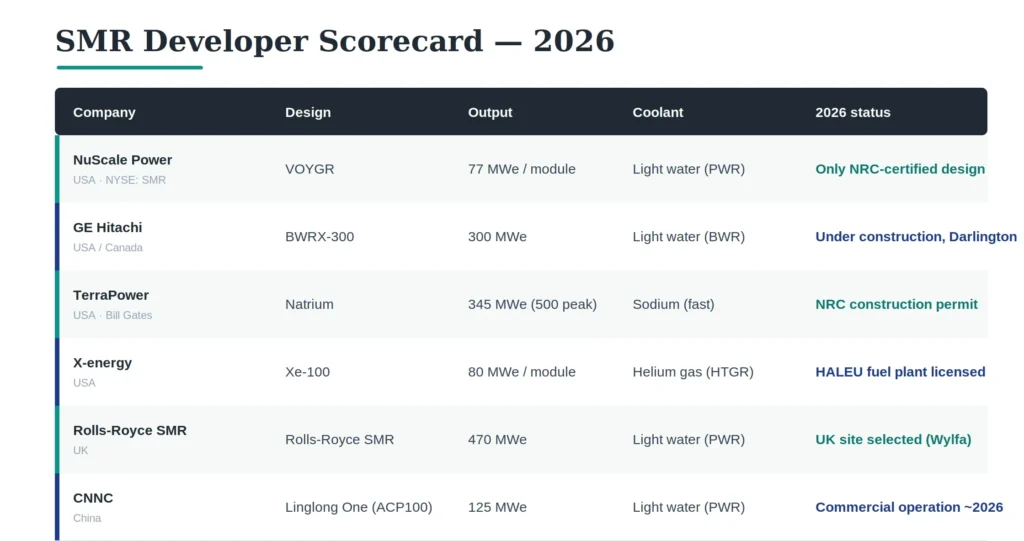
SMR Developer Scorecard (2026)
| Company | Design | Output (MWe) | Coolant | 2026 Status |
| NuScale | VOYGR | ~77 per module | Water (PWR) | Only NRC-approved US design; Utah project cancelled 2023 |
| GE Hitachi | BWRX-300 | ~300 | Water (BWR) | First SMR under construction in North America (Darlington) |
| TerraPower | Natrium | 345 | Sodium (Fast) | U.S. NRC Construction permit at Kemmerer, WY |
| X-energy | Xe-100 | ~80 per module | Helium gas (TRISO) | Building HALEU fuel capacity; TVA/Amazon backing |
| Rolls-Royce | RR SMR | ~470 | Water (PWR) | UK site selected; first concrete later this decade |
| CNNC (China) | Linglong One (ACP 100) | 125 | Water (PWR) | On track to be world’s first land-based commercial SMR |
So Will Small Modular Reactors Ever Actually Happen?
The short answer: The better question is which ones. Most reactor concepts never reach commercial scale ,some SMR designs will quietly disappear. But it doesn’t take many winners: if even a handful start repeating, they could reshape how the world makes electricity.
It’s the wrong question. The right one is: which SMRs will happen?
History is unsentimental here. Most reactor concepts never make it commercially. Some die on the engineering. Some die on the economics. Plenty die because the energy market moved on before they were ready. The SMR generation won’t be different, some designs will quietly disappear, some companies will run out of runway, and some projects will never advance past a single demonstration unit.
But and this is the part the pure skeptics miss, it doesn’t take many winners. If even a handful of these designs cross the finish line and start repeating, they could genuinely reshape how the world makes electricity in the back half of this century. That asymmetric payoff is exactly why governments, utilities, investors, and trillion-dollar tech companies keep writing the cheques, even knowing most of the bets will fail.
The Verdict: Neutrons Aren’t the Problem — Factories Are
So where does that leave us? Small modular reactors are neither the miracle machines their boosters promise nor the vaporware their critics dismiss. They are a serious, credible attempt to crack nuclear power’s oldest and most stubborn problem, which was never really physics — it was cost.
The reactor physics is well understood; I’d trust it with my career, because I more or less do. The open question lives entirely on the industrial side: manufacturing discipline, supply chains, financing, and the unglamorous grind of execution.
Which means the future of SMRs probably won’t be decided by neutrons at all. It’ll be decided by factories — by whether anyone can finally build the hundredth reactor as cheaply and calmly as the world now builds the hundredth aircraft.
And that may turn out to be the most important nuclear experiment of the century — the one where the breakthrough we’re all waiting for isn’t a discovery, but a production line.
Frequently Asked Questions
What is a small modular reactor?
A small modular reactor (SMR) is a nuclear reactor with a power output of about 300 megawatts or less — a third or less of a conventional reactor — whose major components are designed to be mass-produced in a factory and assembled on site. The reactor physics is conventional; the innovation is in how it’s built.
Why haven’t small modular reactors taken off yet?
Mainly economics, not engineering. The cost savings depend on building many identical units, but the first-of-a-kind reactor is always expensive, and no Western developer has yet reached the volume where costs fall. The flagship U.S. project, NuScale’s, was cancelled in 2023 after its cost estimate nearly doubled to $9.3 billion.
Are any small modular reactors in operation?
Yes, but only a few. China’s HTR-PM (two gas-cooled modules driving one 210 MWe turbine) and Russia’s floating Akademik Lomonosov (two 35 MWe units) are the main SMRs generating power commercially in 2026; most Western designs are still in licensing or construction.
Are small modular reactors cost competitive?
Not yet. Early SMR electricity is landing around $90–$160 per megawatt-hour, above wind and solar, and competitive with natural gas only in the narrow role of firm, always-on power. Big reactors are cheaper per megawatt because of economies of scale; SMRs are betting they can win that back through mass production, which remains unproven.
Can SMRs power AI data centers?
That’s the central hope. Data centers need enormous, round-the-clock, carbon-free electricity, which SMRs could in theory supply right next to the demand. By 2026 the largest U.S. tech companies had committed to over 10 gigawatts of new nuclear. But most SMRs won’t be operating until around 2030, so the near-term answer has been to restart existing reactors — like Microsoft’s deal at Three Mile Island — rather than build new SMRs.
What is the difference between an SMR and a traditional large reactor?
Size and construction method. A traditional reactor produces 1,000–1,600 MW and is built as a one-off megaproject on site. An SMR produces 300 MW or less and is designed to be factory-built in modules and assembled on site. The nuclear physics is essentially the same; the manufacturing philosophy is completely different.
Which companies are building SMRs?
The leaders in 2026 include NuScale (the only NRC-approved U.S. design), GE Hitachi (whose BWRX-300 is the first SMR under construction in North America, at Darlington, Canada), TerraPower, X-energy, and Rolls-Royce SMR. China’s Linglong One is on track to become the world’s first land-based commercial SMR.
Are small modular reactors safe?
SMR designs generally rely heavily on passive safety using natural forces like convection and gravity to cool the reactor without pumps or operator action, so the reactor tends toward a safe state on its own (the decay heat these designs must remove passively). The physics of these safety features is well understood; the open questions are about cost and manufacturing, not core safety. Many modern SMRs also go a step further and drop the soluble boron that large pressurized-water reactors dissolve in their coolant, controlling the reaction with solid burnable absorbers and control rods instead a choice that simplifies the plant and strengthens its self-stabilizing response. Those absorbers, and the reactor’s own fission product poisons like xenon-135, are what a load-following reactor must constantly manage as it changes power
What are the disadvantages of small modular reactors?
Although SMRs offer several advantages, they also face important challenges. The biggest obstacles include high first-of-a-kind construction costs, lengthy licensing and regulatory approvals, limited factory manufacturing capacity, supply chain constraints, and financing risks. Because few SMRs have been built commercially, developers have not yet achieved the economies of scale that factory production promises. As more reactors are manufactured and standardized over time, many experts expect costs to decline through the industry’s learning curve.
Sources and Further Reading
- Microsoft–Constellation Three Mile Island (Crane Clean Energy Center) restart, 835 MW, September 2024 — Constellation Energy.
- NuScale / UAMPS Carbon Free Power Project cost rise ($5.3B → $9.3B) and 2023 cancellation — Utility Dive and Science / AAAS.
- Vogtle and Olkiluoto-3 cost/schedule overruns — reporting via Science / AAAS.
- World Nuclear Industry Status Report: “13 Years Behind Schedule” https://www.worldnuclearreport.org/Europe-s-First-EPR-13-Years-Behind-Schedule-Olkiluoto-3-in-Finland-Starts-Up
- Big Tech nuclear commitments (~10 GW) and Google–Kairos Master Plan (500 MW by 2035) — Carnegie Endowment for International Peace..
- Levelized cost of electricity comparisons (SMR, large nuclear, gas, wind, solar) — Lazard LCOE+ 2025; SMR-specific LCOE targets via NucNet.
- BWRX-300 at Darlington (first SMR under construction in North America) and Linglong One (first land-based commercial SMR) — World Nuclear Association: Small Nuclear Power Reactors.
- SMR cost projections (LCOE) — IEA/NEA: Projected Costs of Generating Electricity.
- IAEA Platform on SMALL MODULAR REACTORS AND THEIR APPLICATIONS SMR_booklet_WebVersion
- INTERNATIONAL STATUS AND PROSPECTS FOR NUCLEAR POWER 2025 25-01880E_BRO_Status_Nuclear_Power_cover.indd
- IAEA’s ARIS Advanced Reactor Information System | Aris
- Antares Mark-0 criticality https://www.nucnet.org/news/antares-achieves-initial-criticality-of-privately-developed-advanced-nuclear-reactor-6-5-2026
Where costs and timelines are vendor projections rather than proven results, this article says so — because in SMRs, the spreadsheet and the construction site have not yet been shown to agree.
About the Author
Elliot Marsh is a working reactor engineer with hands-on experience in reactor physics, core management, reactivity control, and nuclear fuel-cycle planning at an operating power station. He writes about nuclear energy for readers who want the engineering reality, not the press release.
Need content like this for your company?
I write white papers, technical explainers, and thought-leadership for nuclear vendors, reactor developers, and the agencies that serve them — accurate enough for engineers, clear enough for buyers.