What Is a Nuclear Microreactor? A Reactor Engineer’s Plain Guide
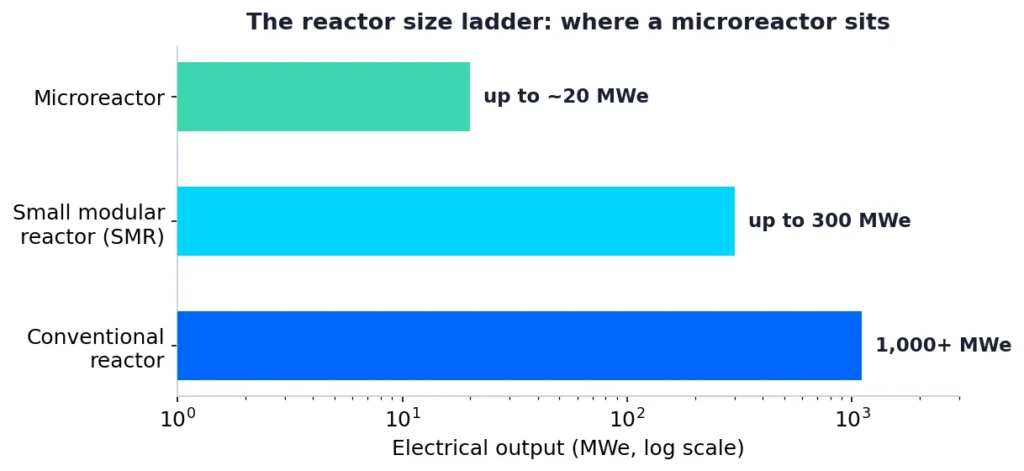
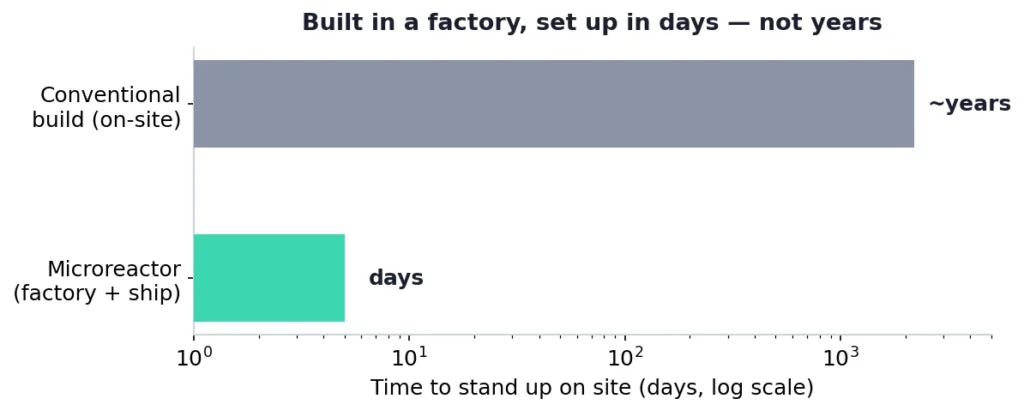
A nuclear microreactor is a very small fission reactor that generates roughly 1 to 20 megawatts of electricity — small enough to build in a factory, ship on a truck, and switch on at a site in days rather than years. The U.S. Department of Energy’s microreactor program focuses on the 1–10 MWe range. That makes a microreactor a fraction of a small modular reactor, which can reach 300 MWe, and a tiny sliver of a conventional plant that runs past 1,000 MWe.
I spend my working life around a full-size pressurized water reactor (PWR). It is a machine the size of a building, feeding a grid that serves millions. So the first time I read that a company wanted to put a reactor on the back of a truck and drive it to a mine, my reaction was the same one most operators have: interesting, but show me the fuel handling and the decay heat path.
This guide is the answer I wish someone had handed me — what a microreactor actually is, how it differs from the reactors you already know, and an honest read on whether the trucks will really roll.
What is a nuclear microreactor?
A microreactor sits at the very bottom of the reactor size ladder. The line most of the industry uses is power output. The IAEA defines a small modular reactor (SMR) as producing up to 300 MWe per unit.
A microreactor is smaller still: NuScale puts the class at up to about 50 MWe with many concepts under 20 MWe, while the U.S. Department of Energy frames its own program around the 1 to 10 MWe band
Three features separate a microreactor from everything larger, and none of them is the physics of fission itself:
- Factory build. The whole unit is assembled and fuelled in a plant, then delivered. A conventional reactor is poured and welded in place over years.
- Transportability. DOE describes microreactors as systems that can be moved by truck, ship, railcar, or aircraft and set up in days
- Autonomy. Many designs are built to run for years with minimal staffing, some for a decade or more before the fuel is swapped.
In other words, a microreactor is less a shrunken power plant than a sealed appliance that happens to run on fission. That shift — from a construction project to a manufactured product — is the whole pitch.
Microreactor vs SMR vs a Conventional reactor
The three categories get lumped together in headlines, but they solve different problems. The cleanest way to keep them straight is by what each one is trying to power.
| Parameters | Microreactor | Small modular reactor (SMR) | Conventional reactor |
| Electric output | ~1–20 MWe | Up to 300 MWe | ~1,000+ MWe |
| Built | Factory, delivered whole | Factory modules, site-assembled | Constructed on site |
| Transport | Truck, ship, rail, air | Oversized module shipments | Not transportable |
| Typical use | Remote sites, bases, mines | Grid, industry, data centers | Regional baseload |
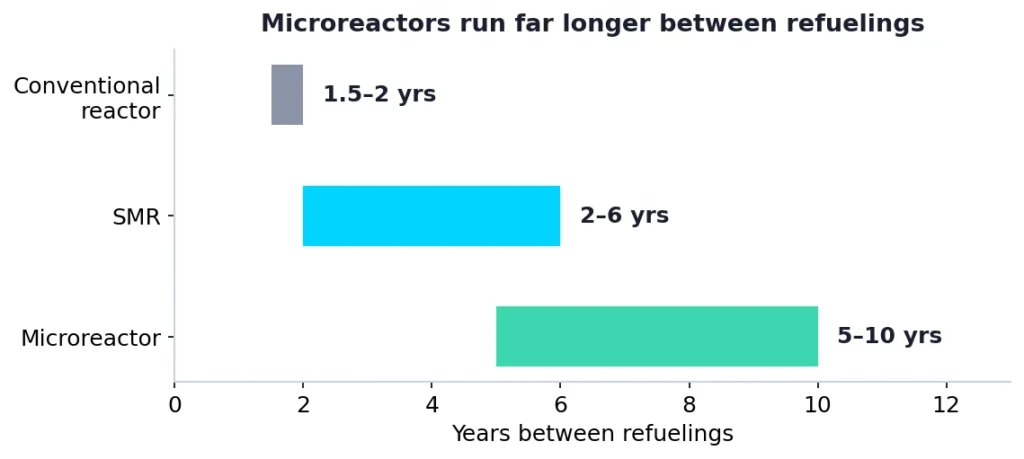
| Refueling | 5–10+ yrs, or sealed | Periodic | Every ~18–24 months |
| Staffing | Minimal / near-autonomous | Reduced crew | Large staff |
A useful mental model: a conventional reactor powers a region, an SMR powers a city or a big industrial customer, and a microreactor powers a single load — a base, a mine, a remote town, a cluster of servers. If you want the full picture on the middle tier, see our small modular reactors explainer.
How much power does a microreactor produce?
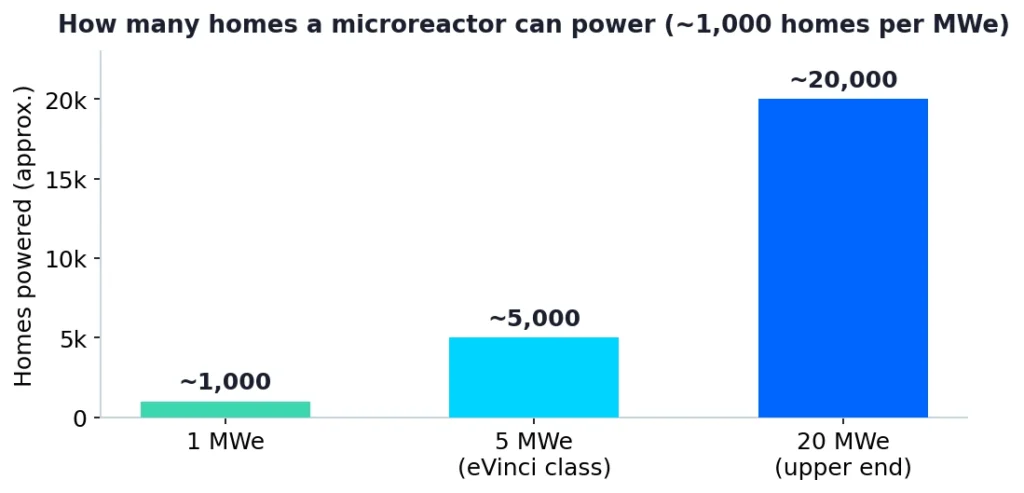
Most microreactor designs land between 1 and 20 MWe. To turn that into something concrete: DOE estimates that one megawatt of electricity supplies roughly 1,000 homes. So a 5 MWe unit — the size of the Westinghouse eVinci test reactor — could keep the lights on in about 5,000 homes, continuously, for years.
That is not “power a city.” It is closer to “power a hospital, a military base, a remote community, or a mid-size data hall.” The point of a microreactor is not scale. It is putting firm, carbon-free power exactly where a diesel generator sits today, without the fuel convoys.
What are microreactors used for?
The target markets are the places where grid power is unreliable, absent, or ruinously expensive to truck in as diesel:
- Remote communities. Arctic and island towns that burn shipped diesel year-round.
- Military bases. The U.S. Department of Defense has pushed hard here; its Project Pele transportable reactor and a 2026 U.S. Air Force move to site microreactors at bases both reflect a security interest in power that does not depend on a vulnerable grid or a fuel supply line.
- Mines and industrial sites. Off-grid operations that run around the clock.
- Data centers. The same AI power crunch driving SMR deals reaches down to microreactors for smaller, behind-the-meter loads.
- Disaster response and heat. Some concepts target process heat, desalination, or clean drinking water, not just electricity.
The common thread is firmness and independence. A microreactor is sold as power you can drop next to the load and forget about for years.
What fuel do microreactors use?
Almost every advanced microreactor design depends on HALEU — high-assay low-enriched uranium, uranium enriched to between 5% and just under 20%, well above the roughly 5% used in today’s commercial plants. The higher enrichment is what lets a very small core stay critical and run for years without refueling.
Many designs pair HALEU with TRISO fuel — tiny uranium kernels wrapped in layers of carbon and ceramic, each particle its own miniature containment shell rated for very high temperatures.
It is a genuinely tough fuel form, but it points at the sector’s real bottleneck: the HALEU supply chain barely exists commercially yet. We cover that gap in detail in how HALEU is made and HALEU explained. A reactor you can build in a factory is only useful if the fuel to load it exists, and right now that is the harder half of the problem.
Are microreactors safe?
On paper, small size is a safety advantage, and this is the part the physics genuinely supports. A microreactor holds a tiny fraction of the radioactive inventory of a large plant, so the worst-case source term is far smaller.
Most designs lean on passive cooling — the Westinghouse eVinci, for example, uses heat pipes to carry heat out without pumps or operator action, so there is no station-blackout (SBO) scenario of the kind that drives large-plant safety analysis.
That does not make them magic. A sealed, near-autonomous reactor parked at a remote site raises its own questions: physical security with almost no staff present, transport safety for a fuelled or irradiated core, and how you handle decay heat in an accident when the unit is sitting on two acres next to a town.
The GAO’s technology spotlight lays these trade-offs out plainly. The safety case is strong, but it is a different case than for a big plant — not simply a smaller version of it.
Who is building microreactors in 2026?
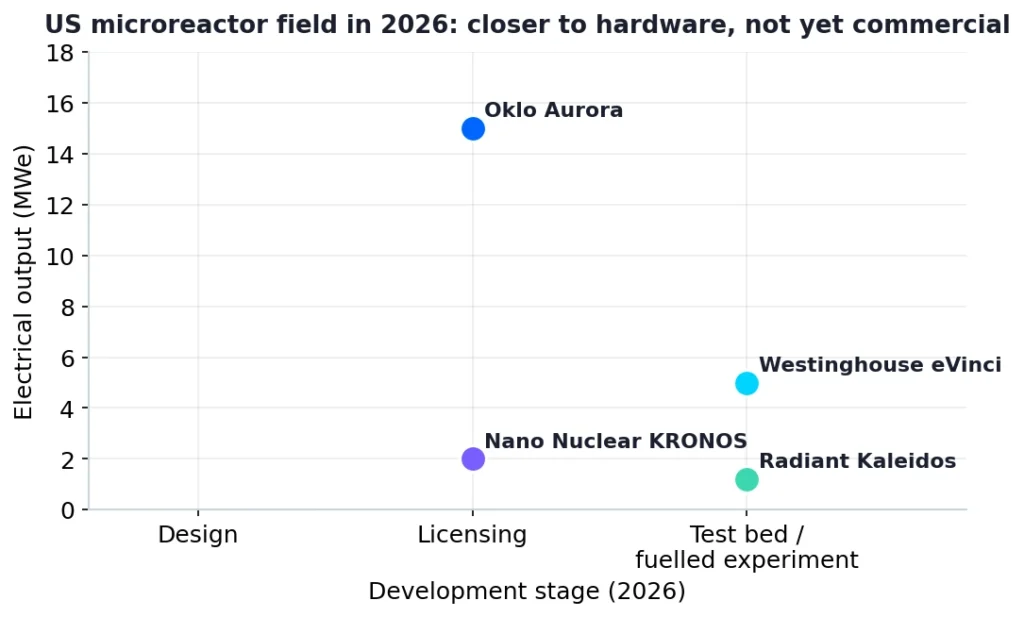
The field is crowded. DOE says more than 20 U.S. companies are working on designs. The 2026 milestone that matters is that testing has moved from slideware to fuelled hardware, largely through the Department of Energy’s DOME test bed at Idaho National Laboratory.
| Developer | Design | Output | Cooling | 2026 status |
| Westinghouse | eVinci | 5 MWe | Heat pipe | First fuelled experiment targeted at DOME as early as spring 2026 |
| Radiant | Kaleidos | 1.2 MWe | Gas (HTGR) | Selected for DOME; 5-year core; diesel-genset replacement |
| Oklo | Aurora | ~15 MWe class | Sodium | Commercial deployment planned at INL; hiring reactor operators |
| Nano Nuclear | KRONOS | Research-scale | Gas (HTGR) | Construction permit filed for a University of Illinois campus unit, March 2026 |
Beyond these, the Department of Defense’s Project Pele and a wave of designs profiled as “20+ commercial microreactors by 2028” round out a field that is real but still pre-commercial. Every one of these is either in a test bed, in licensing, or on paper. None is selling power to a customer yet.
When will microreactors actually arrive? The honest verdict
Here is where I put on the operator’s hat rather than the enthusiast’s.
The near-term signals are genuine. The DOME test bed is built and taking fuelled experiments in 2026. The NRC finalized Part 53, a technology-inclusive licensing framework, effective April 2026, and is working on a licensing approach aimed specifically at high-volume microreactor deployment. The military demand is real money, not a press release.
But three things stand between a spring-2026 test reactor and a microreactor humming away at a mine:
- Fuel. The commercial HALEU supply chain is not there yet. This is the binding constraint, and it is bigger than any single reactor design.
- The first-of-a-kind cost. No developer has a firm public price, and early estimates in the tens of millions per unit are for first units. The whole economic case rests on building many, cheaply, on a production line — exactly the thing the nuclear industry has never actually done. It is the same trap that has held back SMRs.
- Licensing and public consent at volume. One test reactor at a national lab is a very different thing from dozens of sealed reactors sitting next to towns and bases, each needing security, oversight, and community buy-in.
My read: microreactors are the most technically believable part of the advanced-nuclear wave — the physics is sound and the safety case is real — but the timeline you should trust is measured in “first commercial units late this decade,” not “coming soon.”
The neutrons were never the hard part. The factory, the fuel, and the price are. If that framing sounds familiar, it is the same conclusion we reached for SMRs: the reactor works; the industrial model is the bet.
Frequently Asked Questions
What is a nuclear microreactor?
A microreactor is a very small nuclear reactor, generally producing 1 to 20 megawatts of electricity, that is built in a factory, transported to its site, and run for years with minimal staffing. It is a fraction of the size of an SMR and a tiny fraction of a conventional plant.
How much power does a microreactor produce?
Most designs generate between 1 and 20 MWe. Since roughly 1,000 homes can be supplied per megawatt, a typical 5 MWe microreactor could power around 5,000 homes.
How is a microreactor different from an SMR?
Size and purpose. An SMR produces up to 300 MWe and supports a grid or large industrial customer. A microreactor produces up to about 20 MWe, is transportable, and powers a single site such as a base, mine, or remote community.
What fuel do microreactors use?
Most use HALEU — uranium enriched to between 5% and just under 20% — often in TRISO particle form. The higher enrichment lets a small core run for years, but the commercial HALEU supply chain is still developing.
How long can a microreactor run without refueling?
It depends on the design. Many target 5 to 10 years or more between refuelings, and some are sealed to run for their full life without on-site refueling.
Are microreactors safe?
They carry a much smaller radioactive inventory than large plants and typically use passive cooling that needs no pumps or operator action. The main open questions are physical security, transport of fuelled cores, and siting near communities.
How much does a microreactor cost?
No developer has published a firm price. Early estimates run into the tens of millions of dollars per unit for first-of-a-kind reactors, with the economic case depending on producing many units at lower cost over time.
When will microreactors be available?
Fuelled test reactors are expected at DOE’s DOME test bed in 2026, but the first commercial microreactors selling power are more realistically a late-decade prospect, gated by fuel supply, cost, and licensing at scale.
Sources and Further Reading
- IAEA — What are Small Modular Reactors (SMRs)?
- IAEA — HALEU: Power for a new generation of reactors
- U.S. DOE — The BIG Potential for Nuclear Microreactors
- U.S. DOE — First Microreactor Experiments in DOME Test Bed
- U.S. GAO — Science & Tech Spotlight: Nuclear Microreactors
- NuScale — SMRs vs Microreactors: What’s the Difference?
- U.S. NRC — Part 53 final rule (Federal Register)
About The Author
Elliot Marsh is a working reactor engineer with hands on experience in reactor physics, core management, reactivity control and nuclear fuel cycle planning at an operating power station. He writes about nuclear energy for readers who want the engineering reality, not the press release.
Need content like this for your company?
I write white papers, technical explainers, and thought-leadership for nuclear vendors, reactor developers, and the agencies that serve them — accurate enough for engineers, clear enough for buyers.