Is Dry Cask Storage Safe? A Reactor Engineer’s Honest Answer to the “Ticking Time Bomb”
Is dry cask storage safe? Short answer: yes and I say that as a person who works inside a commercial reactor, not as a spokesperson for anyone. A dry cask is one of the most boring, over-built pieces of hardware in all of nuclear power.
It has no moving parts, needs no electricity, and in more than four decades of use in the United States, no dry cask has ever released radiation in a way that harmed the public. That does not mean the way the country handles its spent fuel is problem-free. It is not, and I will be straight with you about the real weak points further down. But the “ticking time bomb” picture is simply the wrong mental model and once you see how these things actually work, it is hard to unsee.
The fear, stated fairly
Open a certain kind of article or forum thread and you will meet the same story every time: tens of thousands of tonnes of deadly waste, parked in more than 30 states, “just miles from where families live,” waiting for the earthquake or the attack that cracks a cask open like an egg. I am not going to pretend that story comes from nowhere. Some of its raw facts are true.
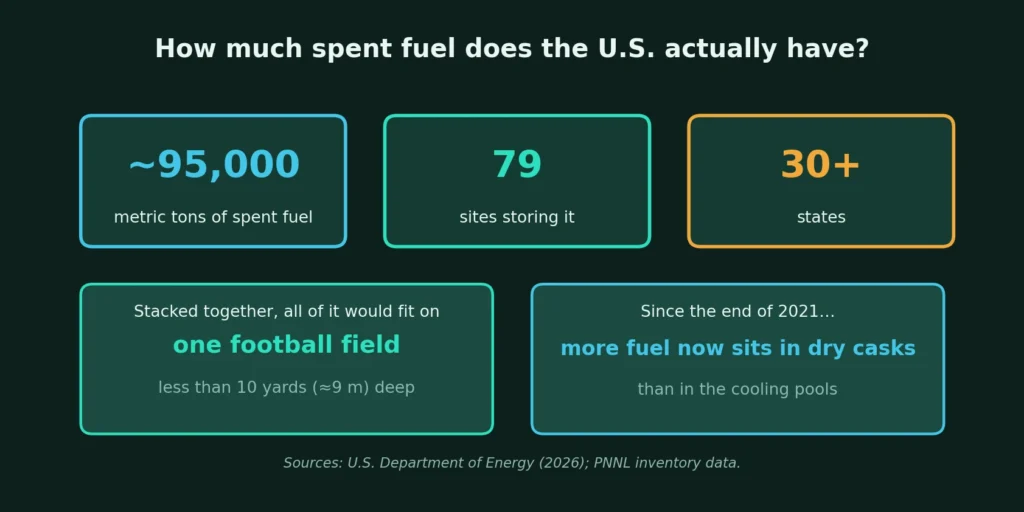
The United States really does have a lot of spent fuel. According to the U.S. Department of Energy, more than 95,000 metric tons of it are now stored across 79 sites in over 30 states, and that figure could roughly double over the life of the current reactor fleet. There is no permanent home for it yet. And spent fuel is genuinely dangerous when freshly removed from a core intensely radioactive and thermally hot.
So the ingredients of the scare are real. What is wrong is the leap from “this material is dangerous” to “the way we store it is a disaster waiting to happen.” Those are two completely different claims, and the second one does not follow from the first. To see why, you have to follow the fuel.
Where your spent fuel actually goes
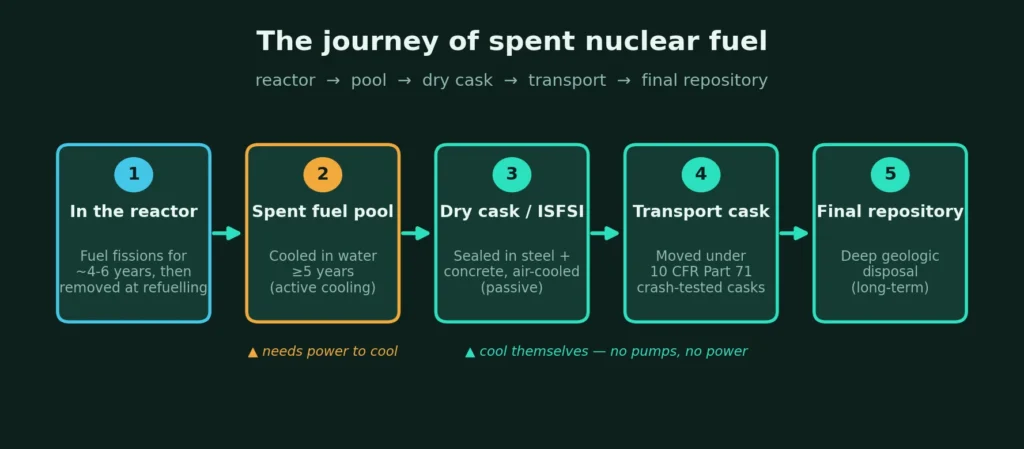
Nothing goes straight from a reactor into a cask. The fuel takes a deliberate, staged journey, and each stage is designed around one fact, radioactivity and heat both fall off quickly with time.
When we pull an assembly at a refuelling outage, usually after four to six cumulative years in the core it goes first into the spent fuel pool, a deep, steel-lined concrete pool of water right at the plant.
Water is a superb radiation shield and heat sink. The fuel sits there for years, cooling and decaying, while pumps circulate and cool the water. This is the one stage that depends on active systems, pumps, power, operators and I will come back to that, because it matters. If that cooling ever stopped, the pool still buys hours to days before it would boil — but it is the one link in the chain that needs power.
Once an assembly has cooled enough (the NRC allows dry storage after at least one year in the pool, though in practice utilities wait five years or more), it can be moved into a dry cask.
From there the fuel may sit in a dry storage array on-site, an Independent Spent Fuel Storage Installation, or ISFSI or eventually be loaded into a transport cask for shipment, and ultimately into a deep geologic repository. Interestingly, the country quietly crossed a milestone here since the end of 2021, more U.S. spent fuel sits in dry casks than in the pools.
What a dry cask actually is
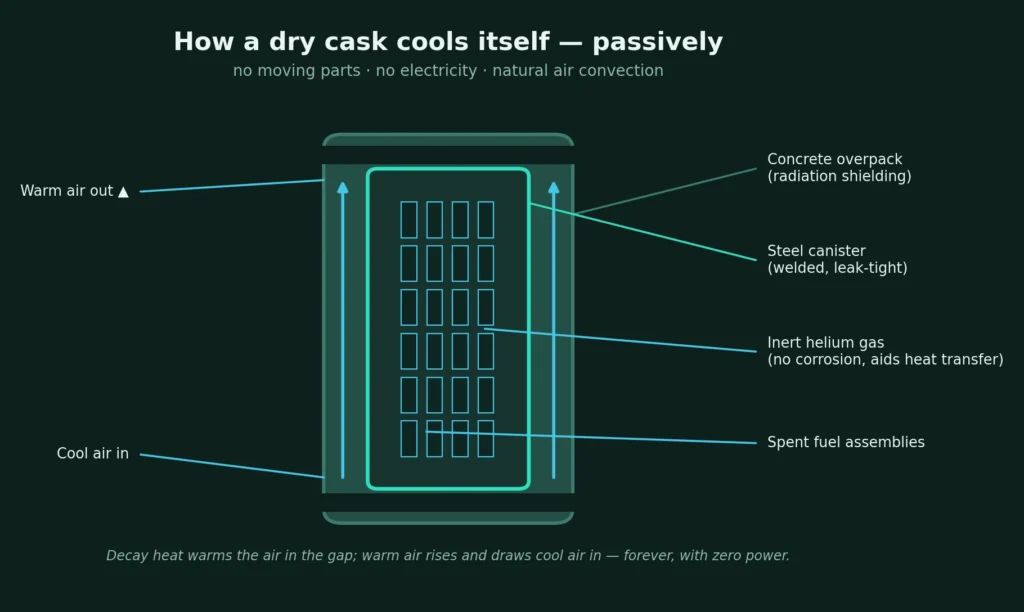
Here is the part the scary articles almost never describe, because it is genuinely undramatic. A dry cask is a set of nested barriers. The fuel assemblies sit inside a welded or bolted steel canister that provides leak-tight confinement.
Before that canister is sealed, the water is drained and the space is dried and back-filled with an inert gas usually helium, so there is no oxygen and no moisture to drive corrosion, and the helium helps carry heat outward. That steel canister then sits inside a much thicker outer shell of steel and concrete that does the radiation shielding.
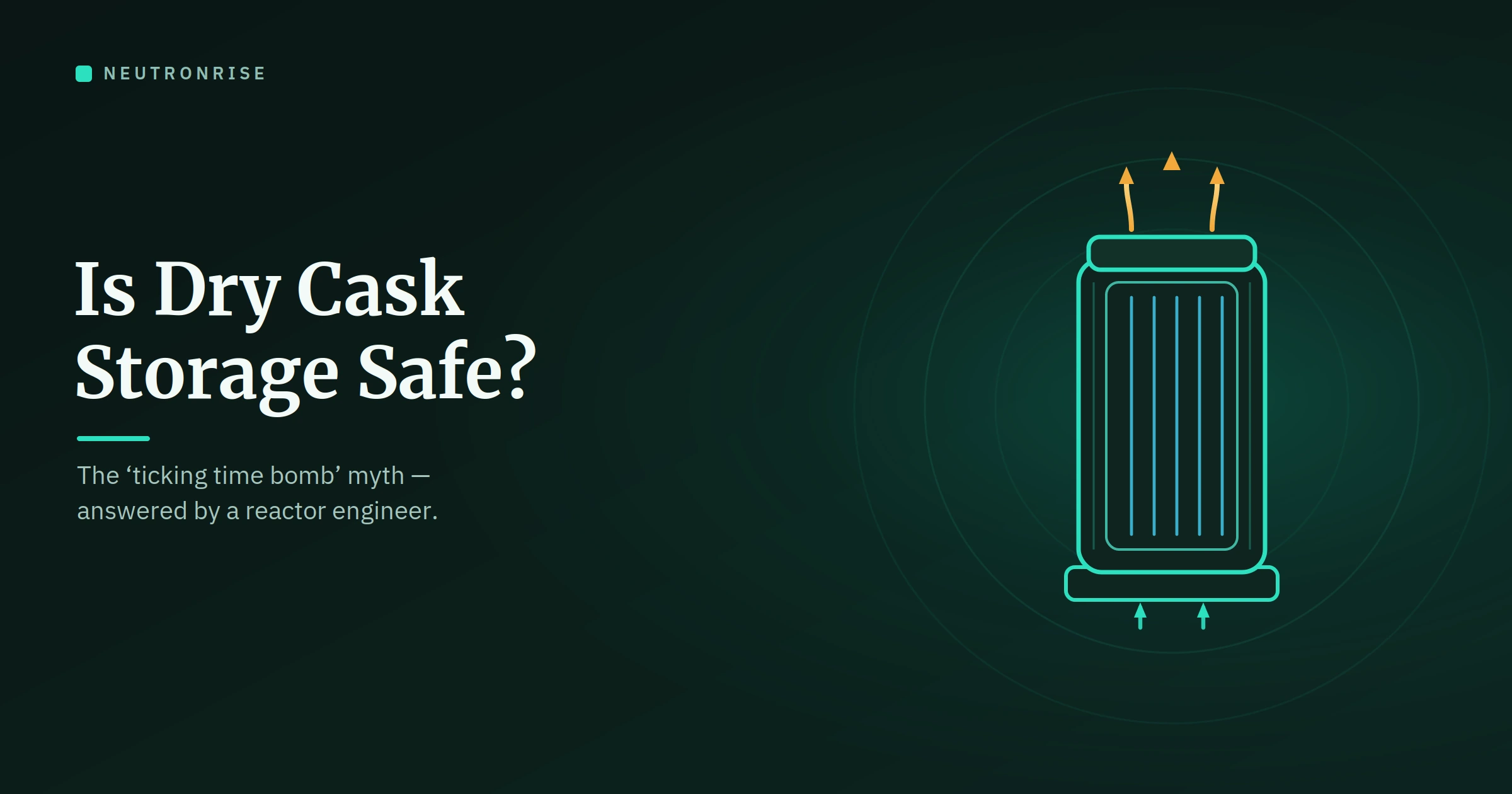
And that is essentially it. There is no pump, no fan, no valve to fail, no control system to hack, nothing to lose power. The cask cools itself by natural convection: decay heat from the fuel warms the air in the gap between the canister and the overpack, the warm air rises and vents out the top, and cooler air is drawn in the bottom to replace it.
It is the same physics that makes a chimney draw. Left completely alone, a loaded cask will keep doing this for decades. When a person walk past a loaded ISFSI pad, the radiation level a short distance away is a small fraction of what you would pick up on a long-haul flight.
None of this is improvised. Every cask design in the U.S. has to earn a Certificate of Compliance under 10 CFR Part 72, which means demonstrating by test or analysis that it keeps the fuel sub-critical, shielded, retrievable, and confined under normal, off-normal, and credible accident conditions. That is a high bar, and it is the reason casks look so massively over-built for the job.
“But how long is it dangerous — a million years?”
This is where the public debate gets genuinely confused, so let me separate two things that get mashed together: how long the material stays radioactive at all, versus how long it stays dangerous enough to need serious protection. They are not the same number, and the gap between them is enormous.
The intense hazard is short-lived. The isotopes that make fresh spent fuel so ferociously radioactive and hot are mostly short-lived fission products, so they burn themselves out fast.
The World Nuclear Association notes that after about 40 years, the radioactivity of used fuel has fallen to roughly one-thousandth of what it was at unloading. The Health Physics Society puts the decline at about 99.9% over 40 to 50 years. The single biggest drop happens in the very first year.
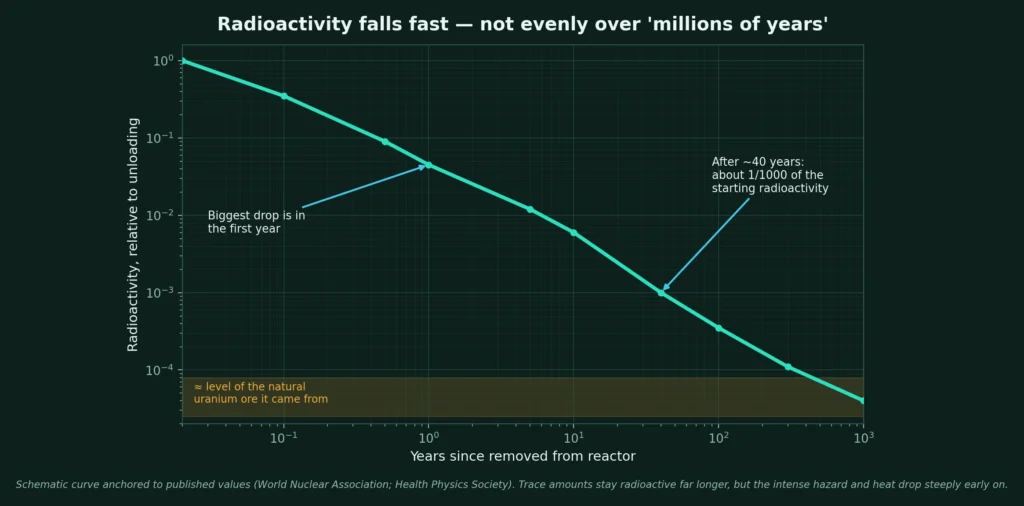
The famous “hundreds of thousands of years” figure is real, but it refers to when the last, faint traces of long-lived isotopes “actinides” finally fade back to the radioactivity level of the natural uranium ore we originally dug out of the ground.
That is a valid reason to build a permanent repository. It is not a description of a cask that is going to “go off.” The material sitting in a dry cask is not a bomb, and it never becomes more dangerous with time, it only becomes less.
The track record — including the ultimate stress test
Engineering claims are cheap; the record is what counts. In more than 55 years of moving this material, the Department of Energy counts over 2,500 shipments of spent fuel across the country without a single radiological release that harmed the public or the environment. Storage has been just as quiet. The failures the fear stories “imagine a cask cracking open and dusting a neighbourhood with radiation” have simply not happened.
If you want a sense of how detached that fear has become from the physics, consider that in late 2024 the nuclear advocate Isabelle Boemeke posted a photo of herself kissing a dry cask. It pulled in more than 20 million views and a wave of replies insisting she was endangering her future children.
She was fine, of course: the casks are shielded well enough that the dose right beside one is a small fraction of what you would pick up on a cross-country flight. The outrage in that thread is a near-perfect specimen of the misconception this whole article exists to correct.
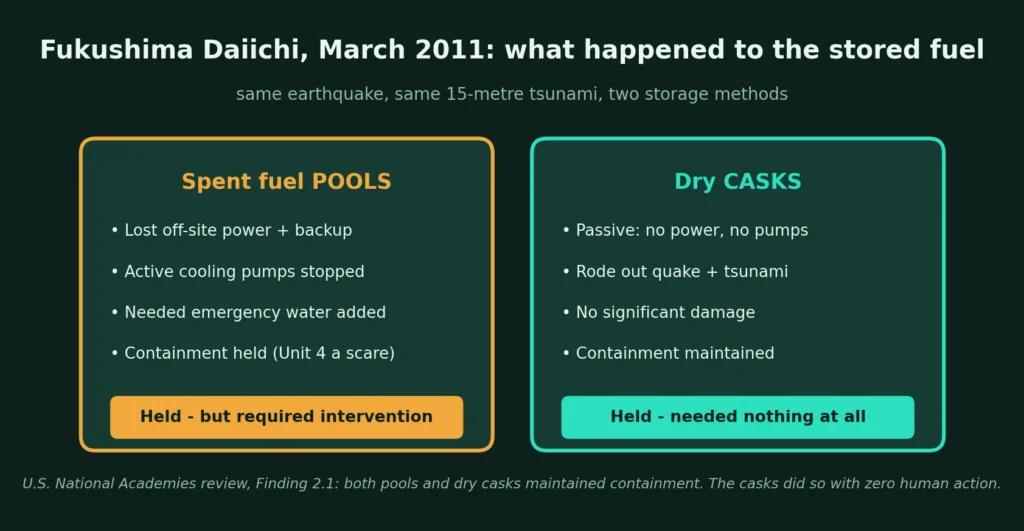
The most convincing evidence, though, came from an event nobody designed as a test. When the March 2011 earthquake and tsunami hit Fukushima Daiichi, the site had spent fuel in both pools and a dry cask facility.
The reactors melted down because they lost the power that ran their active cooling. The pools became a source of real, tense worry for exactly the same reason. But the dry casks “the passive ones” rode out the largest earthquake in Japan’s recorded history and a 15-metre tsunami and came through with no significant damage.
This is not a nuclear-industry talking point. A U.S. National Academies review of the accident found (its Finding 2.1) that the spent fuel storage facilities both pools and dry casks maintained their containment through the earthquake and tsunami.
The CSIS summary of the same events is blunter still: the dry storage facilities were, in effect, just fine. The casks did their job in the middle of one of the worst natural disasters of the century, and they did it with zero human intervention, because there was nothing for a human to do.
The honest part: where the real problems are
If I only told you the reassuring half, I would be doing exactly what I criticise the scaremongers for. So here is the other half, from a reactor engineer’s point of view.
First, pools deserve more respect than casks in the risk conversation, not less. A pool relies on active cooling, pumps, power and people paying attention. That is a genuine vulnerability, and it is the vulnerability Fukushima actually exposed. The reassuring part is how much time that vulnerability actually leaves you: even with cooling lost, a spent fuel pool takes hours to days to boil, not minutes.
Casks are the safer end state precisely because they are passive; the honest policy argument is that fuel should be moved out of crowded pools and into dry storage sooner, not that dry storage is the danger.
Second, the casks are certified and monitored, but they were mostly designed as interim storage, and “interim” in the U.S. has quietly stretched toward permanent. That raises legitimate long-term questions the industry is actively researching: how welded canisters age over many decades, how higher-burnup fuel behaves in storage, and how we will eventually repackage and move this material. These are real engineering problems. They are also slow, well-funded, and being worked, not the stuff of an imminent catastrophe.
Third, and biggest: the United States still has no operating permanent repository. That is a real failure, but notice what kind of failure it is. It is political and institutional, not a failure of the storage hardware sitting on the pads today.
What happens next
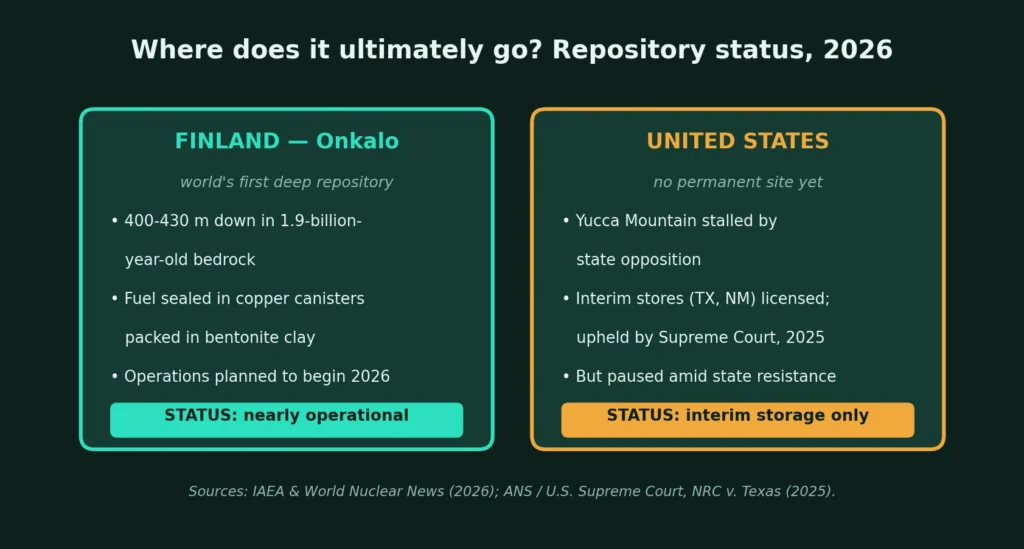
The plan was always that spent fuel would ultimately be sealed deep underground. The rest of the world is proving it can be done. In Finland, the Onkalo facility, the world’s first deep geologic repository for spent fuel is nearly operational, emplacing fuel in copper canisters packed in bentonite clay some 400 to 430 metres down in 1.9-billion-year-old bedrock.
World Nuclear News tracks similar programmes advancing in Sweden, France, Canada and Switzerland. The concept works; it just takes decades and, above all, community consent.
The U.S. picture is messier. The Yucca Mountain repository remains stalled by state opposition. Two consolidated interim storage sites, in Texas and New Mexico, were licensed by the NRC, and in 2025 the U.S. Supreme Court cleared away the main legal challenge to them, a position it effectively reaffirmed in January 2026.
Yet both projects are currently paused amid state and local resistance, so the fuel is, for now, staying where it is, in the casks. Internationally, the IAEA continues to set the safety standards that govern all of this under the Joint Convention on the safety of spent fuel management.
So — is dry cask storage safe?
YES. On the evidence, dry cask storage is one of the most robust, best-behaved technologies in the entire energy sector. It is passive, heavily shielded, tightly regulated, and it has a decades-long record with no public harm, a record that includes surviving a magnitude-9 earthquake and a tsunami.
The genuine problems are elsewhere: in ageing pools that still hold too much fuel, and in a political system that has not yet finished the last step of building a permanent home. Those are worth your concern and your pressure on decision-makers. The cask on the pad, quietly cooling itself with nothing but rising air, is not the thing that should keep you up at night.
Frequently Asked Questions
Has a dry cask ever leaked or failed?
No dry cask in the United States has ever released radiation in a way that harmed the public. There have been handling and loading incidents at individual sites, which is why every step is procedurally controlled and NRC-inspected, but the storage casks themselves have a clean containment record spanning more than four decades.
Can a dry cask explode?
No. There is no mechanism for it. The fuel is subcritical by design, the canister is back-filled with inert gas so there is nothing to burn, and a cask generates only gently declining decay heat, not the runaway conditions needed for any kind of explosion. It is a passive block of steel and concrete, not a reactor.
How long can spent fuel stay in a dry cask?
Casks are licensed for decades at a time and renewed, and regulators generally consider dry storage safe for at least 100 years, with ongoing research into even longer periods. Because there are no moving parts, ageing is about slow material behaviour, monitored and manageable rather than mechanical wear.
Is spent nuclear fuel dangerous forever?
No. Its most intense radioactivity fades within decades, to roughly one-thousandth of the starting level in about 40 years. Faint traces of long-lived isotopes persist far longer, which is why a permanent repository is worthwhile, but the material only ever becomes less hazardous with time, never more.
Why doesn’t the U.S. just recycle its spent fuel?
More than 90% of the potential energy remains in spent fuel, and countries such as France reprocess it. The U.S. chose not to, historically over cost and weapons-proliferation concerns. It remains a live policy debate, and several advanced-reactor designs aim to use this material as fuel.
Sources and Further Reading
- Inside One of the Nation’s Biggest Research Projects on Spent Nuclear Fuel https://www.energy.gov/ne/articles/inside-one-nations-biggest-research-projects-spent-nuclear-fuel
- Storage of Spent nuclear fuel https://www.nrc.gov/waste/spent-fuel-storage
- Dry Cask Storage https://www.nrc.gov/waste/spent-fuel-storage/dry-cask-storage
- Specific requirements for spent fuel storage cask approval and fabrication https://www.ecfr.gov/current/title-10/chapter-I/part-72/subpart-L/section-72.236
- Approval of Spent Fuel Storage Casks https://www.ecfr.gov/current/title-10/chapter-I/part-72/subpart-L
- Radioactive waste – Myths and Realities https://world-nuclear.org/information-library/nuclear-fuel-cycle/nuclear-waste/radioactive-wastes-myths-and-realities
- Radioactivity in Spent nuclear fuel https://hps.org/publicinformation/ate/q10835/
- 5 Fast facts about Spent Nuclear Fuel https://www.energy.gov/ne/articles/5-fast-facts-about-spent-nuclear-fuel
- I kissed a cask (of nuclear waste) and I liked it. https://x.com/isabelleboemeke/status/1869770868353859808
- Fukushima Daiichi Accident https://world-nuclear.org/information-library/safety-and-security/safety-of-plants/fukushima-daiichi-accident
- Fukushima Daiichi Nuclear Accident: Lessons Learned for Spent Fuel Storage https://www.ncbi.nlm.nih.gov/books/NBK373721/
- Mitigating the Risks of Spent Nuclear Fuel in Japan https://www.csis.org/analysis/mitigating-risks-spent-nuclear-fuel-japan
- A sustainable solution for spent fuel and high level waste disposal https://www.iaea.org/bulletin/a-sustainable-solution-for-spent-fuel-and-high-level-waste-disposal
- How are geological repository projects progressing? https://www.world-nuclear-news.org/articles/how-are-geological-repository-projects-progressing
- Supreme Court rules against Texas in interim storage case https://www.ans.org/news/2025-06-18/article-7124/supreme-court-rules-against-texas-in-interim-storage-casesupreme-court-rules-against-texas-in-interim-storage-case/
- Supreme Court nixes Beyond Nuclear’s CISF challenge https://www.ans.org/news/article-7671/supreme-court-nixes-beyond-nuclears-cisf-challenge
About The Author
Elliot Marsh is a working reactor engineer with hands-on experience in reactor physics, core management, reactivity control, and nuclear fuel-cycle planning at an operating power station. He writes about nuclear energy for readers who want the engineering reality, not the press release.
Need content like this for your company?
I write white papers, technical explainers, and thought-leadership for nuclear vendors, reactor developers, and the agencies that serve them — accurate enough for engineers, clear enough for buyers.