7 Nuclear Safety Myths Even Smart People Believe
Here’s something that should bother you. If I asked you to name the most dangerous way humanity makes electricity, a lot of intelligent, well-read people would say nuclear. And they would be almost exactly wrong — not a little wrong, but ranked-at-the-bottom-of-the-list wrong. Nuclear is, by the hard numbers, one of the very safest energy sources ever built, sitting right alongside wind and solar.
So how did one of the safest things we do end up with the scariest reputation? The answer is a handful of nuclear safety myths so sticky, so emotionally loaded, and so often repeated that even careful, skeptical people absorb them without noticing.
I’m a reactor engineer — I’ve spent my career around the actual machines, not the headlines — and I want to walk you through the seven I hear most often. Not to sell you on nuclear, but because being scared of the wrong thing is its own kind of danger.
A promise before we start: I’m not going to wave away every concern. Nuclear has real risks and a real history, and I’ll be honest about every one of them. But honest is exactly what’s been missing from this conversation. Let’s fix that, one myth at a time. Some of these will surprise you — and number four genuinely unsettles most people the first time they hear it.
Myth #1: “Nuclear Power Is the Most Dangerous Way to Make Electricity”
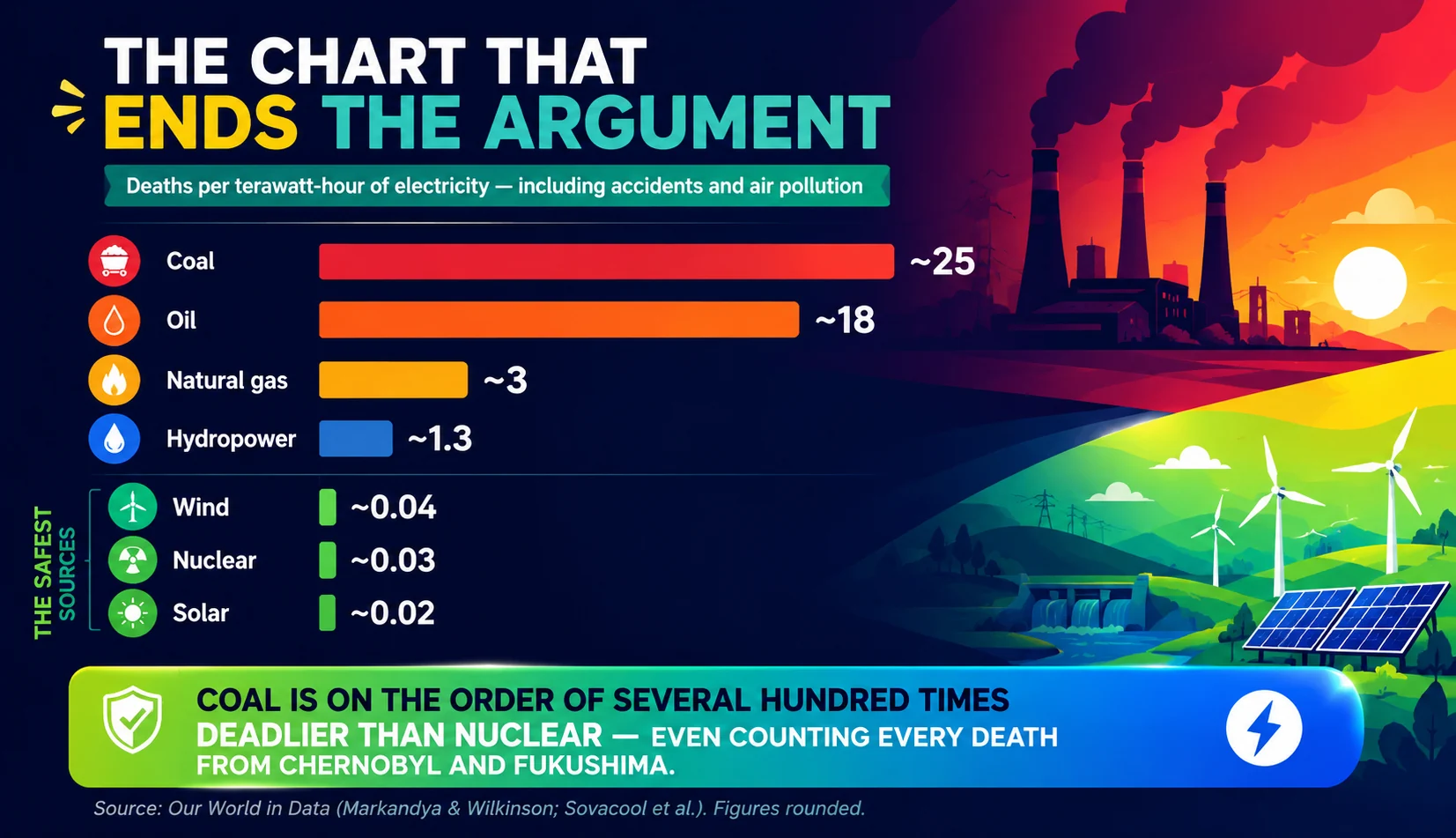
The truth: Per unit of electricity produced, nuclear is about as safe as wind and solar — and on the order of several hundred times safer than coal.Let’s start with the big one, because it’s the foundation under all the others. The reality is almost the exact opposite of the myth, and the data isn’t close.
When researchers count deaths per unit of electricity produced — including accidents and air pollution — coal causes roughly 25 deaths per terawatt-hour. Oil, around 18. Natural gas, about 3. Nuclear? Somewhere around 0.03. That’s not a typo. Coal is on the order of several hundred times deadlier than nuclear, per unit of energy.
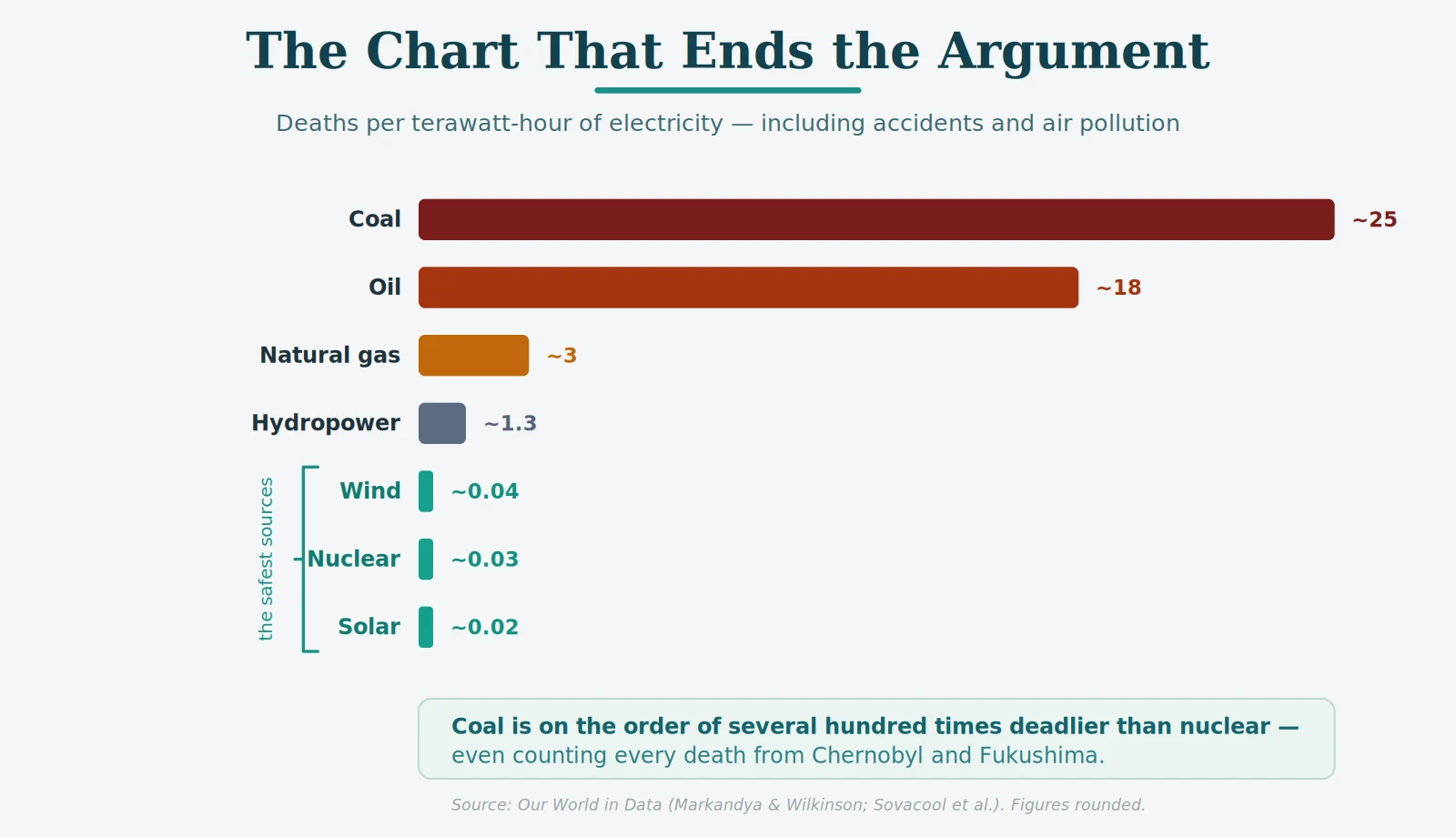
Sit with that comparison, because it reframes everything. The energy source people fear the most is statistically about as safe as wind and solar, while the sources they shrug at — especially coal — quietly kill enormous numbers of people through air pollution every single year.
One way to feel the scale: across its entire history, commercial nuclear power has caused fewer deaths than fossil fuels cause before lunch on an average day. The danger was always real — we just pointed it at the wrong smokestack. (These figures come from Our World in Data, drawing on the peer-reviewed work of Markandya & Wilkinson and Sovacool et al. — see Sources below.)
Myth #2: “Chernobyl Killed Tens of Thousands of People”
The truth: The deaths scientifically attributable to Chernobyl’s radiation number roughly 30 to 50 (UNSCEAR, WHO, IAEA) — not the tens of thousands the myth claims.
Chernobyl is the ghost that haunts every nuclear conversation, and it deserves to be taken seriously it was a genuine catastrophe caused by a reckless reactor design and a broken safety culture (how a runaway reactivity insertion races past prompt criticality). So let me be careful and precise here, because precision is the whole point.
The number of deaths directly and scientifically attributable to radiation from Chernobyl is, according to the international scientific consensus (UNSCEAR, WHO, and IAEA), around 30 to 50 people — mostly the plant workers and firefighters who received massive doses fighting the disaster in its first hours.
Beyond that confirmed toll, models estimate a number of additional long-term cancer deaths, with genuinely wide and debated ranges. But the figure tens of thousands of people carry in their heads — a poisoned continent, mass casualties — simply isn’t what the long-term scientific follow-up found.
The most reliably attributable later effect was a wave of thyroid cancers in people exposed as children, a disease that, devastatingly diagnosed as it is, has a survival rate above 98%.
None of this excuses what happened. The point is narrower and more important: the worst nuclear accident in human history, as real and as frightening as it was, killed on a scale measured in dozens of confirmed deaths — not the tens of thousands the myth insists on. And crucially, it happened in a reactor type with no containment dome, run in a way no Western regulator would ever permit. We’ll come back to that.
Myth #3: “Fukushima Was a Radiation Massacre”
The truth: UN scientific bodies found essentially zero deaths from Fukushima’s radiation — but the panicked evacuation is linked to more than 2,000 disaster-related deaths.
This one carries a twist so counterintuitive that it changes how people think about risk itself. In 2011, a massive earthquake and tsunami struck Japan, killing more than 18,000 people and crippling the Fukushima Daiichi plant, The reactors themselves shut down automatically the instant the quake hit — but a core keeps producing intense decay heat for days after the chain reaction stops, and when the tsunami destroyed the backup cooling, that residual heat is what melted three of the cores.
The same physics follows the fuel afterwards — used fuel keeps making heat in its storage pool, which is exactly why a pool needs active cooling and how long a spent fuel pool would take to boil without it. It was, by any measure, a disaster. So how many people did the radiation kill?
According to the United Nations scientific committee (UNSCEAR), the World Health Organization, and the IAEA: effectively zero. There were no deaths from acute radiation exposure, and UNSCEAR’s 2020 report concluded that no adverse health effects among residents have been documented that are directly attributable to radiation — nor are any expected to be discernible in the future. The tsunami killed tens of thousands. The radiation, as far as the science can measure, killed essentially no one.
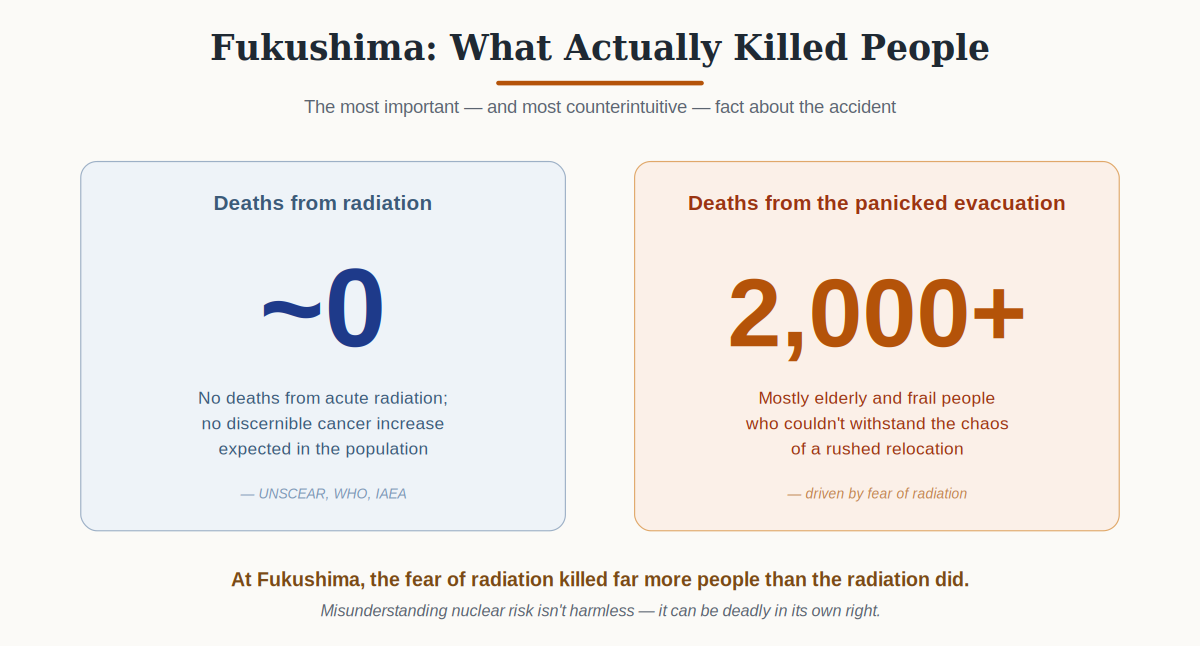
But here’s the part that should stay with you, because it’s the real lesson of Fukushima. The rushed, panicked evacuation of the area — driven by fear of radiation — is linked to more than 2,000 disaster-related deaths, overwhelmingly among elderly and frail people (around 90% were over 66) who couldn’t withstand the chaos of being moved.
Read that again: at Fukushima, the fear of radiation is tied to far more deaths than the radiation itself. That’s not an argument that the accident didn’t matter. It’s the single clearest illustration of this entire article’s theme — that misunderstanding nuclear risk is itself dangerous, sometimes lethally so.
Myth #4: “A Nuclear Plant Can Explode Like a Nuclear Bomb”
The truth: It is physically impossible. Reactor fuel is enriched to about 3–5%, while a bomb needs roughly 90%+ — the concentration for a nuclear explosion simply isn’t there.
This is the one I most want to put to rest, because it’s physically impossible — and it’s number four, the one that genuinely unsettles people when they realize how deeply they’d assumed otherwise. A nuclear power plant cannot detonate like a nuclear weapon. Not unlikely. Not well-guarded against. Impossible, by the laws of physics.
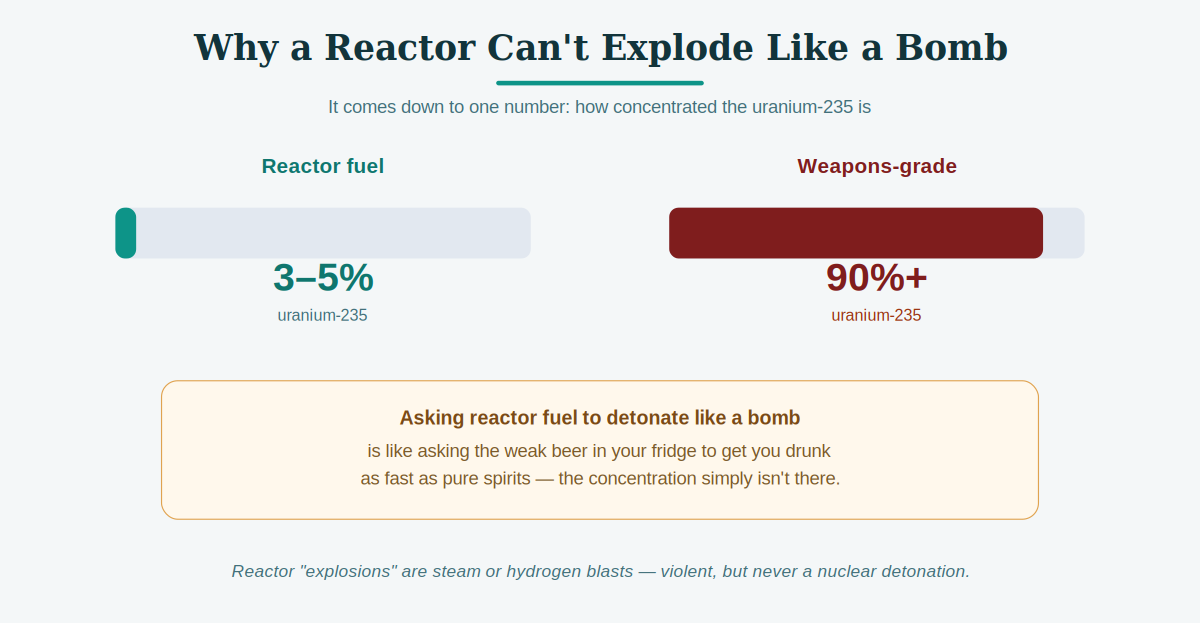
Here’s why, in plain terms. A nuclear bomb requires uranium enriched to over 90% — weapons-grade. Reactor fuel is enriched to around 3 to 5%. (The IAEA draws the civilian line clearly: fuel-grade uranium sits at a few percent, while anything above 20% is classed as highly enriched, and weapons need roughly 90%+.)
Asking reactor fuel to produce a nuclear explosion is like asking the weak beer in your fridge to get you drunk as fast as pure spirits — the concentration simply isn’t there, and no arrangement of it can be. The physics that makes a bomb work cannot happen in a power reactor. When you hear about a reactor “explosion” — as at Chernobyl or Fukushima — that was a steam or hydrogen explosion, the violent but ordinary kind you could get from any pressurised industrial system. Frightening and damaging, yes. A mushroom cloud, never.
Myth #5: “Nuclear Waste Is a Vast, Unsolvable Poison”
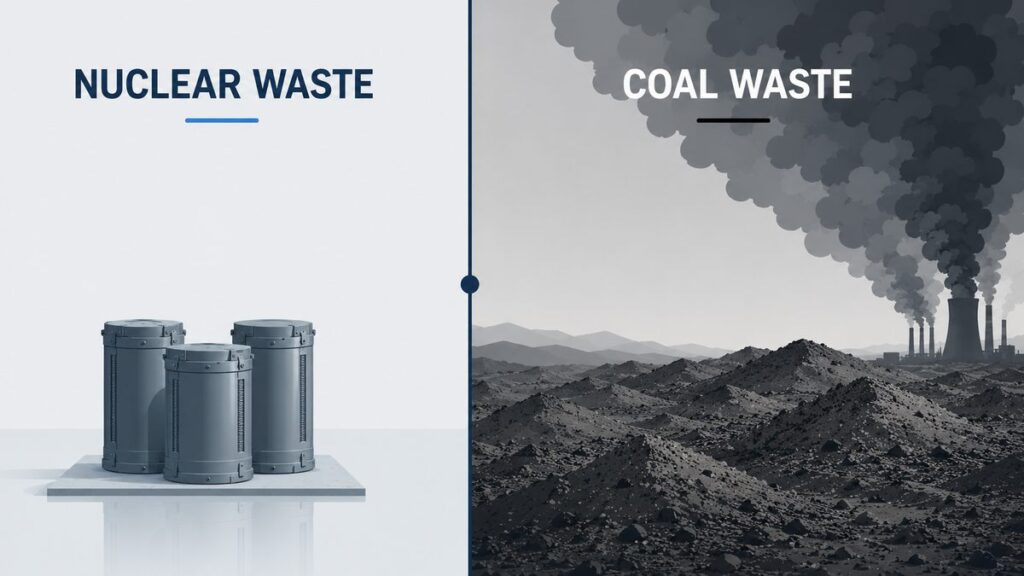
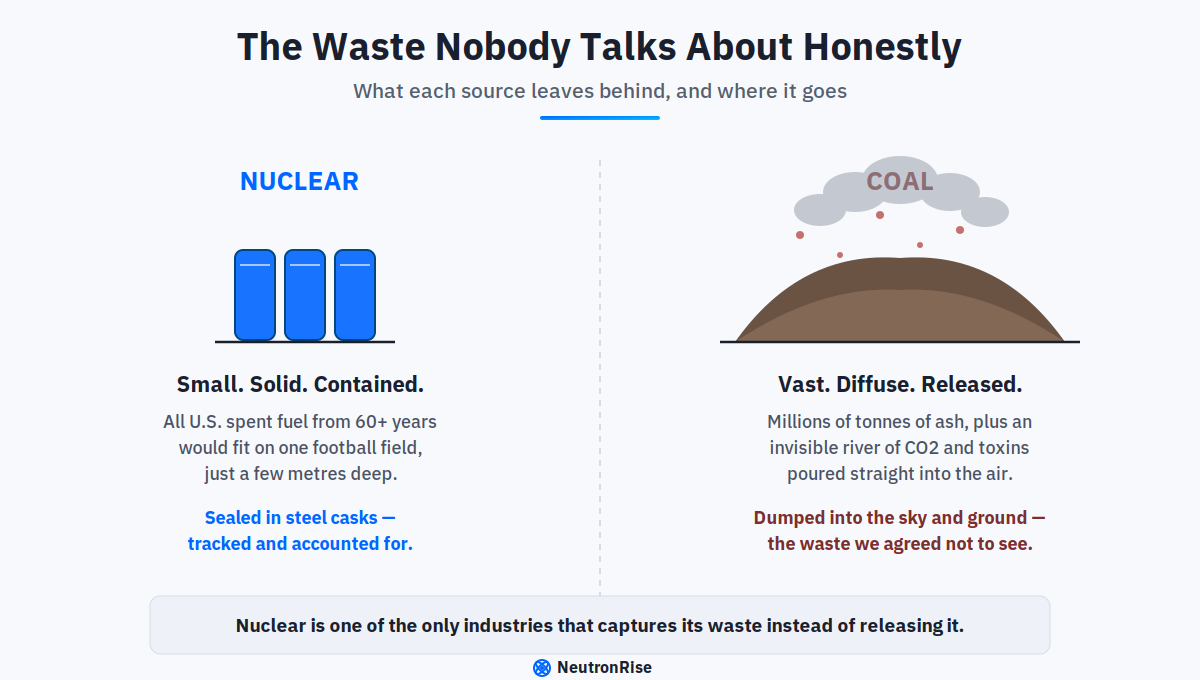
The truth: Nuclear waste is small, solid, and contained — all U.S. spent fuel from 60+ years would fit, stacked, on a single football field a few metres deep.
Waste is the most legitimate concern on this list, so I won’t hand-wave it — it’s a real problem that demands real engineering, and I’ve written elsewhere about the genuine challenges. But two facts reliably surprise people and reshape the picture.
First, the volume is astonishingly small. Because uranium is so energy-dense, the total amount of waste is tiny compared to any other source. All the spent fuel the entire U.S. nuclear fleet has produced in over sixty years would fit, stacked, on a single football field a few metres deep.
Compare that to the millions of tonnes of ash and the invisible river of carbon dioxide a coal fleet produces — waste we simply dump into the sky and the ground. Second, nuclear waste is contained. It’s solid, tracked, and stored in engineered casks — not pumped into the atmosphere we all breathe.
Whether those casks are actually as safe as that sounds is a question worth its own answer — here’s the honest version. The honest framing isn’t “nuclear has a waste problem and other sources don’t.” It’s that nuclear is one of the only industries that actually captures and accounts for its waste instead of releasing it.
Myth #6: “We Got Lucky — Reactors Aren’t Really Designed to Be Safe”
The truth: Modern reactors are built on defense in depth and, increasingly, passive safety — designed so physics alone shuts them down even if every operator walks away.
This myth imagines reactors as barely-contained dragons held back by nervous operators and good fortune. The reality, from the inside, is almost the opposite — and it’s the part of my job I’m proudest of.
Modern reactors are among the most obsessively engineered machines on Earth, built around a principle we call defense in depth: layer upon independent layer of protection, so that no single failure — and ideally no combination of failures — can cause disaster. Even routine control reflects this, right down to the neutron-absorbing boron we deliberately dissolve in the coolant that holds the reaction perfectly steady.
And the newest designs go further still, into something genuinely beautiful: passive safety. These are reactors engineered so that if everything fails — all power lost, every operator gone — the laws of physics alone shut the reactor down and keep it cool, with no human action required.
Gravity, natural circulation, and materials that quiet the reaction as they heat up do the work. The whole philosophy has shifted from “watch it carefully so it doesn’t run away” to “build it so it physically can’t.” That’s not luck. That’s the accumulated paranoia of an industry that learned from every one of its mistakes, engineered into steel.
America’s own worst nuclear accident makes the point better than any diagram. At Three Mile Island in 1979, Unit 2’s core partially melted — and the containment building did exactly what it was built to do.
Decades of health studies found no detectable radiation effects among the surrounding population. The reactor was destroyed; the public was not harmed. That is defense in depth working under the worst conditions it was ever asked to face. Unit 1, the undamaged reactor next door, is now being restarted — and the engineering behind that is its own story.
Myth #7: “Living Near a Reactor Bathes You in Dangerous Radiation”
The truth: A year living next to a nuclear plant delivers about 0.0001 mSv — the same dose as eating one banana, and a vanishingly small slice of natural background radiation.
Finally, the everyday fear: that a nuclear plant leaks a constant, invisible menace into the lives of everyone nearby. Here’s the fact that ends this one. You are exposed to more radiation eating a banana, or spending an afternoon at high altitude, than you’d receive in a year living next to a normally operating nuclear plant.
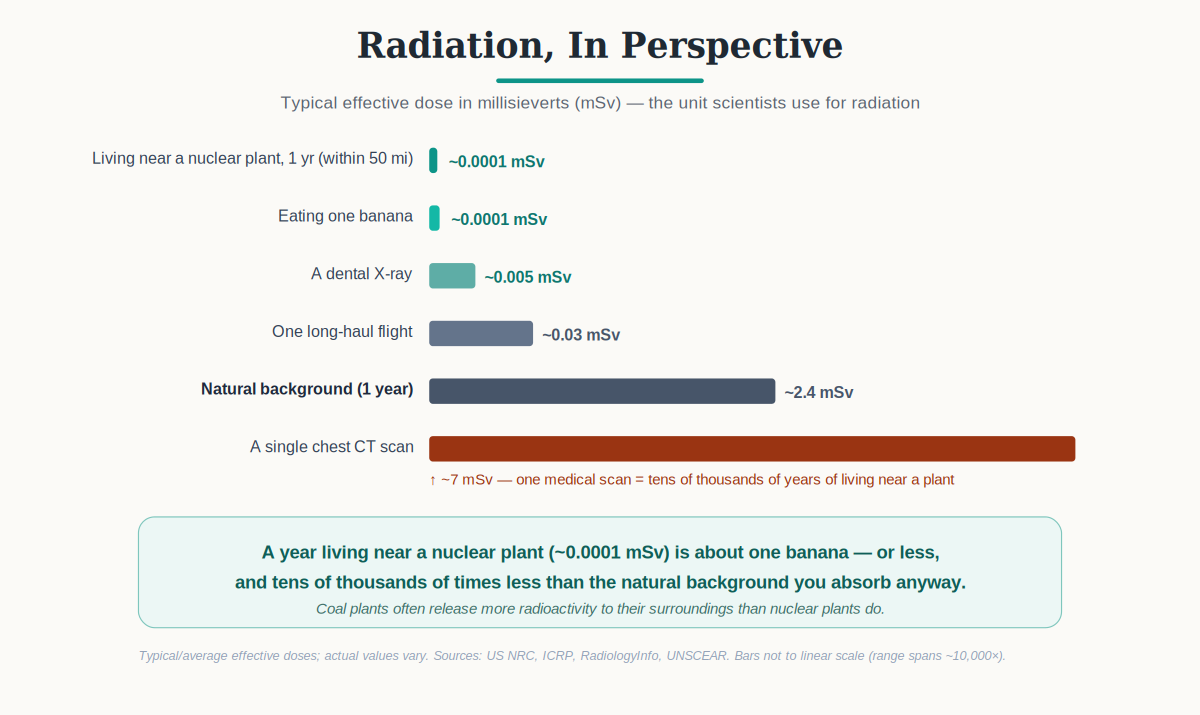
Radiation is not some exotic nuclear invention — it’s everywhere, all the time. It’s in the rocks, the soil, the sky, your own body, the food you eat. The radiation dose from living beside a nuclear plant is a vanishingly small fraction of the natural background you absorb just by existing on this planet — the IAEA puts the average annual dose to someone living near a plant at about 0.0001 mSv, the same as eating a single banana.
In a grim irony, a coal plant typically releases more radioactive material into the surrounding environment than a nuclear plant does — because coal ash contains naturally occurring radioactive elements that get blown out the stack. The plant people are afraid to live near is, on this measure, cleaner than the one they don’t think about at all.
But let me make this less abstract, because I can offer you something a chart can’t. I don’t just believe nuclear is safe — I live it. I spend my working days at an operating nuclear plant, and life there is about the most ordinary thing you can imagine.
We take our lunch breaks like anyone in any office. There’s a cafeteria; there’s a snack bar. On cold mornings, some of us stand outside with our toast and tea in the open air, chatting before the shift — with the reactor dome standing quietly in view, just as it always is. Nobody flinches at it. It’s simply where we work.
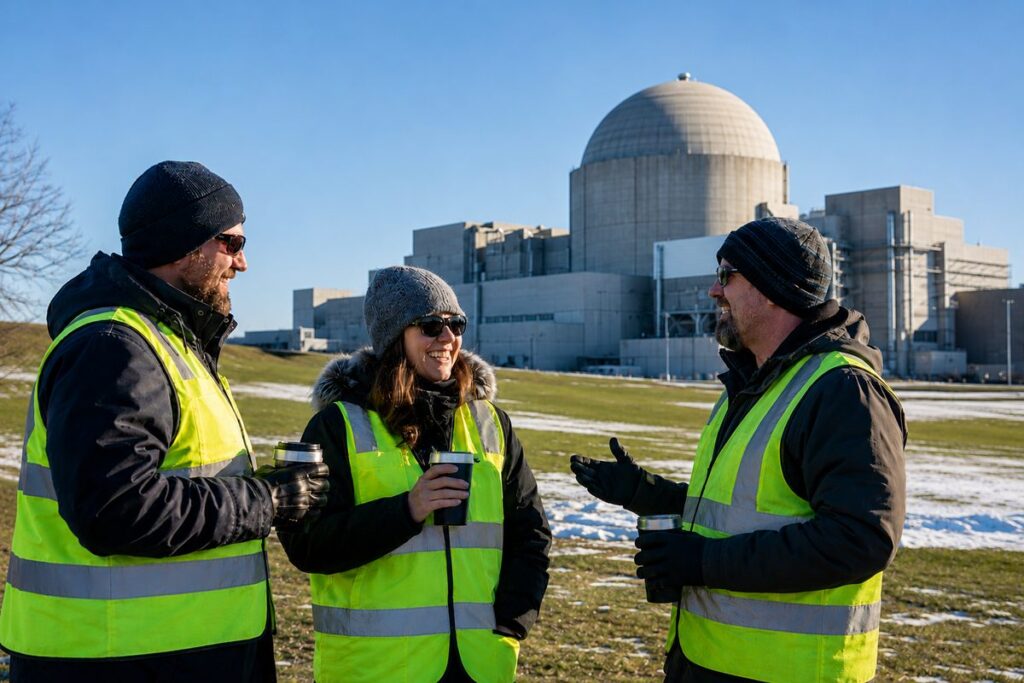
And it isn’t only the engineers. Families live their lives around these sites — ordinary, happy, unremarkable lives. Kids, routines, weekend plans, the whole texture of normal existence, carried out in the shadow of the very thing the myths say should terrify us.
I’ll be honest: that daily normalcy is the most convincing safety statistic I know. You can read every dataset I’ve cited in this article, and you should. But if you want to know whether I truly trust the safety of a nuclear plant, the answer is in the most boring evidence imaginable — I eat my breakfast next to one, and I don’t think twice about it.
Nuclear Safety Myths: The Real Danger Isn’t the Reactor
Step back and look at the seven together, and a pattern emerges that’s bigger than any single fact. Almost every nuclear safety myth runs in the same direction: it makes us terrified of a small, well-managed, contained risk — while we calmly accept far larger risks that don’t come with a scary name. We fear the reactor and ignore the smokestack. We flee the radiation and overlook the fact that the fear itself can be deadlier.
I’m not asking you to love nuclear power. I’m asking you to be afraid of the right things, in the right proportion, for the right reasons — because that’s what keeps people safe. The genuine danger in the nuclear story was never really the technology.
As an engineer who has spent his life with these machines, I can tell you the thing most worth fearing has always been the same: not the reactor, but the myth that keeps us from thinking clearly about it. Fear that’s pointed at the wrong target doesn’t make us safer. It just makes us afraid.
Frequently Asked Questions
Is nuclear power safe?
Yes. Measured by deaths per unit of electricity produced — including every accident and air-pollution death — nuclear is among the safest energy sources ever built, on par with wind and solar and hundreds of times safer than coal. Its fearsome reputation comes from a handful of persistent nuclear safety myths, not from its actual safety record.
How many people died from Chernobyl?
The deaths directly attributable to radiation, according to the scientific consensus (UNSCEAR, WHO, IAEA), number around 30 to 50 — mostly workers and firefighters exposed in the first hours. Long-term modelled cancer estimates add a debated range, but the popular “tens of thousands” figure is not what decades of scientific follow-up found. Chernobyl also used a Soviet reactor design with no containment dome that no Western regulator would permit.
How many people died from Fukushima radiation?
Directly, essentially none. UN scientific bodies, the WHO, and the IAEA found no deaths from acute radiation and no discernible expected increase in cancer. The 2011 tsunami killed more than 18,000 people, and the panicked evacuation is linked to over 2,000 disaster-related deaths — meaning the fear of radiation is tied to far more deaths at Fukushima than the radiation itself.
Can a nuclear power plant explode like a nuclear bomb?
No — it is physically impossible. A bomb needs uranium enriched above 90%, while reactor fuel is enriched to only about 3 to 5%. The concentration simply isn’t there. Reactor “explosions” like those at Chernobyl or Fukushima were steam or hydrogen blasts, not nuclear detonations.
Is it safe to live near a nuclear power plant?
Yes. A year spent living next to a normally operating nuclear plant delivers less radiation than eating a single banana or taking one long flight — a tiny fraction of the natural background radiation everyone absorbs anyway. A coal plant typically releases more radioactive material into its surroundings than a nuclear plant does.
Is nuclear waste as dangerous as people think?
Nuclear waste is a real engineering challenge, but two facts reshape the picture: the volume is tiny (all U.S. spent fuel from 60+ years would fit on one football field a few metres deep), and it is solid, tracked, and contained rather than released into the air. Nuclear is one of the few industries that actually captures and accounts for its waste.
Sources & Further Reading
Every safety figure in this article is drawn from primary scientific and regulatory sources. You’re encouraged to read them directly:
- Deaths per terawatt-hour by energy source — Our World in Data: Safest sources of energy (based on Markandya & Wilkinson, 2007; Sovacool et al., 2016).
- Chernobyl health effects — UNSCEAR: Chernobyl, with corroborating assessments from the WHO and the IAEA.
- Fukushima health effects — UNSCEAR 2020 Report on Fukushima (“no adverse health effects… directly attributable to radiation”).
- Fukushima evacuation and disaster-related deaths, radiation dose comparisons — World Nuclear Association: Fukushima Daiichi Accident.
- Radiation dose from living near a nuclear plant (“about 0.0001 mSv… equivalent to eating a banana”) — IAEA: Understanding radioactive discharges; dose comparisons corroborated by the US NRC and ICRP.
- Uranium enrichment levels (reactor fuel ~3–5% vs weapons-grade ~90%+) — IAEA: Nuclear Fuel Cycle — Enrichment, which defines uranium below 20% as low-enriched (civilian) and above 20% as highly enriched.
Where long-term effects are genuinely uncertain or debated, this article says so rather than overstating the case. Honesty about the limits of the data is part of taking the science seriously.
About the Author
Elliot Marsh is a working reactor engineer with hands-on experience in reactor physics, core management, and reactor safety at an operating nuclear power station. He writes about nuclear energy for readers who want the engineering reality, not the press release.
Need content like this for your company?
I write white papers, technical explainers, and thought-leadership for nuclear vendors, reactor developers, and the agencies that serve them — accurate enough for engineers, clear enough for buyers.