The Reactor That Acts Like a Battery: How TerraPower’s Natrium Works
In a small Wyoming town built on coal, a reactor called Natrium is rising from the grave of a fossil-fuel plant— and the Natrium reactor is unlike anything nuclear power has built before.
Kemmerer, Wyoming, population around 2,600, spent a century mining and burning coal. Its coal-fired station was winding down toward retirement — and in most American coal towns, that’s the start of a familiar obituary: the plant closes, the jobs leave, the young people follow, and the tax base that funded the schools and the roads quietly collapses.
Except Kemmerer’s story took a turn nobody saw coming. On April 23, 2026, crews broke ground there on the first commercial advanced nuclear reactor the United States has approved in over forty years — a machine that doesn’t just generate power, but does something no nuclear plant before it has ever done at commercial scale. It can store its energy and surge on command, like a giant battery welded to a reactor.
It’s called Natrium. And to understand why a Bill Gates-founded company chose a dying coal town to build the most-watched reactor in America — and why Meta is betting billions on eight more of them — you have to understand three quietly brilliant ideas stacked on top of each other. None of them is the reactor alone. The genius is in how they fit together.
Worth crediting up front: Natrium is co-developed by TerraPower and General Electric GE Vernova Hitachi Nuclear Energy, and it builds on decades of sodium-reactor work — including GE-Hitachi’s PRISM design. This isn’t one company’s gamble; it’s two serious nuclear players standing on a long engineering legacy. And the reactor at its core is a type with a 70-year history: a sodium-cooled fast reactor.
Idea #1: Build Where the Wires Already Are — Repurposing Coal Plants for Nuclear
Here’s a fact about nuclear power plants that almost nobody outside the industry knows: an enormous share of what makes them expensive has nothing to do with the reactor.
It’s the connection. The high-voltage switchyard, the transmission lines, the grid interconnection, the substations, the roads, the water rights, the trained workforce — the infrastructure that links a power plant to the people who use its electricity. Building all of that from scratch on an empty field can cost a fortune and take years of permitting before a single watt flows.
Now think about what a retiring coal plant already has sitting right there: a fat connection to the grid, sized to carry the output of a large power station. Transmission lines already strung. A switchyard already built. A workforce that already knows how to run a thermal power plant — because a nuclear plant and a coal plant do the same fundamental thing: boil water, spin a turbine, make electricity. The heat source is different; the back half of the plant is remarkably similar.
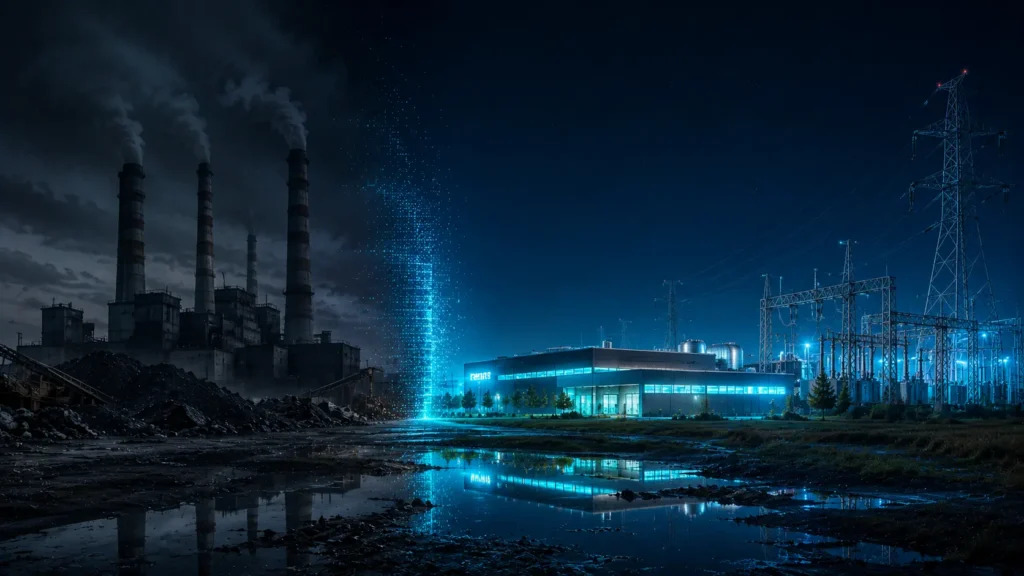
TerraPower looked at that and saw the opportunity hiding in plain sight. By building Natrium on the bones of Kemmerer’s coal station, they inherited the grid connection, the transmission capacity, and a community of energy workers ready to be retrained instead of laid off. The cost of nuclear, as the engineering logic goes, is largely in the first hundred meters of getting power onto the grid — and they eliminated much of it by building where those wires already existed.
The human payoff is just as real as the financial one. The workforce transitions instead of disappearing. The tax base survives. The town that powered the old economy gets to power the new one. It’s one of the rare energy stories where the engineering decision and the human decision point in exactly the same direction — and it’s why you’ll increasingly hear about advanced reactors being eyed for retiring coal sites across the country.
Idea #2: A Reactor That Refuses to Boil — Inside the Natrium Reactor’s Sodium Cooling
Now to the machine itself — and the choice at its heart that sounds, at first, completely insane: instead of water, Natrium cools its reactor with liquid metal. Molten sodium, specifically. (Natrium is simply the Latin word for sodium — the “Na” on the periodic table.)
To see why that’s brilliant rather than reckless, you have to understand the quiet tyranny that has ruled nuclear power for seventy years: pressure.
Almost every reactor operating today is a water-cooled reactor, and water has a problem — it boils at 100°C. But a reactor core runs far hotter than that. So to keep the water liquid, today’s plants squeeze it under crushing pressure — roughly 150 times atmospheric pressure in a typical pressurized water reactor.
That single requirement cascades into enormous engineering consequences: you need a reactor pressure vessel (RPV) with steel walls thick enough to contain that pressure, a massive containment structure to handle what happens if that pressure ever escapes, and layers of safety systems whose main job is managing the constant risk that hot, high-pressure water poses. A huge fraction of a conventional plant’s cost and complexity traces back to one stubborn fact: water wants to boil, and you’re spending fortunes to stop it.
Sodium changes the entire equation. Liquid sodium doesn’t boil until about 880°C — far, far hotter than the reactor runs. So Natrium can run its core hot for efficiency while keeping the coolant comfortably liquid without pressurizing it at all. The reactor operates at essentially atmospheric pressure.
Think about what that eliminates. No crushing pressure means no thick pressure vessel straining to contain it, and no risk of a high-pressure rupture. And because there’s no high-pressure water that could flash to steam, Natrium doesn’t need the massive high-pressure containment dome of a conventional plant — instead it uses a smaller, low-pressure functional containment: a set of barriers designed to retain radioactivity, not to withstand enormous pressure. The reactor gets simpler, and a simpler machine is often a safer and cheaper one.
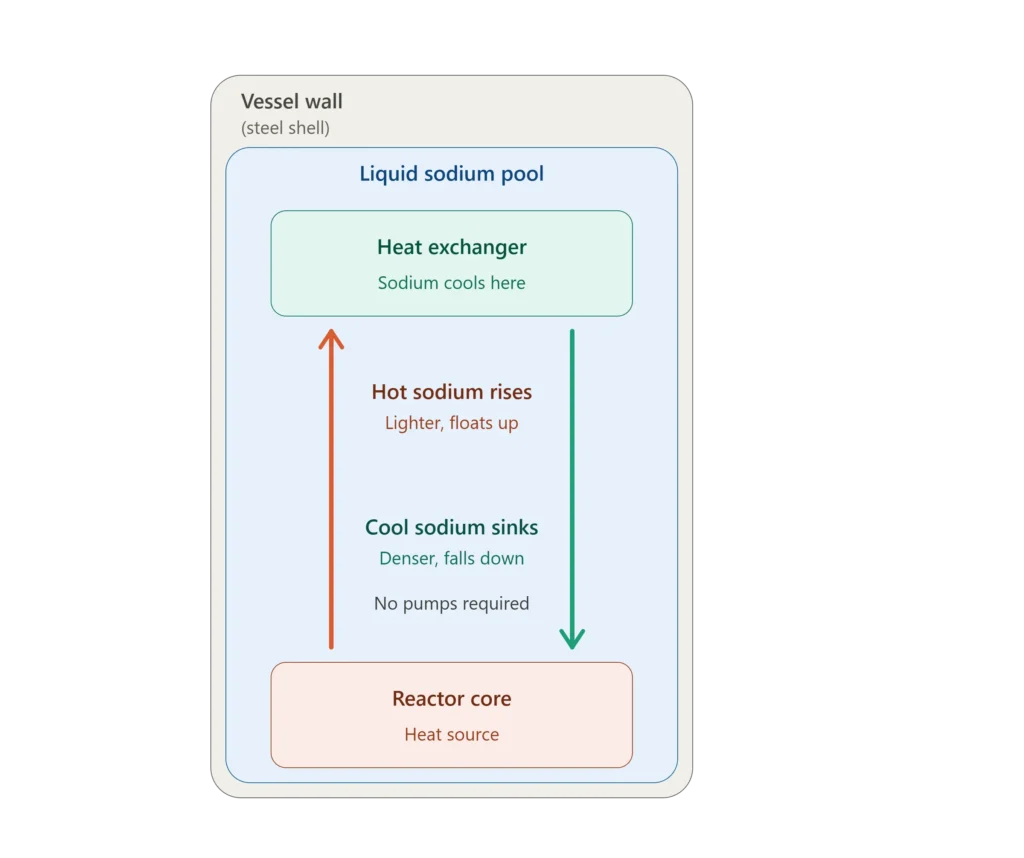
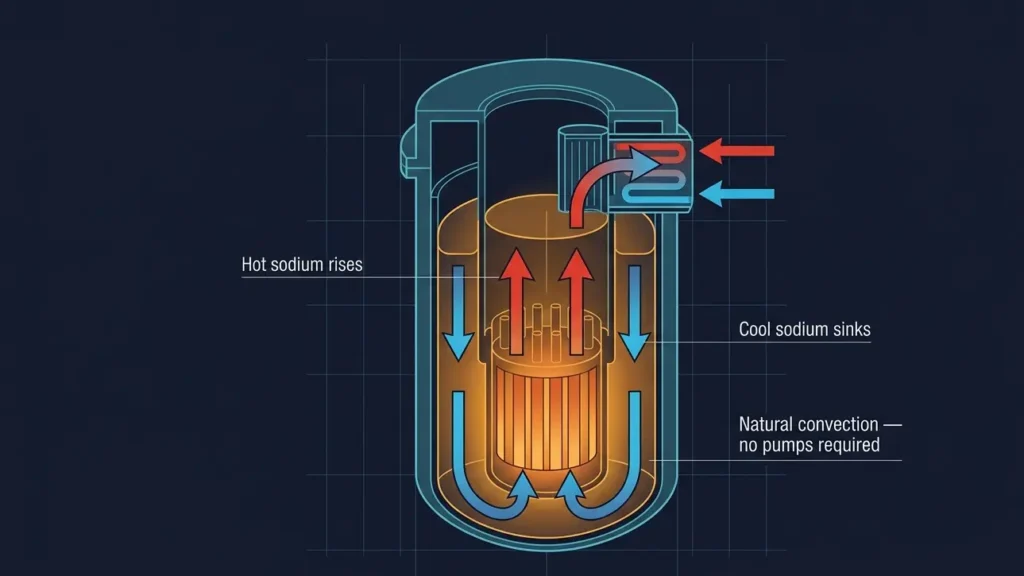
And sodium brings a second gift: it’s an extraordinary conductor of heat — far better than water. It pulls heat away from the core so readily that the plant can lean on natural physics for safety. If power is lost and the pumps stop, hot sodium naturally rises and cool sodium sinks, circulating heat away from the core by convection alone — no pumps, no operators, no emergency power required.
The plant has a built-in tendency to settle toward a safe state on its own. Engineers call these “passive” or “inherent” safety features, and they are the holy grail of reactor design: safety that comes from the laws of physics rather than from machines that could fail.
How Passive Cooling Actually Works
To understand this more clearly, picture the reactor not as a single pipe, but as a tall pool of liquid sodium with the core sitting near the bottom. Above the core, near the top of that pool, sits a heat exchanger — basically a giant radiator that pulls heat out of the sodium and passes it along to the power-generating side of the plant.
Under normal operation, pumps push sodium through this loop: cold sodium flows down into the core, picks up heat, rises straight up past the heat exchanger, drops its heat there, and the now-cooler sodium is pushed back down to do it again. The pumps are what make this fast and controllable.
Now take the pumps away. This is the moment that matters. Sodium that’s just been heated by the core is lighter — its density drops as it warms, the same way warm air is lighter than cold air. So even with no pump pushing it, that hot sodium keeps floating upward on its own, straight up toward the heat exchanger near the top of the pool.
When it reaches the heat exchanger, it does the same job it always did: it gives up its heat. Except now there’s no pump forcing it through quickly, so it lingers a bit longer, releasing heat into the heat exchanger until it cools down. As it cools, it gets denser — heavier than the warm sodium still rising beneath it.
That weight is what makes it sink. It falls back down along the outer edges of the pool, outside the rising column of hot sodium from the core, and arrives back at the bottom, right at the core’s inlet, ready to absorb heat again.
But there’s one more step, and it’s the part that makes the whole thing genuinely remarkable: the heat doesn’t just circulate inside the vessel forever — it actually leaves the building. That circulating sodium carries the core’s heat to the reactor vessel wall. From there it radiates across a thin gap to an outer “guard vessel,” and the outside of that guard vessel is bathed in a column of ordinary outside air drawn upward by natural draft.
Hot air rises, cool air is pulled in behind it, and the atmosphere itself becomes the final destination for the heat. TerraPower calls this Reactor Air Cooling, and its defining feature is that it has no dampers, no blowers, and no on/off switch. It is simply always running. The ultimate heat sink is the sky, reached without a single pump or a single human decision.
Two design choices make this even harder to defeat. First, the pool has no piping or fittings running below the surface of the sodium — there is simply nothing down low that could break and let the coolant drain away from the core, which is the nightmare scenario in a water reactor.
Second, that close-fitting guard vessel wraps the reactor vessel like a backup cup around a glass: if the inner vessel ever sprang a leak, the sodium would be caught in the gap rather than lost, keeping the core covered. The safety, again, comes from the shape of the machine rather than from systems that have to spring into action.
The Honest Catch: The Engineering Challenge of Taming Liquid Sodium
Now, if you know a little chemistry, an alarm bell may be ringing — and you’d be right to ring it. Sodium has a notorious dark side: it reacts violently with water, and it burns on contact with air. Drop a chunk of sodium into a glass of water in a classroom and it fizzes, skitters, and can erupt into flame. So how on earth do you cool a power plant with a substance that catches fire if it ever meets the very water in the steam system next door?
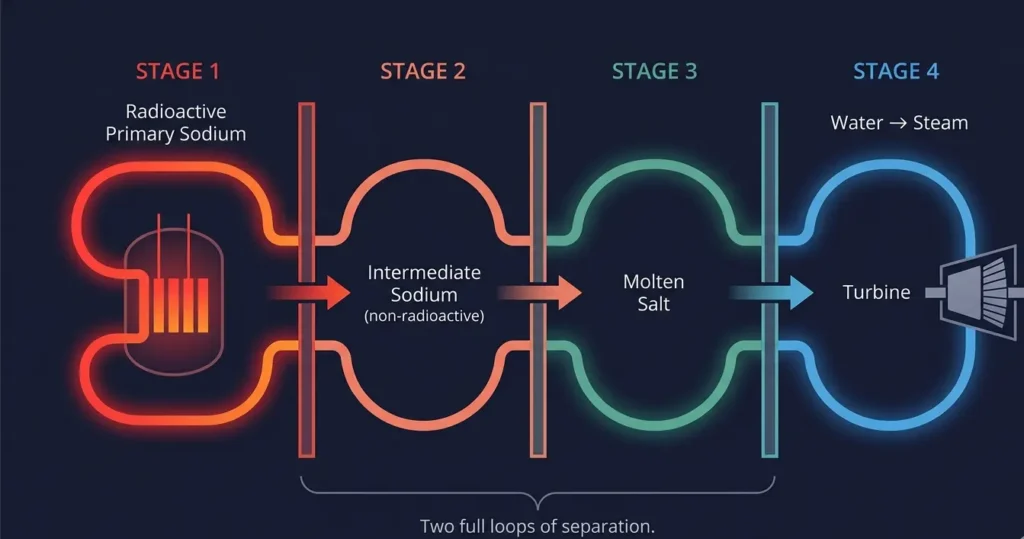
This is the honest engineering challenge of every sodium reactor, and it deserves a straight answer rather than a sales pitch. The solution is separation — keeping the sodium and the water rigorously apart, and Natrium does it with not one but a whole chain of barriers.
The radioactive sodium that bathes the core never touches water at all. Instead it hands its heat to a second, non-radioactive sodium loop; that loop hands its heat to the molten salt; and only the salt, much further down the line, ever goes near the water that becomes steam. So the dangerous, radioactive sodium is kept two full loops away from any water.
It’s still a real design burden — it’s something sodium reactors have wrestled with for decades, and it’s a legitimate reason these reactors are harder to engineer than the cheerful brochures suggest — but the separation is far more thorough than a single wall between fire and water.
It’s worth being clear-eyed here: this isn’t unproven fantasy. Sodium-cooled reactors have a long pedigree — Natrium draws on roughly 40 reactor-years of U.S. operating experience from the Experimental Breeder Reactor (EBR-II) in Idaho and the Fast Flux Test Facility, where exactly these inherent safety behaviors were demonstrated in real hardware decades ago.
In fact, the famous 1986 EBR-II test — where operators cut the cooling pumps at full power and the reactor shut itself down on physics alone is the ancestor of Natrium’s whole safety case. But it’s an honest pedigree, not a flawless one: commercial sodium plants elsewhere in the world have also had sodium leaks and fires that shut them down.
That reliance on inherent physics runs deeper than cooling. Because boron is a far weaker neutron absorber in a fast-neutron spectrum than in an ordinary water reactor, a fast reactor like Natrium can’t lean on the soluble-boron chemical shim a PWR uses as its smooth reactivity dial, it leans instead on control rods and the same strong physical feedbacks that shut EBR-II down.
Natrium is genuinely first-of-a-kind (FOAK) at this commercial scale in the U.S., and that means real risk alongside real promise. An honest look at Natrium holds both at once: the physics offers beautiful safety advantages, and sodium demands respect and disciplined engineering to tame. Both things are true.
Idea #3: The Reactor That Moonlights as a Battery — Molten Salt Thermal Storage
Here’s the piece that makes Natrium genuinely new — not just a better reactor, but a different kind of power plant.
Every power grid lives with a frustrating mismatch. Electricity demand swings wildly through the day: low overnight, surging in the morning as a country wakes up, peaking again in the evening when everyone’s home with the lights and the AC on.
But a nuclear reactor doesn’t like to swing. Reactors are happiest running flat-out, 24/7, at a constant level — you don’t throttle a reactor up and down through the day the way you’d rev a gas turbine. It wants to run steady.
That mismatch has always been nuclear’s awkward limitation. A reactor pours out the same power at 3 a.m., when half of it isn’t needed, as it does at 6 p.m., when the grid is gasping for more.
Natrium’s answer is elegant enough to make an engineer smile: don’t store the electricity — store the heat.
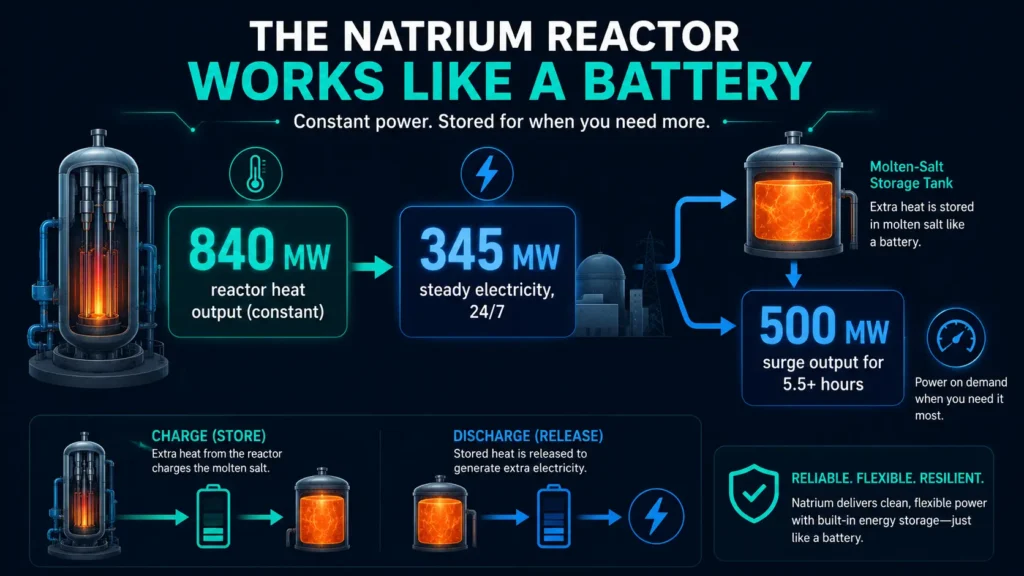
Instead of sending all its heat straight to the turbine, Natrium can route that heat into giant tanks of molten salt — the very same nitrate salt chemistry that concentrated solar power plants use to hold the sun’s heat after dark.
When the grid is quiet overnight, the reactor keeps running flat-out as it likes to, and the surplus heat pours into the salt tanks, charging them up like a giant thermal battery. Then, when the evening peak hits and the grid is desperate for power, the plant draws on that stored heat to make extra steam and surge its electrical output.
The numbers tell the story. The reactor core itself pours out a constant 840 megawatts of heat — and in steady operation, that translates to roughly 345 megawatts of electricity flowing onto the grid, around the clock. But by tapping its molten-salt reservoir, the plant can surge its electrical output to about 500 megawatts for more than five hours at a stretch — right when the grid needs it most — without the reactor changing its heat output at all.
So to a grid operator, a 345-megawatt baseload reactor can, on demand, suddenly behave like a 500-megawatt peaker plant. That is an entirely new operational profile for nuclear power, and no reactor has ever done it at commercial scale before.
Why does this matter so much right now? Because of the other revolution happening at the same time: renewables. Solar and wind are cheap and clean but maddeningly fickle — they vanish when the sun sets or the wind dies. A power source that can sit quietly and then surge on command is the perfect dance partner for a grid full of solar and wind. Natrium isn’t trying to beat renewables; it’s built to complement them — to fill exactly the gaps they leave.
Why Now: AI, Coal Towns, and Why Meta and Big Tech Are Betting on Natrium
Step back, and you can see why this particular reactor, in this particular moment, has the entire energy world watching.
A new and ravenous customer has arrived: artificial intelligence. The data centers training and running AI models consume staggering, around-the-clock electricity — and the tech giants building them have discovered that there simply isn’t enough clean, reliable, 24/7 power to go around.
Solar and wind alone can’t do it; they’re intermittent. And these companies have made climate promises they don’t want to break. That leaves exactly one carbon-free source that can deliver enormous, steady, weather-independent power at scale: nuclear.
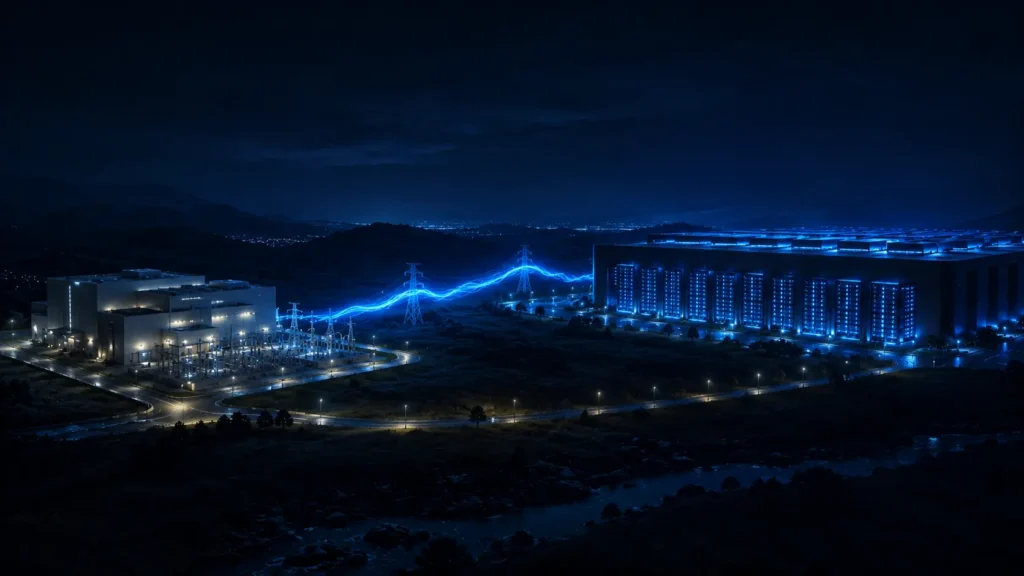
The result has been a stampede of tech money into nuclear that would have sounded absurd five years ago. Meta signed an agreement for up to eight Natrium plants — its largest advanced-nuclear commitment yet — to feed its AI data centers.
And note who that isn’t: Microsoft is the giant backing the restart of Three Mile Island; Meta is backing Natrium. Two of the most powerful companies on Earth, two completely different nuclear bets — one reviving a reactor from the dead, the other building a first-of-its-kind machine from scratch — driven by the very same force.
Government is pushing too, with the U.S. Department of Energy (DOE) cost-sharing the Natrium demonstration through its Advanced Reactor Demonstration Program, part of a broader national effort to get advanced reactors built.
It’s not all tailwind, though, and an honest account has to say so. Natrium has already hit a very real obstacle: fuel. It needs a special, more-enriched uranium called HALEU (high-assay low-enriched uranium), and the supply chain to produce HALEU at scale barely exists yet — a shortage rooted in how much more it costs to enrich that has already pushed the timeline back toward 2030.
First-of-a-kind projects also carry first-of-a-kind risks of cost overruns and delays. The promise is enormous; so is the difficulty. Both are real.
The Bigger Picture: A Glimpse of Nuclear’s Second Act
Strip away the details and Natrium is really a story about reinvention — at every level.
A coal town reinvents itself as a clean-energy hub. A seventy-year-old idea, the sodium-cooled reactor, gets a second life with modern engineering. And nuclear power itself — long stereotyped as a lumbering, inflexible giant that can only run flat-out — reinvents itself as something nimble: a plant that stores energy and surges on demand, built to dance with renewables rather than compete with them.
Whether Natrium fully delivers is still an open question, and a fair observer keeps both eyes open. The fuel supply has to catch up. The sodium has to be tamed, plant after plant. First-of-a-kind costs have to be controlled. None of that is guaranteed, and the next few years in Kemmerer will tell us a great deal about whether this model can scale.
But the idea is genuinely exciting, and it’s worth sitting with. For decades, nuclear’s story was about giant plants built once and run unchanged for sixty years. Natrium hints at a different future — smaller, more flexible reactors that slot into retiring coal towns, charge up like batteries, and flex with a grid full of wind and sun. Out in a small Wyoming town that thought its energy days were ending, that future is, right now, being poured in concrete and steel.
And that’s a story worth watching.
Frequently Asked Questions
What is the Natrium reactor?
Natrium is an advanced nuclear power plant developed by TerraPower and GE Vernova Hitachi. It pairs a 345-megawatt sodium-cooled fast reactor with a molten-salt energy storage system, letting it store heat and surge its electrical output on demand — like a giant battery welded to a reactor. The first unit is under construction at Kemmerer, Wyoming, on the site of a retiring coal plant.
How does the Natrium reactor work?
The reactor core is cooled by liquid sodium instead of water, which lets it run hot at atmospheric pressure. That heat is passed through a non-radioactive sodium loop to tanks of molten salt. The salt can either make steam immediately to drive a turbine, or store the heat for later — so the plant can boost its output when the grid needs more power, without changing the reactor’s steady heat output.
Why does Natrium use sodium instead of water?
Water boils at 100°C, so water-cooled reactors must run under roughly 150 times atmospheric pressure to stay liquid — which demands thick vessels and heavy safety systems. Sodium doesn’t boil until about 880°C, so Natrium runs at atmospheric pressure, eliminating a whole category of pressure-related cost and risk. Sodium is also a far better heat conductor, enabling passive, pump-free cooling.
What fuel does the Natrium reactor use?
Natrium runs on HALEU — high-assay low-enriched uranium — enriched to just under 20%, higher than the roughly 5% used in conventional reactors but well below weapons grade. Specifically, it uses a metallic uranium-zirconium fuel rather than the ceramic oxide pellets in a typical water reactor. The main hold-up for the whole project has been that a commercial HALEU supply chain barely exists yet, which has pushed the timeline toward the early 2030s.
What is the problem with the Natrium reactor?
Three real challenges. First, fuel: Natrium needs HALEU, and the supply chain isn’t ready — this has already delayed the project. Second, sodium itself burns in air and reacts violently with water, so the whole plant is engineered around keeping it rigorously separated from the steam system. Third, it’s a first-of-a-kind commercial plant, which means genuine risk of cost overruns and schedule slips. The physics is elegant; the execution is the hard part.
Is the Natrium reactor safe?
Its safety is designed to come from physics rather than machinery. If power and pumps are lost, natural convection circulates the sodium and carries heat to the atmosphere with no operator action. The core sits in a pool with no low-level piping that could drain it, inside a guard vessel that catches any leak. The main challenge is sodium itself, which burns in air and reacts with water — managed by keeping it multiple loops away from the steam system.
How is Natrium like a battery?
A conventional reactor produces the same power around the clock. Natrium’s molten-salt storage lets it bank surplus heat when demand is low and release it when demand peaks — surging from a steady 345 MW to about 500 MW for more than five hours, without changing the reactor’s output. It charges and discharges energy like a thermal battery.
Who is building Natrium and where?
Natrium is co-developed by TerraPower (founded by Bill Gates) and GE Vernova Hitachi, with Bechtel as constructor. The first plant, Kemmerer Unit 1, is being built in Kemmerer, Wyoming, on the site of a retiring coal station. Construction began on April 23, 2026, with the U.S. Department of Energy cost-sharing the demonstration.
Why is Meta investing in Natrium?
AI data centers need enormous amounts of clean, reliable, 24/7 electricity, and intermittent solar and wind can’t supply it alone. Meta signed an agreement for up to eight Natrium plants — its largest advanced-nuclear commitment — to power its data centers with carbon-free, always-on nuclear energy.
When will the Natrium reactor be finished?
TerraPower is targeting the early 2030s. The timeline has slipped from an earlier 2028 goal largely because of a shortage of HALEU fuel — the higher-enriched uranium Natrium needs — whose supply chain is still being built out.
Sources and Further Reading
- Natrium specifications (840 MWth, 345 MWe, 500 MWe surge for 5.5 hours, atmospheric pressure) — TerraPower: Natrium and Bechtel: Natrium Project.
- Kemmerer Unit 1 construction start, April 2026 — Enerdata; design detail via POWER Magazine.
- EBR-II passive safety demonstration, 3 April 1986, and U.S. sodium-reactor operating experience — Argonne National Laboratory.
- HALEU fuel supply constraint and revised timeline — reporting via POWER Magazine.
- Sodium-cooled fast reactor technology overview — World Nuclear Association: Fast Neutron Reactors.
- Natrium safety features (control, passive cooling, and low-pressure “functional containment”), Reactor Air Cooling, and Nuclear Island / Energy Island separation — TerraPower Topical Report NATD-LIC-RPRT-0001, Regulatory Management of Natrium Nuclear Island and Energy Island Design Interfaces (submitted to the U.S. NRC; NRC-approved for licensing reference, 2023).
Where a project’s outcome is genuinely uncertain — first-of-a-kind costs, the HALEU supply chain, long-term sodium reliability — this article says so rather than overstating the case.
About the Author
Elliot Marsh is a working reactor engineer with hands-on experience in reactor physics, core management, reactivity control, and nuclear fuel-cycle planning at an operating power station. He writes about nuclear energy for readers who want the engineering reality, not the press release.
Need content like this for your company?
I write white papers, technical explainers, and thought-leadership for nuclear vendors, reactor developers, and the agencies that serve them — accurate enough for engineers, clear enough for buyers.