How Long Does a Spent Fuel Pool Take to Boil?
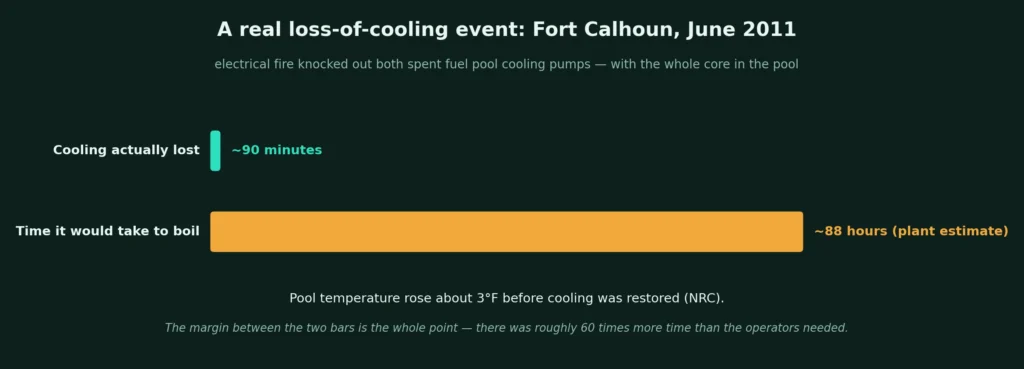
On a June morning in 2011, an electrical fire broke out in a switchgear room at the Fort Calhoun plant outside Omaha. The smoke did something strange: it let current arc across an open breaker and the voltage swings that followed knocked out power to both pumps cooling the spent fuel pool. For about 90 minutes, the pool holding the plant’s used fuel had no active cooling at all.
Here’s the part that should stick with you. At the time, the reactor was shut down for refueling and its entire core was sitting in that pool. The plant’s own estimate for how long it would take the water to reach a boil? About 88 hours. The pool warmed by roughly three degrees Fahrenheit before cooling came back, a figure the NRC put in writing afterward.
Ninety minutes against 88 hours. That gap is the whole story of spent fuel pool safety and it’s the thing the scary version of this topic always leaves out. So when people ask about a spent fuel pool time to boil (TTB), the honest answer isn’t one number. It’s “a lot longer than you’d guess and it depends almost entirely on timing.” Let me show you why.
Why the pool needs cooling in the first place
Spent fuel doesn’t stop being hot when you pull it from the core. Fission stops the instant the control rods go in, but the fission products packed into the fuel keep decaying and that decay releases heat also called the decay heat.
Right after a reactor trips, this decay heat runs about 7% of the reactor’s full power. For a 1,000 MW reactor that’s 70 MW, the moment it shuts down. It drops off quickly, though under 2% within an hour, under 1% within a day, according to the U.S. Department of Energy’s decay-heat handbook.
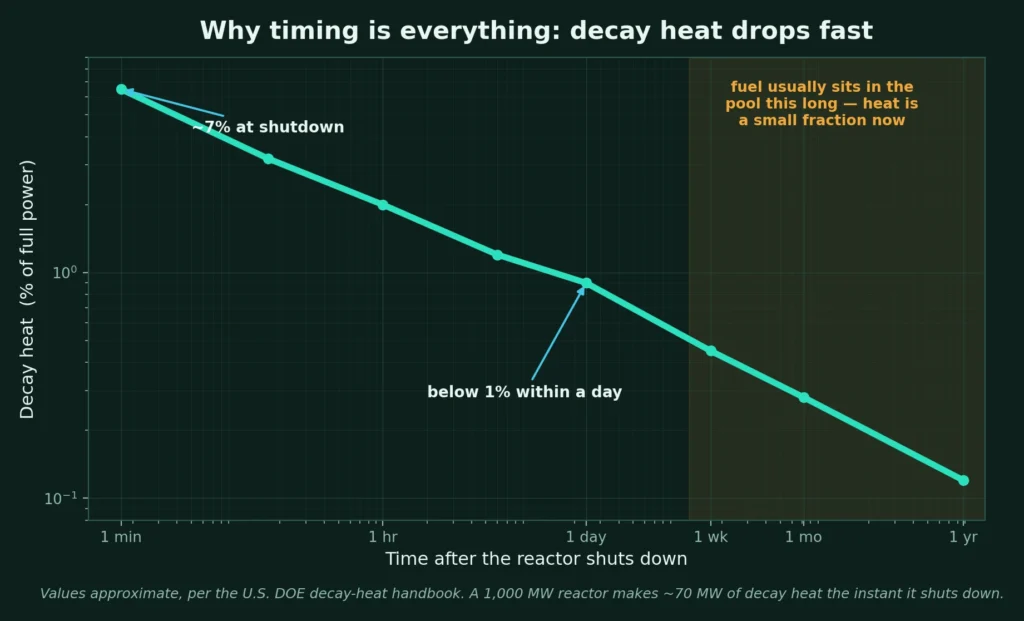
By the time fuel reaches the pool it has usually been cooling for years, so its heat output is a small slice of that. But a small slice of a huge number is still a lot. A full pool plus a recent offload can add up to a few megawatts that have to go somewhere.
The cooling system pulls warm water off the top, runs it through heat exchangers and sends it back, the same idea as a car radiator, just larger and with higher stakes. The reason pools get singled out as a vulnerability, and I think this is fair, is that this cooling is active. It needs pumps and pumps need power. That’s the one link in the whole spent fuel chain that depends on something staying switched on. A dry cask, by contrast, cools itself with nothing but rising air.
What actually happens when the cooling stops
So a pump trips, or the power goes, and cooling stops. What then? Not much, at first and that’s the part people miss.
The decay heat starts warming the water. A pool is a huge slug of water, a typical one runs about 12 meters deep, with the fuel in the bottom few meters and roughly 7 meters of water above the top of the rods, as the Union of Concerned Scientists described during the Fukushima coverage. That much water takes a long time to heat up. This is the first phase, a slow climb toward boiling.
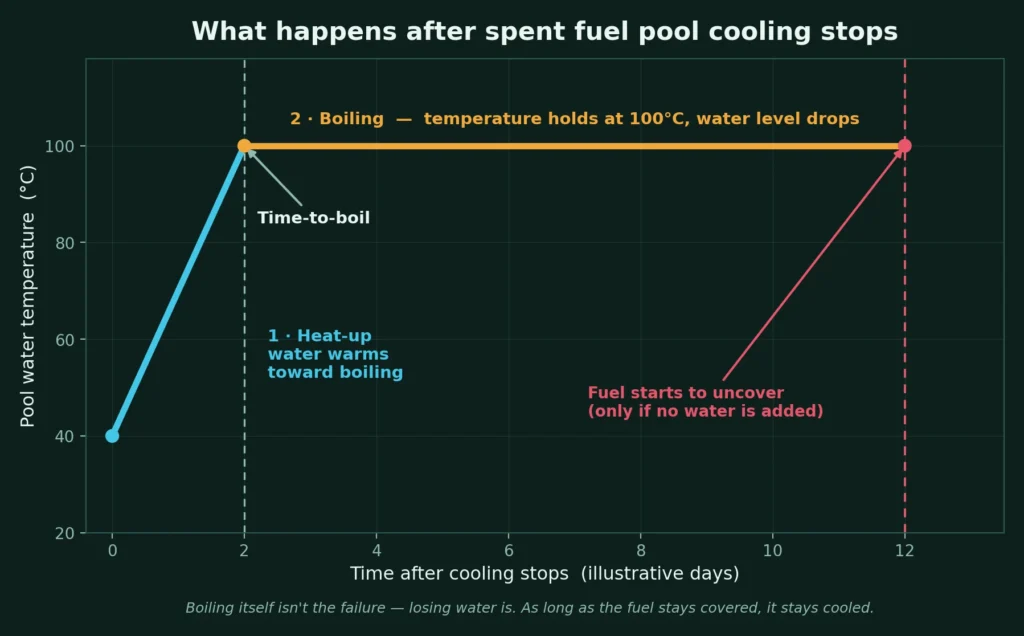
When the water reaches 100°C it starts to boil and here’s a detail that trips people up, the temperature stops climbing. Boiling water stays at its boiling point. The heat now goes into turning water to steam instead of raising temperature and that steam is clean water vapor, not radioactive. The pool doesn’t run away or explode. It simmers. The level drops slowly as steam leaves.
That second phase can last a long time and the fuel stays cooled the entire time it’s under water, boiling or not. The failure everyone pictures, fuel bare to the air, only happens if the level keeps falling and nobody adds water. Which brings up the number that actually matters.
So how long, really – the numbers
“Time to boil” is the headline, but it’s really the clock for a much simpler job, get water flowing again before the pool gets low. And that clock is long.
Fort Calhoun’s 88 hours is one data point, and a conservative one. That was with a whole core freshly offloaded, as the Union of Concerned Scientists noted. A real NRC licensing analysis for another plant put the time to boil at about 32 hours, with another 153 hours after that before the water dropped to a level that mattered roughly 7.7 days total to respond to an extended loss of power. For a pool holding only older fuel, a week or more just to reach a boil is common.
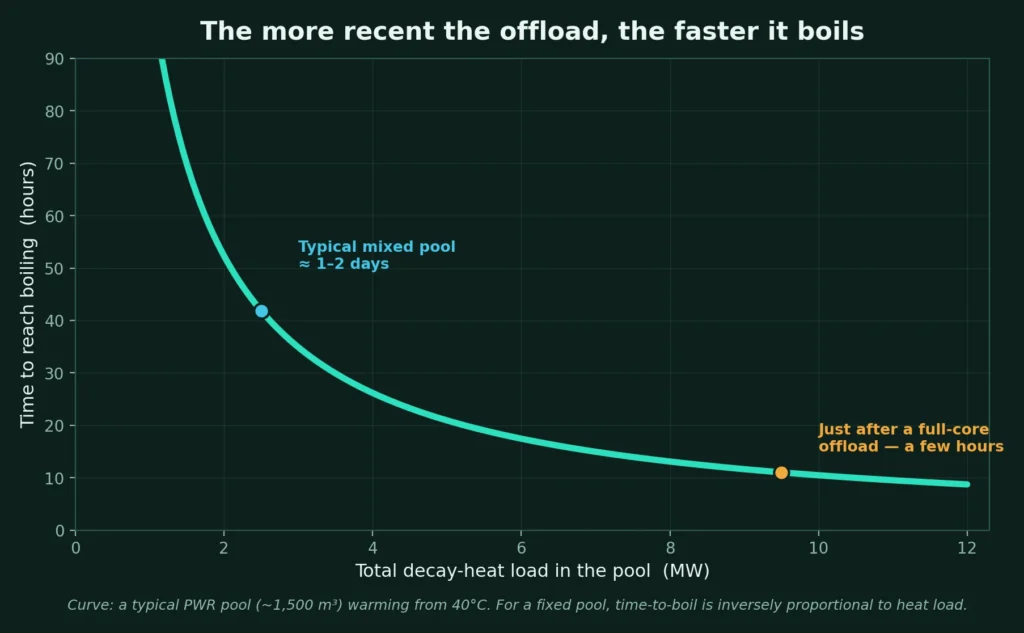
The spread comes down to one variable, how recently fuel came out of the reactor. A pool that just took a full core offload sits at the hot end, where a recent discharge can pull time to boil down toward a handful of hours.
Let a few months pass and that same fuel’s heat has fallen enough to stretch the clock into days. This is exactly why utilities wait before moving fuel and why the worst case for any pool is the window right after a refueling outage.
What actually sets the number
Three things move a spent fuel pool’s time to boil and once you know them you can size up any pool without much effort.
The first is how recently fuel was offloaded, the lever we’ve been circling this whole time and by far the strongest.
The second is how much water sits above the fuel. More water is a bigger heat sink, so a pool near its normal level buys far more time than one that’s already run down.
The third is the starting temperature. A pool sitting at 40–50°C in normal operation has less room to climb before it hits 100°C than a cooler one, so it boils a little sooner.
The equation analysts use for a first estimate is deliberately plain. Time to boil is the water’s heat capacity times the temperature rise it can still absorb, divided by the heat load, the same relation laid out in Oak Ridge National Laboratory’s work on the problem. Double the heat load and you halve the time. Add water and you buy it back. That’s the entire relationship and it’s why a decent estimate needs only a few honest inputs.
Calculate the time to boil for a specific pool
I built a free tool that does this math, enter your batches (by power, burnup, or assembly count), pool size, and how recently fuel was offloaded and it estimates the heat load, time to boil, boil off rate and makeup water needed. It’s an educational estimator, not a licensing tool.
The part that actually matters is water, not boiling
Let me be blunt about where the safety margin really lives, because it isn’t where the fear points.
Boiling is not the emergency. Losing water is. As long as the fuel stays covered it’s being cooled, whether the water sits at 40°C or at a rolling boil. The whole job during a loss of cooling is to keep the level up, restore the pumps or start adding makeup water.
Plants are set up for exactly this. After Fukushima, U.S. plants added portable pumps, generators and hoses meant to feed spent fuel pools even if the normal systems and offsite power are gone.
The NRC’s own summary is that even with cooling lost, operators have substantial time to get water back before boiling and a lot more time after that. Those first days of makeup can come from water already on site, the pool’s own inventory, the fuel transfer canal, other tanks.
Look at the Fort Calhoun numbers again. Ninety minutes to fix a problem that handed them 88 hours of runway. That isn’t a near miss. That’s a system doing what it was built to do.
When it does get serious
None of this makes loss of pool cooling a non issue. If makeup water genuinely failed, every pump, every backup, for days, the level would eventually reach the top of the fuel and that’s a different situation.
Once fuel is uncovered, air has to carry the heat instead of water and for a recently offloaded, tightly packed pool the fuel can get hot enough for the zirconium cladding to start reacting with steam. That reaction is where the real hazard lives and it’s what the serious analyses, the ones run with system codes like MELCOR, actually study.
The National Academies looked hard at this after Fukushima and their work is worth reading if you want the version without the spin. The risk isn’t zero. It depends on how full and how hot the pool is, and it’s a solid reason to move fuel into dry casks sooner rather than later.
But every one of those scenarios begins with days of complete makeup failure. The pool in the building, like the cask on the pad, is far more forgiving than the “ticking time bomb” framing wants you to believe.
Frequently Asked Questions
How long does a spent fuel pool take to boil if cooling is lost?
Anywhere from a few hours to well over a week, set mostly by how recently fuel was offloaded. A pool just after a full core offload is at the fast end, a real NRC licensing case put one plant at about 32 hours to boil and the Fort Calhoun event carried an 88 hour estimate even with a full core in the pool.
What happens if a spent fuel pool boils?
The water holds at 100°C and slowly turns to steam, so the level drops while the temperature stays flat. The fuel keeps being cooled the entire time it stays underwater. Boiling on its own doesn’t damage the fuel, only a sustained loss of water does.
Is the steam from a boiling spent fuel pool radioactive?
No. The steam is ordinary water vapor. The radioactive material stays in the fuel, it doesn’t boil off with the water.
Why don’t spent fuel pool cooling pumps have backup power like the reactor?
Historically the pools weren’t treated as a fast moving hazard because the heat up is so slow, hours to days of margin. Since Fukushima, U.S. plants have added portable pumps and generators specifically to supply the pools even after a total loss of normal power.
Has a spent fuel pool ever actually lost cooling?
Yes. Fort Calhoun in 2011 is the clearest U.S. example. An electrical fire knocked out both cooling pumps for about 90 minutes. The pool warmed roughly three degrees Fahrenheit, and cooling was restored long before boiling was ever a concern.
Sources and Further Reading
- NRC — Special NRC Oversight at Fort Calhoun Station (2011 cooling loss, ~90 min, 3°F rise)
- NRC — Spent Fuel Storage FAQs (loss of cooling, backup makeup, substantial time)
- NRC — Licensing analysis with a worked time-to-boil (~32 h to boil, ~7.7 days total)
- U.S. DOE — Decay Heat (handbook: ~7% at shutdown, <1% within a day)
- National Academies — Loss-of-Coolant Events in Spent Fuel Pools (Fukushima lessons)
- Union of Concerned Scientists — Fire at the Nuclear Plant (Fort Calhoun, full core offloaded)
- Union of Concerned Scientists — Where Did the Water in the Spent Fuel Pools Go? (pool geometry, boil-off)
- Scientific American — Electrical Fire Knocks Out Spent Fuel Cooling at Nebraska Nuclear Plant (88-hour estimate)
- Oak Ridge National Laboratory — Calculation of Spent Fuel Pool Time-to-Boil (methodology)
About The Author
Elliot Marsh is a working reactor engineer with hands-on experience in reactor physics, core management, reactivity control, and nuclear fuel-cycle planning at an operating power station. He writes about nuclear energy for readers who want the engineering reality, not the press release.
Need content like this for your company?
I write white papers, technical explainers, and thought-leadership for nuclear vendors, reactor developers, and the agencies that serve them — accurate enough for engineers, clear enough for buyers.