Xenon-135: Why a Reactor Is Hardest to Restart Right After You Shut It Down
The core makes this poison itself, and it peaks after shutdown, which is why a quick restart is a careful, cycle-dependent judgement call, and sometimes off the table entirely
By Elliot Marsh · Reactor engineer ·
On the night of 26 September 1944, the world’s first full-scale plutonium reactor started up on the banks of the Columbia River, ran beautifully for a few hours and then quietly died. Nobody had touched the controls.
Enrico Fermi had loaded the first fuel slug into Hanford’s B Reactor himself; the machine went critical at 10:48 p.m. and by the early hours it was drifting toward shutdown on its own, as if something invisible were closing a valve on the chain reaction. A few hours later it came back to life. Then, on schedule, it died again.
The physicist John Wheeler had been worrying about exactly this for months. He suspected a fission product, a poison the reactor was manufacturing inside its own fuel that absorbed neutrons, built up while the reactor ran, and then decayed away once it stopped.
Working through the night with the timing of the failures, he and Fermi (and physicist Leona Woods) pinned it down, a decay chain producing xenon-135. What saved the Hanford project was a piece of quiet over-engineering, DuPont’s engineers had insisted on building in extra fuel channels, against the physicists’ advice, and those spare tubes gave operators just enough extra reactivity to overpower the poison and keep the reactor running.
Eighty years later, xenon-135 reactor poisoning is still the single most consequential effect an operator plans around. It is the reason you cannot always switch a reactor back on the moment after you switch it off.
It shaped the final, fatal hour at Chernobyl. And it is, in my experience, the concept that separates people who have read about reactors from people who have actually run one. Let me walk you through it the way I understand it from the control-room side, then you can watch the whole transient unfold yourself in the simulator further down.
What is xenon-135, in one paragraph?
Xenon-135 is a radioactive fission product with the largest thermal-neutron appetite of any known nuclide about 2.6 million barns. It absorbs the neutrons a reactor needs to keep its chain reaction going, so it acts as a “poison.” Most of it isn’t produced directly by fission; it’s made second-hand, from the decay of iodine-135. That one-step delay is why the poison keeps building for hours after a reactor shuts down, temporarily making restart difficult or impossible.
Two features make it dangerous, and they only matter together: it is an extraordinarily strong neutron absorber, and it arrives on a time delay. Either one alone would be manageable. Combined, they produce the behaviour that caught out the Hanford scientists and that every startup reactor engineer since has had to plan around.
Why xenon-135 is such a violent neutron absorber?
Xenon-135’s thermal absorption cross-section is roughly 2.6–2.7 million barns, about 4,000–5,000 times that of the uranium-235 it sits next to. Even trace amounts remove enough neutrons to shut a reactor down.
A “cross-section” is just a target area, how big a nucleus looks to a passing neutron. The unit, the barn, was named by physicists who joked that a certain nucleus was “as big as a barn door.” By that scale, most reactor materials are pebbles. Xenon-135 is a stadium.
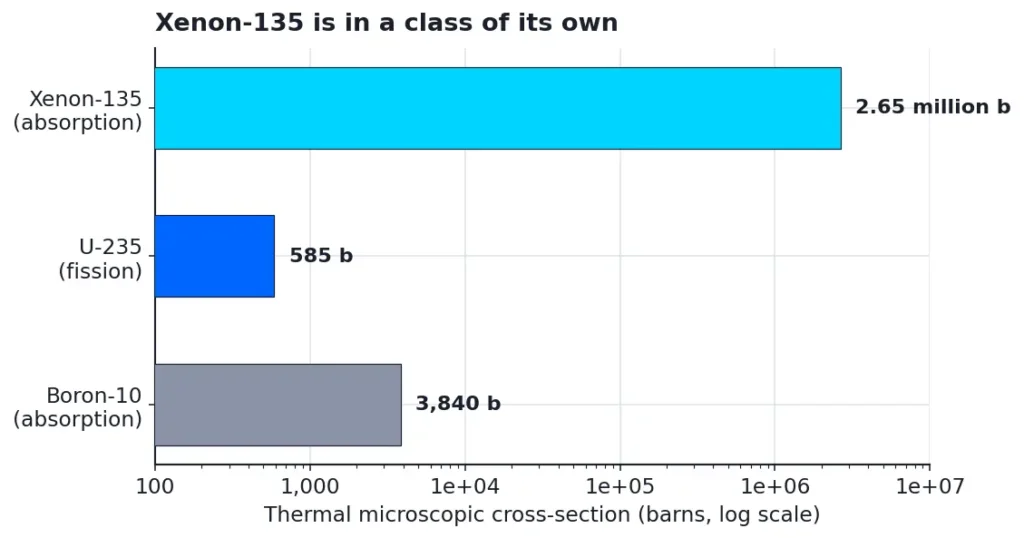
The DOE reactor-theory handbook lists xenon-135 at 2.6 × 10⁶ barns; modern evaluated nuclear data (ENDF/B) put it near 2.65 × 10⁶ barns at thermal energy, with the effective value in a real core running anywhere from about 2 to 3 million barns depending on the neutron spectrum.
Whichever number you use, the takeaway is the same: a few atoms of xenon per million atoms of fuel is enough to matter, and at equilibrium in a pressurised-water reactor xenon is worth up to about 2,500 pcm of negative reactivity, a substantial bite out of the reactivity budget an operator has to manage every single day.
Where xenon comes from: the iodine chain
Only ~0.3% of xenon-135 comes straight from fission. The other ~95% is produced by the beta decay of iodine-135, which itself comes from fission. Iodine-135 has a ~6.6-hour half-life, so xenon keeps being “delivered” for many hours after fission stops.
Here is the chain, and the delay hiding inside it. Fission throws off tellurium-135, which beta-decays in about 19 seconds to iodine-135. Iodine-135 is itself a weak neutron absorber, it mostly just sits there and decays, with a half-life of about 6.6 hours, into xenon-135. Xenon-135 then either captures a neutron (becoming near-inert xenon-136) or decays with a ~9.1-hour half-life to caesium-135.
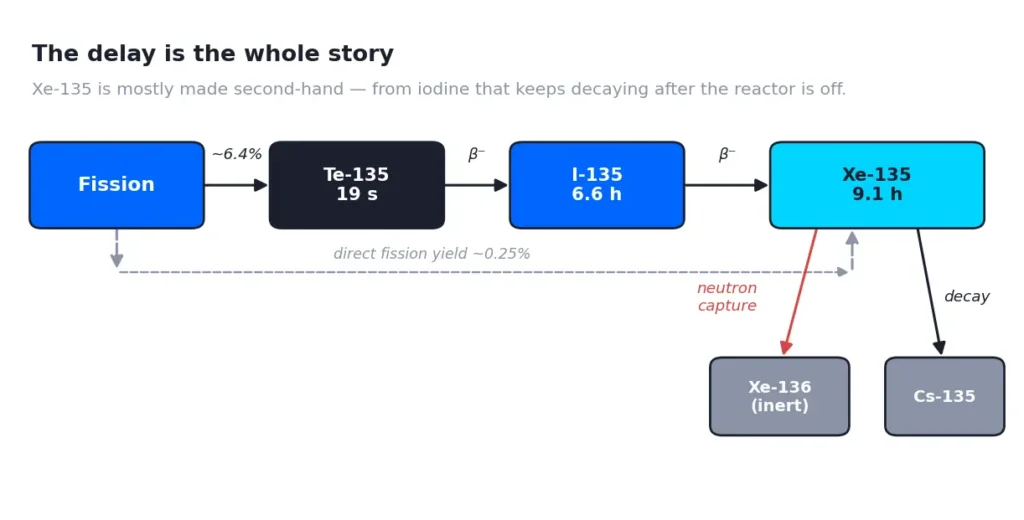
Read that chain again with an operator’s eye. While the reactor is running, xenon is created (from iodine) and destroyed (by neutron capture) at once, and the two rates settle into a balance.
But the creation side is fed by an iodine reservoir that was built up over the previous several hours. The reactor has, in effect, a loaded magazine of future xenon sitting in its fuel at all times. Cut the neutron flux, and you stop making new poison from fission but you do nothing to the iodine already there. It keeps decaying. It keeps delivering xenon. And now nothing is burning that xenon away.
Equilibrium xenon: the steady poison you run against every day
After a startup from a clean core, iodine and xenon build up over roughly 40–50 hours (about seven half-lives) to a steady “equilibrium” level, where production and removal balance. This stationary xenon is a permanent tax on the reactivity budget at power.
Bring a fresh core up to power and the poison doesn’t appear instantly. Iodine has to accumulate first; xenon then follows it up. Over about two days both level off at an equilibrium set by the power level.
Above a certain flux, xenon burnup dominates its removal and the equilibrium concentration stops climbing much with power which is a small mercy, because it means the tax doesn’t grow without bound as you push the reactor harder.
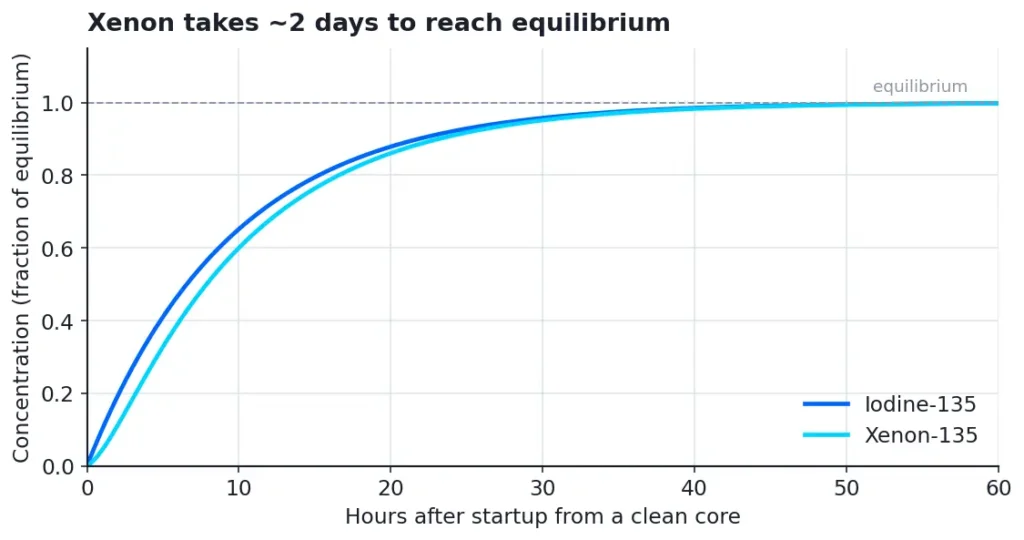
None of this is dramatic yet. Equilibrium xenon is just a number you design around: you carry enough excess reactivity to hold the reactor critical against it, control rods and in a PWR, soluble boron take up the slack. This is the natural place to draw the contrast that runs through all of reactor physics.
Boron is the poison engineers add on purpose a dial you turn to trim reactivity exactly where you want it. Xenon is the poison the reactor makes itself, on its own schedule, whether you want it or not. The steady state is easy. The trouble starts the moment you change power and it’s worst of all when you shut down.
The iodine pit: why shutting down makes it worse, not better
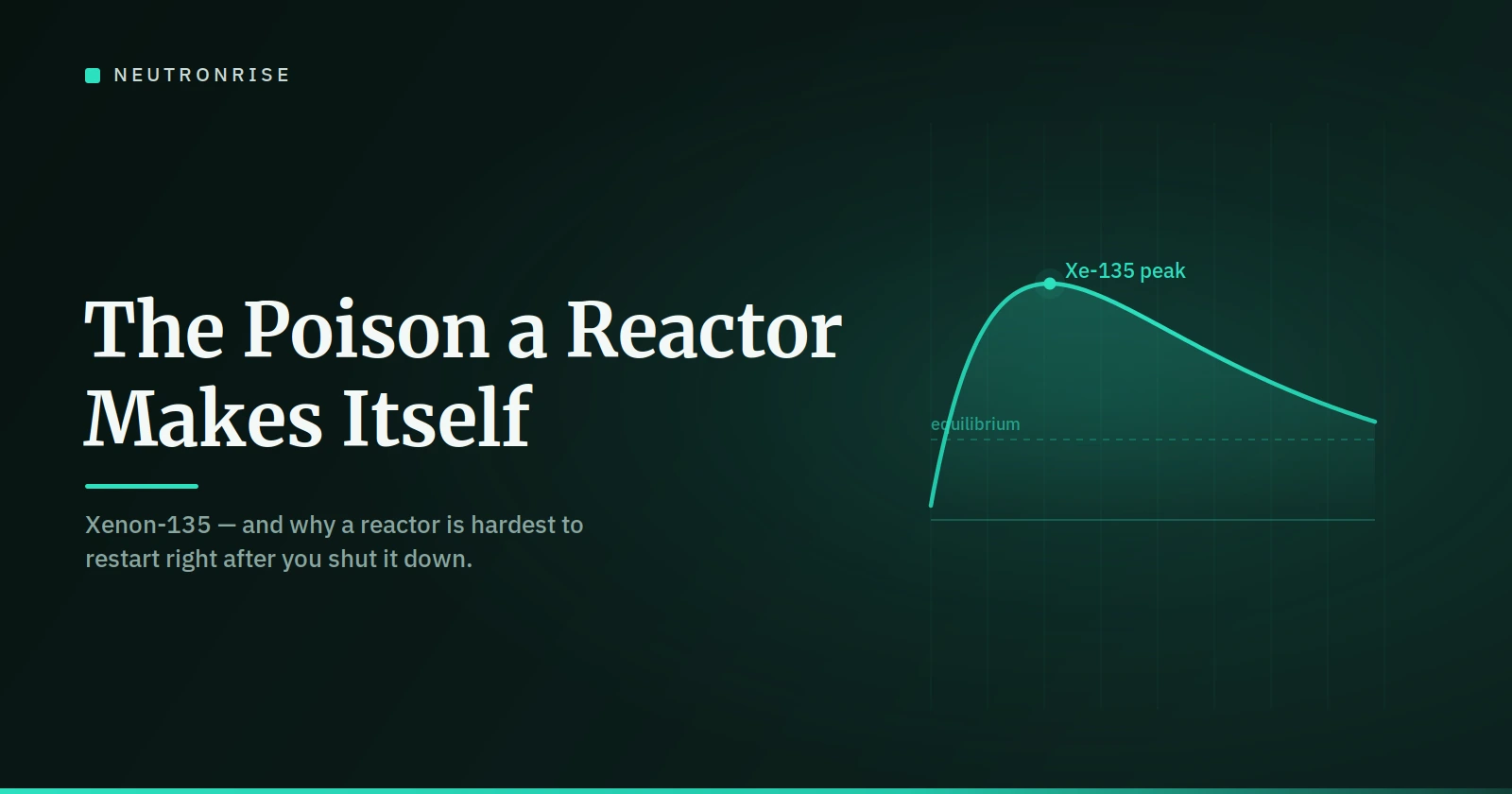
When a reactor shuts down from full power, xenon-135 keeps being produced by leftover iodine but is no longer burned off by neutrons. Its concentration climbs to a peak roughly 10–11 hours after shutdown often two to three times the equilibrium level before decaying away over the next two to three days. This post-shutdown surge is the “iodine pit” or “xenon pit.”
This is the part that still catches my eye at three in the morning. You have scrammed the reactor. Everything else on the plant is behaving: power is dropping, temperature is falling, the core is subcritical and settling down.
And the one parameter that should be falling is instead climbing. The reactor is poisoning itself, and there is nothing you can do to stop it, the iodine that will become that xenon is already in the fuel, and the neutron flux that used to burn xenon away is gone.
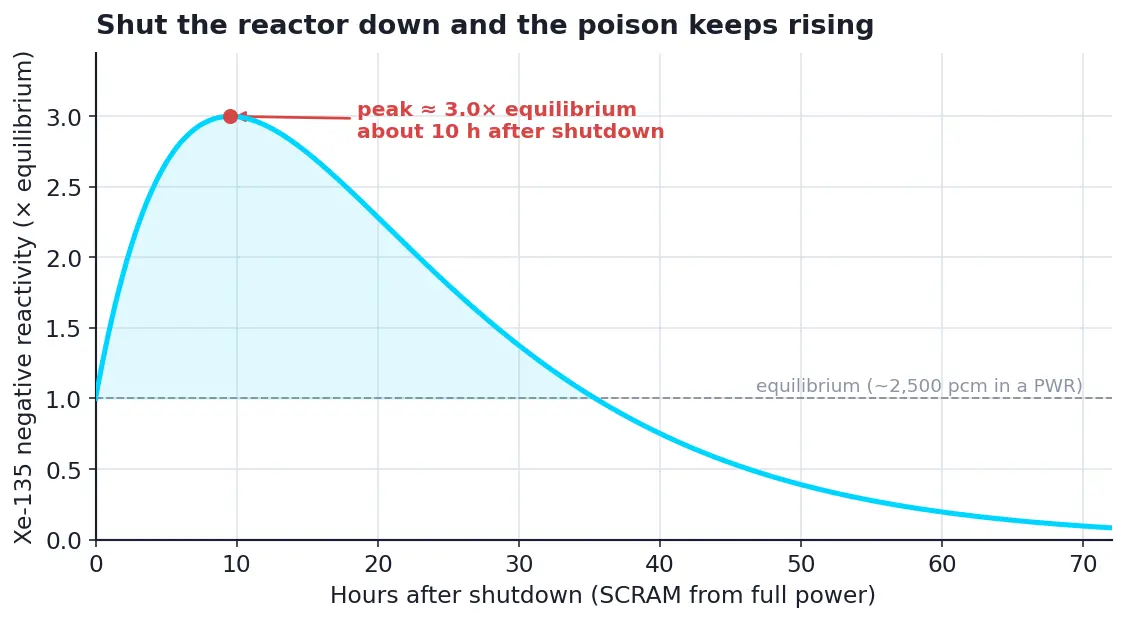
▶ See it happen — interactive
Don’t take the curve on faith. Run it yourself: set a power history, trigger a shutdown, and watch the peak build in real time in the Xenon-135 Transient Simulator. It’s benchmarked against the NRC reference curves to better than 0.1%.
How high the xenon peak climbs depends on how hard the reactor was running higher pre-shutdown flux means more iodine banked, so a deeper pit. For a typical light-water reactor shutting down from full power, the peak roughly doubles the equilibrium xenon worth; very high-flux cores can climb to several times that. From there it takes roughly two to three days to clear. Which brings us to the practical question every operator actually cares about: during that window, can you restart?
Xenon dead time and “precluded startup”: the honest version
“Xenon dead time” is the window after shutdown when the xenon peak exceeds the reactivity available to restart, so the reactor can’t be made critical until the poison decays. Whether it happens at all comes down to two things: the reactor’s design margin and “the part most explainers miss” where you are in the fuel cycle. Early to mid cycle there’s usually enough excess reactivity to override the peak and restart; late in the cycle that margin is spent, and the same pit can lock you out.
You will read, in a lot of otherwise good explainers, that a poisoned reactor is “impossible” to restart during the peak. As a blanket statement that’s simply not true, and the nuance is exactly the kind of thing that matters on shift.
Whether you’re locked out is a race between two numbers: how much negative reactivity the xenon peak represents, versus how much positive reactivity you have left in hand to pull the reactor back critical.
And that second number, the reactivity you have in hand is not fixed. It’s largest with fresh fuel at the beginning of a fuel cycle and bleeds away steadily as the fuel burns toward the end.
Early in a cycle, and through most of the middle, there is normally plenty of positive reactivity available to override the xenon peak and take the reactor critical straight through it. Late in the cycle, once that excess has been spent down, the very same peak that was a non event a few months earlier can genuinely preclude a restart.
So “can you start into the pit?” has no single answer for a given reactor, it depends on the day. I have taken a reactor critical roughly nine hours after a trip, right through the neighbourhood of the peak, because the cycle had the margin to carry it. Near end-of-cycle, the same trip would have meant waiting the poison out.
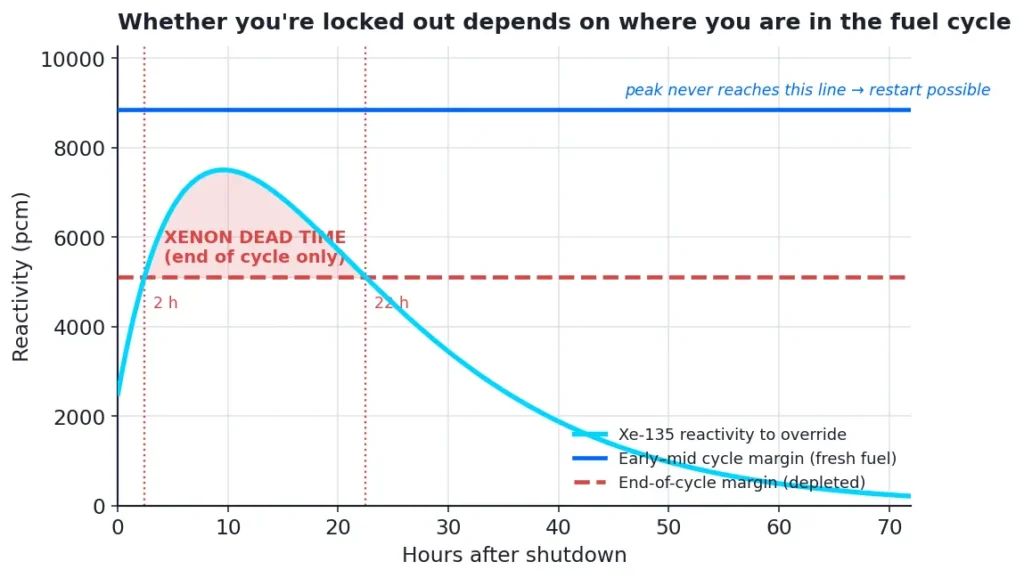
When you do restart into a pit, none of it is casual. The negative reactivity the xenon represents has to be bought back from somewhere, and in a PWR that somewhere is control rod worth and boron dilution, withdrawing rods and diluting the primary coolant boron concentration to add exactly the positive reactivity needed to offset the xenon and reach criticality.
We don’t do this by feel: before the startup we predict an estimated critical position, balancing the available control-rod worth and the current boron concentration against everything pulling the other way, with xenon as one of the largest and fastest-moving terms in that balance.
Get the xenon term wrong and your predicted critical point is wrong which is precisely why a restart a few hours after a trip behaves nothing like a startup from a clean, xenon-free core.
Where the pit bites hardest is a reactor that runs lean on excess reactivity by design, a heavy-water reactor like CANDU is the classic case. There the margin can be too thin to override the peak in any cycle phase, so the reactor enters a true reactor dead time and is genuinely precluded from starting until xenon decays. It’s also why power reactors are generally held below a design flux ceiling (around 5 × 10¹³ neutrons per cm² per second): keep the flux modest and enough xenon leaves by decay rather than burnup that a timely restart stays on the table.
So the honest sentence is this: after a shutdown from power you have a window of hours in which restart gets progressively harder, and then depending on the reactor and, just as much, on where you are in the fuel cycle, either a period where it’s genuinely off the table, or a stretch where it’s entirely doable but demands a careful, xenon-aware startup.
It’s the same family of “you can’t just flip the switch” constraints I’ve written about in the context of restarting a reactor that has sat cold except here the obstacle isn’t paperwork or hardware, it’s the core’s own chemistry, on a nine-hour clock.
The transient nobody talks about: xenon on the way UP
Xenon reacts to any power change, not just shutdowns. Raise power and xenon is burned off faster than iodine can replace it, so it dips — which inserts positive reactivity. Lower power and it surges. This burn-off effect is what turned a stalled reactor into a runaway at Chernobyl.
Most articles stop at the shutdown pit. But the mirror-image transient, what xenon does when you raise power is the one with the darker history. Increase flux and you suddenly burn xenon away faster than the iodine reservoir can top it up.
Xenon concentration dips below its new equilibrium, and that missing poison shows up as positive reactivity that the operator has to catch. Hours later, as iodine catches up, xenon climbs back and the effect reverses.
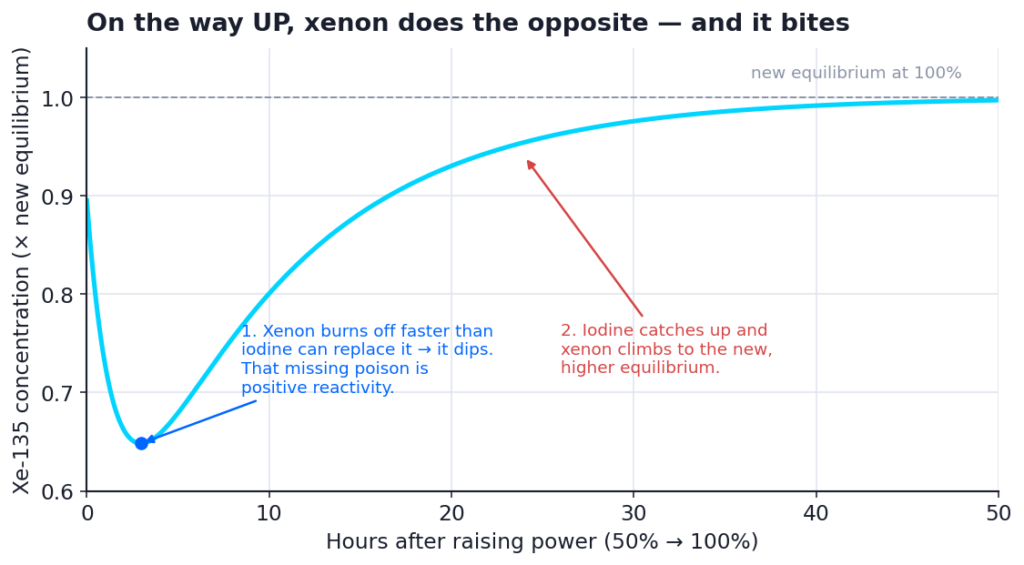
Now put the two halves together, because that combination is the Chernobyl story in physics terms. In the hours before the accident, Unit 4’s power sagged deep into an iodine pit down to a small fraction of the level the test called for, with xenon heavy in the core.
According to the World Nuclear Association’s account of the IAEA INSAG-7 findings, xenon poisoning was a significant contributor to what followed. To claw the power back up, operators withdrew control rods far past their own limits.
Doing so began burning off the accumulated xenon, and that burn-off fed positive reactivity into a core that, because of the RBMK’s positive void coefficient and a fatal control-rod design flaw, was already dangerously unstable. INSAG-7 ultimately placed the primary cause on the reactor’s design rather than the operators alone, but the xenon dynamics are woven all the way through the timeline. It is the clearest, grimmest demonstration of why this poison earns an operator’s respect.
If you want to feel how a reactivity insertion like that translates into a power excursion, how fast a core responds when positive reactivity is added and why the delayed-neutron fraction is all that stands between control and runaway, you can put numbers to it in the Point Kinetics Simulator.
How operators actually manage xenon?
Operators manage xenon by planning power changes around it: reactors carry excess reactivity to override equilibrium xenon, calculate an estimated critical position before every startup, and either restart before the pit deepens or wait out the peak. Slow, deliberate power manoeuvres keep xenon transients controllable.
None of this is guesswork in a real plant. A few things that actually happen on shift:
- Reactivity budgeting. The core is designed and fuelled with enough excess reactivity to hold critical against equilibrium xenon and then some. That margin is what buys the option to restart into a pit at all.
- Estimated critical position. Before a startup, we calculate where the reactor should go critical, and current xenon is a major term in that estimate. Xenon that’s still moving is why a restart a few hours after a trip looks nothing like a restart from a cold, xenon-free core.
- Race it or wait it out. After an unplanned trip, there’s often a genuine decision: restart quickly, before the pit deepens past your margin, or accept the outage and wait the ~1–2 days for xenon to decay. Research reactors that make medical isotopes live and die by this call.
- Move slowly. Large, fast power swings set up large xenon transients and in big cores they can even drive slow spatial power oscillations from one side of the core to the other. Deliberate, gradual manoeuvres keep the poison predictable.
And in the background, the reason any of this is survivable at all is that the core keeps itself warm long after shutdown, the same decay heat that complicates a shutdown is a reminder that a reactor is never truly “off.”
If you want to see how much heat a core keeps producing after the chain reaction stops, that’s the heat a core keeps producing after shutdown, a separate story from poisoning but part of the same truth: shutting a reactor down is the beginning of a process, not the end of one. That heat doesn’t stop mattering once the fuel leaves the core — it’s what a storage pool has to keep removing, and it sets how long a spent fuel pool would take to boil if its cooling failed.
The bottom line
Xenon-135 is the reactor’s self-inflicted poison and has one of the largest known thermal-neutron absorption cross sections and is extraordinarily important in reactor physics, it’s manufactured on a delay by decaying iodine, and it peaks after you shut the reactor off rather than before.
That single fact, the poison rises when the reactor goes quiet is why startups are planned around a nine-hour clock, why a tripped reactor can be locked out of restarting for a day, and why a stalled reactor at Chernobyl became something far worse. Understand xenon and you understand something real about what it means to operate a reactor: you are never just running a machine, you are staying ahead of its chemistry.
Frequently Asked Questions
What is xenon-135 in a nuclear reactor?
Xenon-135 is a radioactive fission product with the highest thermal-neutron absorption cross-section of any known nuclide (about 2.6 million barns). Because it soaks up the neutrons that sustain the chain reaction, it acts as a neutron “poison” and xenon-135 reactor poisoning is the single biggest reactivity effect a reactor makes itself. Most of it forms indirectly, from the decay of iodine-135, rather than directly from fission.
What is the iodine pit (or xenon pit)?
The iodine pit is the surge in xenon-135 that follows a reactor shutdown. With the neutron flux gone, xenon is no longer burned away, but leftover iodine-135 keeps decaying into fresh xenon. The concentration climbs to a peak roughly 10-11 hours after shutdown often two to three times the equilibrium level before decaying over the next two to three days.
What is xenon dead time?
Xenon dead time also called reactor dead time or a poison outage is the period after shutdown when the xenon peak exceeds the reactivity available to restart, so the reactor cannot be made critical until the poison decays. It mainly affects reactors with small excess reactivity, such as heavy-water and some research reactors; many commercial PWRs carry enough margin to override xenon and restart if needed.
What is the half-life of xenon-135?
Xenon-135 has a half-life of about 9.1 hours, decaying to caesium-135. Its precursor iodine-135 has a half-life of about 6.6 hours. The mismatch between those two half-lives, iodine decaying faster than xenon is what drives the post-shutdown xenon peak.
Why can’t you restart a nuclear reactor immediately after shutdown?
Because the reactor poisons itself as it cools. For hours after shutdown, xenon-135 keeps building from decaying iodine while nothing burns it off, adding negative reactivity. If that xenon exceeds the reactivity you have available, the reactor physically cannot be brought critical until the xenon decays typically a wait of one to two days for a low-margin design.
Did xenon poisoning cause the Chernobyl disaster?
Xenon poisoning was a significant contributor, not the sole cause. Before the accident, Chernobyl’s Unit 4 fell deep into an iodine pit; recovering power burned off that xenon and inserted positive reactivity into a reactor already made unstable by design flaws (a positive void coefficient and a control-rod design fault). The IAEA’s INSAG-7 report attributed the primary cause to the reactor’s design.
Sources and Further Reading
Every physics claim above is traced to primary or authoritative sources. Half-lives, cross-sections, and the post-shutdown behaviour are drawn from the following:
- THE B REACTOR NATIONAL HISTORIC LANDMARK https://www.energy.gov/sites/default/files/2020/07/f76/B%20Reactor%20Fact%20Sheet%207.9%20Final.pdf
- U.S. DOE Fundamentals Handbook, Nuclear Physics and Reactor Theory (DOE-HDBK-1019), Vol. 2, xenon-135 production, removal, and the iodine pit. [link]
- World Nuclear Association, Chernobyl Accident Appendix 1: Sequence of Events xenon poisoning and the INSAG-7 findings. [link]
- U.S. Department of Energy, B Reactor National Historic Landmark fact sheet, dates and history of the 1944 Hanford startup. [link]
- Atomic Heritage Foundation / National Museum of Nuclear Science & History, profiles of John Wheeler and Enrico Fermi, the diagnosis of xenon poisoning at Hanford B Reactor. [link]
- IAEA teaching material, reactor xenon-poisoning experiment protocols, dead-time behaviour and the 8–20 hour precluded-startup window. [link]
- IAEA Safety Series INSAG-7 https://www-pub.iaea.org/MTCD/publications/PDF/Pub913e_web.pdf
- John R. Lamarsh & Anthony J. Baratta, Introduction to Nuclear Engineering, 4th ed. (Pearson, 2018), Chapter 7 “The Time-Dependent Reactor,” §7.5 “Fission Product Poisoning.” Print ISBN 978-0134570051.
About The Author
Elliot Marsh is a working reactor engineer with hands-on experience in reactor physics, core management, reactivity control, and nuclear fuel-cycle planning at an operating power station. He writes about nuclear energy for readers who want the engineering reality, not the press release.
Need content like this for your company?
I write white papers, technical explainers, and thought-leadership for nuclear vendors, reactor developers, and the agencies that serve them — accurate enough for engineers, clear enough for buyers.