Restarting a Nuclear Reactor: Three Mile Island’s Workforce and Legal Wall (Part 2)
Can you restart a nuclear reactor that’s sat cold and defueled for years? In 2024, Microsoft signed a 20-year deal to buy the entire output of a nuclear reactor that had been switched off since 2019 — Three Mile Island Unit 1, now renamed the Crane Clean Energy Center.
Backed by that agreement and a $1 billion federal loan (closed in November 2025), Constellation Energy is racing to bring the reactor back online by 2027, in one of the first restarts of its kind in U.S. history. (And to settle the question everyone asks: this is Unit 1 — not Unit 2, the reactor involved in the 1979 accident. Unit 1 was licensed in 1974 and operated until its economic shutdown in 2019, idled only once — from 1979 to 1985, in the aftermath of the Unit 2 accident — compiling a safety record entirely its own.)
But restarting a dormant reactor is far harder than flipping a switch. With years of hands-on experience in core management and reactor engineering, I’ve been walking through the real hurdles standing between this plant and the grid.
In Part 1, I covered the two engineering hurdles buried inside the reactor itself: the stagnant primary loop, where still water turns corrosive, and the embrittled reactor pressure vessel — the one component with no spare. (If you haven’t read it, start with Part 1: The Engineering Hurdles Inside the Reactor.)
Those were problems of metal. This part turns to two hurdles that no inspection can fix and no analysis can settle: the workforce that scattered when the plant went dark, and the regulatory wall a restart must clear approval to operate a reactor the law had switched off. In many ways, these are the harder hurdles.
Can You Restart a Nuclear Reactor? The Short Version
Yes, but not by flipping a switch. Part 1 covered the two hurdles inside the reactor; this part takes on the two outside it, and they may be the harder ones. A reactor switched off for economics, not broken by failure, is an engineering and institutional project, not a lost cause. Here’s the map of what stands between Three Mile Island and the grid:
- The workforce wall. When the plant went dark in 2019, its licensed operators scattered and their federal licenses lapsed and those licenses can’t be transferred. A fresh crew has to be trained and pass the NRC’s exams before the reactor can go critical.
- The legal wall. Filing to permanently close a plant converts its license into a decommissioning only license under 10 CFR 50.82. Restarting requires a one time federal exemption to reverse a shutdown the law was written to make permanent.
- The precedent. This isn’t hypothetical: in 2025, Palisades in Michigan became the first U.S. reactor to win that exemption, and the NRC has since built a repeatable restart framework. Three Mile Island is the second to walk the path.
- The verdict. Every one of these hurdles is real; none of them is a wall. The honest question isn’t whether the restart is possible, it is, but whether a first-of-its-kind revival can be done not just fast, but wisely.
A reactor that fails is a tragedy. A reactor that was simply switched off is an engineering project and Three Mile Island Unit 1 is the second kind.
Hurdle #3 — The Vanished Workforce: You Can’t Re-License a Reactor’s Operators Overnight
This hurdle cannot be welded, flushed, or calculated back into existence. It is the problem of people.
A nuclear plant doesn’t run on hardware alone. It runs on a highly trained operating organization — licensed reactor operators in the control room, plus the maintenance crews, chemistry and radiation-protection staff, reactor engineers and security force standing behind them. That human system takes years to build, and it is held to standards every bit as rigorous as the steel.
When Three Mile Island Unit 1 shut down in 2019, that organization began to dissolve. Operators retired, moved to other plants, or left the industry. And here is the part outsiders rarely grasp: a reactor operator’s license is not portable. It is issued by the NRC for one specific plant, and it lapses when its holder stops actively operating. The licenses that ran Unit 1 are, for practical purposes, gone.
It cannot be transferred to another operator or another site, and it is issued for one specific plant. It expires after six years — or sooner, the moment its holder’s employment with that plant ends — and even before then, an operator who stops standing regular watches loses ‘active’ status and can’t return to the controls without recertifying (10 CFR 55.53, 55.55)
So the plant cannot simply rehire its old crew and reopen. Before fuel can be loaded and the reactor can go critical, Constellation must rebuild a qualified workforce and put a fresh complement of operators through one of the most demanding licensing processes in any industry. No licensed crew, no criticality. It is a hard regulatory gate, not a formality.
The scale of the rebuild is significant. Constellation plans to hire more than 600 full-time employees before the restart, alongside hundreds of skilled contractors — and an independent study by the Brattle Group, commissioned by the Pennsylvania Building & Construction Trades Council, tied the project to roughly 3,400 direct and indirect jobs.
This is why the restart has been called the leading edge of an entirely new discipline: the industry is, in effect, learning how to un-retire a reactor, and rebuilding its people is one of the longest poles in that tent.
When a Reactor Shuts Down, the Expertise Walks Out the Door
You can mothball a building. You cannot mothball expertise.
When a plant closes, its steel and concrete sit frozen in place — but its people don’t. They have careers, mortgages, and families, and they cannot wait years on the chance of a restart. So they disperse.
This is what makes the workforce hurdle fundamentally different from the engineering ones. A corroded pipe is still a corroded pipe in 2026; the problem waits patiently for you to fix it. Human expertise does the opposite — it decays the moment it stops being used, and it walks out the door on its own two feet.
And the loss runs deeper. Consider the reactor engineering group — the people who carry the entire life story of the core in their heads. These are highly trained specialists who know the core’s full history: the fuel management strategy, the burnup accumulated by each individual fuel assembly, how many times the control rods have been replaced, the reactor operating limits, and the operating history of every cycle the plant has run.
Every decision about core and fuel management — what goes where, how to protect fuel integrity, how the next reload is designed, how the plant squeezes margin out of each cycle — runs through these engineers. When they scatter, that accumulated, plant-specific understanding scatters with them.
And the loss is not just headcount. It’s tacit knowledge — the feel for how this particular plant behaves that never fully makes it into a procedure. Every reactor has its own personality: the valve that always sticks slightly, the instrument that reads a touch high, the way this core responds to a load change. That muscle memory lives in the people, not the manuals, and it is the hardest thing to rebuild.
There is, however, an important nuance that cuts in Constellation’s favor — and it’s one a lot of the “impossible” commentary misses. While the licenses lapse, the people are not necessarily gone for good. A former operator who already knows the plant can be rehired and re-qualified far faster than a newcomer trained from scratch.
Constellation has leaned on exactly this, bringing back former Three Mile Island staff who carry the institutional memory the plant needs. A returning veteran still has to re-earn the license — there is no shortcut around the NRC — but they bring back the tacit knowledge that can’t be taught in a classroom.
So the workforce hurdle is real, but it is not a void. It is more like a team that has been disbanded and must be reassembled — some old players returning, many new ones recruited, and every one of them required to re-qualify before they can take the field.
The question is not whether the people can be found. It’s how long it takes to turn them back into a licensed, exam-passed, fully qualified crew — and that is where the licensing process itself becomes the hurdle.
Inside Reactor Operator Licensing: Why It Takes Years, Not Weeks
Imagine being pulled off your job for a full month, every six months, for years — sent back to school to prove, all over again, that you can keep a nuclear reactor under control when everything goes wrong. That isn’t a punishment. That is a normal part of being a licensed reactor operator. It is also a glimpse of why you cannot simply rehire a crew and flip a switch.
In the nuclear industry, sitting at the controls requires a federal license — and earning one is measured in years, not weeks. The control room runs on two tiers of licensed staff. A Reactor Operator (RO) is licensed to manipulate the controls directly. A Senior Reactor Operator (SRO) is licensed to direct those manipulations and supervise the shift — the commanding authority in the main control room.
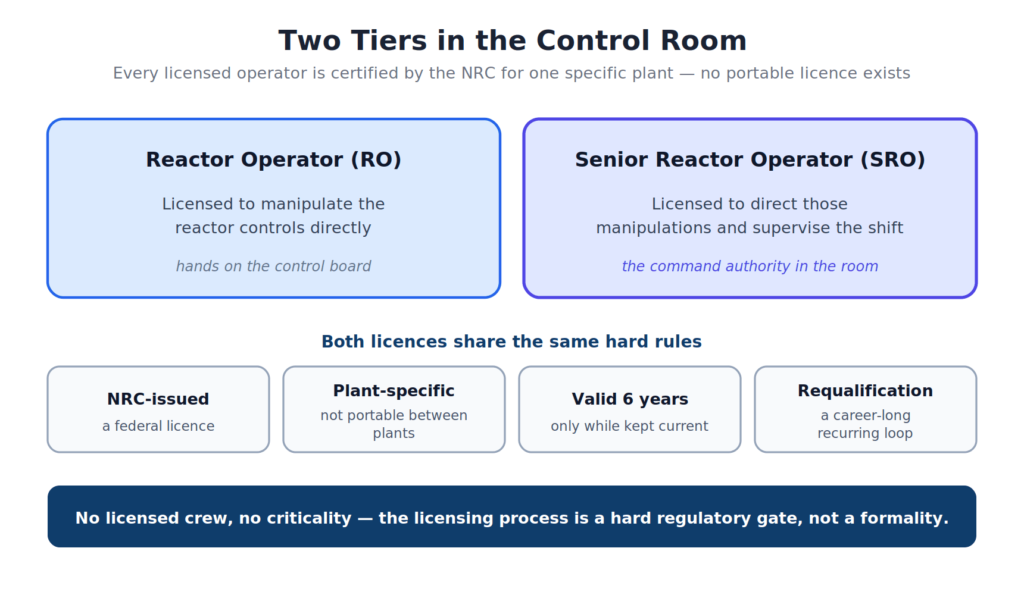
Both licenses are issued by the NRC, and here is the crucial part: they are granted for one specific plant. There is no portable “nuclear operator” license you carry from job to job. You are licensed for that control board, those systems, that exact configuration — and no other.
Earning the license is only the beginning; keeping it is a career-long discipline. In my own experience, the requalification cycle is relentless — and it’s deliberately so. On a regular cycle (the exact interval varies from utility to utility), operators are rotated out of the plant for roughly a month at a time and sent to the training institute to be re-examined on every system, from top to bottom.
And it isn’t just the operators in those rooms. Maintenance, chemistry, instrumentation and control (I&C), reactor engineering, health physics, and quality assurance are all pulled in together — direct classroom sessions, open technical discussion of how the systems actually behave, everyone sharpening the same shared understanding of the plant.
Then comes the simulator — and this is where licensing stops being academic. Operators are placed in front of a full-scale replica of their control room and handed the worst-case scenarios: cascading failures, accidents they must never get wrong on the real plant. An external observer watches the whole time, and they are not only grading whether you take the right actions.
They are watching how you hold up — whether you can control the situation, manage the room, and handle the panic when alarms are screaming and decisions have seconds to be made. It is a deliberate stress test, designed to forge people who stay calm and correct under the worst pressure the plant could ever throw at them. That is the standard a restart has to rebuild — not just trained operators, but operators proven under fire.
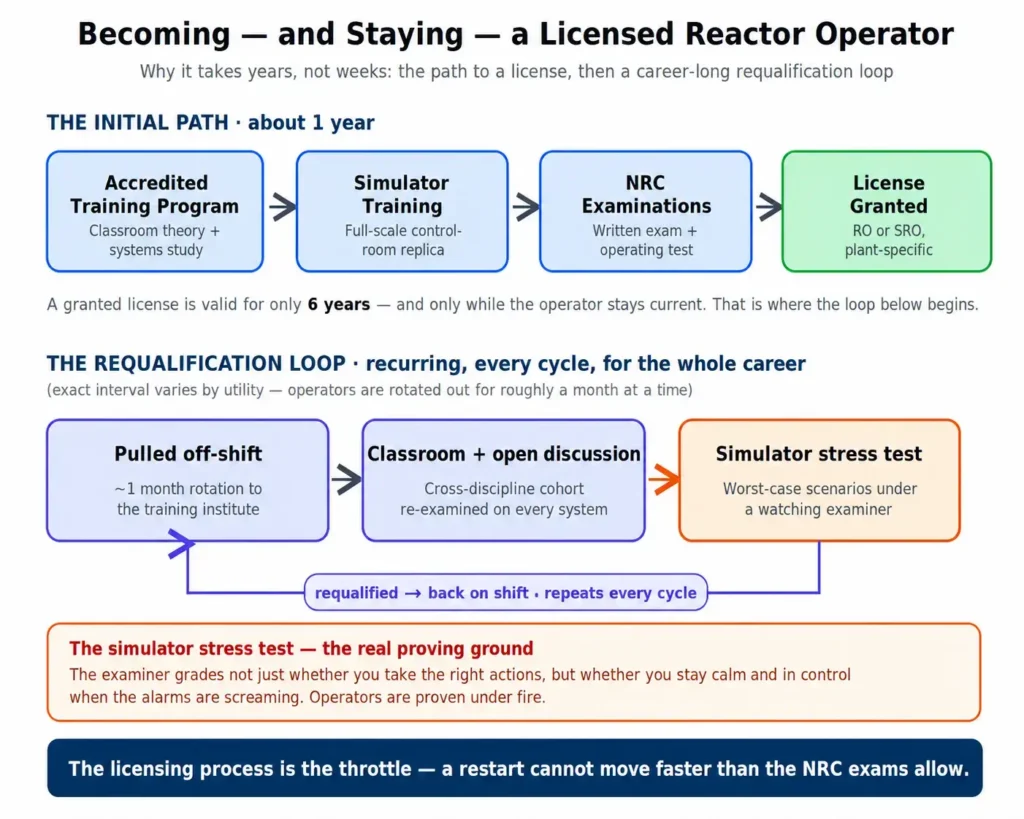
Now layer the restart problem on top of that. The simulator itself has to be restored and revalidated to match the plant before anyone can train on it. A full pipeline of operators — enough to staff every shift around the clock, with margin — has to move through training and pass the NRC’s licensing examinations: a written exam plus an operating test, with an examiner watching them perform real evolutions and walk the plant’s systems.
And it isn’t only the control room: the engineering, maintenance, chemistry, reactor physics, radiation-protection, and security organizations all have to be rebuilt to the standard of an operating plant, not a dormant one, before fuel is ever loaded. This is, in effect, a cold start of an entire human system.
Constellation has been moving on exactly this for months — hiring and training staff, restoring the training facility, and pushing operator candidates through the pipeline well ahead of the planned restart.
The company has said it is training roughly 90 operators toward their NRC licenses, with new fuel due on site by the end of 2026. None of it can be rushed past the NRC’s exams, and that is the point: the licensing process is the throttle. It is also why the workforce timeline, not the metallurgy, may prove to be one of the real pacing items for the whole project.
So how hard is this hurdle, honestly? Like the embrittlement question, the answer cuts both ways. It is genuinely formidable — you cannot conjure a licensed crew, and the NRC will not let you shortcut the exams that stand between a candidate and the controls.
But it is not a wall, because it is a known, bounded process. The industry knows precisely how to train and license operators; it does this continuously at every operating plant in the country. The task here is larger and runs against a clock, but it is a matter of time, money, and disciplined execution — all of which Constellation has committed. This is the kind of hurdle that sets a schedule, not the kind that ends a project.
Hurdle #4 — The Regulatory Wall: Restarting a Reactor the Law Says Is Closed
Imagine signing the legal paperwork to permanently close something — a death certificate, in effect — and then, years later, walking back into the same office and asking the government to declare it alive again. Not “renew” it. Not “reopen” it. Un-declare its death. There is no form for that, because no one was ever supposed to need one.
That is, almost exactly, the legal position of the Three Mile Island restart.
When a U.S. nuclear plant shuts down for good, it doesn’t just stop generating — it files formal certifications with the federal government stating two things: that it has permanently ceased operations, and that it has permanently removed its fuel. Those words matter enormously.
Under the Nuclear Regulatory Commission’s own regulations — specifically 10 CFR 50.82(a)(2) — the moment those certifications are docketed, the plant’s license no longer authorizes operation of the reactor at all. The reactor isn’t merely switched off. It is, in the eyes of the law, switched off permanently — its license downgraded from “operating power plant” to “facility being dismantled.”
Three Mile Island Unit 1 filed exactly those certifications after it shut in 2019. So Constellation’s challenge here isn’t engineering at all — it’s legal and institutional. Before a single fuel assembly can go back into that core, the company must persuade the NRC to do something the regulator’s own rulebook never contemplated: rescind a permanent-shutdown declaration and restore a license that the law had deliberately closed.
This is the hurdle the skeptics lean on hardest. In a January 2026 op-ed for The Hill, former FERC chairman Neil Chatterjee argued the effort would fail, pointing to “too many regulatory, material and logistical hurdles.” And of all four hurdles, it’s the one where his case is strongest — because here, for the first time, the obstacle isn’t a problem engineers know how to solve. It’s a door the law was written to lock behind a plant forever. The question is whether that door can be reopened — and, just as importantly, whether it should be.
The “Dead or Alive” License: The Legal Catch at the Heart of a Restart
To understand why this hurdle is so unusual, you have to understand a quiet but powerful piece of nuclear law — the rule that turns a permanent shutdown into a one-way door.
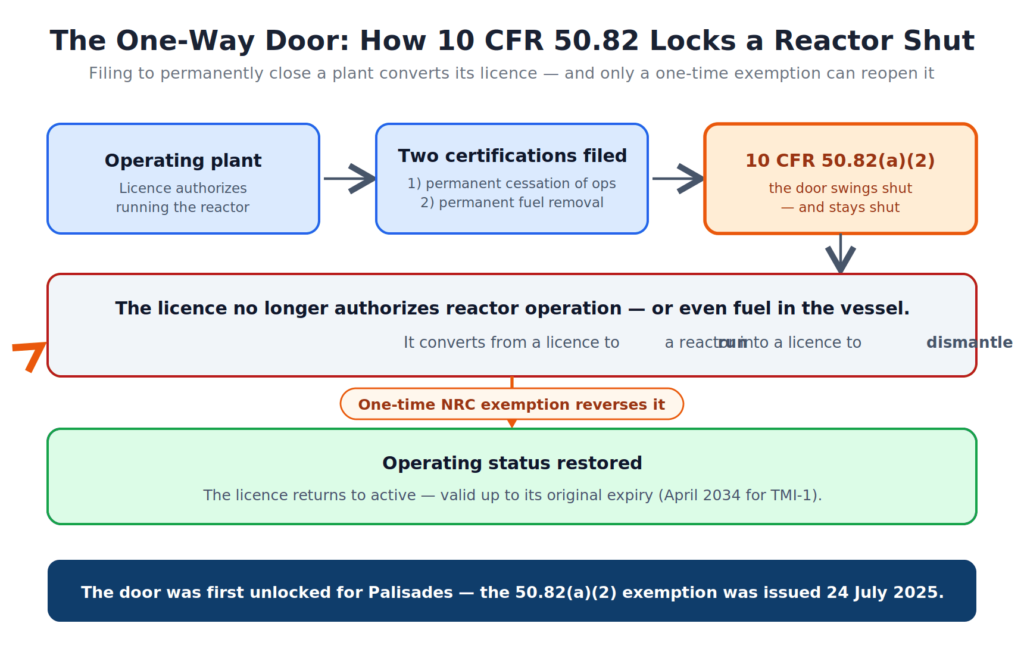
When a plant decides to close for good, federal regulations require it to file two certifications with the NRC: one confirming it has permanently ceased operations, and one confirming it has permanently removed the fuel from the reactor. The instant those are docketed, a specific regulation kicks in.
In plain terms, the plant’s license stops authorizing reactor operation or even putting fuel back into the vessel. The license isn’t torn up — the plant still holds it, and still answers to the NRC — but its character changes completely. It converts from a license to run a reactor into a license to safely take one apart.
That conversion is the heart of the problem. It was written to be permanent and one-directional, for a sensible reason: once a plant commits to decommissioning, regulators, the public, and the plant itself can all rely on the certainty that this reactor will never run again.
Whole decisions follow from that certainty — staffing, safety oversight, spent-fuel planning, even the relaxation of certain operating-era requirements that no longer apply to a plant being dismantled. The one-way door exists precisely so everyone can trust it stays shut.
Constellation now has to open it. To restart Three Mile Island Unit 1, the company has asked the NRC to grant a one-time exemption from that shutdown regulation — essentially a formal request to rescind the permanent-cessation certifications and restore the plant’s operating license to active status, valid up to its original expiration in April 2034.
Alongside that exemption, Constellation filed a set of license amendment requests to bring the licensing basis back to operating-plant standards. Restoring that licensing basis — the full body of commitments, analyses, and technical requirements a plant must satisfy to be allowed to operate — is the formal, paperwork-heavy core of the entire restart.
Here is where the critics press hardest, and it’s worth engaging honestly. Opponents argue that a plant cannot have it both ways. During the years it claimed decommissioning status, the argument goes, the plant enjoyed regulatory relief — relaxed requirements that apply only to a reactor that will never run again.
To now reverse course and restore the operating license, critics say, is to treat the plant as having been “dead and alive at the same time”: legally closed enough to shed operating-era obligations, yet somehow still alive enough to flip back on.
A coalition — Beyond Nuclear, Don’t Waste Michigan, and Michigan Safe Energy Future — put exactly this argument before a federal court in the parallel Palisades case, arguing the exemption violates the Atomic Energy Act.
In mid-2026 a district court dismissed the suit, but on jurisdiction rather than merits — holding that such challenges belong in a U.S. Court of Appeals — so the core legal question remains untested, and the challengers have signalled they may refile.
It’s a serious objection, and dismissing it would be dishonest. But it has a serious answer, too — and that answer is the subject of the next section. Because as novel and uncomfortable as this legal maneuver sounds, it is no longer hypothetical. Another reactor has already walked through this exact door first.
A Path No One Had Walked: Palisades, the Precedent, and a New Rulebook
For all the force of the “you can’t reopen a closed reactor” argument, it ran into an inconvenient fact in 2025: someone did.
Until very recently, the critics were right in a literal sense no fully shut-down U.S. reactor on its way to decommissioning had ever been restarted. It had never been done because it had never been tried, and because the regulations seemed to forbid it.
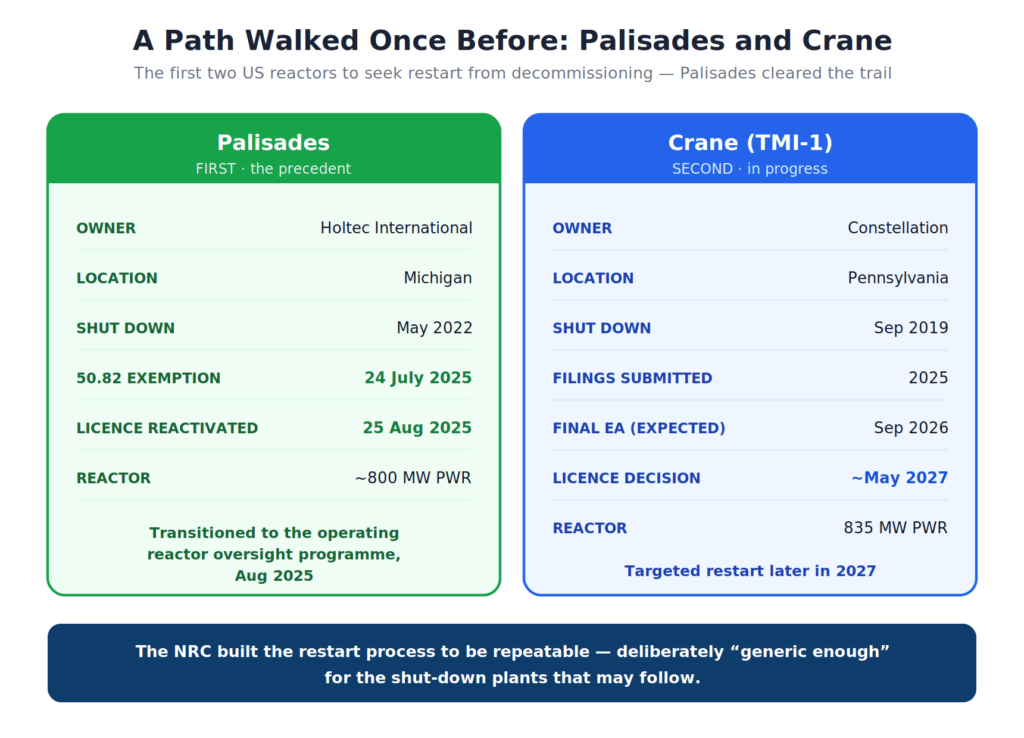
Then two plants tried at once: Palisades in Michigan, owned by Holtec, and Three Mile Island Unit 1. Palisades moved first, and in doing so it became the test case that clears or blocks the path for Crane.
The licensing novelty was clear from the start. When Holtec first announced its Palisades restart back in 2022, the nuclear trade press flagged that the NRC had no established playbook for it — the agency acknowledged it had never dealt with re-licensing a shut-down reactor.
In July 2025, the NRC did the thing its own rulebook never anticipated: it granted Palisades a one-time exemption from the permanent-shutdown regulation (10 CFR 50.82(a)(2)), allowing fuel to be loaded back into a reactor that had legally been on its way to the scrapyard. The exemption was issued on 24 July 2025; Palisades reactivated its power-operations license about a month later, on 25 August 2025.
The agency’s reasoning was narrow but decisive — it concluded that allowing the plant to return to its prior licensed status would not pose an undue risk to public health and safety. With that single decision, the “impossible” became merely unprecedented. The door the law was written to lock had been opened once, deliberately, under federal authority.
What makes this more than a one-off is that the NRC didn’t just improvise. It began building the machinery to do this repeatably — standing up a restart-specific oversight and inspection framework that hadn’t existed before, because it had never been needed.
For Three Mile Island, the NRC established a dedicated CCEC Restart Panel to coordinate the licensing actions, exemptions, and inspections, and it created a “potential restart” track for the plant in its own systems. In other words, restarting a dead reactor is, as of now, becoming an actual regulatory procedure — novel, but no longer formless.
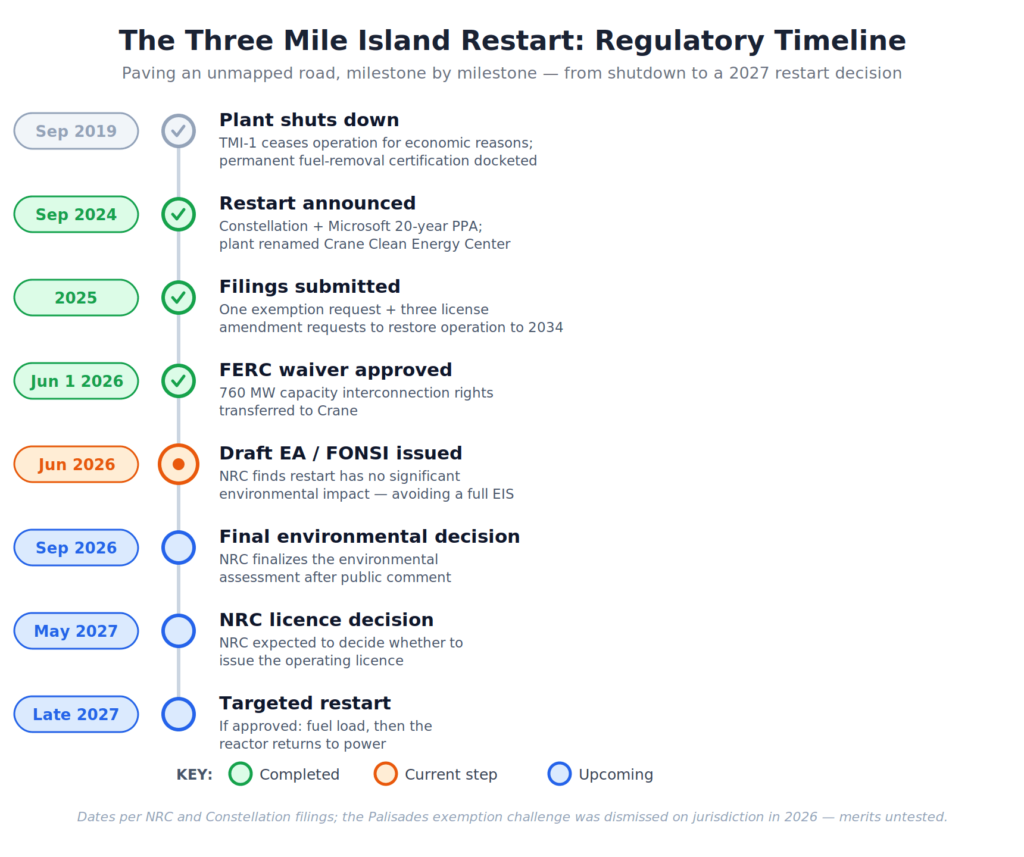
That’s why the more accurate way to see this hurdle is not a brick wall but an unmapped road that is being paved in real time, milestone by milestone. And Crane is moving along it at a striking pace.
The plant’s original operating license ran to 2034, and Constellation has asked the NRC to restore operation up to that date through one exemption request and three license amendment requests.
In June 2026, the NRC released its draft environmental assessment and a preliminary “finding of no significant impact” — concluding the restart would have no significant environmental effects, which lets the agency proceed without a far longer full environmental impact statement.
A public comment period followed, with the final environmental decision expected in September 2026. From the latest public meeting, the NRC and Constellation now expect a decision on the operating license around May 2027, with the reactor targeted to return to power later that year.
But — and this is where the honest engineer has to slow down — moving fast is not the same as moving safely, and the speed itself has become the controversy. The entire restart push is unfolding against a federal climate actively trying to accelerate nuclear licensing: a 2025 executive order directing the NRC to cut red tape, a streamlining of the advisory reviews (the ACRS) that historically scrutinized such decisions, and the politically charged momentum of powering the AI data-center boom.
Supporters see an agency finally moving at the speed the moment demands. Critics see a regulator being pushed to approve a first-of-its-kind action faster than caution warrants and a coalition took the parallel Palisades exemption to federal court, arguing it was unlawful. That suit was dismissed in mid-2026 on jurisdictional grounds,not on its merits so the underlying question is still unresolved, and a court, not an engineer, could yet decide the door must stay shut..
The Verdict: Can You Restart a Nuclear Reactor Like This?
Step back from all four hurdles, and a clear picture emerges — one that is neither the breezy “just flip the switch” of the headlines nor the flat “it will never happen” of the skeptics.
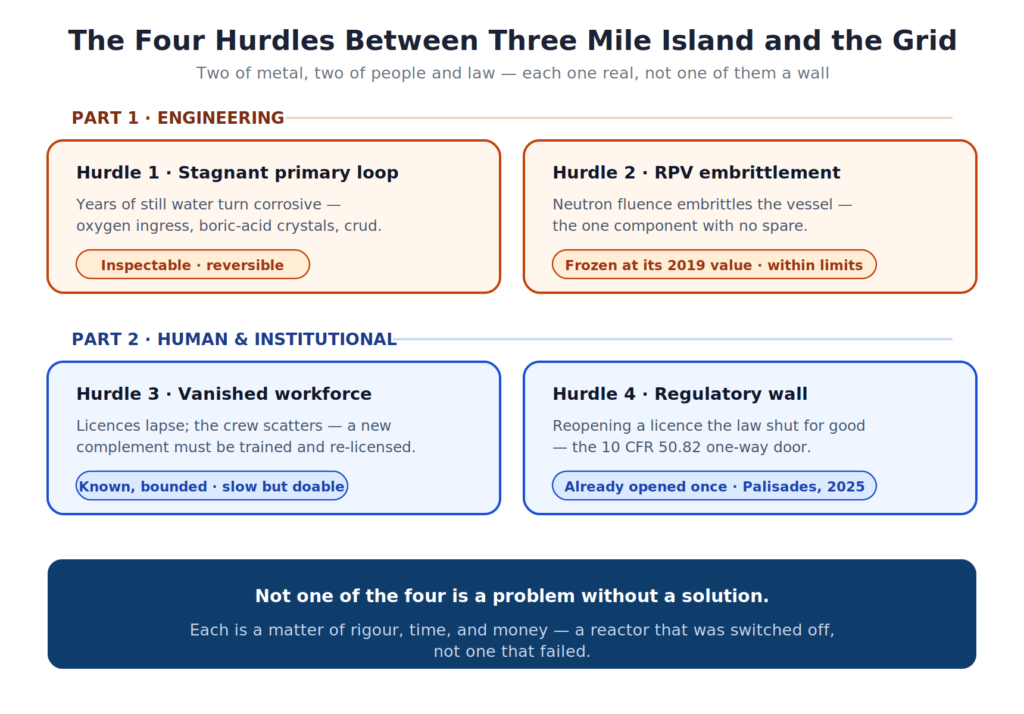
Across two parts, we’ve walked the real obstacles standing between this reactor and the grid. In Part 1, the hurdles were physical: a stagnant primary loop where still water turns corrosive, and an embrittled reactor pressure vessel, the one component with no spare.
In Part 2, they were human and institutional: a vanished workforce that must be rebuilt and re-licensed operator by operator, and a regulatory wall that requires the NRC to reopen a door the law was written to lock forever.
Now line them up and ask the question this whole series set out to answer. Neil Chatterjee, the former FERC chairman, argued the restart would fail because of these regulatory, material, and logistical hurdles. So — was he right?
My honest engineer’s verdict is this: he is right that every one of these hurdles is real, and wrong that any of them is a wall.
Look at the pattern. The corrosion is inspectable and reversible. The embrittlement is frozen at its 2019 value and, for a near-term restart, sits within its limits. The workforce is a known, bounded training-and-licensing problem — demanding and slow, but something the industry does every day.
And the regulatory barrier, the one that looked most absolute, has already been opened once: Palisades proved the door can be unlocked, and the NRC has built the machinery to do it again. Not one of these four is a problem without a solution. Each is a matter of rigor, time, and money — and Constellation has committed all three.
That is the through-line of the entire series. None of these hurdles exists because the plant failed. They exist because the plant stopped — and almost everything that stopping caused can, with enough discipline, be undone. A reactor that fails is a tragedy. A reactor that was simply switched off is an engineering project. Three Mile Island Unit 1 is the second kind.
But honesty cuts both ways, and the series shouldn’t end on a victory lap. Two real questions remain — and notice that neither is the “can they do it?” that dominates the headlines.
The first is the one buried in the steel: not whether the vessel can restart, but how long it can safely run before embrittlement, not economics, sets its true retirement date. A 20-year power deal leans on decades of operation, and every additional year of neutron fluence narrows the margin.
The second is the one raised by the regulatory wall: not whether the door can be opened, but whether opening it this fast, under this much political and commercial pressure, leaves enough room for caution.
The lawsuit challenging the precedent was thrown out in mid-2026 on a jurisdictional technicality — not on its merits — so the core legal question stays open, and a court, not an engineer, could yet have the final word.
So the real story of the Three Mile Island restart was never “is it possible?” It is possible. The deeper, more honest question — the one worth watching as the reactor moves toward 2027 — is whether a first-of-its-kind revival can be done not just successfully, but wisely: fast enough to matter, yet careful enough to deserve the trust that restarting a nuclear reactor demands.
That is the line the Crane Clean Energy Center now has to walk. And whether it walks it well will set the precedent for every shut-down reactor that comes after.
Frequently Asked Questions
Can a decommissioned nuclear plant be restarted?
Yes — but it is extraordinarily rare. Once a plant files its permanent-cessation and permanent-fuel-removal certifications, 10 CFR 50.82 means its license no longer authorizes operation, so a one-time NRC exemption is required to reverse that. Palisades in Michigan became the first U.S. plant to do it, receiving its exemption in July 2025; Three Mile Island Unit 1 (Crane) is the second.
When will Three Mile Island restart?
Constellation is targeting 2027. Following the NRC’s draft finding of no significant impact in June 2026, the final environmental decision is expected in September 2026, and the NRC and Constellation now expect a decision on the operating license around May 2027, with the reactor returning to power later that year.
Why did Three Mile Island Unit 1 shut down?
For economic reasons, in 2019 — not because of an accident. The 1979 accident involved a different reactor at the site, Unit 2, which never restarted. Unit 1 operated separately until its economic closure.
How do you become a licensed reactor operator?
You complete an accredited training program, train on a full-scale control-room simulator, and pass the NRC’s licensing examinations — a written exam plus a hands-on operating test. The license is plant-specific and valid for six years, and it is maintained through a career-long requalification program.
What is a 10 CFR 50.82 exemption?
10 CFR 50.82(a)(2) states that once a plant’s permanent-shutdown certifications are docketed, its license no longer authorizes operating the reactor or placing fuel in the vessel. A one-time exemption from that rule is what allows a shut-down plant to rescind those certifications and restore its operating license.
Who is buying the power from the restarted Three Mile Island?
Microsoft, under a 20-year power purchase agreement signed in 2024, to supply carbon-free electricity for its data centers.
Has any U.S. nuclear plant been restarted after decommissioning?
Yes — Palisades in Michigan, operated by Holtec, is the first, having reactivated its power-operations license in August 2025. Crane (Three Mile Island Unit 1) is the second plant attempting it.
Is the Three Mile Island restart controversial?
It is. The NRC issued a draft finding of no significant impact, but critics argue the process is moving too fast. A coalition of environmental groups challenged the parallel Palisades exemption in federal court; that suit was dismissed in mid-2026 on jurisdictional grounds — not on its merits — so the underlying question of whether the NRC can lawfully reverse a permanent shutdown remains unsettled.
Sources and Further Reading
- NRC — Christopher M. Crane Clean Energy Center (restart status page)
- Federal Register — Palisades 10 CFR 50.82(a)(2) exemption (24 July 2025)
- ANS Nuclear Newswire — NRC issues preliminary EA/FONSI for Crane restart
- Brattle Group — Economic Impacts of Establishing the Crane Clean Energy Center
- World Nuclear News — DOE closes $1 billion loan for the restart
- The Hill — Neil Chatterjee op-ed on the restart
- White House — Fact sheet: reform of the Nuclear Regulatory Commission (23 May 2025)
- eCFR — 10 CFR 50.82, Termination of license
- World Nuclear Association https://world-nuclear.org/information-library/safety-and-security/safety-of-plants/three-mile-island-accident
- https://www.law.cornell.edu/cfr/text/10/55.53
- https://www.law.cornell.edu/cfr/text/10/55.55
- https://www.ecfr.gov/current/title-10/chapter-I/part-55/subpart-A/section-55.4
- 50.54 Conditions of licenses. https://www.ecfr.gov/current/title-10/chapter-I/part-50/subject-group-ECFR2f76ac8b7f9e21e/section-50.54
- https://www.ecfr.gov/current/title-10/chapter-I/part-55/subpart-E/section-55.46
- https://www.cpbj.com/crane-clean-energy-center-on-pace-for-accelerated-restart/
- Constellation request for exemption from 10 cfr 50.82(a)(2) to support reauthorization of power operations https://www.nrc.gov/docs/ML2435/ML24355A057.pdf
- Michigan Advance https://michiganadvance.com/2025/11/21/palisades-opponents-pursue-federal-lawsuit-over-restart-of-nuclear-plant-on-lake-michigan-shoreline/
About The Author
Elliot Marsh is a working reactor engineer with hands-on experience in reactor physics, core management, reactivity control, and nuclear fuel-cycle planning at an operating power station. He writes about nuclear energy for readers who want the engineering reality, not the press release.
Need content like this for your company?
I write white papers, technical explainers, and thought-leadership for nuclear vendors, reactor developers, and the agencies that serve them — accurate enough for engineers, clear enough for buyers.