Why Is HALEU So Expensive? The Enrichment Cost Math
The reason isn’t radiation, and it isn’t rare ore. It’s a unit of accounting and a line drawn at 10%.
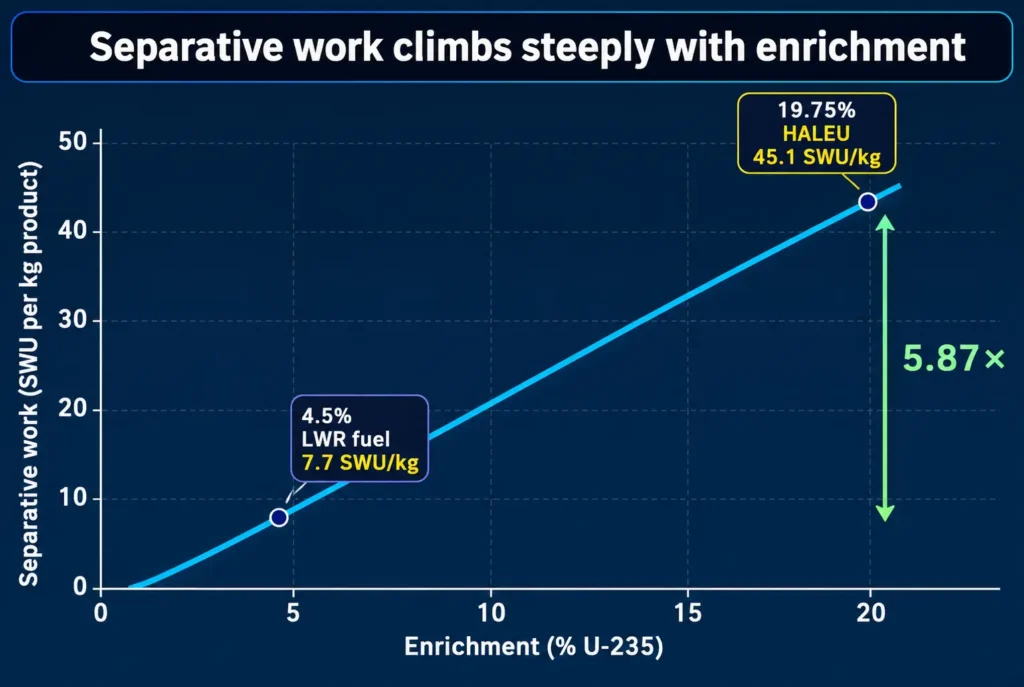
The HALEU enrichment cost is set almost entirely by one thing — separative work — and enriching uranium to 19.75% takes about 5.9 times more of it than the 4.5% fuel in today’s reactors.
I spend my working days thinking about a number most people outside the industry never see: the enrichment of the fuel sitting in a pressurized-water reactor (PWR) core. In a commercial PWR it runs around 4.5% U-235.
The advanced reactors going up now — the sodium-cooled and high-temperature designs — want fuel enriched to nearly 20%. Say that out loud and someone always asks why it costs so much more. The usual answers are wrong. It isn’t that the fuel is dramatically more radioactive, and it isn’t that the ore is rarer. The real reason lives in a unit of accounting called the SWU, and in a regulatory line the industry draws at 10%.
The short version: pushing uranium to 19.75% takes roughly 5.9 times the separative work, per kilogram, that 4.5% fuel does. (Read our article on what separates the two fuels beyond cost). That ratio carries most of the cost. But it doesn’t carry all of it — and the part that gets left out of most explanations is the more interesting half.
| Per kg of finished fuel | 4.5% (LWR fuel) | 19.75% (HALEU) | Ratio |
| Separative work (SWU/kg) | 7.69 | 45.12 | 5.87× |
| Natural uranium feed (kg) | 8.42 | 38.26 | 4.55× |
Basis: 0.711% natural feed, 0.20% tails, standard SWU value function.
What a SWU actually measures
A separative work unit, or SWU, measures effort — the work of separating isotopes to raise the U-235 fraction. It says nothing about how much material you’re handling or how much energy ends up in the finished fuel.
You start with natural uranium, where just 0.711% by weight is U-235, and spin it through centrifuge cascades to nudge that fraction up. Every additional kilogram of product costs more separative work than the last, and the price of enrichment tracks that work far more tightly than it tracks the ore. Ore is comparatively cheap. Separative capacity is not.
The 6x number, and the twist behind it
Reaching 4.5% costs about 7.69 SWU for every kilogram of product. Reaching 19.75% costs about 45.12 — call it six times the work for each kilogram you walk away with. Intuitive enough: enrich higher, pay more.
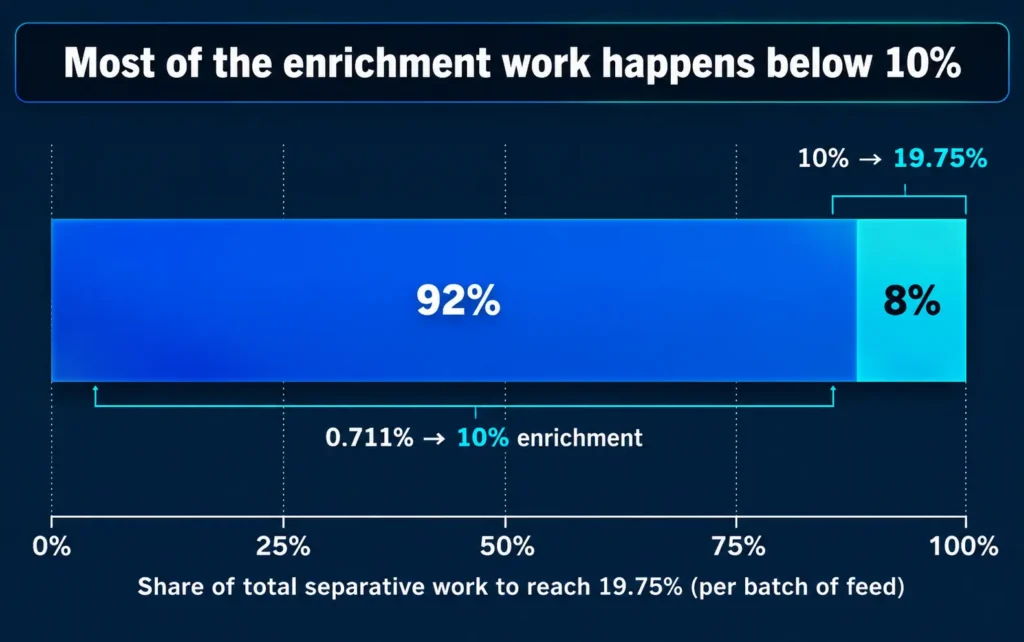
Now the twist. DOE’s HALEU Environmental Impact Statement points out that about 90% of the separative work needed to climb from natural uranium all the way to 19.75% is spent below 10%. The final push from 10% to 19.75% adds less than a tenth of the total.
Those two statements look like they fight each other. They don’t — they’re just measured on different bases.
- Per kilogram of finished product, HALEU takes about 5.9× the work of LWR fuel.
- Per batch of natural uranium fed in, roughly 90% of the work to reach 19.75% is done by the time the material passes 10%.
They reconcile through something easy to overlook: the higher you enrich, the less product a batch yields. Follow one fixed batch up the cascade and most of the effort is burned early, getting to 10%.
But that batch keeps shrinking into a smaller quantity of richer material, so the work per kilogram of the finished 19.75% product still lands about six times higher than for 4.5% fuel. The 6x is per kilogram of product. The 90% is per batch of feed. Hold those two frames apart and the paradox disappears.
Per kilogram, or per unit of fissile? Why the denominator matters
One important caveat to the 5.9× figure deserves to be explicit. That ratio is separative work per kilogram of product per kilogram of bulk enriched uranium. It answers a narrow question well: how much more separative work does it take to enrich a kilogram of uranium to 19.75% rather than 4.5%?
But a kilogram of HALEU is not equivalent to a kilogram of LEU. It contains far more of what you are actually paying for, fissile U-235. Normalize the same numbers by fissile mass rather than bulk mass, and the premium shrinks sharply:
- At 4.5%: 7.69 SWU per kg of product ÷ 0.045 ≈ 171 SWU per kg of U-235
- At 19.75%: 45.12 SWU per kg of product ÷ 0.1975 ≈ 228 SWU per kg of U-235
- A ratio of about 1.3× — a premium of roughly a third, not a factor of six.
Which figure is the right one depends on the question. Per unit of fissile material, the denominator that matters most for the economic value of the fuel, HALEU’s enrichment premium is modest.
The per kilogram of product figure remains the honest measure of separative work per unit mass, and it carries straight over to the mass-based realities of packaging, criticality safety, and transport, where you handle kilograms of material regardless of their fissile content. Both are correct; they answer different questions. Read as a blanket claim that HALEU fuel is “six times as expensive,” though, the per-kilogram figure overstates the cost.
Thanks to a reader for pushing on this point.
So Why Is HALEU Expensive — Really?
If the separative work is mostly spent by 10%, then the last stretch to 19.75% isn’t where the bill explodes. Three things matter more than those final few percent.
First, sheer SWU intensity. Even with the “most of the work is below 10%” effect, each kilogram of HALEU still carries around 5.9× the separative work of reactor fuel. On a fuel-mass basis that intensity is real, and it sets the floor under the price.
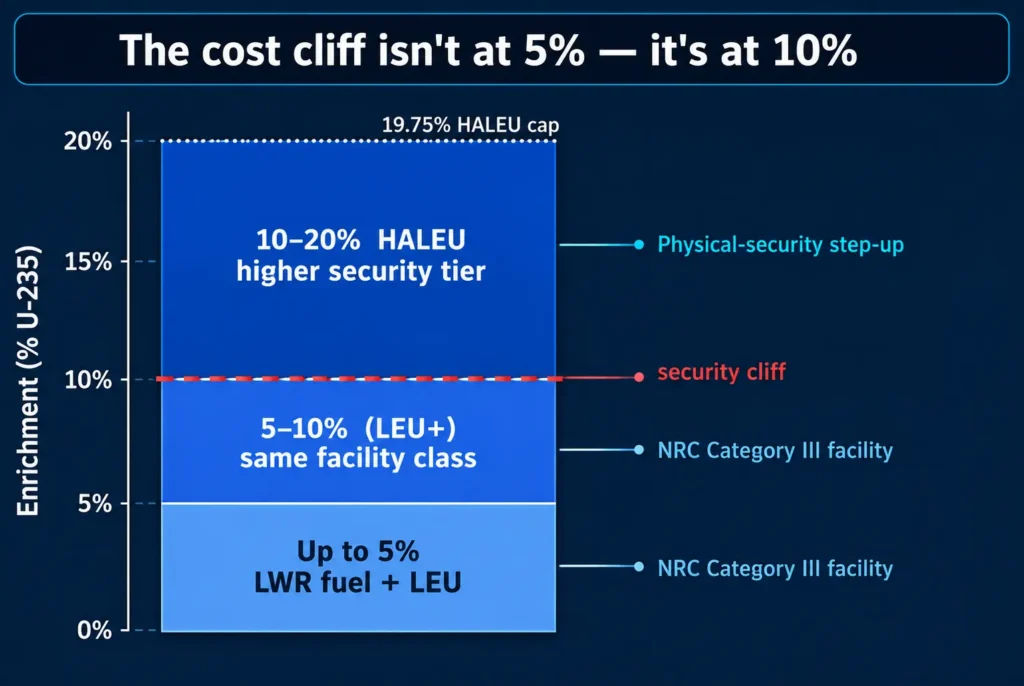
Second, a regulatory cliff. The same DOE analysis makes a point that rarely survives into popular explainers: material enriched above 5% but below 10% — LEU+, in the jargon — can be made in the very same facilities that enrich natural uranium to 5%, inside an NRC Category III facility.
Cross 10% U-235 and the physical-security and licensing burden steps up sharply. Part of what makes HALEU costly, then, has nothing to do with the SWU curve. It’s the security tier that comes with holding material above that line.
Third — the big one right now — supply. Almost nobody makes HALEU commercially. That’s a scarcity problem, and scarcity is expensive.
The Supply Picture, Honestly
Two numbers frame the gap. Across the entire life of the U.S. HALEU demonstration program, cumulative output came to a little over 1,900 kilograms — under two metric tons, spread across years.
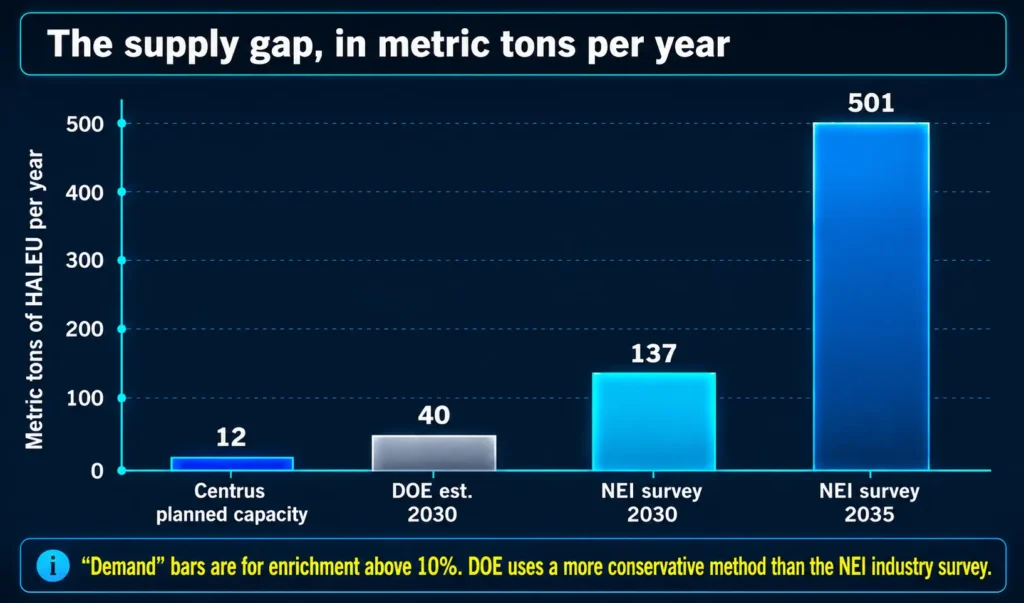
Then, on 30 June 2026, Centrus finalized a $900 million firm fixed-price contract with DOE to stand up commercial capacity at Piketon, Ohio: an initial build-out of 12 metric tons a year, first new capacity expected by 2029, and a delivery milestone of one metric ton of HALEU by March 2032, all under DOE’s wider $2.7 billion domestic enrichment program.
Separately, TerraPower and ASP Isotopes hold a framework for up to 150 metric tons of HALEU across 2028 to 2037, with a nearer-term initial-core supply agreement worth roughly $375 million for first fuel cores in the 2027/28 window, from a planned South African plant rated near 15 metric tons a year.
Set that against demand. A 2020 Nuclear Energy Institute forecast put demand for enrichment above 10% at 137 metric tons in 2030, rising to 501 by 2035. Centrus’s planned 12 MT/yr covers under a tenth of the 137-tonne 2030 figure alone.
DOE’s own projections are more conservative — more than 40 MT by 2030, over 50 MT/yr by 2035 — because the department uses a less aggressive method than the industry survey. Pick either. The shape is identical: forecast demand runs well ahead of installed commercial capacity, and price follows scarcity — the reason [why building more centrifuges won’t fix it] runs through conversion and deconversion, not enrichment.
From where I sit, managing cores that run on the cheap, abundant end of the enrichment scale, the HALEU number is a useful reminder that fuel cost isn’t really about uranium. It’s about separative work, the regulatory line at 10%, and whether anyone has built the capacity to make the stuff. The SWU math sets the floor. The security threshold and the empty order book do the rest.
Frequently Asked Questions
What drives the HALEU enrichment cost?
Three reasons, in order of weight. Each kilogram of 19.75% HALEU needs about 5.9 times the separative work of the ~4.5% fuel in today’s power reactors; possessing material enriched above 10% U-235 triggers a higher physical-security and licensing tier; and almost no HALEU is made commercially yet, so scarcity drives price. The enrichment work sets the floor — the security threshold and supply gap do the rest.
How much more does it cost to enrich to 19.75% versus 4.5%?
Reaching 19.75% takes about 45.12 SWU per kilogram of product against about 7.69 for 4.5% fuel — a ratio near 5.87×. Natural-uranium feed also rises, from about 8.42 to 38.26 kilograms per kilogram of product (4.55×), assuming 0.711% feed and 0.20% tails.
What is a SWU?
A separative work unit measures the effort of separating uranium isotopes to raise the U-235 fraction, independent of how much material you process or how much energy the finished fuel holds. Enrichment cost tracks SWU far more closely than the amount of ore consumed, because separative capacity is the scarce, expensive input.
Is it true most of the enrichment work happens below 10%?
Yes. Per DOE’s HALEU Environmental Impact Statement, about 90% of the separative work to enrich natural uranium from 0.711% to 19.75% is spent in the 0.711%-to-10% range, on a per-batch-of-feed basis. That doesn’t contradict HALEU costing roughly six times more per kilogram of product: the higher you enrich, the less product a batch yields, so the two figures sit on different bases.
Who is building commercial HALEU supply?
In June 2026 Centrus finalized a $900 million DOE contract to build commercial HALEU capacity at Piketon, Ohio, with an initial 12 metric tons per year expected online by 2029. TerraPower and ASP Isotopes hold a framework for up to 150 metric tons across 2028–2037 from a planned South African facility. Forecast demand still runs well ahead of installed capacity.
Further reading: the transport and criticality-control side of moving HALEU through the fuel cycle , a genuinely thorny problem — I covered separately for Dan Yurman’s Neutron Bytes: “The HALEU Transport Problem Isn’t Radiation. It’s Criticality.”
Sources and Further Reading
1. DOE — Final HALEU Environmental Impact Statement, Volume 1 (Oct 2024) — the ~90%-of-separative-work-below-10% figure, and the LEU+ / NRC Category III facility tiers.
2. DOE HALEU EIS — Summary volume (Oct 2024) — DOE’s own demand estimates: >40 MT by 2030 and >50 MT/yr by 2035.
3. POWER Magazine — “Centrus Signs $900M DOE Contract” (July 2026) — the $900M contract, 12 MT/yr build-out, 2029 first capacity, March 2032 milestone, $2.7B program, and 1,900 kg cumulative demo output.
4. ASP Isotopes Inc. — Form 8-K, TerraPower agreements (May 2025), SEC EDGAR — up to 150 MT HALEU across 2028–2037, and the ~$375M initial-core supply agreement.
5. ANS Nuclear Newswire — TerraPower–ASP HALEU supply terms (May 2025) — the planned Pelindaba plant rated ~15 MT/yr, with initial production in 2027.
6. Orano — “HALEU Supply Chain: Transport Packages” white paper — the 2020 NEI forecast for >10%-enrichment demand: 137 MT in 2030, 501 MT in 2035.
Note: SWU and feed-factor figures (45.12 / 7.69 SWU per kg; 38.26 / 8.42 kg feed) are the author’s own calculation from the standard SWU value function V(x) = (2x−1)·ln[x/(1−x)], using 0.711% feed and 0.20% tails.
About The Author
Elliot Marsh is a working reactor engineer with hands-on experience in reactor physics, core management, reactivity control, and nuclear fuel-cycle planning at an operating power station. He writes about nuclear energy for readers who want the engineering reality, not the press release.
Need content like this for your company?
I write white papers, technical explainers, and thought-leadership for nuclear vendors, reactor developers, and the agencies that serve them — accurate enough for engineers, clear enough for buyers.