Why Nuclear Reactors Run on Poison: The Surprising Job of Boron
Boron in nuclear reactors does something that sounds alarming:every nuclear reactor on Earth is quietly drinking a poison — on purpose. That poison is boron, and without it, controlling a reactor would be like driving a car with only an on/off switch and no brake pedal. The technical name for what boron does even sounds ominous: engineers call it a neutron poison.
That sounds alarming, so let me reassure you right away: this is by design, it’s completely routine, and it’s one of the most elegant safety ideas in all of engineering. “Poison” isn’t me being dramatic — neutron poison is the actual technical term for any material that soaks up the neutrons a reactor runs on.
Here’s the puzzle boron solves. A nuclear reactor produces an almost unimaginable amount of energy from a tiny amount of fuel. Left to itself, that reaction wants to either race ahead or die out — and “race ahead” is the direction nobody wants. So the entire art of running a reactor is control: holding the reaction steady at exactly the right level for months at a time, while being able to nudge it gently up or down as needed.
The problem is that a reactor is far too powerful for crude, all-or-nothing controls. You need two kinds working together: something fast and forceful for emergencies, and something smooth and precise for everyday fine-tuning. Boron dissolved into the reactor’s water is that second one — the smooth dial.
In this article, I’ll explain in plain terms what boron actually does inside a nuclear reactor, why this one element is so perfect for the job, how engineers manage it across the months-long life of a fuel load, how it also serves as an emergency shutdown system, and the surprising downsides of dissolving a corrosive acid into the heart of a power plant.
Why is boron used in nuclear reactors? Boron is used because it is an exceptional neutron absorber — a “neutron poison.” Dissolved in the coolant as boric acid (H₃BO₃), a technique called chemical shim, or built into control rods as boron carbide, it lets operators fine-tune the chain reaction, hold power steady across a fuel cycle, and shut the reactor down in an emergency.
From the control room: boron isn’t a fault to be fixed — in a PWR, operators dilute it steadily across the whole fuel cycle to track fuel burnup. The entire cycle is, in effect, a slow and deliberate un-poisoning. That day-to-day balancing act is what this piece is really about.
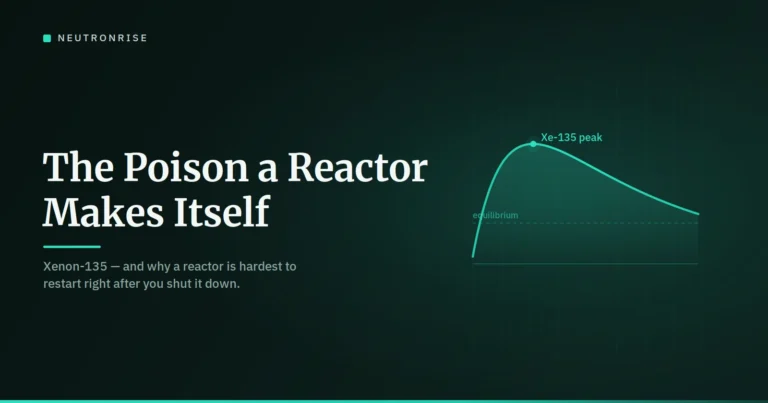
Boron isn’t the only poison a reactor runs on. Watch another one build and burn off in real time: Xenon-135 Transient Simulator →
First, What Are We Controlling? Neutrons and the Chain Reaction
To see why boron matters, you need one simple idea: neutrons.
A nuclear reactor runs on a chain reaction. Inside the fuel, atoms of uranium split apart — and each split is astonishingly productive. A single split releases about 200 million electron-volts of energy; for scale, a single kilogram of uranium fuel can release roughly two to three million times more energy than a kilogram of coal. And crucially, each split also throws off, on average, about 2.5 fresh neutrons.
That number is the whole reason a chain reaction is possible. Each split needs just one neutron to trigger the next split — but it produces about two and a half. That surplus is what lets the reaction sustain and grow. Those spare neutrons fly off and split more atoms, releasing more energy and yet more neutrons, and on it goes.
The entire game is keeping that chain balanced on a knife’s edge: not growing, not shrinking, just holding steady. And since every link in the chain is a neutron, “controlling a reactor” really means one thing — controlling how many of those neutrons are allowed to keep flying. Soak up the spares and the reaction turns down. Free them up and it turns up.
That’s the job. Now, who does it?
Control Rods vs. Boron: The Brake and the Dial
A reactor has two control systems, built for two different purposes.
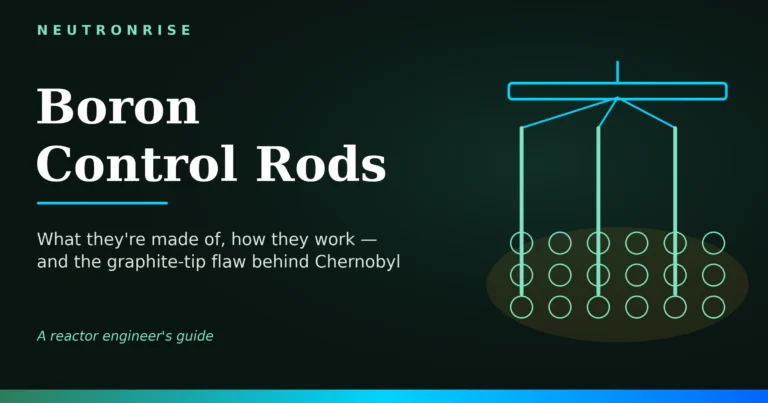
The first is control rods — solid rods that drop down into the reactor core, made of metals that greedily absorb neutrons. (Depending on the reactor design, these are often a special silver-indium-cadmium alloy, or a hard ceramic called boron carbide.)
Push them in and they soak up neutrons fast, choking the reaction down; pull them out and it picks up. Control rods are the brakes: fast and forceful, and in an emergency they can slam fully in and shut the reactor down in seconds.
But brakes are too blunt for everyday driving — and here’s the subtle problem most people never hear about. Because a control rod is a solid object plunged into one part of the core, it doesn’t just lower the overall reaction; it distorts the shape of where the power is produced (the neutron flux).
Think of it like pressing down on one spot of a stretched trampoline. Two things happen at once. First, the whole surface sags a little — that’s the overall reaction turning down, because the rod is genuinely removing neutrons from the chain, not just shuffling them elsewhere. But second, the dip is deepest right under your hand and shallower toward the edges — the shape becomes uneven.
A control rod does exactly this: it lowers the total power and skews where that power is concentrated. Right around the rod, the neutron activity gets locally suppressed, pushing the reactor’s power to lean toward other regions — higher in some places, lower in others, both top-to-bottom (axial power) and side-to-side (radial power) across the core. For an operator, an uneven power shape like that is something to be carefully managed, not something you want to create just to make a routine adjustment.
That’s why you need a second, gentler system: boron dissolved in the reactor’s cooling water. Because the boron is spread perfectly evenly through all the coolant — everywhere the water touches the fuel — it turns the entire reaction up or down uniformly, without favoring any region.
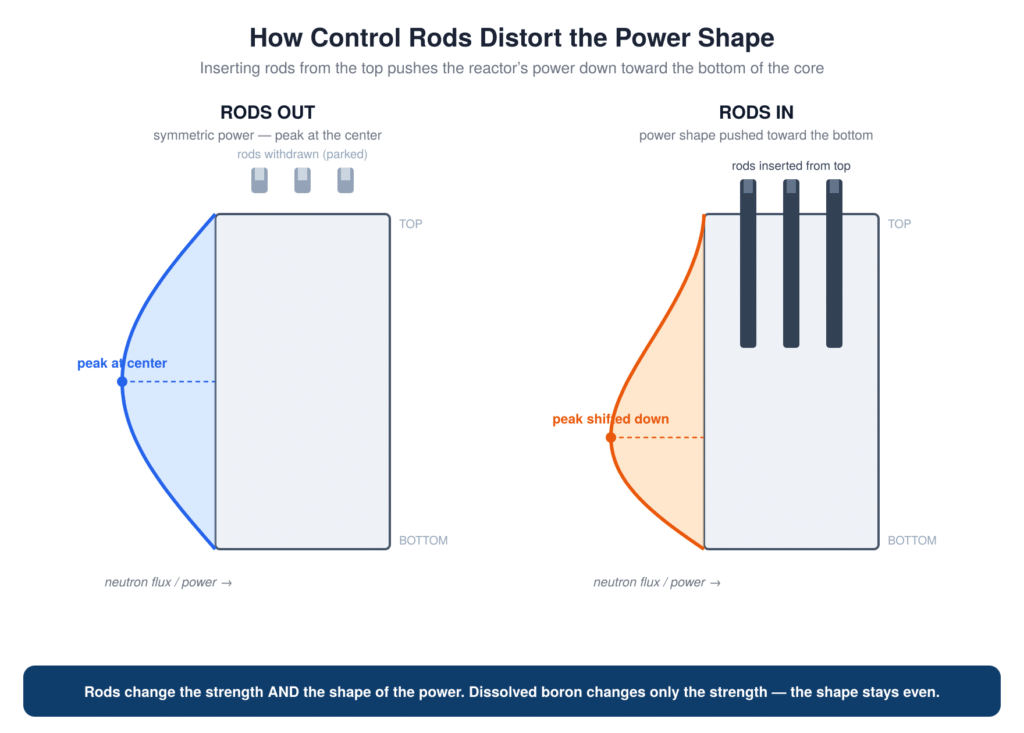
From a reactor engineering standpoint, the uniform distribution of boron matters immensely: it keeps the neutron flux profile flat, so power isn’t shifted from one region of the core to another.
Control rods do the opposite. Because they’re inserted from the top (in some reactor designs they are inserted from the bottom), they suppress power there and push the core to produce more power — and become more reactive — in the opposite region. And the disturbance doesn’t end the moment you pull the rods back out.
When you withdraw them, the flux redistributes, but that temporarily more-reactive region drives an uneven buildup of fission products and neutron-absorbing poisons like iodine-135 and xenon-135. Those have to decay or burn off before the core fully settles, which can take many hours — a phenomenon called xenon oscillation. Boron is the poison engineers add on purpose, the reactor also makes its own (see xenon-135 reactor poisoning).
This is exactly why operators lean on boron for routine adjustments and leave the rods parked: dissolved boron, or chemical shim, changes the reactor’s strength without ever stirring up that spatial instability. (Xenon dynamics are a fascinating subject in their own right — you can watch the full iodine–xenon transient play out in the Xenon-135 Transient Simulator.)
Add a little boron and the whole reactor eases down; dilute it and the whole reactor comes up, all while the power keeps its smooth, even shape. It’s a dial, not a switch — and unlike the control rods, it adjusts the reactor’s strength without ever distorting where that power is made.
In routine plant operation, operators keep the control rods at a small, steady insertion depth called the bite position — barely dipped into the core, just enough to keep a little fine control in hand, without disturbing the reactor’s power shape.
The rods stay there unless an emergency requires moving them. That position only shifts gradually in response to fuel depletion — what we call burnup — so it isn’t a daily adjustment.
But the fuel depletes a little every day, and that daily change is compensated through boron: operators reduce the coolant’s boron concentration bit by bit, diluting the primary system with non-borated, demineralized water.
Why Boron in Nuclear Reactors? Neutron Absorption and the Boron-10 Advantage
Out of the entire periodic table, why does the nuclear industry reach for boron? Three reasons.
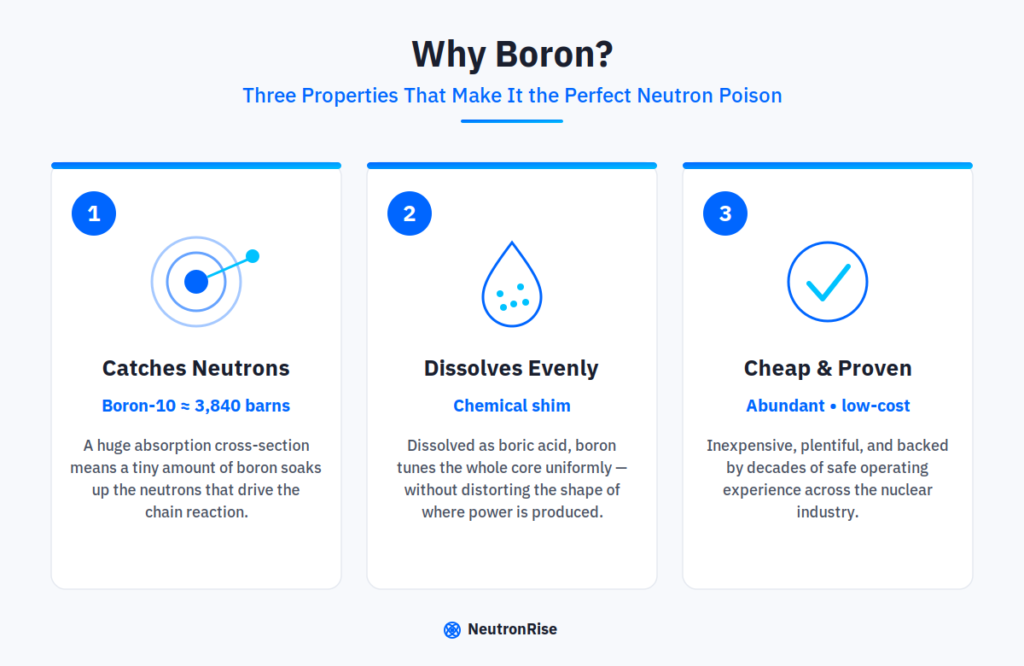
1. It’s spectacularly good at catching neutrons
This is the big one. Boron has an enormous appetite for the slow-moving neutrons that drive a reactor — physicists measure this “appetite” with a number called the absorption cross-section, and boron’s is huge.
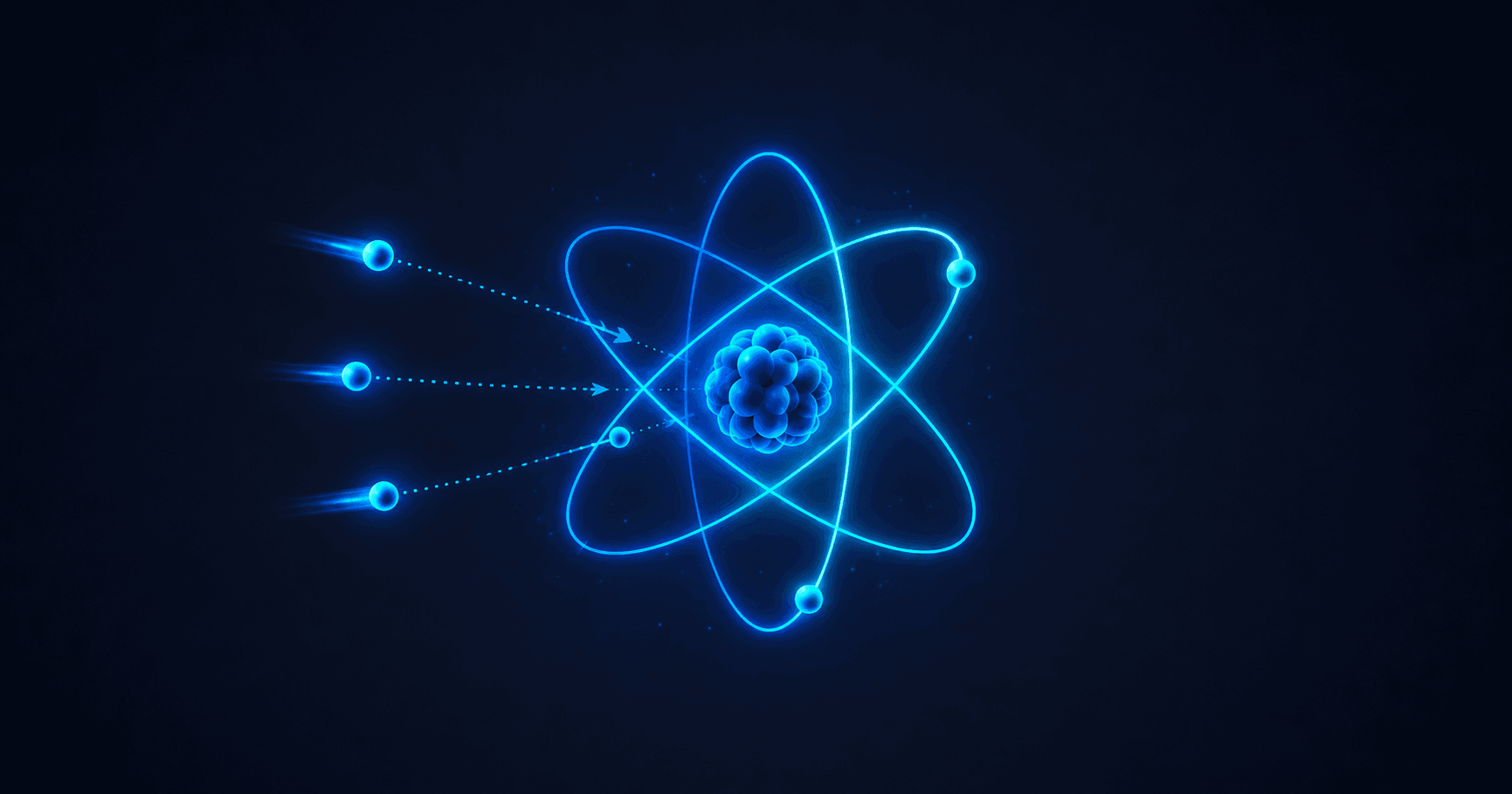
Natural boron contains about 20% (precisely, 19.9%) of the isotope boron-10, which has an absorption cross-section of around 3,840 “barns,” compared to almost nothing for the more common boron-11. In plain terms: boron-10 is like a catcher’s mitt the size of a barn door for neutrons. A small amount does a big job.
And here’s the mechanism behind that number. When boron-10 catches a slow neutron, it doesn’t simply hold it, it splits into a lithium-7 nucleus and a fast-moving alpha particle (a helium-4 nucleus), a reaction written ¹⁰B(n,α)⁷Li. Both products are stable, which is the quiet reason boron can mop up neutrons year after year without turning into long-lived radioactive waste, the trace of tritium from rare side reactions (below) being the main exception.
2. It dissolves and spreads evenly
Boron can be dissolved into the coolant homogeneously as boric acid, which lets it do that smooth, whole-core control we just described — adjusting the reaction’s strength without distorting the shape of the power the way a solid rod does.
This technique of dissolving boric acid in the cooling water and tuning the reaction by adjusting its concentration is known as chemical control, or chemical shim. A solid lump of metal simply can’t do this; only something dissolved uniformly can.
3. It’s cheap and well-understood
Boron is abundant, inexpensive, and engineers have decades of experience handling it safely. When you’re building something as serious as a nuclear plant, a cheap, predictable, thoroughly proven material is worth a great deal.
Chemical Shim: How Boron Concentration Changes Over a Fuel Cycle
Here’s a part most people never hear about — and it’s genuinely clever.
When a reactor is loaded with fresh fuel, that fuel is overstuffed with energy potential. A core is deliberately built with far more reactivity (watch how a reactivity change turns into reactor period) than it needs at the start, so it can keep running for the whole fuel cycle — typically somewhere between twelve and eighteen months — before it has to be refueled. But that excess is a problem on day one: a fresh core wants to run too hot.
Boron is how engineers tame it. Operators measure its concentration in the coolant in parts per million (ppm). At the beginning of the cycle, when the fuel is fresh and feisty, the water typically carries a high concentration — on the order of 1,500 to 2,000 ppm of boron — to soak up all that extra reactivity and hold the reaction in check.
Then, day by day, as the fuel gradually burns up and naturally loses some of its punch, operators slowly dilute the boron — removing a little at a time to compensate. By the end of the cycle, when the fuel is nearly spent, the boron has been diluted to almost nothing, often down to around 0 to 10 ppm.
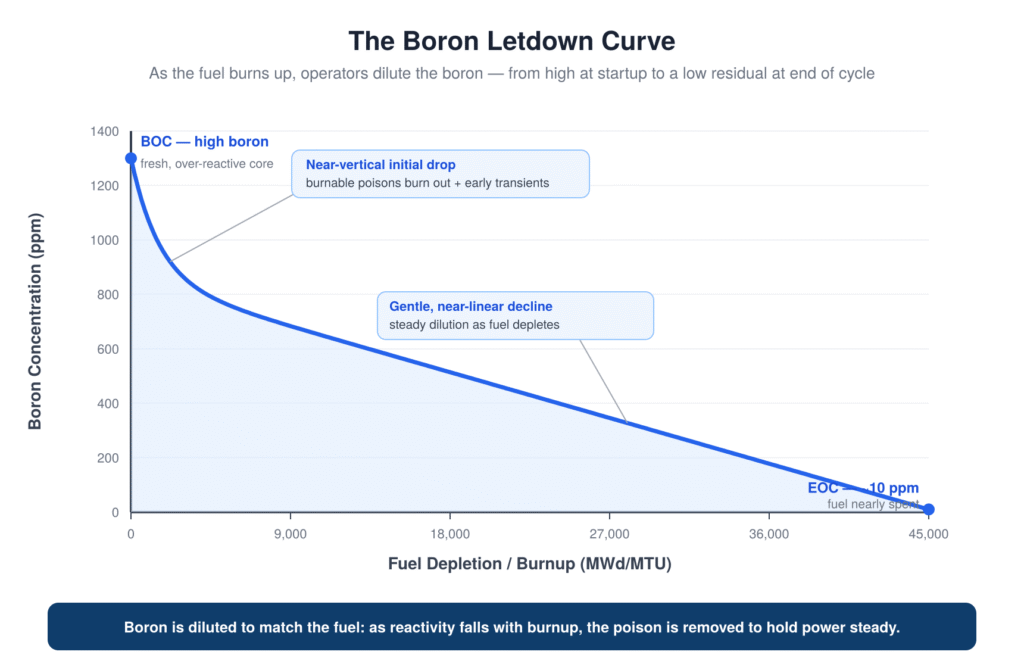
It’s like easing off a brake at exactly the same rate the engine loses power, so the car holds a perfectly steady speed for a year. That slow, deliberate dilution — the boron letdown curve — is one of the quiet rhythms of running a nuclear plant.
Burnable Poisons: Boron Built Into the Fuel
There’s a third on-purpose use of boron that works differently from both the soluble shim and the control rods: the burnable poison. Instead of being dissolved in the water or riding on a movable rod, a burnable absorber is built directly into the fresh fuel for example as a thin zirconium-diboride (ZrB₂) coating on the fuel pellets, a design Westinghouse calls IFBA (Integral Fuel Burnable Absorber), or as discrete boron carbide pins.
Its job is to hold down the big surge of excess reactivity in a fresh core, the same problem chemical shim tackles but to do it from inside the fuel. As the reactor runs, the boron-10 steadily absorbs neutrons and “burns out,” depleting on roughly the same schedule as the fuel it’s protecting.
That lets engineers load a core with more energy up front while keeping the early life power distribution flat and reducing how much soluble boron the coolant has to carry. Gadolinium is the other workhorse burnable poison, usually mixed as an oxide into the fuel itself.
Do All Reactors Use Boron the Same Way?
Not at all — and this trips up a lot of people. How boron is used depends heavily on the reactor design.
Pressurized water reactors (PWRs) are the classic case for everything I’ve described. They keep their coolant under high pressure so it never boils, which makes it easy to dissolve boric acid in the water and fine-tune reactivity through chemical shim.
Boiling water reactors (BWRs) work differently. Their coolant is meant to boil into steam, and dissolved boron in that environment would cause problems — so BWRs generally don’t use soluble boron for everyday reactivity control. Instead, they steer power with control rods (inserted from the bottom) and by adjusting coolant flow. They still keep boron in reserve for emergencies, through a dedicated safety feature called the Standby Liquid Control System (SLCS).
The RBMK — the Soviet-era graphite-moderated design used at Chernobyl — relied on boron carbide control rods rather than dissolved boron. Its control and safety characteristics were very different from Western reactors, a difference that became tragically important in 1986.
Small modular reactors (SMRs) are pushing in a new direction. A major trend in modern SMR design is going soluble-boron-free (SBF) altogether — controlling reactivity with burnable absorbers and control rods instead of dissolved boron. Removing soluble boron simplifies the plant, reduces corrosion and liquid waste, and gives the core a more strongly self-stabilizing response to temperature. (Boron often still appears in these designs, just in solid form or held in reserve for shutdown.)
Molten salt reactors (MSRs) rewrite the rules entirely. With fuel dissolved in a flowing liquid salt, reactivity is governed largely by the fuel and the reactor’s strong inherent feedbacks, not by a boron dial in the coolant — a fundamentally different control philosophy.
So “reactors run on poison” is really a PWR story at its heart. Everywhere else, boron either changes its role or steps aside for a different approach entirely.
The Emergency Poison: Borated Water as a Last Line of Defense
Boron isn’t only the smooth everyday dial. It’s also a nuclear plant’s ultimate backstop — a way to shut a reactor down even if the mechanical systems fail.
Nuclear plants keep large quantities of highly concentrated borated water on-site, ready to be injected straight into the core. Because that water floods every gap between the fuel and carries a heavy dose of neutron-hungry boron-10, it can smother the chain reaction fast.
In a PWR this is called emergency boration; in a BWR it’s the job of the Standby Liquid Control System. Either way, the principle is the same: when you absolutely must stop fission, you drown the core in poison.
This is also the reason you may have heard boron mentioned alongside Chernobyl. In the aftermath of that accident, onto the wreckage, sand and clay to smother the burning core, lead for shielding, and boron precisely because it absorbs neutrons and can help choke off fission.
It was boron’s neutron-poison property being used in the most desperate circumstances imaginable. Modern reactors are designed so that this same property is available in a controlled, engineered way, long before things ever get that far.
That’s the quiet reassurance built into the chemistry: the very same element that lets an operator make a delicate one-percent adjustment on a calm Tuesday is also standing by to slam the entire reaction shut if it’s ever truly needed.
The Downsides: Boric Acid Corrosion and Other Trade-offs
If boron were perfect, there’d be no downsides — and of course there are. This is the part the textbook summaries usually skip, and it’s where the engineering gets real.
Boric acid is, well, an acid. Dissolving it into the very water that runs through the reactor’s pipes and vessel for years means living with its corrosive side. If that water leaks and the boric acid concentrates — say, drying out around a fitting — it can aggressively eat into certain metals.
This isn’t hypothetical. In 2002, the Davis-Besse plant in Ohio discovered that borated water leaking from cracked control-rod-drive nozzles had eaten a football-sized cavity clean through the carbon-steel reactor vessel head, leaving only a thin inner layer of stainless-steel cladding holding back the full pressure of the reactor coolant.
Workers removed roughly 900 pounds of boric-acid deposits from the head. It remains one of the most serious corrosion events in U.S. nuclear history, and it reshaped how the industry inspects for boric-acid corrosion. (You can read the NRC’s account of the Davis-Besse event for the full story.)
There are other trade-offs too. Catching neutrons with boron-10 produces small amounts of other substances over time, including tritium, a radioactive form of hydrogen that plants must carefully manage.
And there are limits to how much boron you can use before it starts to interfere with the reactor’s natural self-stabilizing behavior, so the concentration has to stay within a careful window.
None of this makes boron a bad choice — it’s still the best tool for the job. But it’s a reminder that in nuclear engineering, even the most elegant solution comes with a price tag, and managing that price is a daily part of running a plant.
The Bottom Line
Boron is one of those unsung heroes of technology — a humble element, the same family of stuff you might find in household cleaners, doing quiet, critical work at the heart of a machine that powers entire cities.
It’s the smooth dial that lets engineers hold a nuclear reaction perfectly steady for a year at a time, the fast brake inside the control rods, and the emergency backstop waiting in a tank to flood the core if it’s ever needed.
Calling it a “poison” is technically correct and a little theatrical — but the real story is more impressive than the nickname. Boron isn’t a hazard engineers tolerate. It’s a tool they rely on, every hour of every day a reactor runs.
Frequently Asked Questions
Why is boron used in nuclear reactors?
Boron is a powerful neutron absorber, or “neutron poison.” Reactors use it to control the chain reaction — soaking up excess neutrons to hold the reaction steady, fine-tune power, and, in an emergency, shut the reactor down. In pressurized water reactors it’s dissolved in the coolant as boric acid (chemical shim); in most reactors it’s also used in control rods as boron carbide.
What is a neutron poison?
A neutron poison is any material that readily absorbs neutrons, removing them from the chain reaction. Since a reactor runs on neutrons, adding a poison like boron turns the reaction down, and removing it turns the reaction up. Boron and gadolinium are the most common examples.
Do all nuclear reactors use boron in the coolant?
No. Pressurized water reactors (PWRs) dissolve boron in their coolant for everyday reactivity control. Boiling water reactors (BWRs) do not — they use control rods and coolant flow, and keep boron in reserve for emergency shutdown. Many new small modular reactors are being designed soluble-boron-free, and molten salt (fast) reactors control reactivity through entirely different means.
Is boron radioactive or dangerous inside a reactor?
Boron itself is not radioactive, and boron-10 absorbs neutrons without fissioning. In boric-acid form it can be corrosive if it leaks and concentrates, and neutron capture slowly produces small amounts of tritium — both of which plants manage carefully. As a controlled reactor material, boron is safe and thoroughly understood.
How does boron shut down a reactor in an emergency?
Plants store concentrated borated water ready to be injected into the core. Flooding the core with this neutron-absorbing solution smothers the chain reaction quickly — called emergency boration in a PWR, or the Standby Liquid Control System in a BWR. It’s a backup that can stop fission even if the control rods fail.
What is chemical shim?
Chemical shim is the technique of controlling a reactor’s reactivity by adjusting the concentration of boric acid dissolved in the coolant, measured in parts per million. Because the boron is spread evenly through the water, it turns the whole reaction up or down uniformly, without distorting the core’s power shape the way a solid control rod does.
How does boron absorb neutrons?
Boron absorbs neutrons through its isotope boron-10, which has an enormous neutron absorption cross-section about 3,840 barns for slow neutrons. When a boron-10 nucleus captures a neutron, it splits into a stable lithium-7 nucleus and an alpha particle (a helium-4 nucleus): the reaction ¹⁰B(n,α)⁷Li. Because both products are stable, boron removes neutrons from the chain reaction without leaving long-lived radioactive waste behind.
What is a burnable poison?
A burnable poison (or burnable absorber) is a neutron absorber built into fresh reactor fuel to hold down its excess reactivity early in the cycle. Unlike soluble boron in the coolant, it stays fixed in the fuel and gradually “burns out” as it absorbs neutrons, depleting on roughly the same schedule as the fuel. Common examples are boron as a zirconium-diboride coating or boron-carbide pins and gadolinium oxide.
Is boron a moderator or an absorber?
Boron is an absorber, not a moderator and the difference is fundamental. A moderator (like water or graphite) slows neutrons down so they can sustain the chain reaction; it keeps neutrons in the game. Boron does the opposite: it removes neutrons from the chain entirely, soaking them up so the reaction turns down. So while a moderator helps the reaction along, boron reins it in. The confusion is understandable because in a PWR the same water both moderates the neutrons and carries the dissolved boron but those are two separate jobs done by two different things in the coolant.
Are control rods made of boron?
Some are, some aren’t. Control rods are made from strong neutron absorbers, and boron in the form of boron carbide (B₄C) is one of the most common choices. But it isn’t the only one: many pressurized water reactors use a silver-indium-cadmium (Ag-In-Cd) alloy instead, and some designs use hafnium. So boron carbide is a frequent control-rod material, not a universal one. It’s worth keeping two boron jobs separate here: the boron carbide inside a solid control rod is different from the boron dissolved in the coolant as boric acid (chemical shim). One rides on a movable rod for fast, forceful control, the other spreads evenly through the water for smooth, whole core fine tuning.
About the Author
Elliot Marsh is a working reactor engineer with hands-on experience in reactor physics, core management, reactivity control, and nuclear fuel-cycle planning at an operating power station. He writes about nuclear energy for readers who want the engineering reality, not the press release.
Need content like this for your company?
I write white papers, technical explainers, and thought-leadership for nuclear vendors, reactor developers, and the agencies that serve them — accurate enough for engineers, clear enough for buyers.